
How Magnetic Joysticks Are Permanently Eliminating Controller Stick Drift
Hall Effect and TMR technologies are replacing decades-old mechanical sensors in gaming controllers, using magnetic fields to eliminate friction and solve the notorious problem of stick drift.
By Factlen Editorial Team
- Hardware Engineers
- Focused on eliminating mechanical friction to maximize the lifespan of consumer electronics.
- Competitive Players
- Prioritizing raw input fidelity, zero latency, and customizable physical tension.
- Right-to-Repair Advocates
- Fighting against planned obsolescence and the environmental waste of disposable hardware.
- Technology Analysts
- Synthesizing market trends and the evolution of consumer hardware standards.
What's not represented
- · First-party console manufacturers (Sony/Microsoft/Nintendo)
Why this matters
For decades, gamers have been forced to replace expensive controllers every few months due to inevitable mechanical failure. The industry-wide shift to magnetic sensors means players can finally invest in hardware that lasts for years without degrading in accuracy.
Key points
- Traditional controllers use ALPS potentiometers, which rely on physical friction and inevitably wear down, causing stick drift.
- Hall Effect joysticks use magnets and sensors to measure movement without physical contact, eliminating mechanical wear.
- Tunnel Magnetoresistance (TMR) is emerging as the premium esports standard, offering quantum-level precision with lower latency than standard Hall Effect.
- Modern premium controllers are introducing mechanical tension rings to restore the heavy, familiar feel of traditional sticks to frictionless magnetic sensors.
The universal frustration of stick drift is a rite of passage for modern gamers. You are holding a perfect angle in a competitive shooter, and without warning, your character creeps forward. Your aim pulls slightly to the left mid-gunfight, forcing you to fight your own hardware instead of the enemy. It ruins matches, breaks immersion, and forces players to constantly replace expensive peripherals. For years, consumers accepted this degradation as an unavoidable reality of gaming. But in 2026, a hardware revolution is finally putting an end to the disposable controller era. By replacing decades-old mechanical friction with advanced magnetic physics, the industry is permanently solving the stick drift epidemic.[1][2]
To understand the solution, one must first understand the fundamental flaw of the old guard. For decades, the gaming industry has relied on a piece of 1990s engineering known as the ALPS potentiometer. This mechanical sensor is the baseline standard for almost every major first-party controller on the market, from the PlayStation DualSense to the Xbox Elite series. While cheap to manufacture and easy to calibrate on an assembly line, the ALPS potentiometer harbors a fatal, unavoidable design flaw that guarantees its eventual demise. It is a product of a bygone era being forced to perform in a high-stakes, modern gaming environment.[6][8]
Potentiometers rely entirely on resistive physical contact to function. Inside the joystick module, a tiny metal wiper physically drags across a curved carbon track to measure the stick's position. As the player pushes the stick forward, the wiper slides along the track, changing the electrical resistance. The controller's internal processor reads this changing resistance and translates it into on-screen movement. It is a simple, highly effective system that has served the industry well for generations, but it is fundamentally designed for inevitable failure due to the basic laws of friction.[2][6]
This physical friction is the root cause of the stick drift epidemic. Every single time a player moves the thumbstick, the metal wiper acts like microscopic sandpaper, slowly scraping away the carbon track. Over hundreds of hours of intense gameplay, this constant friction creates a buildup of conductive dust—often referred to by hardware engineers and repair technicians as "carbon sludge." This degradation is not a manufacturing defect or the result of a player mistreating their hardware; it is the unavoidable physics of mechanical wear and tear.[6][8]

Over time, this carbon wear creates dead spots and false inputs along the resistive track. The controller's internal brain reads the conductive debris as intentional movement, causing the dreaded phantom drift. The player's character moves on the screen because the sensor is literally falling apart from the inside out. Repair advocates have long criticized this design as a form of planned obsolescence, noting that it is not a matter of if a potentiometer will fail, but simply when. Once the track is worn down, no amount of external cleaning can reverse the physical damage.[2][6]
Enter Hall Effect technology. While the underlying physics phenomenon was first discovered by physicist Edwin Hall in 1879, its modern application in gaming controllers has sparked a massive hardware revolution. By abandoning mechanical friction entirely, Hall Effect sensors promise a permanent end to stick drift, offering a lifeline to gamers tired of treating their expensive peripherals as disposable, six-month rentals. The technology relies on the Lorentz force acting on electrons within a semiconductor, fundamentally changing how a controller interprets human input.[7][8]
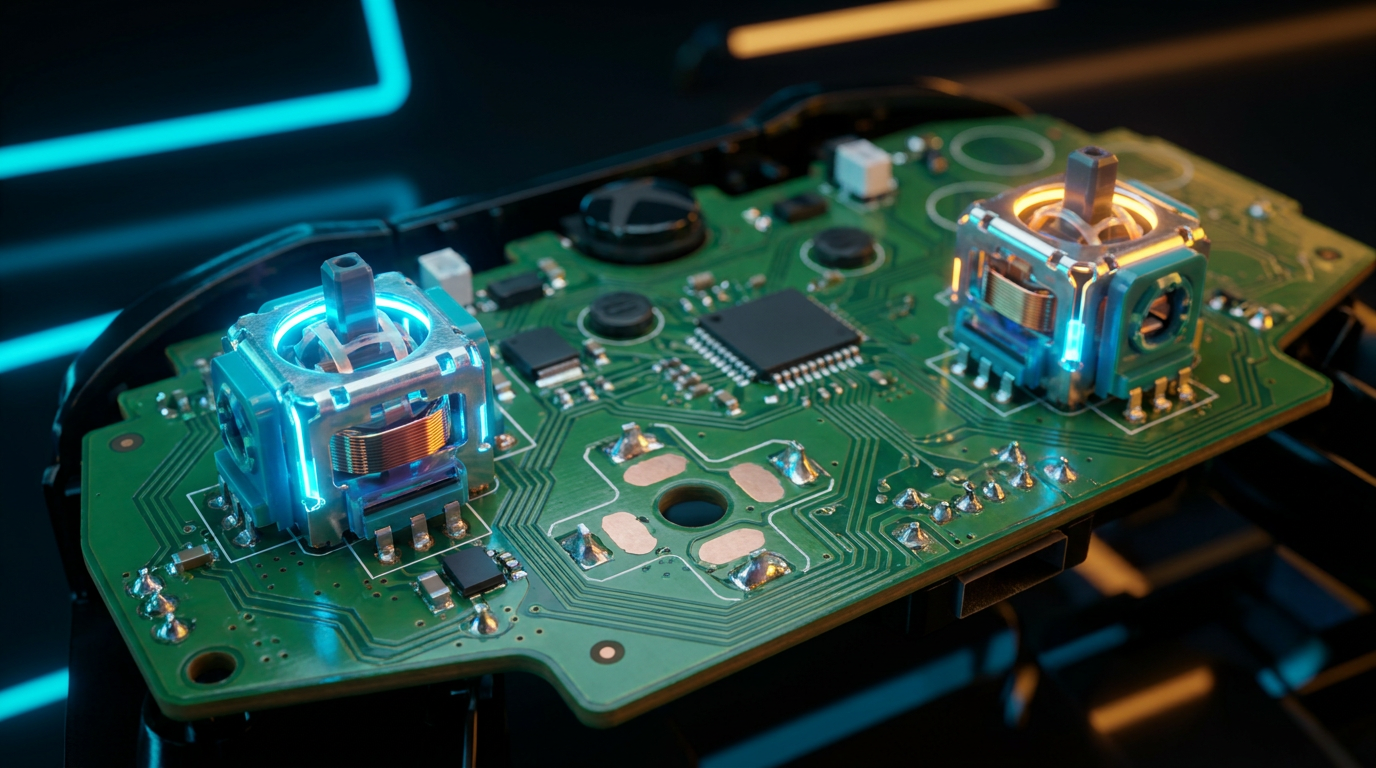
Hall Effect joysticks eliminate physical contact entirely. Instead of a scraping metal wiper, they utilize a small magnet attached directly to the joystick shaft, paired with a specialized sensor mounted on the circuit board below. As the player tilts the stick, the magnet shifts its position in the air above the board. The sensor measures the changing strength and direction of the magnetic field, converting that invisible data into precise voltage signals that dictate the X and Y axes in-game.[1][4]
As the player tilts the stick, the magnet shifts its position in the air above the board.
Because the internal components never actually touch each other, there is absolutely zero mechanical friction. No friction means no wear, no carbon dust, and effectively no stick drift. Hardware engineers note that Hall Effect sensors boast a Mean Time Between Failure (MTBF) of over 50 million cycles. This immense durability means the magnetic sensors will frequently outlast the physical plastic shell and rubber grips of the controller itself, providing an unprecedented level of longevity for consumer gaming hardware.[1][6][8]
The transition to magnetic sensors fundamentally changes how a controller feels in the hands. Without the physical resistance of a wiper dragging across a carbon track, Hall Effect sticks offer a remarkably smooth, "glider-like" movement. Many players find this frictionless sweep instantly superior for tracking moving targets in first-person shooters or panning the camera in sprawling role-playing games. The arc from the center to the edge is perfectly fluid, completely devoid of the subtle, scratchy grinding that plagues older controllers.[3][8]

However, this frictionless design introduces a new, highly technical quirk known as centering jitter. Because the stick moves so freely and lacks the physical grounding of a mechanical track, it sometimes struggles to return to a mathematically perfect 0.0000 center when the player lets go. The stick might occasionally rest at 0.0002, registering a microscopic input. To combat this, standard Hall Effect controllers apply heavy software filtering to smooth out the "noisy" magnetic signal and force a deadzone.[5][8]
While this software filtering is perfectly fine for casual play, competitive gamers and esports professionals sometimes notice it as a microscopic delay or a slightly "mushy" input feel. In high-stakes tournament environments where milliseconds dictate the outcome of a match, any artificial smoothing of the player's raw input is considered a severe competitive bottleneck. This precise demand for unfiltered, immediate accuracy has led to the next major evolution in drift-proof hardware: Tunnel Magnetoresistance, commonly referred to as TMR. If Hall Effect is the baseline magnetic solution, TMR is the high-fidelity upgrade specifically engineered for the esports tier.[6][8]
TMR sensors operate on an entirely different level of physics, measuring a quantum effect known as the resistance of electrons tunneling through a barrier. This quantum resistance changes drastically and instantly in the presence of a magnetic field. As a result, TMR provides a raw, immediate signal that is significantly more sensitive and accurate than standard Hall Effect sensors. Industry experts frequently compare standard Hall Effect to reading Braille with thick winter gloves on, while TMR is akin to reading it with bare hands.[6][8]
Because the TMR signal is so inherently clean and precise, it requires virtually no software filtering to find its center. This results in crisper, lower-latency inputs that perfectly mirror the player's twitch reactions. The lack of physical friction in both Hall Effect and TMR sticks also means they feel noticeably "looser" than traditional ALPS sticks. For players accustomed to the heavy 60-gram-force tension of standard first-party controllers, the transition to frictionless aiming can require a significant adjustment period.[5][6][8]
Hardware manufacturers are actively solving this tension discrepancy by introducing mechanical tension rings into their premium designs. High-end controllers, such as the Flydigi Vader series, now allow players to manually twist a physical dial located around the base of the joystick. This mechanism physically tightens or loosens the resistance of the stick, allowing players to combine the infinite durability of magnetic sensors with the familiar, heavy feel of traditional potentiometers. It represents the ultimate convergence of customization and longevity.[5][8]

In 2026, magnetic sticks are no longer a niche luxury reserved for hardware modders and tech enthusiasts. Budget-friendly options like the GameSir G7 SE have successfully democratized standard Hall Effect technology, proving that drift-proof controllers can be manufactured and sold for under fifty dollars without sacrificing build quality. Meanwhile, premium pads like the Razer Wolverine V3 Pro are pushing the absolute boundaries of competitive play, combining blazing-fast 1000Hz polling rates with quantum TMR sensors to deliver the fastest, most accurate wireless inputs currently available on the market.[5][8]
The era of treating gaming controllers as disposable hardware is rapidly coming to a close. By replacing physical friction with magnetic physics, the peripheral industry is finally delivering hardware built to survive the entire lifespan of the console itself. As third-party manufacturers continue to innovate with TMR and adjustable tension, the pressure is mounting on first-party console makers to abandon the ALPS potentiometer entirely, ensuring that stick drift becomes nothing more than a frustrating memory of gaming's past.[2][5][8]
How we got here
1879
Physicist Edwin Hall discovers the Hall effect, proving that magnetic fields can alter electrical currents.
1999
Sega releases the Dreamcast, featuring an early, pioneering version of a Hall Effect joystick.
2023-2024
Third-party manufacturers begin mass-producing Hall Effect controllers to combat the industry-wide stick drift epidemic.
2026
Tunnel Magnetoresistance (TMR) emerges as the new premium standard, offering quantum-level precision for esports professionals.
Viewpoints in depth
Hardware Engineers
Focused on eliminating mechanical friction to maximize the lifespan of consumer electronics.
Engineers view the traditional ALPS potentiometer as an outdated relic of 1990s design. By relying on physical resistance—a metal wiper scraping against a carbon track—these modules are fundamentally designed to fail. The shift to magnetic sensors is seen as a necessary evolution, replacing mechanical wear with physics-based measurement to achieve a Mean Time Between Failure (MTBF) that outlasts the controller's plastic shell.
Competitive Players
Prioritizing raw input fidelity, zero latency, and customizable physical tension.
For esports professionals, durability is secondary to performance. While early Hall Effect sticks solved stick drift, competitive players often criticized their 'mushy' software filtering and overly loose physical feel. This camp has championed the adoption of Tunnel Magnetoresistance (TMR) sensors, which provide a raw, unfiltered signal, alongside mechanical innovations like adjustable tension rings that restore the heavy, precise feel of traditional sticks.
Right-to-Repair Advocates
Fighting against planned obsolescence and the environmental waste of disposable hardware.
Repair communities have long pointed to stick drift as a prime example of planned obsolescence. Because potentiometer failure is inevitable, millions of otherwise perfectly functional controllers end up in landfills every year. Advocates view the democratization of Hall Effect technology as a massive victory for consumers, proving that drift-proof hardware is economically viable even in budget-friendly $40 controllers.
What we don't know
- Will first-party console makers fully adopt TMR for their base controllers in the next console generation?
- How will external magnetic interference from mobile devices affect the long-term calibration of portable TMR gaming setups?
Key terms
- Stick Drift
- A hardware failure where a controller registers movement even when the joystick is not being touched.
- ALPS Potentiometer
- The traditional mechanical joystick sensor that uses physical friction to measure movement, prone to wear and tear.
- Hall Effect
- A physics phenomenon where a magnetic field generates a voltage; used in controllers to measure stick position without physical contact.
- Tunnel Magnetoresistance (TMR)
- An advanced quantum sensing technology that measures magnetic fields with extreme precision and zero latency, used in high-end esports controllers.
- Deadzone
- A software setting that ignores small joystick movements to hide the effects of stick drift or centering jitter.
Frequently asked
Can I fix stick drift on my current controller?
While cleaning the sensors can temporarily alleviate drift, the physical carbon track inside a traditional potentiometer is permanently worn down. A true fix requires soldering new modules onto the circuit board.
Do Hall Effect controllers ever get stick drift?
They do not develop drift from mechanical wear and tear, which is the cause of 99% of controller failures. However, extreme magnetic interference or software glitches can occasionally cause temporary centering issues.
Why don't PS5 and Xbox controllers use Hall Effect?
First-party manufacturers have historically stuck to cheaper ALPS potentiometers due to established supply chains and the higher calibration costs associated with magnetic sensors, though pressure from consumers is mounting.
Is TMR better than Hall Effect?
Yes, for competitive gaming. TMR provides a cleaner, more immediate signal that requires less software filtering, resulting in lower latency and higher precision than standard Hall Effect sensors.
Sources
Source coverage
8 outlets
4 viewpoints surfaced








[1]Turtle BeachRight-to-Repair Advocates
What is the Hall Effect in Gaming Controllers?
Read on Turtle Beach →[2]Controller RepairsRight-to-Repair Advocates
Hall Effect Joysticks Explained: The End of Stick Drift?
Read on Controller Repairs →[3]The Controller PeopleCompetitive Players
Hall Effect vs TMR
Read on The Controller People →[4]ELO EsportsHardware Engineers
What Are Hall Effect Joysticks and Why Are They Important for Gaming?
Read on ELO Esports →[5]Gamepad Tester ProCompetitive Players
Best Hall Effect Controllers (Drift Proof) in 2026
Read on Gamepad Tester Pro →[6]Gadget HyperHardware Engineers
The Analog Stick Problem: Why ALPS Fails
Read on Gadget Hyper →[7]The Screen SurgeryHardware Engineers
Understanding the Difference Between Hall Effect, TMR, and ALPS Joysticks
Read on The Screen Surgery →[8]Factlen Editorial TeamTechnology Analysts
Synthesis by Factlen editorial team
Read on Factlen Editorial Team →
Every angle. Every day.
Get gaming esports stories with full source coverage and perspective breakdowns delivered to your inbox.