
SpaceX's Historic Trading Debut Signals the Maturation of the Commercial Space Economy
Following a highly anticipated public debut that pushed its valuation to record highs, SpaceX has cemented a new era for aerospace entrepreneurship. The milestone highlights how reusable rocket technology and satellite internet have transformed space from a government monopoly into a profitable commercial sector.
By Factlen Editorial Team
- Financial Markets
- Focuses on the company's valuation, recurring revenue streams, and the validation of the patient capital model.
- Aerospace Industry
- Focuses on the reduction in launch costs, reusability metrics, and the democratization of space access for startups.
- Public Sector
- Focuses on the success of public-private partnerships and the need for updated orbital regulations.
What's not represented
- · Legacy aerospace contractors facing disruption
- · Astronomers concerned about satellite light pollution
Why this matters
SpaceX's transition to the public markets proves that capital-intensive, high-risk aerospace ventures can achieve massive commercial viability. This opens the door for a new generation of space entrepreneurs to secure funding for orbital manufacturing, asteroid mining, and deep-space logistics.
Key points
- SpaceX shares surged 20% in their public trading debut, pushing founder Elon Musk's net worth to $1.3 trillion.
- The company's valuation is driven by its ability to drastically lower launch costs through reusable rocket technology.
- Starlink's satellite internet service provides the recurring subscription revenue that Wall Street investors demand.
- The successful debut validates NASA's strategy of using commercial partnerships rather than traditional cost-plus contracts.
- The massive liquidity event is expected to fund a new generation of aerospace startups and deep-tech ventures.
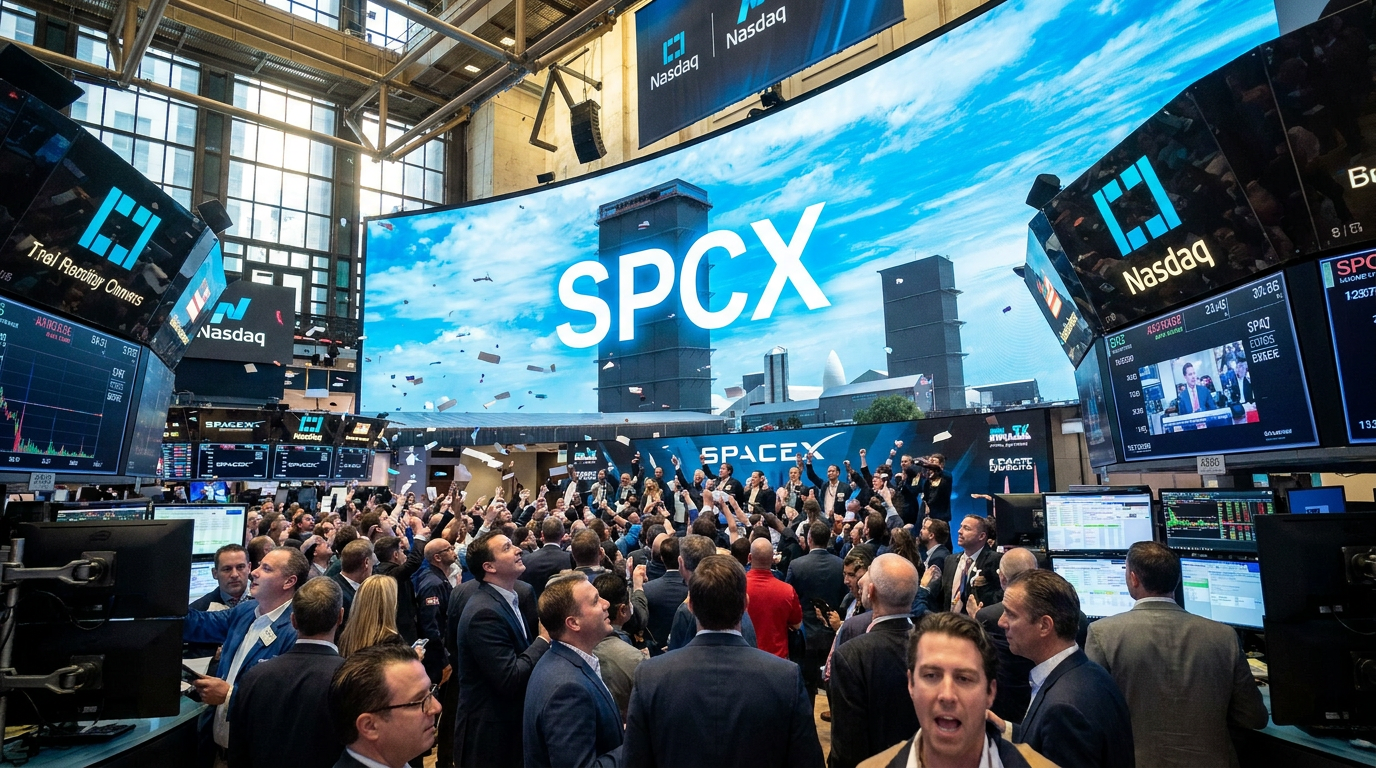
The opening bell on Wall Street rang with a distinctly extraterrestrial echo this week, as Space Exploration Technologies Corp.—better known globally as SpaceX—made its long-awaited public trading debut. Shares immediately surged 20% in their first hours of open market trading, representing a massive vote of confidence from both institutional fund managers and retail investors alike. The dramatic price pop not only cemented the company's status as the most valuable aerospace entity in history but also pushed founder Elon Musk’s personal net worth past the unprecedented $1.3 trillion mark, making him the world's first trillionaire.[1][2]
But beyond the staggering wealth generation and the headline-grabbing financial milestones, the trading debut represents a watershed moment for modern entrepreneurship and industrial strategy. For decades, the space domain was the exclusive purview of national governments, funded entirely by taxpayer dollars and driven primarily by geopolitical competition rather than economic viability. SpaceX’s successful transition to the public markets definitively proves that the commercial space sector can stand on its own financial merits, transforming a historically subsidized domain into a self-sustaining, profitable industry.[6]
To understand how a rocket company achieved a valuation that dwarfs legacy defense contractors and legacy aerospace giants, one must look at the underlying economics revealed in the company's recent financial disclosures. According to comprehensive filings with the Securities and Exchange Commission, SpaceX has successfully decoupled launch frequency from exponential cost growth, a feat previously thought impossible in orbital mechanics. The S-1 documentation outlines a business model where high fixed costs are amortized over an unprecedented cadence of successful orbital missions.[3]
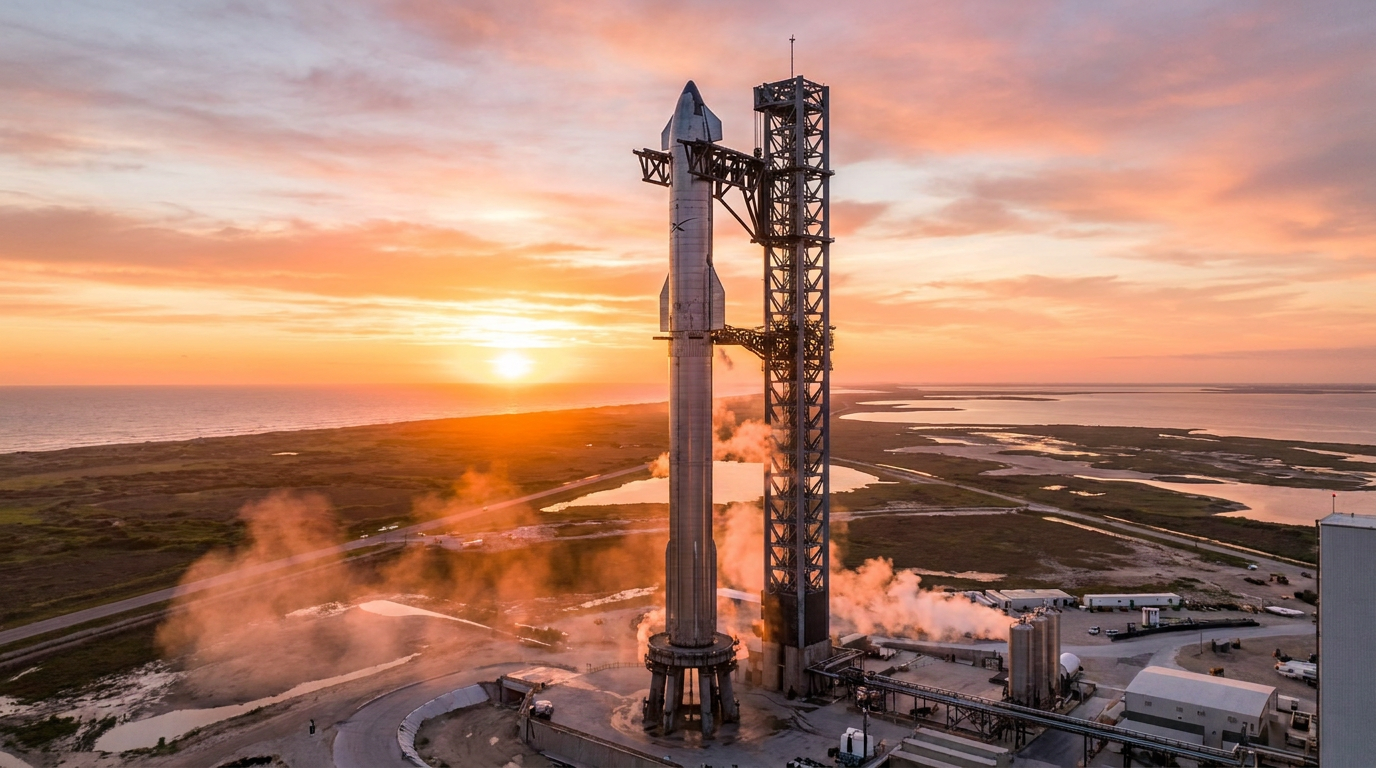
The fundamental secret to this economic transformation lies in rapid reusability. By successfully landing and refurbishing Falcon 9 first-stage boosters, the company fundamentally altered the mathematical realities of orbital access. Historically, putting a single kilogram of payload into Low Earth Orbit (LEO) cost upwards of $18,000 during the Space Shuttle era, making commercial enterprise in space prohibitively expensive. Today, commercial industry estimates place that figure closer to $1,500 per kilogram, with the next-generation, fully reusable Starship vehicle aiming to push it into the low hundreds in the coming years.[4][6]

This dramatic reduction in launch costs did not just improve SpaceX's internal profit margins; it birthed an entirely new ecosystem of space-based startups and secondary markets. Smaller companies that previously could never afford dedicated rockets can now purchase affordable "rideshare" slots on Falcon 9 missions. This has enabled a boom in deploying Earth-observation satellites, zero-gravity manufacturing experiments, and pharmaceutical research modules at a fraction of historical prices, effectively democratizing access to the space environment for mid-sized enterprises.[5]
However, launch services alone do not justify a trillion-dollar market capitalization, no matter how efficient the rockets become. The true financial engine driving SpaceX's astronomical valuation is Starlink, its sprawling constellation of thousands of Low Earth Orbit satellites providing high-speed, low-latency internet access globally. Investors flocked to the public offering largely because of Starlink's transition from a capital-intensive deployment phase into a highly lucrative, recurring-revenue subscription business that serves millions of customers across continents.[1][2]
Starlink represents a masterclass in vertical integration and entrepreneurial audacity. By acting as its own primary customer for launch services, SpaceX ensured a steady, predictable cadence of rocket launches, which in turn drove down the per-unit cost of manufacturing both the launch vehicles and the satellites themselves. Financial analysts note that Starlink's recurring subscription revenue provides the stable, predictable cash flow that volatile, contract-based launch manifests historically lacked, making the company highly attractive to traditional Wall Street investors.[2][6]

Starlink represents a masterclass in vertical integration and entrepreneurial audacity.
The success of this vertically integrated model has profound implications for future deep-tech founders and venture capitalists. It demonstrates that modern public markets are willing to tolerate immense upfront capital expenditures—and years of operating unprofitability—if the ultimate total addressable market is large enough and the technological moat is sufficiently deep. In Starlink's case, that addressable market is the entire unconnected global population, alongside highly lucrative enterprise contracts in the aviation, maritime, and defense sectors, providing a revenue ceiling that traditional telecommunications companies struggle to match.[3][6]
The public offering also serves to highlight the resounding success of public-private partnerships, specifically NASA's visionary Commercial Crew and Cargo programs initiated over a decade ago. Rather than building its own vehicles from scratch using traditional, bloated cost-plus contracts, NASA opted to act as an anchor tenant. The agency provided crucial seed funding and guaranteed service contracts to private companies that could meet specific technical milestones, fundamentally changing how the government procures spaceflight and shifting the financial risk away from the American taxpayer and onto private investors.[4]
This paradigm shift allowed SpaceX to survive its precarious early years when failure was a constant threat. The government provided the baseline revenue necessary to keep the lights on, while the company retained its intellectual property and the freedom to iterate rapidly without bureaucratic interference. Today, NASA relies heavily on commercial partners for International Space Station resupply and astronaut crew rotation, freeing up the agency's limited budget for deep-space exploration and lunar infrastructure development under the Artemis program.[4][6]
For the broader entrepreneurial ecosystem, the SpaceX debut serves as the ultimate validation of the "mega-unicorn" strategy in venture capital. By remaining a private entity for over two decades, the company was able to undertake high-risk, iterative development—such as the explosive early test flights of the Starship program—without facing the punishing quarter-to-quarter scrutiny of public shareholders who often demand immediate profitability over long-term technological breakthroughs. This patient capital approach allowed the engineering teams to fail fast, learn quickly, and ultimately deliver revolutionary hardware.[2][5]

Now that the company has matured and its core technologies are undeniably proven, the public markets are eagerly rewarding that decades-long patience. The sheer scale of the public offering has injected massive liquidity into the venture capital ecosystem, as early institutional backers, angel investors, and veteran employee shareholders finally realize their astronomical returns. This newly unlocked capital is already beginning to flow back into the next generation of aerospace startups, funding new ventures in orbital logistics and lunar mining.[5][6]
Yet, operating as a publicly traded company inevitably introduces new operational and philosophical challenges. SpaceX must now carefully balance the visionary, multi-planetary ambitions of its founder with the strict fiduciary duty to deliver consistent, predictable shareholder returns. The incredibly capital-intensive development of a self-sustaining city on Mars, for instance, may face significantly tougher questions from institutional investors who are primarily focused on near-term profitability and dividend yields rather than interplanetary colonization. Managing this tension between science-fiction goals and Wall Street realities will be the executive team's greatest test.[3][6]
Regulatory scrutiny is also expected to intensify as the company's market dominance becomes more entrenched. As the undisputed leader in both global launch services and satellite internet provision, the company faces mounting questions from international regulators regarding orbital debris management, space traffic control, and the potential monopolization of prime Low Earth Orbit shells. Competitors and watchdog groups are increasingly calling for updated international frameworks to ensure fair access to space, arguing that a single corporate entity should not dictate the rules of orbital engagement.[3][5]

Despite these looming regulatory hurdles and the inherent pressures of the public market, the prevailing sentiment across the aerospace, technology, and financial sectors remains overwhelmingly optimistic. The successful public debut of a company explicitly dedicated to making humanity a multi-planetary species is a profound testament to the power of audacious, long-term entrepreneurship. It definitively proves that the final frontier is no longer just a realm of scientific exploration, but a thriving, investable, and highly profitable commercial economy that will shape the next century of human progress.[1][6]
How we got here
2002
SpaceX is founded with the explicit goal of reducing space transportation costs to enable the colonization of Mars.
2008
Falcon 1 becomes the first privately developed liquid-fueled rocket to reach Earth orbit.
2015
The company achieves the first successful landing of a Falcon 9 orbital booster, proving the viability of rapid reusability.
2020
SpaceX successfully launches NASA astronauts to the International Space Station, restoring US human spaceflight capabilities.
June 2026
SpaceX makes its historic public trading debut, surging 20% and cementing its status as the world's most valuable aerospace entity.
Viewpoints in depth
Financial Markets
Investors view the debut as validation of the mega-unicorn model and vertical integration.
Wall Street analysts emphasize that SpaceX is fundamentally different from legacy aerospace companies because of its recurring revenue streams. While traditional defense contractors rely on lumpy, unpredictable government contracts, SpaceX has built a consumer-facing subscription business in Starlink. This predictable cash flow, combined with the massive technological moat created by reusable rockets, justifies a valuation that traditional financial models previously struggled to compute. Furthermore, the successful debut validates the strategy of remaining private for decades to develop capital-intensive technology away from the pressures of quarterly earnings reports.
Aerospace Industry
Industry experts focus on how the company's cost reductions have democratized access to orbit.
For the broader space industry, the financial milestone is secondary to the physical reality of cheap orbital access. Aerospace engineers and startup founders point out that SpaceX's rideshare programs have effectively lowered the barrier to entry for space enterprise. By dropping the cost per kilogram to orbit from tens of thousands of dollars to roughly $1,500, the company has enabled a boom in secondary markets—from Earth observation to zero-gravity manufacturing. The industry consensus is that SpaceX acts as the foundational infrastructure upon which the rest of the trillion-dollar space economy will be built.
Public Sector
Government agencies view the commercial success as a triumph of public-private partnership.
Officials at NASA and other public space agencies view SpaceX's massive valuation as a vindication of their Commercial Crew and Cargo programs. By acting as an anchor tenant rather than a micromanager, the government successfully seeded a commercial industry that now operates independently. This transition allows public agencies to step away from routine orbital logistics and redirect their limited budgets toward deep-space exploration and scientific research. However, regulators also note that the company's sheer dominance will require new frameworks for managing orbital debris and space traffic.
What we don't know
- How public market pressures for quarterly profitability will impact the company's capital-intensive Mars colonization plans.
- Whether international regulators will impose new restrictions on Starlink's orbital shell dominance.
- How quickly competitors like Blue Origin can field fully reusable vehicles to challenge SpaceX's launch monopoly.
Key terms
- Low Earth Orbit (LEO)
- An Earth-centered orbit with an altitude of 2,000 kilometers or less, where most commercial satellites and the International Space Station reside.
- Vertical Integration
- A business strategy where a company owns its supply chain, manufacturing its own components rather than relying on external contractors.
- Rideshare Mission
- A launch where multiple smaller satellites from different companies share space on a single rocket to split the cost of reaching orbit.
- Cost-Plus Contract
- A traditional government contract that pays a company for all its expenses plus a guaranteed profit margin, historically criticized for discouraging efficiency.
Frequently asked
Why did SpaceX wait so long to go public?
Remaining private allowed the company to undertake high-risk, long-term development—like reusable rockets and the Starship program—without the pressure of meeting quarterly earnings expectations from public shareholders.
How does Starlink make money for SpaceX?
Starlink provides high-speed satellite internet to millions of subscribers globally, generating a stable, recurring revenue stream that offsets the volatile and contract-dependent nature of rocket launches.
What does this mean for NASA?
A financially robust commercial space sector allows NASA to continue outsourcing routine orbital logistics, freeing up the agency's budget for deep-space exploration like the Artemis lunar program.
Sources
Source coverage
6 outlets
3 viewpoints surfaced






[1]ForbesFinancial Markets
SpaceX Soars Another 20%—Rocketing Musk’s Net Worth To $1.3 Trillion
Read on Forbes →[2]CNBCFinancial Markets
SpaceX public debut marks historic milestone for commercial space economy
Read on CNBC →[3]U.S. Securities and Exchange CommissionFinancial Markets
Space Exploration Technologies Corp. Form S-1 Registration Statement
Read on U.S. Securities and Exchange Commission →[4]NASAPublic Sector
Commercial Crew and Cargo Program: Economic Impact Report 2026
Read on NASA →[5]BryceTechAerospace Industry
State of the Space Economy 2026: The Trillion Dollar Frontier
Read on BryceTech →[6]Factlen Editorial TeamAerospace Industry
Synthesis by Factlen editorial team
Read on Factlen Editorial Team →

Every angle. Every day.
Get business stories with full source coverage and perspective breakdowns delivered to your inbox.