
A 30-Year Community Effort Transformed a Barren Himalayan Slope Into a Thriving Forest
Local villagers and scientists in Uttarakhand, India, have successfully restored 71 acres of degraded land into a self-sustaining ecosystem. A new study confirms the site now supports hundreds of returning bird and plant species, offering a scalable blueprint for global conservation.
By Nabil Faris

- Conservation Scientists
- Focus on the ecological data, the success of native species, and the scalable bioengineering model.
- Local Community Advocates
- Emphasize the socio-economic benefits, including local wages, sustainable resource harvesting, and the reduced labor burden on women.
- Open-Source Ecologists
- Highlight the importance of sharing geospatial data and restoration blueprints globally to accelerate worldwide climate resilience.
Why this matters
As global deforestation accelerates, Surya-Kunj proves that degraded land can be fully rehabilitated when local communities are paid and empowered to lead the effort. It provides a replicable, open-source model for reversing ecological collapse while boosting local economies.
Key points
- A 30-year community project in India's Himalayas successfully restored 71 acres of degraded, fire-prone land.
- Researchers and villagers planted 190 tree species and built water-harvesting trenches to revive the soil.
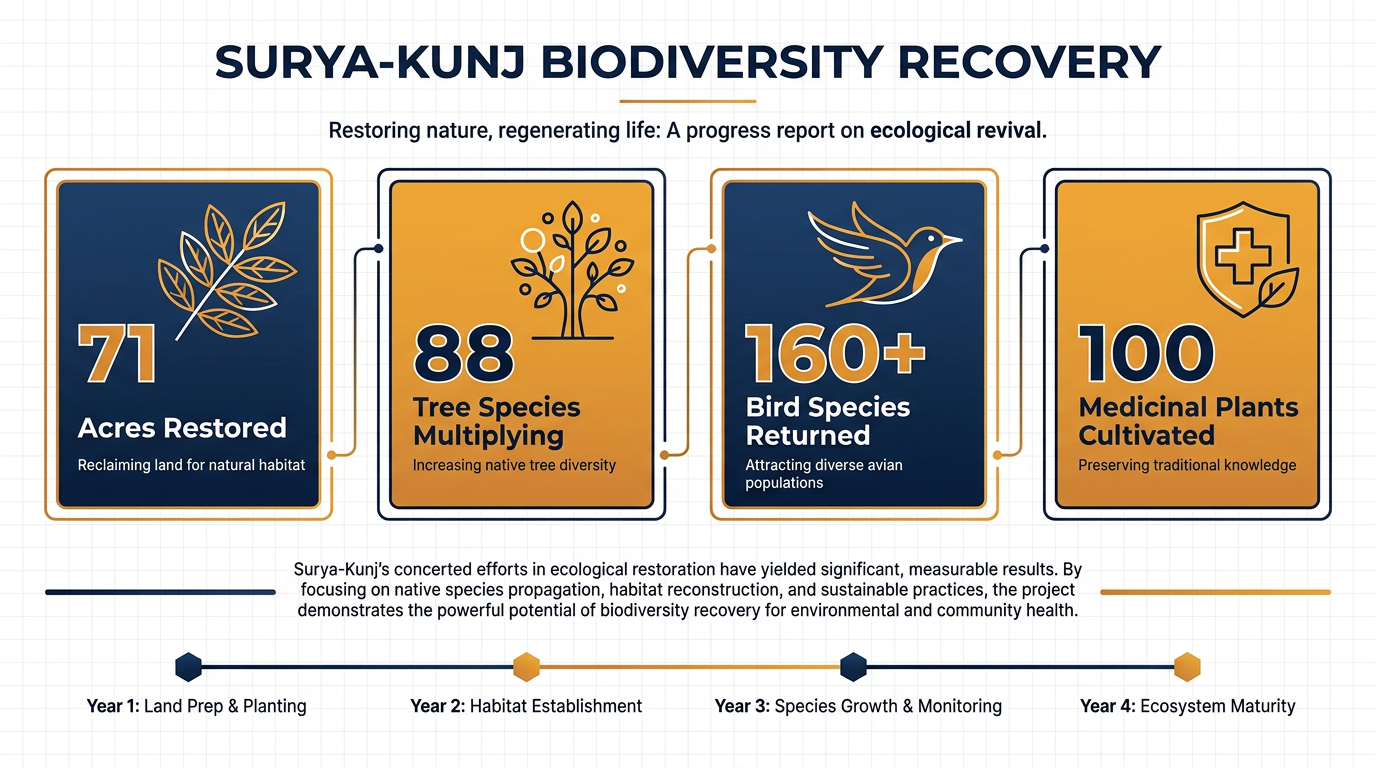
- A recent study confirms 88 tree species are now reproducing naturally, alongside 160 returning bird species.
- The project paid locals for their work and now provides sustainable fodder and medicinal plants.
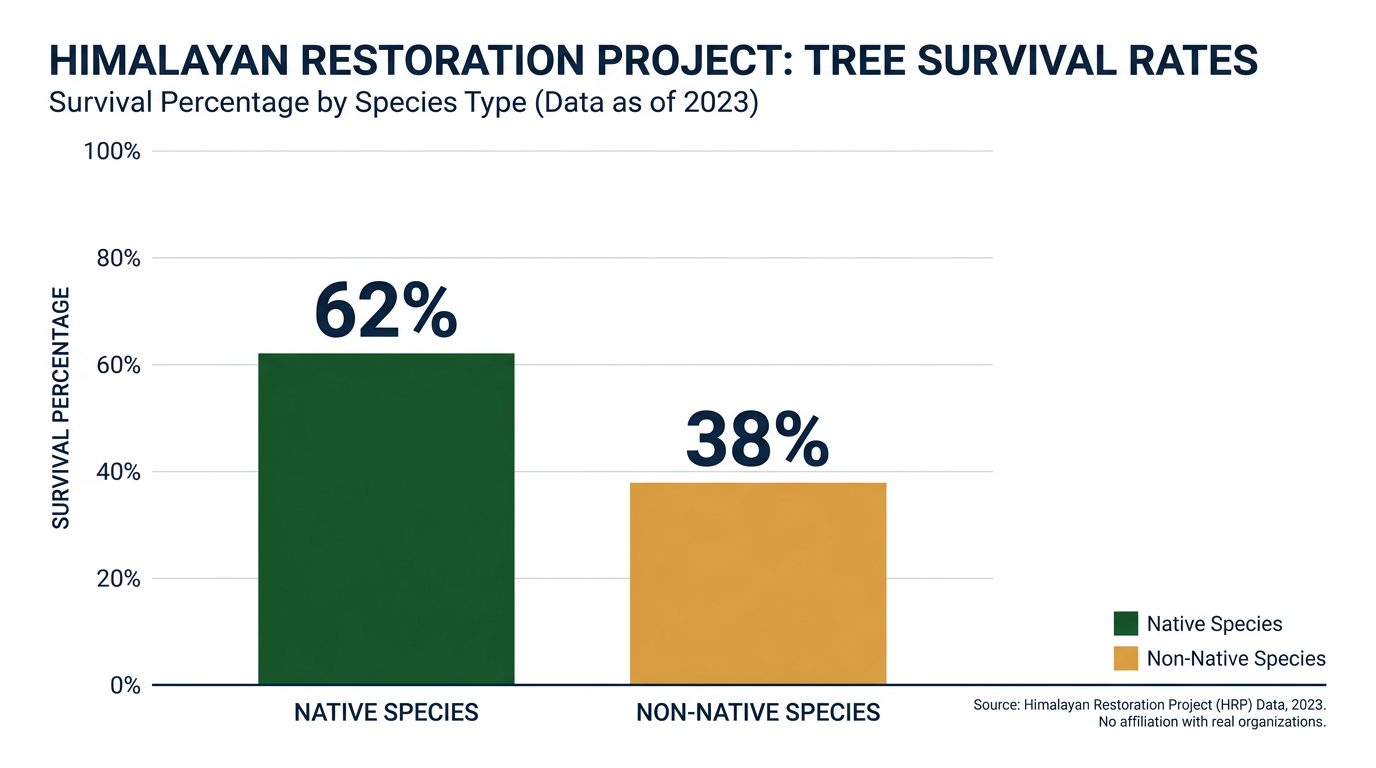
- Native Himalayan plant species showed a 62% survival rate, significantly outperforming non-native species.
- The project's data is open-source, offering a scalable blueprint for global ecosystem restoration.
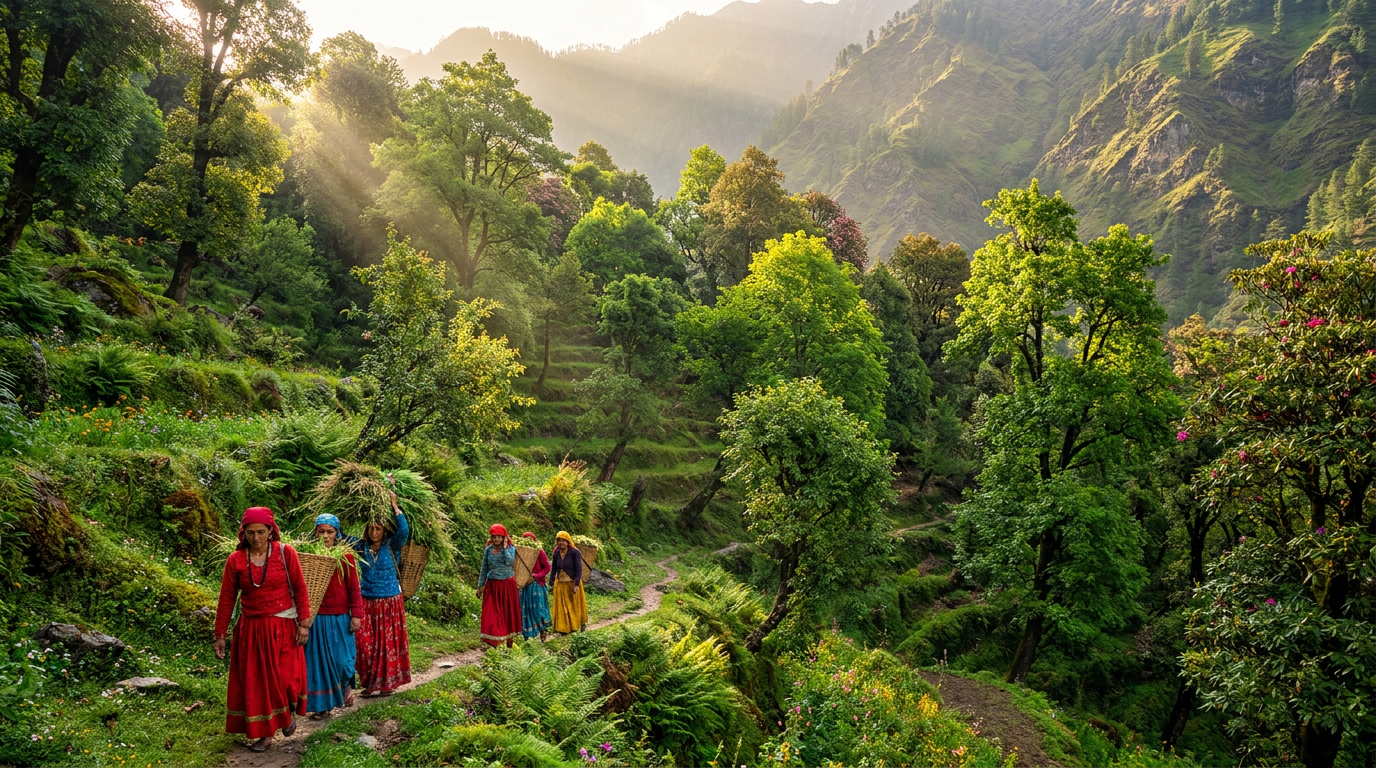
Three decades ago, a 71-acre slope in India's Western Himalayas was a barren, fire-prone expanse of thorns and degraded soil. Today, it is a lush, self-sustaining forest canopy that supports hundreds of species of birds, butterflies, and medicinal plants. The transformation of the Surya-Kunj site in Uttarakhand stands as one of the most successful community-led ecological interventions in South Asia, proving that environmental recovery is possible when local residents are placed at the center of the solution.[1][3]
The project's success was recently quantified in the journal Frontiers in Conservation Science, which published a comprehensive evaluation of the 30-year effort. Researchers found that of the 190 tree species planted since 1992, 88 have become established enough to reproduce naturally without human intervention. The site now hosts over 160 bird species, 100 butterfly species, and a thriving understory of rare Himalayan flora.
The degradation of the landscape originally stemmed from British colonial forestry practices, which replaced diverse broad-leaf forests with monoculture plantings of longleaf Indian pine to harvest resin and timber. This monoculture left the soil highly acidic, depleted of moisture, and uniquely vulnerable to devastating wildfires. By the early 1990s, the land could barely support local grazing.[1][2]
In 1992, researchers from the G.B. Pant National Institute of Himalayan Environment (GBP-NIHE) approached the surrounding villages with a radical proposal: a joint effort to rebuild the ecosystem from the soil up. Rather than fencing off the land for strict conservation, the institute paid villagers wages to actively participate in the restoration, ensuring that the community had an immediate economic stake in the forest's survival.[1]
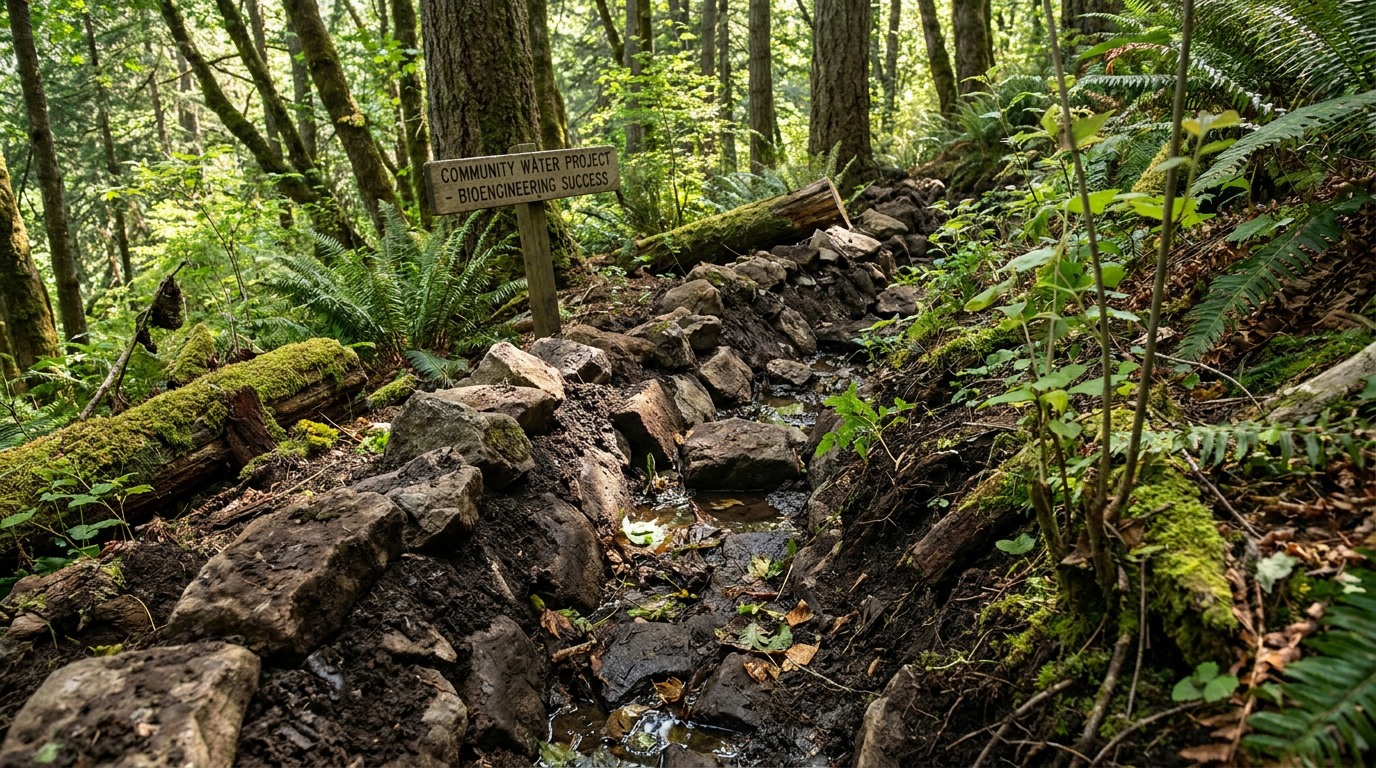
The physical restoration went far beyond simply dropping seeds into the dirt. Villagers and scientists collaborated to implement simple but highly effective bioengineering techniques. They dug trenches, built small dams, and constructed water-harvesting tanks to capture monsoon rains and reduce soil erosion. These terracing efforts fundamentally altered the hydrology of the slope, locking moisture into the ground and creating a hospitable environment for fragile saplings.[1]
The physical restoration went far beyond simply dropping seeds into the dirt.
Species selection proved critical to the forest's long-term viability. The planting strategy heavily favored flora native to the Western Himalayas. The recent data confirms this approach: native species achieved a 62% survival rate, significantly outperforming the 38% survival rate of non-native additions. As the native broad-leaf trees matured, they dropped leaf litter that naturally composted, rebuilding the topsoil and inviting insects and pollinators back to the slope.[3]
The social impact of the growing forest has been just as profound as the ecological recovery. The restored ecosystem now provides surrounding villages with a sustainable source of livestock fodder and leaf litter for agricultural composting. Furthermore, the community developed a dedicated herbal garden featuring over 90 medicinal plant species. Locals harvest these plants for traditional use and external sale, creating a new, sustainable revenue stream.[1][2]
This abundance of local resources has particularly benefited women in the community. Previously, women were forced to walk long distances to gather fuel wood and fodder from distant, fragmented forests. The proximity of the Surya-Kunj resources has drastically reduced this daily burden, freeing up hours for personal development, education, and alternative livelihood activities.[2]
Recognizing the global urgency of ecosystem restoration, the project's leaders have made their findings entirely open-source. Geospatial data detailing carbon sequestration rates, plant distribution, and soil health at Surya-Kunj is freely available on platforms like Restor.eco. This transparency allows conservationists and policymakers worldwide to study the exact mechanics of the Himalayan recovery and adapt the blueprint for other degraded mountainous regions.[3]
Surya-Kunj has also evolved into a premier educational hub. Designated as a Nature Interpretation and Learning Centre, the forest has hosted over 60 conservation workshops, training more than 5,000 students, researchers, and farmers. By turning a once-barren hillside into a living laboratory, the community has ensured that the next generation possesses the practical skills required to defend and expand the Himalayan ecosystem.[1]
How we got here
Pre-1990s
The landscape is degraded by historical monoculture pine planting, leading to acidic soil and frequent wildfires.
1992
The G.B. Pant National Institute of Himalayan Environment launches the Surya-Kunj restoration project, hiring local villagers to begin bioengineering and planting.
1992–2014
Over 190 tree species are planted, alongside the construction of water-harvesting trenches and an herbal medicinal garden.
2024–2025
Researchers conduct a comprehensive survey, confirming that 88 tree species are now naturally multiplying across the 71-acre site.
2026
The project's success is published in Frontiers in Conservation Science, highlighting it as a global blueprint for community-led ecosystem recovery.
Viewpoints in depth
Conservation Scientists
Ecologists view the project as a triumph of data-driven, native-first bioengineering.
For researchers, Surya-Kunj is a masterclass in ecological patience and species selection. The data clearly demonstrates that native Himalayan broad-leaf trees are far more resilient than non-native alternatives, achieving a 62% survival rate. Scientists emphasize that the project's success wasn't just about planting trees, but about fundamentally repairing the hydrology of the slope through terracing and trenches. They view this 30-year dataset as a critical blueprint for the UN Decade on Ecosystem Restoration, proving that heavily degraded, acidic soils can be rehabilitated to support complex food webs and natural regeneration.
Local Community Advocates
Community leaders stress that environmental restoration only works when it serves local economic needs.
Advocates for the surrounding villages argue that Surya-Kunj succeeded precisely because it did not treat humans as the enemy of nature. By paying locals to dig trenches and plant saplings, the project provided immediate economic relief. Over the long term, the forest has become a vital community asset, yielding medicinal herbs for sale and fodder for livestock. Crucially, advocates highlight the gender equity benefits: with resources now available close to home, women no longer have to spend hours trekking to distant forests, allowing them to reclaim their time for education and enterprise.
Open-Source Ecologists
Digital conservationists celebrate the project's commitment to transparent, accessible data.
This camp focuses on the global implications of the project's transparency. By uploading their geospatial data, carbon sequestration metrics, and species catalogs to open platforms like Restor.eco, the Surya-Kunj team has democratized their findings. Open-source advocates argue that the climate crisis is too urgent for siloed research; they believe that freely sharing the exact mechanics of successful projects is the only way to rapidly scale ecosystem recovery across other vulnerable mountain ranges worldwide.
What we don't know
- How the newly restored broad-leaf forest will withstand the increasing frequency of extreme climate-change-driven heatwaves.
- Whether the local government will provide funding to replicate the Surya-Kunj model across other degraded Himalayan slopes.
Key terms
- Bioengineering
- The use of natural materials and simple structural interventions—like digging trenches or planting specific root systems—to stabilize soil and manage water flow.
- Monoculture
- The agricultural or forestry practice of growing a single species of plant over a wide area, which often reduces biodiversity and depletes soil health.
- Natural Regeneration
- The process by which an ecosystem recovers and plant species begin to reproduce and spread on their own, without further human planting.
- Broad-leaf forest
- A forest composed of trees with wide, flat leaves (like oaks), which typically support more diverse wildlife and create richer soil compost than needle-leaf pine forests.
Frequently asked
Where is the Surya-Kunj forest located?
Surya-Kunj is located in the state of Uttarakhand in the Western Himalayas of India.
Why was the land degraded in the first place?
The slope was heavily degraded due to historical British colonial forestry practices, which planted monocultures of longleaf Indian pine that made the soil acidic and highly prone to wildfires.
How did the local community benefit from planting the forest?
Villagers were paid wages to help restore the land. Today, they benefit by sustainably harvesting medicinal plants, collecting livestock fodder, and saving hours of travel time previously spent searching for firewood.
What bioengineering techniques were used?
The community dug trenches, built small dams, and created water-harvesting tanks to capture rainwater, reduce soil erosion, and keep the ground moist enough for saplings to survive.
Sources
Source coverage
3 outlets
3 viewpoints surfaced



[1]MongabayLocal Community Advocates
30-year Himalayan project shows power of community-led forest restoration
Read on Mongabay →[2]World Economic ForumConservation Scientists
How the Himalayas are being restored through participatory forest management
Read on World Economic Forum →[3]Factlen Editorial TeamOpen-Source Ecologists
Synthesis by Factlen editorial team
Read on Factlen Editorial Team →

Every angle. Every day.
Get community stories with full source coverage and perspective breakdowns delivered to your inbox.