
Landmark Cell Therapy Trial Shows 91% Preservation of Heart Function in Duchenne Muscular Dystrophy
A Phase 3 clinical trial published in The Lancet reveals that an investigational cell therapy dramatically slows heart and muscle decline in patients with advanced Duchenne muscular dystrophy.
By Jun Zhao


- Clinical Researchers
- Medical investigators emphasize the unprecedented biological impact of the therapy.
- Patient Advocates
- The Duchenne community stresses the urgent need for treatments that preserve independence.
- Regulatory Skeptics
- FDA reviewers and statistical experts question the robustness of the trial data.
Why this matters
Duchenne muscular dystrophy is a fatal genetic disease with no cure, and heart failure is its leading cause of death. This breakthrough therapy offers the first real hope for preserving independence and extending the lives of young men in the advanced stages of the disease.
Key points
- A Phase 3 trial published in The Lancet shows deramiocel cell therapy significantly slows Duchenne muscular dystrophy progression.
- The therapy reduced the rate of heart dysfunction by 91% and upper limb muscle decline by 54%.
- Deramiocel uses cardiosphere-derived cells from healthy donor hearts to reduce inflammation and scarring in damaged muscle tissue.
- Despite the clinical success, an FDA advisory committee recently voted against the therapy's efficacy due to statistical concerns.
- The FDA is expected to make a final approval decision by August 22, 2026.
For decades, a diagnosis of Duchenne muscular dystrophy has carried a devastating certainty: a relentless, irreversible loss of muscle function that eventually compromises the heart. But a landmark Phase 3 clinical trial published in The Lancet has demonstrated that an investigational cell therapy can dramatically alter this trajectory. The treatment, known as deramiocel, is the first cell therapy shown to preserve heart function in patients battling this rare genetic disease.[1][4]
Duchenne muscular dystrophy (DMD) primarily affects boys, driven by a mutation on the X chromosome that prevents the body from producing functional dystrophin—a crucial protein that acts as a shock absorber for muscle fibers. Without it, normal movement causes microscopic tears that the body cannot properly repair. Over time, healthy muscle tissue is replaced by fat and fibrous scar tissue, leading to profound weakness. Most patients lose the ability to walk by their early teens, and the disease eventually attacks the respiratory muscles and the heart.[1][5]
The HOPE-3 clinical trial, which enrolled 106 boys and young men between the ages of 10 and 22, tested whether deramiocel could halt this decline in patients with advanced stages of the disease. The results were unprecedented. Participants who received the therapy via an intravenous drip every three months experienced a 54 percent reduction in the rate of upper limb muscle weakening compared to those who received a placebo.[2][6]
Even more striking was the therapy's impact on the heart. The trial data revealed that deramiocel slowed the progression of heart dysfunction by 91 percent. For patients already diagnosed with cardiomyopathy—a condition where the heart muscle becomes enlarged and weakened—the therapy resulted in full preservation or even slight improvement of their heart's ability to pump blood.[1][5]
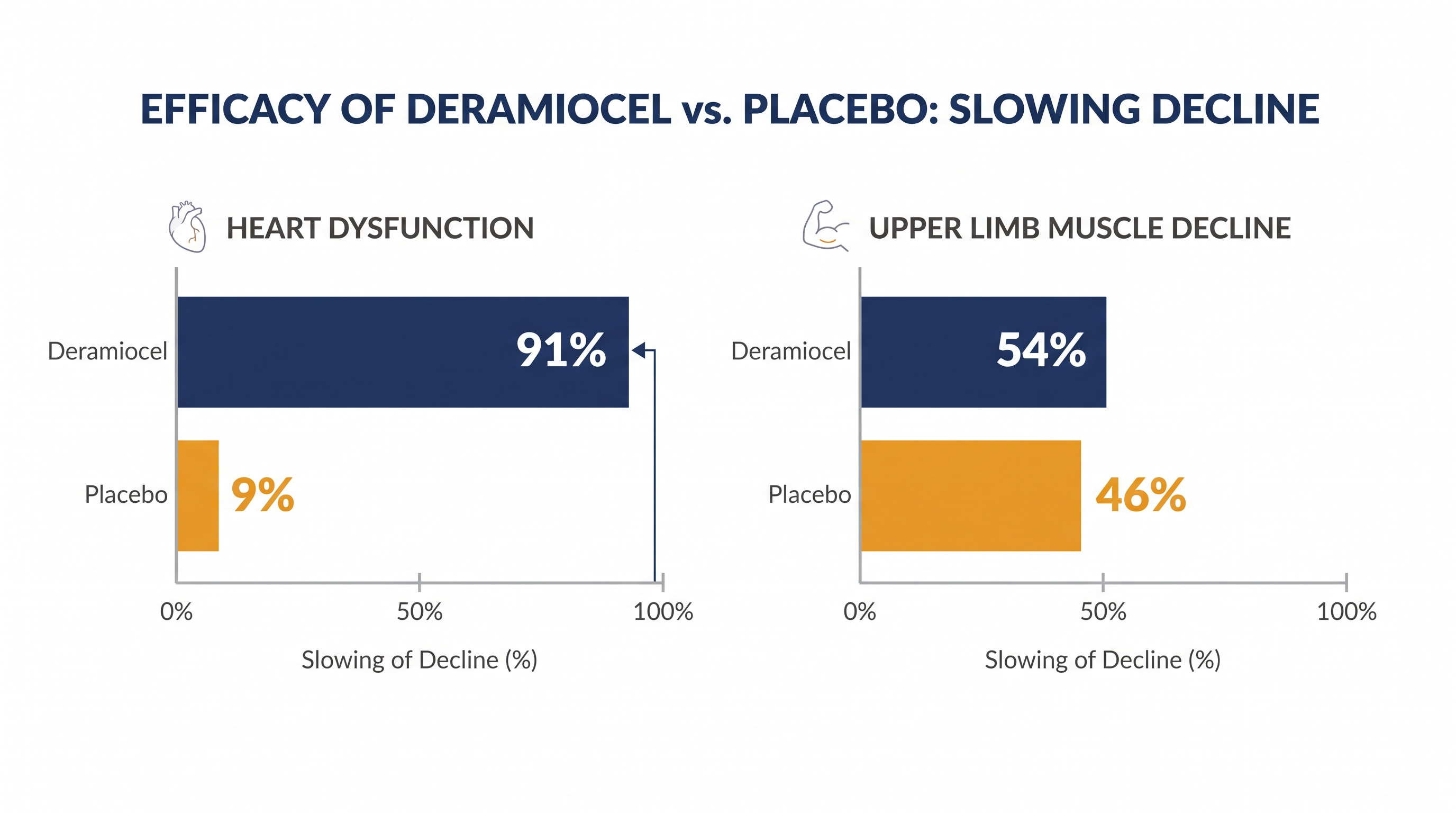
These dual benefits address the most critical quality-of-life and mortality factors for older DMD patients. Preserving upper limb function allows non-ambulatory young men to maintain their independence, enabling them to operate wheelchairs, use computers, and feed themselves. Meanwhile, stabilizing cardiac function directly targets the leading cause of premature death in the Duchenne community.[2][6]
The biological mechanism behind deramiocel represents a significant departure from other Duchenne treatments currently in development. While many modern therapies focus on gene editing or exon-skipping to correct specific genetic mutations, deramiocel is designed to address the downstream consequences of the disease: chronic inflammation and fibrosis. Because it does not rely on a specific genetic target, the therapy has the potential to help patients regardless of their exact dystrophin mutation.[2][4]
Deramiocel is composed of cardiosphere-derived cells (CDCs), a type of heart progenitor cell. These cells are isolated from healthy human hearts that were donated for transplantation but ultimately could not be used for that purpose. Once infused into the patient's bloodstream, these donor cells do not permanently integrate into the patient's heart or skeletal muscle. Instead, they act as microscopic factories.[1][5]
Deramiocel is composed of cardiosphere-derived cells (CDCs), a type of heart progenitor cell.
Upon reaching damaged tissue, the CDCs release exosomes—tiny vesicles packed with signaling molecules, RNA, and proteins. These signals effectively reprogram the patient's immune system, specifically targeting macrophages, which are white blood cells that drive inflammation. By shifting the local tissue environment from a state of chronic inflammation to one of healing, the therapy prevents the runaway scarring that permanently destroys muscle function in Duchenne patients.[3][5]
The HOPE-3 trial is the culmination of more than two decades of research, originating with the discovery of cardiosphere-derived cells in 2004. It marks the first time a Phase 3 trial has demonstrated that a cell therapy administered through the bloodstream can be effective against a genetic disease, or indeed any type of heart disease.[1][4]
Safety data from the trial indicated that deramiocel was generally well-tolerated. No deaths occurred during the study, and serious adverse events were uncommon. The most frequently reported side effects were allergic-type reactions during the infusion, which occurred in 42 percent of patients receiving the therapy compared to 15 percent in the placebo group, but these were manageable in an outpatient clinic setting.[2][4]
Despite the compelling clinical outcomes published in The Lancet, the path to widespread availability remains complicated by regulatory hurdles. In a highly unusual split between peer-reviewed medical consensus and regulatory evaluation, a U.S. Food and Drug Administration (FDA) advisory committee recently voted 9 to 3 against the therapy's evidence of effectiveness.[3][7]
The advisory panel's skepticism did not center on the biological plausibility of the treatment, but rather on the trial's statistical methodology. FDA reviewers expressed concern that the trial's sponsor, Capricor Therapeutics, altered its statistical analysis plan shortly before unblinding the data. Regulators argued that this late-stage adjustment made the findings difficult to interpret, leading several panelists to characterize the data as statistically fragile.[3][7]
This regulatory friction highlights a growing tension in the evaluation of rare disease treatments. Clinical researchers and patient advocates argue that traditional statistical frameworks often fail to capture the nuanced, real-world benefits of therapies in small patient populations with relentless, fatal diseases. During the advisory committee meeting, several clinicians noted that the functional preservation seen in the HOPE-3 trial is essentially unheard of in the natural history of advanced Duchenne muscular dystrophy.[3][5]
The FDA is not bound by the advisory committee's vote, and the agency has set a target action date of August 22, 2026, to make its final decision on approving deramiocel. The outcome will have profound implications not only for the thousands of families affected by Duchenne muscular dystrophy but also for the broader field of regenerative medicine.[3][7]
If approved, deramiocel would establish a new paradigm for treating complex genetic disorders. By proving that donor-derived cell therapies can successfully modulate the immune system to halt tissue destruction, the medical community may soon have a powerful new tool to combat a wide range of inflammatory and fibrotic diseases that currently have no cure.[1][2]
How we got here
2004
Researchers first isolate cardiosphere-derived cells (CDCs) from human heart tissue.
2012
Early clinical studies demonstrate CDCs can regenerate heart muscle damaged by heart attacks.
July 2025
The FDA initially rejects the approval application for deramiocel based on Phase 2 data, requesting more evidence.
July 29, 2026
Phase 3 HOPE-3 trial results are published in The Lancet, showing significant preservation of muscle and heart function.
August 22, 2026
The FDA's target action date to issue a final decision on the therapy's approval.
Viewpoints in depth
Clinical Researchers
Medical investigators emphasize the unprecedented biological impact of the therapy.
Lead investigators from institutions like Cedars-Sinai and UC Davis Health view the HOPE-3 trial as a watershed moment in regenerative medicine. They point out that achieving a 91 percent slowing of heart dysfunction and a 54 percent slowing of upper limb decline in a largely non-ambulatory population is practically unheard of. For these researchers, the fact that the therapy targets the downstream inflammation and fibrosis—rather than the specific genetic mutation—proves that cell therapies can fundamentally alter the course of fatal genetic diseases.
Regulatory Skeptics
FDA reviewers and statistical experts question the robustness of the trial data.
Despite the publication in a top-tier medical journal, regulatory experts remain cautious. The FDA advisory committee's recent 9-3 vote against the therapy's efficacy was rooted in concerns over statistical methodology. Regulators pointed out that the trial's sponsor changed its statistical analysis plan shortly before unblinding the data. This late-stage pivot led statisticians to label the positive findings as 'fragile,' arguing that the results might not hold up under different analytical frameworks, regardless of the urgent clinical need.
Patient Advocates
The Duchenne community stresses the urgent need for treatments that preserve independence.
For patients and their families, the statistical debates are secondary to the tangible functional benefits observed in the trial. Advocacy groups emphasize that preserving upper limb function means the difference between a young man being able to feed himself or operate a wheelchair versus requiring total full-time care. They argue that in the context of a 100 percent fatal disease with no existing cures for advanced stages, the risk-benefit calculus should heavily favor approving a therapy that shows clear signs of stabilizing heart and muscle health.
What we don't know
- Whether the FDA will ultimately approve the therapy by its August 22 target action date despite the advisory committee's negative vote.
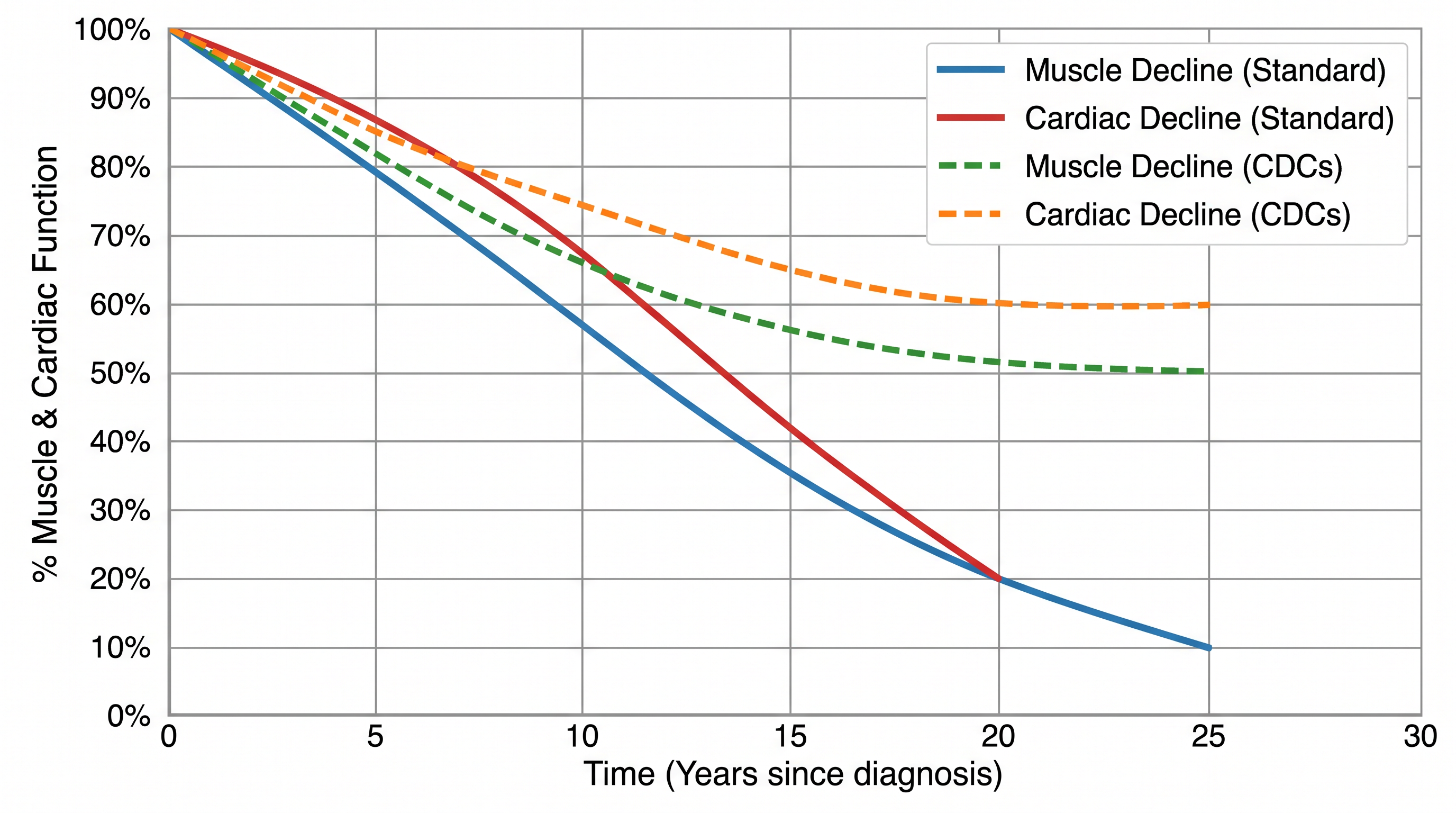
- How long the protective effects on the heart and skeletal muscles will last beyond the one-year trial period.
- Whether the therapy could be equally effective if administered to much younger children before significant muscle damage occurs.
Key terms
- Duchenne Muscular Dystrophy (DMD)
- A severe genetic disorder characterized by progressive muscle degeneration and weakness, primarily affecting boys.
- Cardiomyopathy
- A disease of the heart muscle that makes it harder for the heart to pump blood to the rest of the body.
- Cardiosphere-Derived Cells (CDCs)
- A specific type of progenitor cell isolated from heart tissue that can release healing signals to reduce inflammation and scarring.
- Exosomes
- Tiny vesicles released by cells that carry proteins and genetic information to communicate with and alter the behavior of other cells.
- Fibrosis
- The thickening and scarring of connective tissue, usually as a result of injury or chronic inflammation.
Frequently asked
Is deramiocel a cure for Duchenne muscular dystrophy?
No. Deramiocel does not cure the underlying genetic mutation, but it significantly slows the progression of muscle and heart damage caused by the disease.
How is the therapy administered?
The treatment is given as an intravenous (IV) drip every three months in an outpatient clinic setting.
Does this therapy only help the heart?
No. The Phase 3 trial showed that it also slowed the decline of skeletal muscle function, specifically helping patients preserve the use of their arms and hands.
Why did the FDA advisory committee vote against it?
The panel expressed concerns over the statistical methods used to analyze the trial data, calling the results 'fragile' despite the clinical benefits reported by researchers.
Sources
Source coverage
7 outlets
3 viewpoints surfaced






[1]Cedars-SinaiClinical Researchers
The Lancet Publishes Landmark Trial of Duchenne Muscular Dystrophy Therapy
Read on Cedars-Sinai →[2]UC Davis HealthClinical Researchers
Phase 3 trial shows investigational cell therapy slowed disease progression in Duchenne muscular dystrophy
Read on UC Davis Health →[3]Fierce BiotechRegulatory Skeptics
FDA AdComm votes against Capricor's Duchenne cell therapy amid statistical confusion
Read on Fierce Biotech →[4]News-MedicalClinical Researchers
Cell therapy shows promise in slowing muscle weakening in advanced Duchenne muscular dystrophy
Read on News-Medical →[5]Muscular Dystrophy NewsPatient Advocates
New trial results highlight gains in arm and heart function for DMD
Read on Muscular Dystrophy News →[6]Respiratory TherapyPatient Advocates
Duchenne Muscular Dystrophy Cell Therapy Preserves Heart, Muscle Function
Read on Respiratory Therapy →[7]BioPharma DiveRegulatory Skeptics
Capricor’s Duchenne cell therapy faces FDA panel rejection
Read on BioPharma Dive →
More in health
See all 5 stories →Digital Health
Landmark Trial: 10-Minute Digital Program Significantly Reduces Depression Symptoms
4 sources
Alzheimer's Therapy
How Donanemab Works: The FDA-Approved Therapy Changing Alzheimer's Treatment
5 sources
Food Allergies
Landmark Trial: Drug Treatment Allows Children With Multiple Food Allergies to Safely Eat Full Servings
5 sources
Every angle. Every day.
Get health stories with full source coverage and perspective breakdowns delivered to your inbox.