
USDA Poised to Finalize Rule Allowing Uncapped Pork Processing Line Speeds
The U.S. Department of Agriculture is moving to permanently eliminate maximum line speed limits for pork processing plants, sparking a fierce debate between industry efficiency and worker safety.
By Kabir Mehra

The U.S. Department of Agriculture is poised to finalize a controversial regulatory overhaul that will permanently eliminate maximum line speed limits for eligible pork processing facilities. The impending rule change marks the culmination of a years-long battle over how fast American slaughterhouses can operate, pitting supply chain efficiency against fierce warnings from labor unions and food safety advocates.[1][2]
Under the proposed framework, pork plants operating under the agency's New Swine Inspection System (NSIS) will no longer be bound by the federal cap of 1,106 hogs per hour. Instead, participating facilities will be permitted to set their own operational speeds, provided they can demonstrate the ability to maintain process controls and comply with food safety mandates.[1][4]
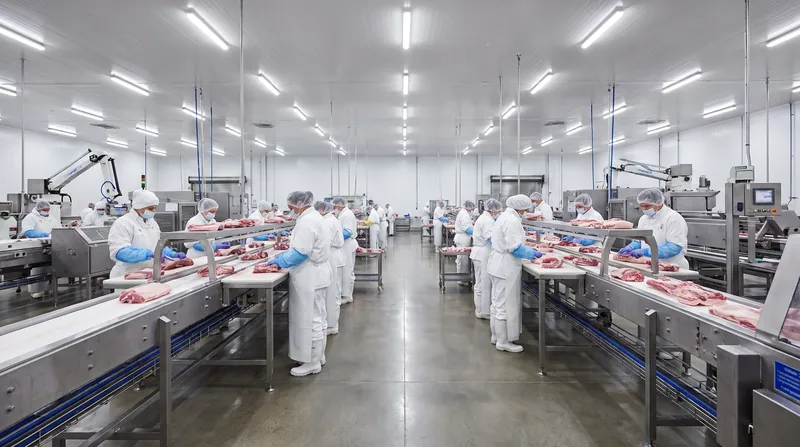
To understand the stakes, it is necessary to look at the mechanics of a modern meatpacking plant. At the current maximum of 1,106 hogs per hour, a facility processes roughly 18 animals every minute. This pace gives line workers approximately three seconds to perform precise, repetitive cuts with sharp knives as carcasses move continuously along a conveyor belt.[7]
The NSIS framework fundamentally shifts how these lines are monitored. Rather than relying solely on federal inspectors to spot every issue, the modernized system allows plant employees to conduct manual sorting and remove defects before the carcasses reach the U.S. Food Safety and Inspection Service (FSIS) personnel for a final check.[5]
For the agricultural sector, lifting the speed cap is a necessary modernization. Industry groups, including the Meat Institute and the National Pork Producers Council (NPPC), have lobbied for the change across multiple presidential administrations, arguing that it unleashes production potential and fosters innovation.[4][5]
The economic implications are substantial. The NPPC estimates that without the increased line speeds permitted under recent pilot programs, some pork producers could have incurred losses of nearly $10 per head. Proponents argue that greater efficiency stabilizes the market, ultimately helping to ease retail pork prices for consumers at the grocery store.[4][5]
The USDA's push to finalize the rule relies heavily on data gathered during a time-limited trial. Over the past few years, six NSIS establishments—accounting for roughly 19 percent of all market hogs slaughtered in the United States—were granted waivers to operate without speed caps. During this period, these plants averaged 1,276 hogs per hour, with some facilities pushing maximum speeds up to 1,450 hogs per hour.[1]
To address historical legal challenges regarding worker safety, the FSIS commissioned a study released in January 2025. The agency concluded that while meatpacking is inherently hazardous, line speeds were not determined to be the leading factor in worker musculoskeletal disorder risk at the evaluated plants, paving the way for the permanent rule.[2][4]
That conclusion has drawn intense fire from labor advocates. Unions representing meatpacking workers, including the Retail, Wholesale and Department Store Union (RWDSU), have condemned the proposal as a dangerous step that prioritizes corporate profits over human health.[2]
Worker advocates argue that the sheer volume of repetitive motion is the primary driver of injury. Meatpacking workers already suffer occupational illness rates significantly higher than the national average. Critics warn that pushing the pace beyond 18 hogs per minute will inevitably lead to a surge in severe lacerations, amputations, and debilitating repetitive strain injuries.[7]
Beyond physical injuries, opponents raise alarms about food safety. Former inspectors and advocacy groups warn that faster lines give short-staffed federal personnel even less time to identify carcasses contaminated with feces, hard plastic, or disease. They argue that the pressure to keep the line moving compromises the thoroughness of carcass-by-carcass inspections.[7]
Animal welfare organizations have also mobilized against the deregulation. Groups like Humane World for Animals and the Animal Legal Defense Fund argue that accelerated slaughter speeds increase the likelihood of chaotic handling and improper stunning, leading to extreme animal suffering before the butchering process begins.[6][8]
The regulatory history of pork line speeds is deeply fractured. The Trump administration initially eliminated the caps in 2019, but a federal judge in Minnesota struck down that portion of the rule in 2021, ruling that the USDA had acted arbitrarily by failing to adequately consider the impact on worker safety.[7]
Following the court ruling, the Biden administration initially forced plants to slow down to the 1,106 cap before initiating the time-limited trials to gather the required safety data. Now, armed with the 2025 FSIS study, the current USDA leadership is moving to formalize the uncapped speeds permanently, arguing the court's mandate for data collection has been satisfied.[1][4]
The impending finalization has triggered a last-minute political intervention. A coalition of federal lawmakers, led by Senator Cory Booker, recently petitioned the USDA to halt the line speed increases, arguing that the new rules lack sufficient safeguards and merely worsen existing risks to both workers and the food supply.[3]
Despite the legislative pushback and tens of thousands of opposing public comments, the USDA appears committed to the overhaul. As the rule nears its final implementation, it cements a profound shift in American agriculture—one that bets on automated efficiency and corporate self-monitoring to feed the nation.[1][7]
Key points
- The USDA is finalizing a rule to remove the 1,106 hogs-per-hour speed cap for pork processing plants.
- Participating facilities will set their own speeds based on their ability to maintain food safety controls.
- Industry groups argue the change is necessary to maximize efficiency and stabilize the pork supply chain.
- Labor unions and safety advocates warn that faster lines will increase severe injuries and repetitive strain disorders.
What we don’t know
- Whether the finalized rule will face immediate legal injunctions from labor unions, similar to the 2021 court ruling.
- How many additional pork processing plants will opt into the New Swine Inspection System once the caps are permanently lifted.
- The long-term impact of uncapped speeds on the frequency of food safety recalls for foreign material or contamination.
How we got here
1981
The USDA first establishes maximum line speeds for the swine industry.
October 2019
The Trump administration finalizes the New Swine Inspection System, eliminating the 1,106 hogs-per-hour cap.
March 2021
A federal judge strikes down the uncapped speeds, ruling the USDA failed to consider worker safety.
March 2022
The USDA launches a time-limited trial, allowing select plants to operate at faster speeds to gather safety data.
January 2025
An FSIS study concludes line speeds are not the leading factor in musculoskeletal risks.
February 2026
The USDA formally proposes new rules to permanently eliminate the maximum line speed limits.
- Meatpacking Industry
- Argues that uncapping line speeds is essential for efficiency, innovation, and preventing financial losses.
- Worker Safety Advocates
- Argues that the sheer repetition of motions at high speeds is inherently dangerous and prioritizes profit over human safety.
- Federal Regulators
- Maintains that recent data collection satisfies legal requirements and proves plants can operate safely without caps.
- Food Safety & Animal Welfare
- Warns that faster lines compromise the ability of inspectors to catch contamination and increase the risk of improper animal stunning.
Perspectives this story doesn't cover
- Frontline meatpacking workers whose daily physical routines will be directly altered by the speed changes.
- Grocery retailers who manage the consumer pricing and supply consistency of pork products.
Sources
Source coverage
8 outlets
4 viewpoints surfaced







- [1]USDAFederal Regulators
NSIS Final Rule
Read on USDA → - [2]Safety+Health MagazineWorker Safety Advocates
USDA proposes removing pork-processing line speed limits
Read on Safety+Health Magazine → - [3]Food Safety NewsFood Safety & Animal Welfare
Lawmakers ask USDA to halt line speed increases
Read on Food Safety News → - [4]National Pork Producers CouncilMeatpacking Industry
NPPC Applauds USDA Proposed Rule to Update NSIS Line Speed Regulations
Read on National Pork Producers Council → - [5]Meat InstituteMeatpacking Industry
Rules Will Allow Companies to Innovate & Benefit Entire Value Chain
Read on Meat Institute → - [6]Humane World for AnimalsFood Safety & Animal Welfare
Agency proposes virtual elimination of slaughter line speed limits
Read on Humane World for Animals → - [7]Food & PowerWorker Safety Advocates
USDA Proposes Faster Line Speeds
Read on Food & Power → - [8]Animal Legal Defense FundFood Safety & Animal Welfare
Pig slaughterhouses would be able to increase from a maximum line speed limit
Read on Animal Legal Defense Fund →
More in Food & Drink
See all →Local Beef Supply
USDA Launches 'Ranchers First' Initiative to Expand Local Beef Processing and Rebuild Cattle Herds
6 sources
Texas Barbecue
San Antonio's 2M Smokehouse Wins Inaugural Season of Food Network's 'Pitmasters'
4 sources
Food Chemistry
The Science of the Smoke Ring: Why Barbecue's Most Coveted Mark Is a Chemical Illusion
3 sources
Food Automation
Meat Industry Adopts AI and Automation as Structural Fix for Labor Crisis and Worker Health
8 sources
Comments
Every angle. Every day.
Get Food & Drink stories with full source coverage and perspective breakdowns, free every day.