full timeline
Volkswagen restructuring and labor protests
Nearly 180,000 workers across Germany's automotive sector staged coordinated protests on Monday, uniting employees from Volkswagen, BMW, Mercedes-Benz, and Porsche against sweeping job cuts.
Follow Volkswagen restructuring and labor protests in the Factlen app and get an alert when there is news. Get the app
Share this story
Latest report
German Auto Workers at BMW, Mercedes, and Porsche Join Volkswagen Protests Against Mass Job Cuts
Nearly 180,000 workers across Germany's automotive sector staged coordinated protests on Monday, uniting employees from Volkswagen, BMW, Mercedes-Benz, and Porsche against sweeping job cuts. The nationwide action marks a significant escalation in the industry's labor crisis as automakers grapple with Chinese competition, high energy costs, and shifting electric vehicle demand.
- Nearly 180,000 workers across Germany's automotive sector staged protests at over 280 sites on Monday.
- Employees from BMW, Mercedes-Benz, Audi, and Porsche joined Volkswagen workers in a unified front against mass layoffs.
- Volkswagen recently slashed its profit forecast and proposed cutting up to 100,000 jobs globally to fund its electric vehicle transition.
- Labor union IG Metall is demanding government intervention, including energy subsidies and protections against cheap imported vehicles.
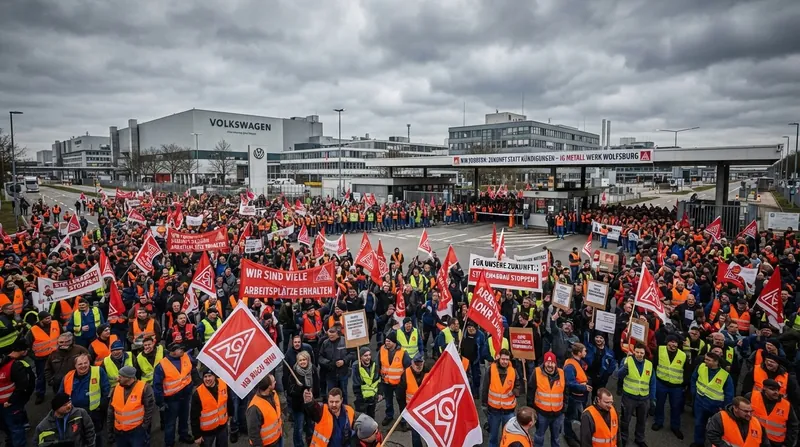
The future of Germany's automotive industry is no longer just being negotiated in boardrooms; it is being contested on the factory floors of the country's most storied brands. On Monday, nearly 180,000 workers across the sector walked off the assembly lines and gathered at more than 280 sites nationwide.
What began as a localized dispute over potential plant closures at Volkswagen has rapidly metastasized into a unified labor revolt, with employees from BMW, Mercedes-Benz, Audi, and Porsche joining the picket lines. For the factory towns that rely on these manufacturing wages, this coordinated action is the critical pressure point that will determine whether the burden of the industry's transition falls on executive margins or local livelihoods.[1][3]
The catalyst for the nationwide mobilization was a stark admission from Volkswagen management that previous cost-saving measures were insufficient. The automaker recently slashed its operating-margin forecast for the year to a maximum of 1 percent, down from an anticipated 4 percent, citing a €6 billion writedown tied to its Porsche subsidiary and rapidly deteriorating market conditions in China. In response, the company floated a restructuring plan that could eliminate up to 100,000 jobs globally, including 50,000 newly targeted positions.[2][4]
But the crisis extends far beyond Wolfsburg. Workers at competing luxury brands recognize that Volkswagen's cuts are a bellwether for the entire sector. BMW is currently navigating a cost-reduction program that could affect 8,000 jobs, while Mercedes-Benz has begun shifting portions of its production footprint to lower-cost facilities in Hungary. Automotive suppliers, the backbone of the local manufacturing economy, have already shed tens of thousands of positions since 2019 as automakers squeeze component prices to fund their electric vehicle transitions.[3][4]
"Things have really hit the fan," IG Metall union leader Christiane Benner told a crowd gathered outside Volkswagen's Wolfsburg plant. "Companies like VW, BMW, Audi, Bosch, Mercedes and Porsche were synonymous with fantastic cars and high quality. Now, management is driving the industry at full throttle into a brick wall." Benner's sentiment reflects a growing consensus on the assembly line: that the current financial shortfall is the result of executive missteps—specifically, a delayed pivot to electric vehicles and sluggish software development—rather than a failure of the workforce.[1][5]
For the local economies anchored by these plants, the stakes are existential. A single assembly facility supports thousands of indirect jobs, from logistics providers to local retail. Thorsten Gröger, IG Metall's regional chief for Lower Saxony, emphasized this ripple effect during the demonstrations. "We won't stand by while a key industry is hollowed out step by step," Gröger stated. "The workers didn't cause the failures of recent years. They shouldn't now be made to pay the bill for them."[3][5]
The labor union is demanding immediate intervention from both corporate boards and the federal government. Beyond halting the proposed layoffs, IG Metall is pushing Chancellor Friedrich Merz's administration to implement policies that protect domestic manufacturing. Their demands include subsidized industrial energy rates, financial assistance for suppliers needing to retool their operations, and strict "Made in EU" procurement rules to counter the influx of heavily subsidized Chinese electric vehicles.[1][3]
The pressure on German automakers is compounding from multiple directions. In China, which has long served as the profit engine for brands like Porsche and Audi, domestic manufacturers like BYD are rapidly capturing market share with affordable, high-tech electric models. Simultaneously, the threat of stringent U.S. tariffs looms over European exports, squeezing the margins on vehicles shipped across the Atlantic. Caught between these geopolitical forces, German executives are attempting to shrink their expensive domestic production bases to free up capital for next-generation software and battery development.[2][4]
The outcome of this standoff will set a precedent for how legacy automakers manage the painful transition to electrification. If the unified front of BMW, Mercedes, and Volkswagen workers succeeds in blocking the closures, companies will be forced to find savings elsewhere, potentially accelerating mergers or altering their global supply chains. For now, the assembly lines remain the ultimate leverage point, and the workers have made it clear that they will not absorb the cost of the industry's strategic delays.[1][4][5]
Sources
- [1]IndustriALL Global Union — 175,000 German autoworkers demand a future, not cutbacks Read on IndustriALL Global Union →
- [2]KELO-AM — German auto workers stage protests as Volkswagen profit warning rocks sector Read on KELO-AM →
- [3]Anadolu Agency — German auto workers stage nationwide protests over job cuts, plant closures Read on Anadolu Agency →
- [4]Cartoq — Volkswagen To Step Up Cost-Cutting, 50,000 People May Lose Their Jobs! Read on Cartoq →
- [5]eNCA — German auto workers stage mass protests in bid to save jobs Read on eNCA →
Charts, maps and images
Timeline
September 2026
German Auto Workers at BMW, Mercedes, and Porsche Join Volkswagen Protests Against Mass Job Cuts
AI
June 2026
Volkswagen Weighs Up to 100,000 Job Cuts and Four Plant Closures in Historic Restructuring