
Rosalía, Karol G and CA7RIEL & Paco Amoroso Take Top Honors at the 2026 Latin Grammys
The 27th annual ceremony celebrated a year of unprecedented global crossover, with major wins for female powerhouses and Argentine alternative acts. The broadcast featured genre-bending performances that highlighted the increasing integration of regional sounds into mainstream pop.
By Jana Rami

Share this story
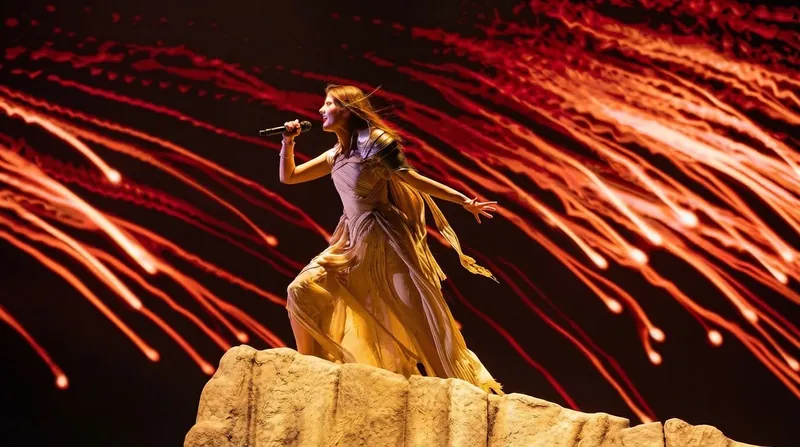
The 27th Annual Latin Grammy Awards opened with an operatic, ethereal performance by Spanish superstar Rosalía, setting a theatrical tone for the music industry's biggest Spanish- and Portuguese-language celebration. Broadcasting to a global audience on Thursday night, the ceremony highlighted a year where Latin music continued to dominate international streaming charts.[1][8]
Rosalía’s opening set, which leaned heavily into avant-garde staging and flamenco-inspired vocals, transitioned into a night that rewarded both established hitmakers and eccentric newcomers. By the end of the broadcast, she had secured multiple trophies, cementing her position as a critical favorite within the Latin Recording Academy.[1][8]
But the evening's most resonant victories belonged to Colombian powerhouse Karol G and the Argentine alternative duo CA7RIEL & Paco Amoroso. The trio of acts dominated the major categories, reflecting a voting body eager to reward artists who push traditional genre boundaries into new sonic territories.[2][8]
A night of genre-bending wins
Karol G took the stage not for a reggaeton anthem, but to deliver a passionate, mariachi-infused rendition of "Ese Hombre Es Malo." The performance underscored her recent pivot toward regional Mexican sounds, a stylistic gamble that earned her a nomination for Best Regional Song this year.[9]
Her success at the 2026 ceremony mirrors her massive commercial footprint over the past twelve months. Industry analysts note that her ability to seamlessly transition between urban club tracks and traditional mariachi soul has broadened her demographic reach far beyond the typical Latin pop audience.[3][6]
Meanwhile, Buenos Aires-based CA7RIEL & Paco Amoroso emerged as the night's breakout stars, translating their chaotic, high-energy club sound into major Academy recognition. Their latest album, which blends funk, trap, and electronic music, captured the attention of both critics and veteran musicians.[2][8]
That veteran attention culminated in one of the ceremony's most surprising moments: British rock icon Sting officially became a Latin Grammy winner. The former Police frontman took home the award for Best Pop/Rock Song for his collaborative work on the Argentine duo's latest record.[10]
Sting's victory highlights a growing trend of legacy Anglo-American artists actively seeking out Latin collaborators. The rocker's win in a major Spanish-language category demonstrates how fluid the boundaries between international pop and regional Latin markets have become in 2026.[3][10]
Spectacle and crossover appeal
The broadcast leaned heavily into massive, festival-ready spectacles, none larger than Daddy Yankee's sprawling medley. The reggaeton pioneer, who previously announced his retirement, returned to the stage for a supershow that felt like a victory lap for the entire genre.[11]
Yankee was joined by a dizzying array of international guests, including LL Cool J, French Montana, Diljit Dosanjh, Feid, and Bizarrap. Entertainment critics immediately labeled the dense, star-studded performance as a likely preview of his rumored 2027 Coachella headlining set.[11]
Brazilian pop star Anitta also delivered a powerhouse performance, bringing the kinetic energy of Rio de Janeiro's funk scene to the arena. Nominated for Album of the Year, she utilized her stage time to showcase the complex choreography and heavy bass that define her roots.[12]
The inclusion of diverse regional sounds extended beyond the main stage performances and into the down-ballot categories. The Academy has spent the last five years expanding its recognition of hyper-local genres that are currently experiencing global streaming surges.[3][6]
Politics and regional triumphs
In one of the week's most unusual crossover narratives, Tejano singer Bobby Pulido claimed his third career Latin Grammy just days after winning a congressional race in the United States. Pulido was awarded Best Tejano Album for his live record, "Bobby Pulido & Friends: Una Tuya y Una Mía (Vol. 2/En Vivo)."[5][13]
Pulido's dual victories in politics and music provided a unique storyline on the red carpet. Reporters covering the ceremony noted that his win underscores the enduring cultural and economic power of the Tejano music market in the American Southwest.[4][5]
The 27th edition of the awards also highlighted the shifting geography of Latin music production. While Miami and San Juan have historically dominated the industry, this year's winners list featured a heavy concentration of artists recording in Buenos Aires, Medellín, and Madrid.[2][8]
This geographic decentralization has forced the Latin Recording Academy to adapt its voting membership and category definitions. The 2026 nominations reflected a concerted effort to capture the fragmented, highly localized scenes that drive viral hits on social media platforms.[3][6]
The global streaming era
As the three-hour broadcast concluded, the overarching narrative was one of absolute global integration. Latin music is no longer treated as a niche or secondary market by major labels; it is the primary growth engine for the entire recorded music industry.[3][7]
The sheer volume of cross-genre collaborations on display Thursday night—from Sting singing over Argentine funk to Diljit Dosanjh trading verses with Daddy Yankee—demonstrates how fluid international pop has become. Artists are bypassing traditional radio formats entirely to reach global audiences.[10][11]
While the official Academy releases and initial news reports did not include direct transcripts of the winners' acceptance speeches, the sheer volume of cross-genre collaborations on display spoke volumes about the industry's direction. For Rosalía, Karol G, and the night's other major winners, the trophies serve as formal industry validation of what streaming numbers have indicated for months.[3][7]
Key points
- Rosalía, Karol G, and Argentine duo CA7RIEL & Paco Amoroso secured multiple major awards at the 27th annual ceremony.
- British rock icon Sting won his first Latin Grammy for Best Pop/Rock Song, highlighting a surge in Anglo-Latin collaborations.
- Daddy Yankee returned to the stage for a massive, star-studded medley that critics viewed as a preview of his rumored 2027 live shows.
- Tejano star Bobby Pulido won his third career Latin Grammy just days after successfully campaigning for a United States congressional seat.
What we don’t know
- It remains unclear if Daddy Yankee's sprawling medley signals a permanent return from his previously announced retirement or a one-off celebration.
- The Latin Recording Academy has not yet released the final global viewership numbers for the 2026 broadcast.
- Global Pop Analysts
- Industry experts who view the Latin Grammys as a barometer for worldwide streaming trends.
- Regional Music Traditionalists
- Advocates for the preservation and recognition of hyper-local Latin genres.
Perspectives this story doesn't cover
- Independent Latin artists operating outside the major label system
Sources
Source coverage
13 outlets
2 viewpoints surfaced







- [1]AFP
Rosalia opens 2026 Latin Grammys with ethereal performance
Read on AFP → - [2]HOLA! USARegional Music Traditionalists
Latin Grammy 2026: The complete list of winners from the 27th edition
Read on HOLA! USA → - [3]Grammy.comGlobal Pop Analysts
2026 Latin GRAMMYs: Winners & Nominees List
Read on Grammy.com → - [4]Los Angeles TimesRegional Music Traditionalists
Lista parcial de ganadores del Latin Grammy 2026
Read on Los Angeles Times → - [5]Los Angeles TimesRegional Music Traditionalists
Latin Grammys 2026: Bobby Pulido wins for best Tejano album
Read on Los Angeles Times → - [6]Yahoo EntertainmentGlobal Pop Analysts
Latin Grammys 2026: Complete list of winners and nominees
Read on Yahoo Entertainment → - [7]In
(untitled)
Read on In → - [8]Rolling StoneGlobal Pop Analysts
Latin Grammys 2026 Winners: The Complete List
Read on Rolling Stone → - [9]Rolling StoneGlobal Pop Analysts
Karol G Embraces Mariachi Soul for Passionate Latin Grammys Performance
Read on Rolling Stone → - [10]Rolling StoneGlobal Pop Analysts
Sting Is Officially a Latin Grammy Winner
Read on Rolling Stone → - [11]Rolling StoneGlobal Pop Analysts
Daddy Yankee’s Latin Grammys Medley Was a Supershow — And Possibly a Coachella Preview
Read on Rolling Stone → - [12]Rolling StoneGlobal Pop Analysts
Anitta Shows Off Brazilian Roots and Powerhouse Moves at Latin Grammys
Read on Rolling Stone → - [13]Rolling StoneGlobal Pop Analysts
Days After Winning Congressional Race, Bobby Pulido Lands Third Latin Grammy
Read on Rolling Stone →
More in Entertainment
See all →Festival Regulations
Why the Cannes Film Festival Bans the Palme d'Or Winner From Taking Other Prizes
4 sources
Pop Music Releases
Taylor Swift Releases Expanded Album 'The Life of a Showgirl: The Encore' With Four New Tracks
6 sources

Festival Circuit
Spanish Drama 'La Bola Negra' Wins TIFF People's Choice Award
7 sources

Streaming Economics
The 28-Day Completion Rate and the Cost-Per-Hour Metric: How Streaming Services Decide a Series Renewal
4 sources

Comments
Every angle. Every day.
Get Entertainment stories with full source coverage and perspective breakdowns, free every day.