
IBM to Link Dual Nighthawk r3 Processors for 1,040-Qubit Quantum System in 2027
IBM has updated its quantum computing roadmap, announcing plans to connect two 520-qubit chips into a single unified machine next year. The architecture aims to execute 10,000 quantum operations before hardware noise overwhelms the system.

Share this story
IBM has committed to delivering a 1,040-qubit quantum computing system in 2027, marking a structural shift in how the company builds its most advanced hardware. Rather than fabricating a single massive processor, the technology giant plans to link two identical chips to function as a unified machine.[3][7]
The architecture relies on the upcoming Nighthawk r3 processor, a design that moves away from brute-force qubit counts toward modular scalability. Each individual Nighthawk r3 chip will house 520 programmable superconducting qubits.[4]
By bridging two of these 520-qubit processors, IBM aims to break through the physical limitations that currently bottleneck superconducting quantum computers. The 2027 system represents a major commercial attempt to maintain delicate quantum states across a physical connection between distinct silicon dies.[5]
The primary performance metric for the dual-chip system is not just its qubit count, but its operational depth. The Nighthawk r3 architecture is specifically designed to "execute 10,000 operations" before quantum noise overwhelms the calculation and destroys the data.[2]
Hitting that 10,000-operation threshold would represent a significant leap in quantum volume and utility. Current generation superconducting systems typically struggle to maintain coherence past a few thousand gates, severely limiting the complexity of the algorithms researchers can run.
The Modular Scaling Strategy
The decision to link two smaller chips rather than build one large one reflects a hard physical reality in quantum hardware manufacturing. As superconducting chips grow larger, manufacturing defects increase, and isolating the qubits from stray electromagnetic interference becomes exponentially more difficult.
IBM previously explored the monolithic approach with its 2023 Condor processor, which crammed 1,121 qubits onto a single massive chip. However, the company quickly pivoted toward smaller, higher-fidelity processors like the 133-qubit Heron, prioritizing gate quality over raw qubit volume.
The Nighthawk announcement confirms that modularity is now the definitive path forward for IBM's quantum roadmap. The company stated the new architecture "demonstrates new levels of speed and quality, with plans to scale beyond 1,000 qubits in 2027."[1]
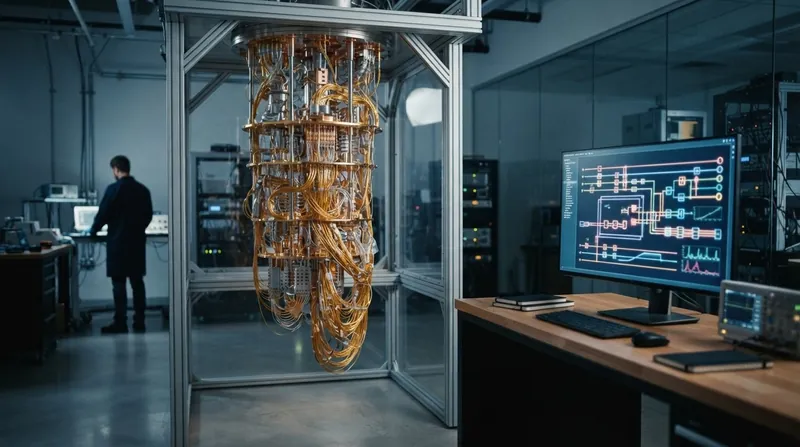
Bridging two processors at temperatures near absolute zero requires specialized cryogenic couplers. These physical links must transfer microwave signals between the chips without introducing heat or allowing the entangled qubits to decohere.
If the 2027 system successfully maintains entanglement across this bridge, it proves that quantum computers can scale horizontally. Engineers could theoretically link three, four, or dozens of processors in the future using the exact same underlying connection technology.[3]
Navigating Quantum Noise
Despite the impressive hardware specifications, the 1,040-qubit system will still operate in the Noisy Intermediate-Scale Quantum era. The machine will not possess enough qubits to perform full fault-tolerant error correction, which requires millions of physical qubits to protect a single logical qubit.
Instead, IBM is relying heavily on error mitigation software to extract useful results from the noisy hardware. By characterizing the specific error profiles of the Nighthawk r3 chips, the system can mathematically cancel out some of the noise after the calculation is complete.
Industry analysts note that the Nighthawk r3 processor serves as the headliner for IBM's updated quantum roadmap. The revised timeline pushes the horizon for true fault tolerance further into the 2030s, while focusing on extracting commercial value from mitigated systems today.[6]
A system capable of 10,000 operations sits right on the boundary of what classical supercomputers can simulate. Once quantum hardware reliably exceeds this threshold, researchers can begin running algorithms that are physically impossible to verify using traditional silicon processors.[2]
The skeptical view of the 2027 target centers entirely on the fidelity of the chip-to-chip connection. Every time a quantum state crosses the physical bridge between the two Nighthawk processors, it risks introducing a new vector for computational errors.
The Competitive Landscape
IBM’s modular superconducting approach faces intense competition from rival architectures that boast naturally higher fidelities. Companies utilizing trapped ions feature lower error rates and longer coherence times, though they operate much slower than superconducting circuits.
Meanwhile, neutral atom startups have demonstrated rapid scaling by manipulating rubidium atoms with lasers. These alternative architectures are advancing quickly, placing pressure on IBM to prove that superconducting transmons can scale without drowning in noise.
Google, IBM’s primary rival in the superconducting space, has historically focused on driving down error rates on single chips rather than rushing to link multiple processors. The 2027 Nighthawk system will test whether IBM’s modular gamble pays off faster than a fidelity-first approach.
Preparing for the 1,040-qubit machine also requires massive investments in supporting infrastructure. The dilution refrigerators required to cool these linked systems are growing to the size of small rooms, demanding specialized helium circulation systems and heavy radiation shielding.
The control electronics that send microwave pulses to the 1,040 qubits must also scale proportionally. Managing the timing and synchronization of these signals across two distinct processors requires a level of classical computing precision that pushes the limits of current field-programmable gate arrays.
The Path to 2027
For enterprise clients and national laboratories, the 2027 target provides a concrete timeline for algorithm development. Chemistry and materials science researchers are currently writing quantum circuits optimized specifically for the 10,000-operation limit of the Nighthawk architecture.[2][7]
These early applications will likely focus on simulating the ground states of complex molecules, a task where even noisy quantum computers hold a theoretical advantage over classical machines. Discovering new battery materials or industrial catalysts remains the holy grail for this class of hardware.
IBM has historically met the hardware delivery dates outlined in its quantum roadmaps, though the usable performance of those systems has sometimes lagged behind the raw specifications. The Nighthawk r3 will be judged strictly on its error rates, not just its 1,040-qubit capacity.[1][6]
The next 36 months will require IBM engineers to perfect the cryogenic couplers and the error mitigation software simultaneously. A failure in either domain would render the dual-chip system too noisy to execute the promised 10,000 operations.[2]
The next 36 months will require IBM engineers to perfect the cryogenic couplers and the error mitigation software simultaneously.
When the linked system powers on in 2027, it will serve as the definitive test of horizontal quantum scaling. The machine will either validate the modular architecture as the blueprint for the next decade, or reveal physical limits that force the industry back to the drawing board.[3]
Key points
- IBM plans to deploy a 1,040-qubit quantum computing system in 2027 by physically linking two identical processors.
- The system will utilize the upcoming Nighthawk r3 architecture, with each individual chip housing 520 programmable superconducting qubits.
- Engineers designed the dual-chip configuration to execute 10,000 quantum operations before hardware noise and decoherence corrupt the calculations.
- The modular approach abandons single massive chips in favor of smaller, higher-fidelity processors connected by specialized cryogenic couplers.
Open questions
- How much latency the cryogenic couplers will introduce when executing operations across the two distinct chips.
- Whether the error mitigation software can successfully handle the specific noise profiles generated by the chip-to-chip connection.
- The exact physical footprint and cooling requirements for the expanded dilution refrigerators needed to house the dual-processor system.
Timeline
2019
IBM deploys the 27-qubit Falcon processor, introducing heavy-hexagon lattice designs to reduce error rates.
2021
The 127-qubit Eagle processor breaks the 100-qubit barrier for superconducting quantum systems.
2023
IBM unveils the 1,121-qubit Condor and the higher-fidelity 133-qubit Heron processors, testing both monolithic and modular approaches.
2026
The Nighthawk r3 architecture is announced, definitively pivoting the roadmap toward modular scaling.
2027
Target deployment for the dual-chip, 1,040-qubit Nighthawk system capable of 10,000 operations.
- Hardware Scaling Optimists
- Believe modular chip connections will rapidly accelerate quantum computing capabilities by bypassing single-chip defect limits.
- Quantum Pragmatists
- Focus on the severe challenges of error rates and the physical limits of cryogenic chip-to-chip coupling.
Perspectives this story doesn't cover
- Alternative architecture developers competing with superconducting approaches
- Enterprise end-users waiting for fault-tolerant hardware
Sources
Source coverage
7 outlets
2 viewpoints surfaced







- [1]IBM NewsroomHardware Scaling Optimists
IBM Quantum Nighthawk Demonstrates New Levels of Speed and Quality, with Plans to Scale Beyond 1,000 Qubits in 2027
Read on IBM Newsroom → - [2]SiliconANGLEHardware Scaling Optimists
IBM Quantum announces upcoming Nighthawk r3 processor designed to execute 10,000 operations
Read on SiliconANGLE → - [3]The Next WebHardware Scaling Optimists
IBM plans to link two quantum chips into a 1,040-qubit system in 2027
Read on The Next Web → - [4]The Quantum InsiderHardware Scaling Optimists
IBM Plans 1,040-Qubit Quantum System with Next-Generation Nighthawk Processors
Read on The Quantum Insider → - [5]Quantum ZeitgeistHardware Scaling Optimists
IBM Plans To Link Two Nighthawk R3 Chips For Over 1,000 Qubits In 2027
Read on Quantum Zeitgeist → - [6]Constellation ResearchQuantum Pragmatists
IBM updated its roadmap for quantum computing with its IBM Quantum Nighthawk r3 processor as the headliner
Read on Constellation Research → - [7]MLQ.aiHardware Scaling Optimists
IBM unveils Nighthawk r3 and plans a 1,040-qubit quantum system for 2027
Read on MLQ.ai →
More in Technology
See all →Quantum Physics
Superconducting Qubits Require 15 Millikelvin Cooling to Keep Thermal Noise Below Their Transition Energy
3 sources
Automated Exploitation
AI Security Firm XBOW Uses GPT-5.6 to Build Full-Chain Chrome Zero-Day Exploit
6 sources

Battery Tech
Solid-State Battery Short Circuits: Dendrites, Voids, and Failure Mechanisms
13 sources

AI Infrastructure
SoftBank, Grab, and PETROS Commit $1.85 Billion Seed Capital for Malaysia AI Infrastructure
4 sources

Comments
Every angle. Every day.
Get Technology stories with full source coverage and perspective breakdowns, free every day.