
The Science of Induction Cooking: Why Magnetic Stoves Are Taking Over the Kitchen
Induction cooktops use electromagnetic fields to heat pans directly, offering unparalleled speed and efficiency while eliminating the indoor air pollution associated with gas stoves.
By Factlen Editorial Team
- Public Health & Environmental Advocates
- Focuses on the urgent need to eliminate indoor combustion to protect respiratory health and reduce carbon emissions.
- Culinary Professionals & Home Chefs
- Prioritizes the performance benefits of magnetic cooking, including rapid heating, precise temperature control, and cooler kitchens.
- Consumer Testing Agencies
- Evaluates the practical realities of the transition, balancing performance gains against upfront costs and electrical requirements.
- Energy Regulators
- Emphasize the grid-level efficiency gains and long-term energy cost savings of electrification.
What's not represented
- · Landlords and Property Managers
- · Traditional Cookware Manufacturers
Why this matters
Switching to an induction cooktop can drastically reduce indoor air pollution, lower your energy bills, and cut cooking times in half, making it one of the most impactful upgrades for both your family's health and your daily routine.
Key points
- Induction cooktops use electromagnetic fields to heat ferromagnetic cookware directly, achieving up to 90% energy efficiency.
- Unlike gas stoves, induction cooking produces zero indoor combustion emissions, eliminating nitrogen dioxide and benzene from the kitchen.
- High-end induction ranges can boil water more than twice as fast as traditional gas or electric coil stoves.
- New federal rebates and 120-volt battery-integrated models are making induction technology more accessible to renters and older homes.
For decades, the great American kitchen debate was strictly binary: serious cooks demanded gas for its visual feedback and precision, while budget-conscious builders installed traditional electric coils for their affordability. But as we move through 2026, a third technology has decisively ended the argument. Induction cooking, once viewed as a pricey, temperamental European niche, is rapidly becoming the gold standard in modern kitchens. Driven by a convergence of plunging appliance costs, new federal rebates, and a growing awareness of the health risks associated with indoor combustion, homeowners are abandoning the blue flame in record numbers. This transition represents the most significant shift in residential cooking technology since the microwave oven was introduced in the 1970s.[6][7]
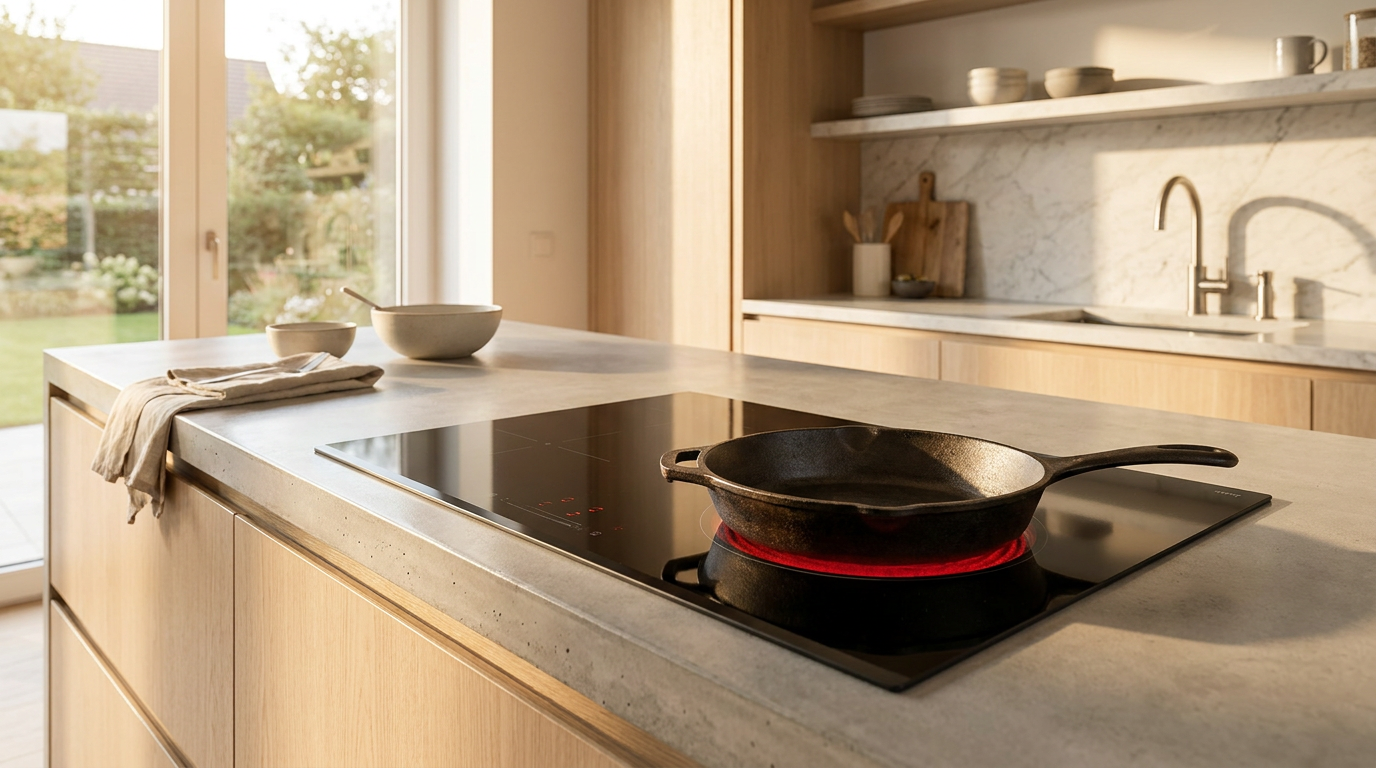
At its core, the rise of induction is a story of superior physics rather than mere culinary preference. To understand why this technology is dominating the market, you have to look beneath the sleek, featureless glass-ceramic surface. Unlike traditional electric stoves that use radiant heat coils to slowly warm up, or gas stoves that rely on the open combustion of fossil fuels, an induction cooktop does not actually generate any heat itself. If you were to turn on an induction burner and place your hand directly on the glass, you would feel absolutely nothing. The magic happens entirely within the cookware.[5]
Beneath each cooking zone lies a tightly wound coil of copper wire. When the stove is powered on, an alternating electrical current flows through this coil, generating a dynamic, invisible, and highly localized oscillating magnetic field above the burner. When a compatible pot or pan is placed within this field, the magnetic waves penetrate the metal. This interaction induces localized electrical currents—known in physics as eddy currents—to swirl rapidly within the base of the cookware. Because the metal of the pan has natural electrical resistance, these swirling currents generate intense friction at the molecular level.[5]

The result of this friction is known as Joule heating. The pan itself becomes the heat source, cooking the food inside it while the glass surface below remains relatively cool, absorbing only the residual heat radiating back down from the hot metal. This direct transfer of electromagnetic energy makes induction thermodynamically superior to any other cooking method currently available. According to data from the U.S. Department of Energy, induction ranges achieve an astonishing 84 to 90 percent energy efficiency, meaning nearly all the electricity consumed goes directly into cooking your meal.[1][2][5]
By contrast, traditional electric smooth-tops hover around 70 to 75 percent efficiency, losing a quarter of their energy to the surrounding environment. Gas stoves are the least efficient of all, converting only 32 to 40 percent of their energy into actual cooking heat. The majority of the thermal energy produced by a gas flame escapes around the sides of the pan, heating the surrounding air and forcing kitchen air conditioning systems to work overtime during the summer months. In an era of rising utility costs, this massive efficiency gap has become a primary selling point for consumers.[2]

In practical terms, this thermodynamic efficiency translates to raw, undeniable speed. In recent benchmark tests conducted by consumer advocacy groups, high-end induction ranges brought six cups of water to a full, rolling boil in just 1 minute and 42 seconds. A standard gas range took nearly five and a half minutes to accomplish the exact same task. For busy families trying to get dinner on the table after a long workday, shaving four minutes off the time it takes to boil pasta water is a tangible, daily quality-of-life improvement that is hard to ignore.[3]
But speed and efficiency are only half the story. The most urgent catalyst for the induction transition in 2026 has been a cascade of alarming public health research regarding indoor air quality. Peer-reviewed studies from institutions like Stanford University have demonstrated that gas stoves emit significant levels of nitrogen dioxide (NO2), carbon monoxide, and benzene—a known carcinogen—even when the burners are completely turned off. Without high-powered, externally vented exhaust hoods, these combustion byproducts can quickly accumulate to levels that exceed Environmental Protection Agency standards for outdoor air quality.[4]
The most urgent catalyst for the induction transition in 2026 has been a cascade of alarming public health research regarding indoor air quality.
The health implications of this indoor pollution are profound. A major meta-analysis linked residential gas stove usage to a 42 percent increased risk of childhood asthma in the United States, attributing roughly one in eight childhood asthma cases directly to gas cooking. Induction eliminates these point-source emissions entirely. Because there is no combustion taking place, there is no NO2, no carbon monoxide, and no benzene. The only things emitted into the kitchen air are the natural aromas of the food being cooked, drastically improving the respiratory environment of the home.[1][4]

Safety is another major factor driving the rapid adoption of magnetic cooking, particularly for families with young children, curious pets, or aging adults. Because the cooktop itself does not generate heat, the surface only gets warm from the residual heat of the pan resting upon it. Once the cookware is removed, the burner cools down rapidly, drastically reducing the risk of accidental burns. Furthermore, induction burners cannot accidentally be left on in a dangerous state; if there is no magnetic pan on the surface to complete the circuit, no heat is generated whatsoever.[1][5]
The primary hurdle for new users transitioning to this technology is the strict cookware requirement. Because the system relies on electromagnetism, induction requires ferromagnetic materials to function. Cast iron skillets, enameled cast iron Dutch ovens like those made by Le Creuset, and most high-quality stainless steel pots work perfectly. However, pure aluminum, copper, and glass cookware will not interact with the magnetic field and will remain completely cold. For some households, upgrading to induction means replacing beloved but incompatible pots and pans.[3][5]
Fortunately, determining whether your current kitchen arsenal is compatible is incredibly simple. The easiest way to check is the universal magnet test: if a standard refrigerator magnet sticks firmly to the bottom of a pan, it is induction-ready. Many modern cookware manufacturers now explicitly label their products as induction-compatible, often embedding a magnetic steel disc into the base of aluminum pans to give consumers the best of both worlds—the lightweight heat conductivity of aluminum combined with the magnetic properties required for the stove.[3]

The other historical barrier to entry has been upfront cost and electrical requirements. Full induction ranges still carry a premium over basic electric coil models, and homes switching from gas often need a dedicated 240-volt electrical outlet installed by a licensed electrician, which can add hundreds of dollars to the installation cost. However, the financial calculus has shifted significantly in 2026. The High-Efficiency Electric Home Rebate Act (HEAR) now provides up to $840 for low- and moderate-income households to upgrade to induction appliances, fundamentally altering the economics of the transition.[2][3]
For renters or homeowners unwilling to upgrade their electrical panels, manufacturers have responded with innovative solutions. New 120-volt battery-integrated induction ranges are now hitting the market, allowing users to plug a full-sized induction stove into a standard wall outlet. These units use a built-in battery to store energy throughout the day, deploying it in high-wattage bursts when multiple burners are needed for dinner. This technological workaround is democratizing access to high-performance electric cooking for millions of Americans living in older buildings.[2]
The culinary community's relationship with induction has also evolved from deep skepticism to enthusiastic adoption. Historically, professional chefs swore by the visual feedback and raw power of a gas flame. However, modern induction technology has proven capable of delivering faster boil times and more delicate, consistent simmers without the ambient heat loss that turns commercial kitchens into sweltering saunas. As professional chefs increasingly abandon hot, gas-filled commercial kitchens for the cool precision of magnetic cooking, the cultural cachet of the blue flame is rapidly fading.[6]
The primary adjustment required for home cooks is a change in workflow. Because induction heats so rapidly, the traditional habit of turning on the burner and then chopping onions while the pan warms up is no longer viable. Ingredients must be fully prepped—a practice known as mise en place—before the stove is turned on, as there is virtually no idle time waiting for a pan to get hot. Once this learning curve is mastered, the precision and control offered by induction make it an indispensable tool for the modern, health-conscious kitchen.[6][7]
How we got here
1933
The first induction cooktops are introduced to the public at the Chicago World's Fair.
1970s
Westinghouse introduces the first consumer induction ranges, but high costs limit widespread adoption.
2022
Major studies link gas stove emissions to childhood asthma, sparking renewed interest in electric alternatives.
2024
The High-Efficiency Electric Home Rebate Act (HEAR) begins rolling out, subsidizing induction upgrades for homeowners.
2026
Induction ranges reach price parity with high-end gas models, accelerating mainstream adoption in American kitchens.
Viewpoints in depth
Public Health & Environmental Advocates
Focuses on the urgent need to eliminate indoor combustion to protect respiratory health and reduce carbon emissions.
For environmental and public health groups, the transition to induction is less about culinary convenience and more about harm reduction. Citing extensive research linking gas stoves to elevated levels of nitrogen dioxide and benzene, these advocates argue that cooking with gas is akin to having a localized pollution source in the center of the home. They emphasize that even with robust ventilation, combustion byproducts pose an unacceptable risk, particularly for childhood asthma. Furthermore, they view the electrification of cooking as a vital step in decarbonizing residential buildings, shifting energy consumption from fossil fuels to an increasingly renewable electrical grid.
Culinary Professionals & Home Chefs
Prioritizes the performance benefits of magnetic cooking, including rapid heating, precise temperature control, and cooler kitchens.
The culinary community's relationship with induction has evolved from skepticism to enthusiastic adoption. Historically, professional chefs swore by the visual feedback and raw power of a gas flame. However, modern induction technology has proven capable of delivering faster boil times and more delicate simmers without the ambient heat loss that turns commercial kitchens into saunas. Chefs note that because the pan itself becomes the heat source, temperature adjustments are instantaneous. The primary adjustment required is a change in workflow: because induction heats so rapidly, ingredients must be fully prepped before the stove is turned on, as there is no idle time waiting for a pan to get hot.
Consumer Testing Agencies
Evaluates the practical realities of the transition, balancing performance gains against upfront costs and electrical requirements.
Organizations focused on consumer advocacy and product testing acknowledge the superior performance of induction but highlight the logistical hurdles of upgrading. They point out that while the operational costs are lower due to high energy efficiency, the initial purchase price of an induction range remains higher than basic gas or electric models. Additionally, they caution buyers about the hidden costs of electrical panel upgrades, as replacing a gas stove often requires installing a dedicated 240-volt circuit. These agencies emphasize the importance of checking cookware compatibility using the magnet test to avoid the surprise expense of replacing an entire set of pots and pans.
What we don't know
- How quickly the electrical grid infrastructure can adapt to the widespread electrification of residential appliances.
- Whether the secondary market for used gas stoves will collapse entirely as building codes increasingly favor electric-only new construction.
Key terms
- Electromagnetic Induction
- The process of generating electrical current in a conductor by placing it in a changing magnetic field.
- Ferromagnetic
- Materials, such as iron or certain steel alloys, that have a high susceptibility to magnetization and are required for induction cooking.
- Eddy Currents
- Loops of electrical current induced within the base of a pan by the alternating magnetic field of an induction burner.
- Joule Heating
- The process by which the passage of an electric current through a conductor produces heat due to electrical resistance.
Frequently asked
Do I need to buy all new pots and pans for an induction stove?
Not necessarily. If a magnet sticks firmly to the bottom of your current pots and pans, they contain enough iron to work perfectly on an induction cooktop.
Will an induction stove heat up my kitchen like a gas stove does?
No. Because induction heats the pan directly rather than the surrounding air, it wastes very little ambient heat, keeping your kitchen significantly cooler.
Can I plug an induction stove into a standard wall outlet?
Traditional full-size induction ranges require a 240-volt outlet. However, new battery-integrated models and portable single burners can plug into standard 120-volt outlets.
Is the glass surface of an induction cooktop safe to touch?
The burner itself does not generate heat, but the glass will become warm from the residual heat of the hot pan resting on it. It cools down much faster than a traditional electric stove.
Sources
Source coverage
7 outlets
4 viewpoints surfaced







[1]U.S. Department of EnergyEnergy Regulators
Making the Switch to Induction Stoves or Cooktops
Read on U.S. Department of Energy →[2]Energy SolutionsPublic Health & Environmental Advocates
Induction vs Gas Cooktops: The Definitive Health, Efficiency & Economic Analysis
Read on Energy Solutions →[3]Consumer ReportsConsumer Testing Agencies
Pros and Cons of Induction Cooktops and Ranges
Read on Consumer Reports →[4]Rewiring AmericaPublic Health & Environmental Advocates
Why induction stoves are better than gas
Read on Rewiring America →[5]Weber State University
Induction Cooking: What is it and how does it work?
Read on Weber State University →[6]Tasting TableCulinary Professionals & Home Chefs
Why Induction Stoves Are Set To Dominate 2026 Kitchen Trends
Read on Tasting Table →[7]Factlen Editorial Team
Synthesis by Factlen editorial team
Read on Factlen Editorial Team →
Every angle. Every day.
Get home stories with full source coverage and perspective breakdowns delivered to your inbox.