
How Hall Effect Sensors Are Finally Curing Controller Stick Drift
After years of frustrating hardware failures, magnetic sensor technology is becoming the new standard for gaming controllers. By eliminating physical friction, Hall Effect joysticks offer a permanent solution to stick drift.
By Factlen Editorial Team
- Third-Party Brands
- Capitalizing on the drift epidemic to capture market share with affordable, durable alternatives.
- Competitive Players & Modders
- Prioritizing absolute precision, zero deadzones, and right-to-repair longevity in their hardware.
- First-Party Console Makers
- Slowly adapting to consumer pressure while balancing the mass-production cost of legacy components.
What's not represented
- · Environmental advocates focused on the reduction of e-waste from discarded controllers
- · Casual gamers who are unaware of the hardware differences and simply buy official replacements
Why this matters
For anyone who has had to throw away a $70 controller because a character wouldn't stop walking left, this hardware shift represents a massive consumer victory. It permanently solves the most common point of failure in modern gaming hardware, saving players money and reducing e-waste.
Key points
- Standard controllers fail because physical friction destroys their internal carbon tracks.
- Hall Effect sensors use magnets to track movement, eliminating physical contact and wear.
- Third-party brands are dominating the market by offering drift-proof controllers at budget prices.
- Premium models now feature adjustable tension rings to counteract the frictionless feel.
- TMR (Tunnel Magnetoresistance) is emerging as the next evolution for ultra-competitive esports.
You are mid-match, lining up a perfect shot, and suddenly your character creeps to the left. Stick drift is the bane of modern gaming, rendering expensive first-party controllers from Sony, Microsoft, and Nintendo virtually unusable after just a few months of heavy play. For years, gamers have treated this hardware degradation as an inevitable tax on the hobby. But in 2026, a massive shift in the peripheral market is finally curing the epidemic. Hall Effect sensors, a technology that relies on magnetic fields rather than physical friction, have moved from niche industrial applications to the mainstream gaming standard, promising a permanent end to phantom inputs.[1][3]
To understand why Hall Effect technology is such a revelation, one must first look at the flawed hardware it replaces. Standard controllers rely on potentiometers—a decades-old analog technology. Inside a traditional joystick, a physical metal wiper blade drags across a curved carbon track to measure the stick's position based on electrical resistance. Every single flick, rotation, and click grinds those physical components together. Over time, this friction scrapes away the carbon, creating conductive dust and uneven tracks. The controller's brain misreads this physical scarring as player input, resulting in the dreaded drift.[4][6]

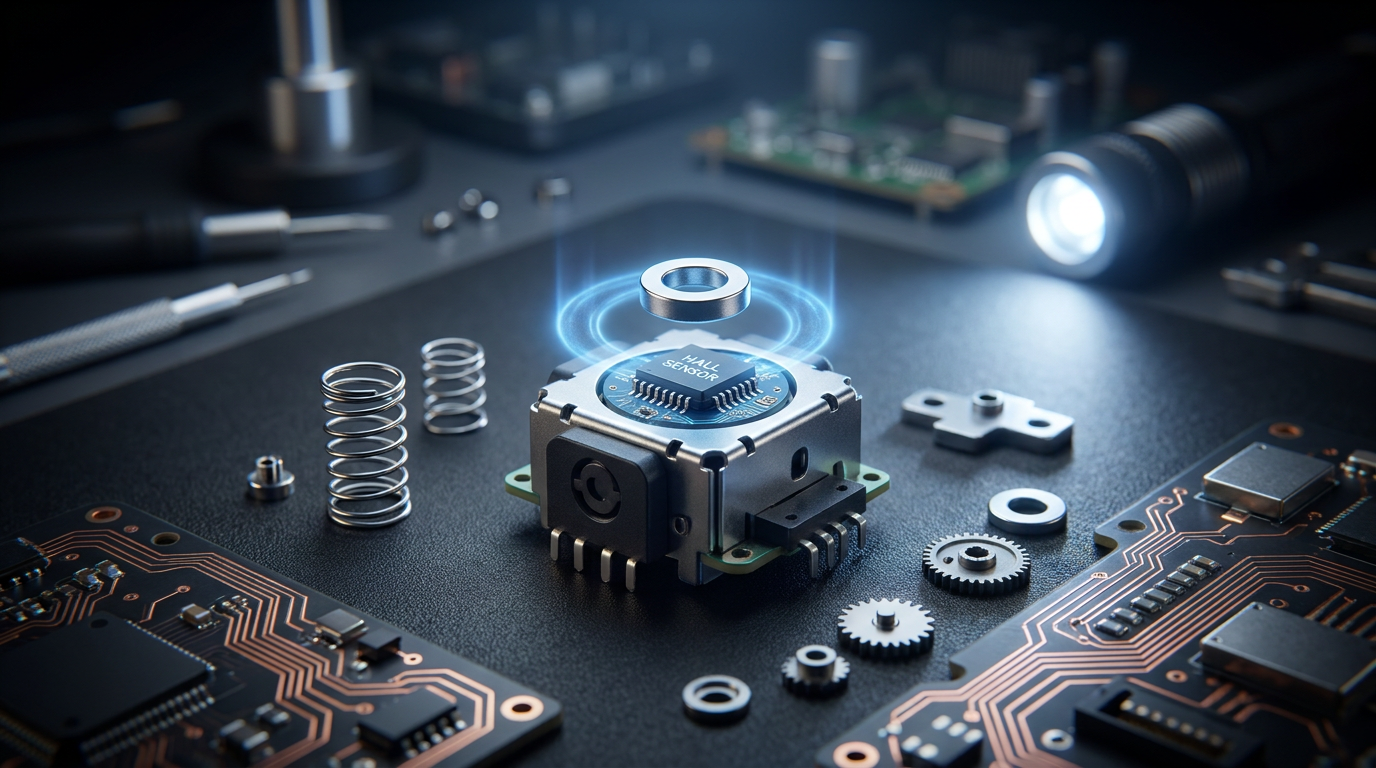
Hall Effect joysticks sidestep this mechanical failure entirely by eliminating physical contact. Named after physicist Edwin Hall, who discovered the underlying principle in 1879, the technology uses magnets to detect the direction and strength of a magnetic field. A small magnet is attached to the base of the joystick shaft, while a stationary sensor sits nearby. As the player tilts the stick, the magnet shifts, altering the magnetic field. The sensor reads this change in voltage—known as the Hall voltage—and translates it into precise positional data. Because the components never actually touch, there is zero friction, zero wear, and zero carbon dust.[1][4][8]
The durability gains are staggering. While a standard potentiometer might begin showing signs of degradation within six to twelve months of daily use, a Hall Effect sensor boasts a Mean Time Between Failure (MTBF) of over 50 million cycles. In practical terms, the magnetic sensor will outlast the plastic shell of the controller itself. Interestingly, this is not a new invention for the gaming industry; the beloved Sega Dreamcast utilized a Hall Effect thumbstick back in 1999. However, the technology was largely abandoned by console manufacturers in the intervening decades to cut production costs, leaving third-party brands to rediscover and popularize it for the modern era.[5][6]
In practical terms, the magnetic sensor will outlast the plastic shell of the controller itself.
The resurgence of drift-proof technology has triggered a gold rush among third-party peripheral manufacturers. Brands like GameSir, Flydigi, and 8BitDo have aggressively captured market share by offering Hall Effect controllers at highly competitive price points. For under $50, players can now purchase wired, officially licensed Xbox and PC controllers that feature magnetic sticks and triggers. This aggressive pricing strategy has put immense pressure on first-party giants, whose standard $70 controllers still largely rely on wear-prone potentiometers. For consumers tired of replacing their hardware annually, the value proposition of a cheaper, drift-proof alternative has become impossible to ignore.[2][3][7]

Despite the overwhelming benefits, the transition to magnetic sensors has introduced new engineering challenges, primarily regarding the "feel" of the sticks. Because there is no physical wiper dragging across a track, Hall Effect joysticks lack natural mechanical friction. To players accustomed to the slight resistance of a standard Xbox or PlayStation controller, magnetic sticks can initially feel overly loose or slippery. To combat this, premium third-party controllers have introduced adjustable tension rings. These physical dials allow players to manually tighten or loosen the stick's resistance, perfectly mimicking the heavy tension of an Xbox 360 pad or the lighter feel of a PS3 controller without sacrificing the frictionless sensor beneath.[5]
Another technical hurdle is centering jitter. Because magnetic fields are incredibly sensitive and frictionless sticks can bounce slightly when released, the joystick might return to a resting position of 0.0002 rather than a perfect 0.0000. Early Hall Effect adopters sometimes experienced micro-stutters as a result. However, modern controllers in 2026 utilize advanced filtering algorithms to instantly deaden this microscopic bounce, ensuring a rock-solid center point. Combined with ultra-fast 1000Hz polling rates, these controllers now offer a level of precision that easily satisfies the strict demands of competitive esports players.[5][8]

As Hall Effect technology becomes the baseline expectation for informed consumers, the high-end market is already moving toward the next evolution: Tunnel Magnetoresistance (TMR). TMR sensors operate on similar contactless magnetic principles but use weaker magnetic forces and consume significantly less power. Found in ultra-premium 2026 releases like the Razer Wolverine V3 Pro and the 8BitDo Ultimate 2, TMR sticks offer even higher resolution and are entirely immune to the minor magnetic interference that can occasionally affect standard Hall sensors. Whether through Hall Effect or TMR, the era of disposable, drifting controllers is rapidly coming to an end, marking one of the most significant consumer hardware victories in recent gaming history.[3][7]
How we got here
1879
Edwin Hall discovers the Hall Effect, proving that magnetic fields can alter electrical voltage in a conductor.
1999
Sega releases the Dreamcast, featuring a controller that utilizes an early Hall Effect thumbstick to prevent wear.
2023
A wave of third-party manufacturers begin mass-producing affordable Hall Effect replacement modules for modern consoles.
2026
Hall Effect and TMR sensors become the de facto standard for PC and competitive gaming, heavily pressuring first-party console makers.
Viewpoints in depth
Third-Party Innovators
Brands like GameSir and Flydigi view magnetic sensors as their primary weapon against console giants.
For years, third-party controllers were viewed as the inferior 'little brother' option handed to guests. Hall Effect technology has completely inverted this dynamic. By rapidly adopting magnetic sensors while Sony and Microsoft hesitated, brands like GameSir, 8BitDo, and Flydigi have positioned themselves as the premium choice for informed consumers. They argue that continuing to sell potentiometer-based controllers in 2026 is inherently anti-consumer, and they are using aggressive pricing—often undercutting standard first-party pads—to force a market-wide standard shift.
Competitive Esports Players
Professional gamers prioritize the zero-deadzone precision and high polling rates of magnetic sticks.
At the highest levels of competitive play in titles like Call of Duty and Apex Legends, stick drift isn't just an annoyance; it's a career liability. The competitive community has embraced Hall Effect and TMR sensors not just for their longevity, but for their raw mathematical precision. Because magnetic sensors lack the physical 'flicker' of a scraping carbon track, players can set their in-game deadzones to absolute zero, ensuring that even the most microscopic thumb movement translates instantly to on-screen aiming. The only point of contention in this camp is the frictionless feel, which has driven the demand for hardware-level tension adjustment rings.
First-Party Console Makers
Sony, Microsoft, and Nintendo face a difficult transition away from legacy mass-production supply chains.
The silence from the 'Big Three' console manufacturers regarding standard-issue Hall Effect controllers is largely a matter of scale and supply chain inertia. Companies have supplied billions of cheap, reliable-enough potentiometers for decades. Switching the default pack-in controllers for the PlayStation 5 or Xbox Series X to magnetic sensors involves retooling massive global assembly lines and absorbing a slightly higher per-unit cost. While they have begun offering magnetic modules in ultra-premium, expensive 'Pro' controllers, they argue that standard potentiometers still meet the needs of the average casual player—a stance that is increasingly drawing ire from the gaming community.
What we don't know
- Whether Sony, Microsoft, or Nintendo will ever upgrade their standard pack-in controllers to Hall Effect technology.
- If TMR sensors will completely replace Hall Effect sensors in the budget market, or remain an esports-exclusive premium feature.
Key terms
- Stick Drift
- A hardware failure where a controller registers movement even when the joystick is not being touched, usually caused by internal wear.
- Potentiometer
- A traditional analog sensor that measures joystick movement using a physical metal wiper dragging across a carbon track.
- Hall Effect Sensor
- A contactless technology that measures joystick position by detecting changes in a magnetic field, eliminating physical friction.
- TMR (Tunnel Magnetoresistance)
- An advanced, highly sensitive magnetic sensor technology that offers even greater precision and lower power consumption than standard Hall Effect sensors.
- Deadzone
- A software setting that ignores small joystick movements, often increased by players to hide the effects of stick drift.
Frequently asked
Can Hall Effect controllers still get stick drift?
They are immune to drift caused by mechanical wear and friction, which is the cause of 99% of controller failures. While extreme magnetic interference or software glitches could theoretically cause issues, they will not physically degrade like standard controllers.
Why don't standard PS5 and Xbox controllers use this?
First-party manufacturers rely on massive, established supply chains for cheaper potentiometer parts. While they offer Hall Effect in some expensive 'Pro' models, upgrading the standard pack-in controllers would increase their baseline manufacturing costs.
Do Hall Effect joysticks feel different to use?
Yes. Because there are no internal parts rubbing together, they feel incredibly smooth and frictionless. Some players find them slightly 'loose' at first, which is why premium models now include adjustable tension rings.
What is the difference between Hall Effect and TMR?
TMR (Tunnel Magnetoresistance) is a newer, premium evolution of magnetic sensing. It uses weaker magnetic forces, consumes less battery power, and offers slightly higher resolution for competitive esports players.
Sources
Source coverage
8 outlets
3 viewpoints surfaced








[1]TechRadarFirst-Party Console Makers
What are Hall effect joysticks? The drift-curing controller tech explained
Read on TechRadar →[2]PC GamerThird-Party Brands
The best PC controller in 2026
Read on PC Gamer →[3]ComicBookThird-Party Brands
The Best Hall Effect Controllers in 2026
Read on ComicBook →[4]EDNFirst-Party Console Makers
How Hall-effect joysticks are revolutionizing gaming
Read on EDN →[5]Gamepad TesterCompetitive Players & Modders
Best Hall Effect Controllers (Drift Proof) in 2026
Read on Gamepad Tester →[6]Controller RepairsCompetitive Players & Modders
Potentiometer vs. Hall Effect: The End of Stick Drift
Read on Controller Repairs →[7]HLPlanetThird-Party Brands
Game Controllers with Hall Effect Joystick Sensors
Read on HLPlanet →[8]AimControllersCompetitive Players & Modders
Hall Effect Sensor Technology to Boost the Performance of Your Controller
Read on AimControllers →
Every angle. Every day.
Get gaming esports stories with full source coverage and perspective breakdowns delivered to your inbox.