
OLED vs. Mini-LED in 2026: Which TV Technology Actually Wins?
The 2026 TV market has narrowed the gap between OLED and Mini-LED, with Tandem OLEDs boosting brightness and RGB Mini-LEDs eliminating blooming. Here is how to choose the right panel for your living room.
By Factlen Editorial Team
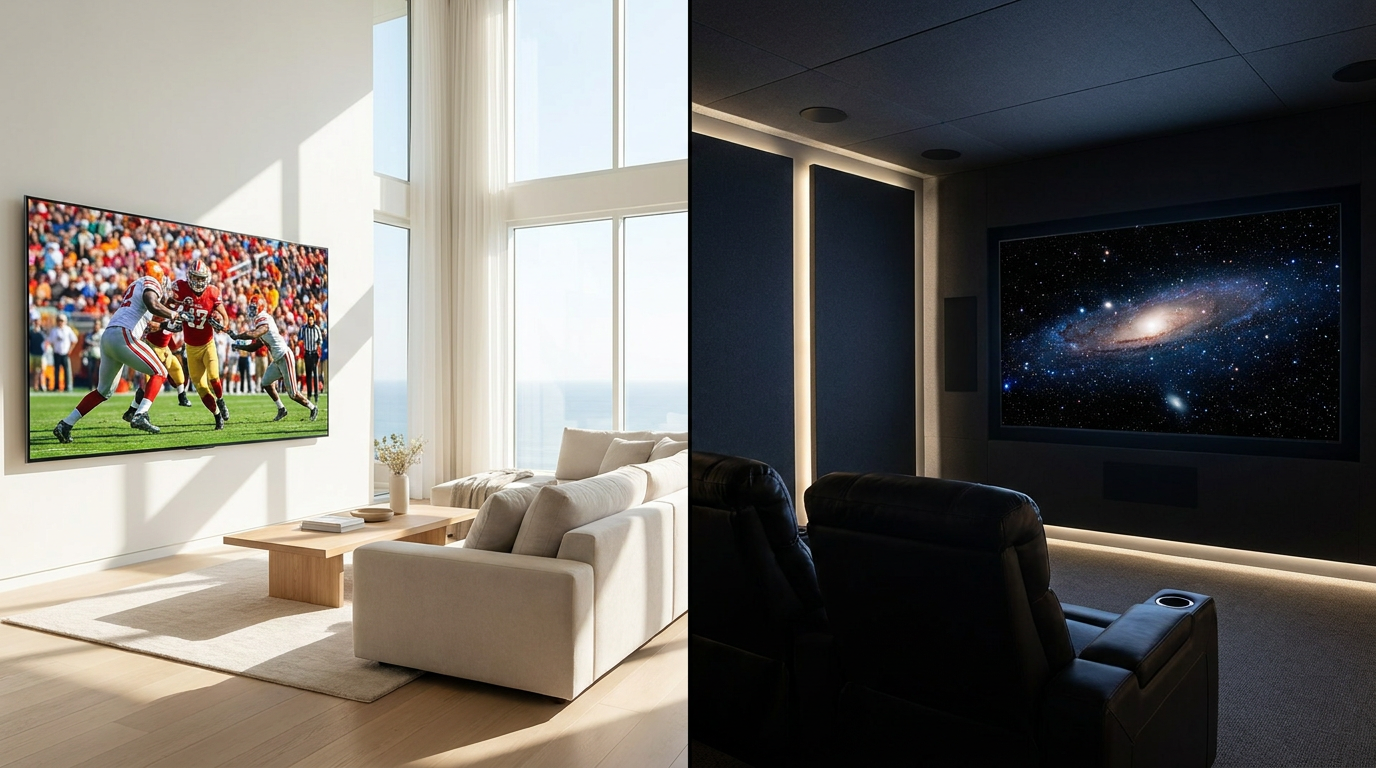
- Cinematic Purists
- Prioritize absolute contrast, perfect black levels, and pixel-level precision for movie watching.
- Bright-Room & Power Users
- Prioritize sheer brightness, glare reduction, and zero burn-in risk for daytime viewing and PC use.
- Value Maximizers
- Focus on the cost-per-inch ratio, favoring massive screens and long-term durability.
What's not represented
- · Professional colorists and studio mastering engineers who rely on reference monitors.
- · Eco-conscious consumers focused strictly on the lifetime energy consumption and e-waste footprint of different panel types.
Why this matters
A premium television is a decade-long investment. Choosing the wrong panel technology for your room's lighting or your viewing habits can mean battling glare every afternoon or risking permanent burn-in from static gaming interfaces.
Key points
- The 2026 TV market is defined by Tandem OLEDs pushing brightness boundaries and RGB Mini-LEDs eliminating color filters.
- Tandem OLEDs can now reach up to 2,800 nits in small highlights, though full-screen brightness is still limited by automatic dimming.
- Modern RGB Mini-LEDs achieve 4,000 to 10,000 nits of peak brightness, making them the undisputed champions for sunlit rooms.
- Mini-LEDs with over 5,000 local dimming zones have virtually eliminated the "blooming" effect for on-axis viewing.
- OLED remains the premium choice for dark-room home theaters, while Mini-LED dominates the 75-inch and larger market due to better cost scaling.
Buying a premium television in 2026 means navigating the most competitive display market in history. For years, the consumer advice was simple: buy an OLED for perfect contrast in a dark room, or buy an LED if you have a sun-drenched living room. Today, those traditional boundaries have collapsed, ushering in a golden age of home entertainment where both technologies have aggressively targeted their historical weaknesses.[1][7]
The convergence is driven by two breakthrough technologies that matured this year: Tandem OLED and RGB Mini-LED. Both architectures were designed specifically to rewrite the rules of display luminance and contrast, resulting in OLEDs that are blindingly bright and Mini-LEDs that offer near-perfect black levels.[3][4]
The case for OLED rests heavily on the new Tandem OLED architecture, popularized by flagship models like the LG G5. Instead of a single emissive layer, Tandem OLED stacks multiple red, green, and blue light-emitting layers on top of each other. The evidence of its success is striking: this allows the panel to achieve a massive brightness jump—pushing peak HDR highlights between 2,300 and 2,800 nits—without sacrificing the pixel-level black control that home theater enthusiasts demand.[4][6]
Competing alongside Tandem OLED is the refined QD-OLED technology, championed by the Samsung S95F and Sony Bravia 8 II. By using a blue OLED emitter shining through a quantum dot color layer, QD-OLEDs deliver unparalleled color volume and saturation at high brightness levels. For viewers who want the purest reds and greens in HDR movies, QD-OLED remains the cinematic gold standard.[1][6]

However, the argument against OLED's dominance comes from the rapidly evolving Mini-LED camp. The industry has aggressively pivoted to RGB Mini-LED, a fundamental rewrite of how LCD televisions create light. Legacy Mini-LEDs used blue LEDs shining through a color filter, but 2026 flagships from TCL and Hisense utilize clusters of independent red, green, and blue LEDs directly at the source.[3][4]
This architectural shift removes the traditional color filter entirely, unlocking staggering luminance. Modern RGB Mini-LED panels can comfortably hit 4,000 to 10,000 nits of peak brightness. In a brightly lit living room flooded with afternoon sunlight, this sheer output cuts through glare and reflections in a way that even the newest OLEDs cannot match.[2][3][8]
The brightness debate also hinges on sustained full-screen output. While a 2026 OLED can hit 2,000 nits in a tiny 3% window—like a specular highlight on a sword—it relies on an Auto Brightness Limiter (ABL) to protect the organic materials from heat degradation. If a bright scene fills the entire screen, such as a hockey game or a snowy landscape, the OLED will aggressively dim itself. Mini-LEDs suffer from no such limitation, maintaining retina-searing brightness across the entire panel indefinitely.[2][7]
The brightness debate also hinges on sustained full-screen output.
Conversely, the strongest argument for OLED remains its absolute contrast. Because each of its 8.3 million pixels generates its own light, an OLED can turn individual pixels completely off, creating true, infinite black. Mini-LEDs must rely on local dimming zones to turn off the backlight behind dark areas of the screen, which historically led to compromised shadow detail.[7][8]

Fortunately for Mini-LED buyers, zone counts have skyrocketed. Premium 2026 models now feature upwards of 5,000 to 20,000 independent dimming zones. At this density, the dreaded "blooming" effect—a halo of light bleeding around bright objects on dark backgrounds—is virtually invisible when sitting directly in front of the television, though it can still appear slightly when viewed from an off-center angle.[3][7][8]
The most persistent argument against OLED technology remains burn-in. Organic compounds naturally degrade over time, and static images left on the screen can cause permanent ghosting. While 2026 panels feature advanced heat dissipation layers and sophisticated pixel compensation algorithms, the underlying chemical limits of organic emitters still exist.[3][8]
Independent testing confirms that after 10,000 hours of heavy use, modern OLEDs show strong mechanical reliability, but they still carry a cumulative risk of visible burn-in under prolonged static workloads. For console gamers who play the same HUD-heavy game for hundreds of hours, or PC users who leave taskbars and browser windows open all day, Mini-LED is widely considered the safer, "forever display" choice.[2][3][5]
When it comes to gaming performance, both technologies are exceptionally capable. Flagship models across both categories now feature four full-bandwidth HDMI 2.1 ports, Variable Refresh Rate (VRR), and native 144Hz to 165Hz refresh rates for PC gamers, ensuring buttery-smooth motion in competitive titles.[6][8]
However, OLED maintains a slight edge in competitive gaming due to its near-instantaneous sub-millisecond pixel response time. Fast-pacing panning shots in first-person shooters remain perfectly crisp on an OLED, whereas even the fastest VA-panel Mini-LEDs may exhibit a microscopic amount of motion blur in the darkest transitions.[8]

The final, and often most decisive, factor is the economics of screen size. If you are shopping for a 55-inch or 65-inch television, the price gap between a premium OLED and a flagship Mini-LED is relatively narrow. But as screen sizes scale up, OLED manufacturing costs become exponential due to the difficulty of producing large, defect-free organic sheets.[8]
Ultimately, the choice between these two display titans comes down to your specific environment. OLED fits perfectly when you watch primarily in dark or dimly lit rooms, prioritize cinematic contrast, and want the fastest possible pixel response time for competitive gaming. It does not fit well when your living room is flooded with afternoon sunlight, or if you plan to use the display as a PC monitor with static taskbars that increase the risk of burn-in.[1][8]

Conversely, Mini-LED fits perfectly when your room gets plenty of natural light, you want a massive 85-inch screen without paying an exponential premium, or you plan to use the display heavily for static productivity and HUD-heavy gaming. It does not fit well when you are a home theater purist who demands absolute, pixel-perfect black levels in a pitch-black room, as even the best local dimming algorithms cannot entirely defeat microscopic blooming.[2][8]
How we got here
2013
The first commercial OLED televisions hit the consumer market, establishing a new benchmark for perfect black levels.
2019
Mini-LED technology is introduced, shrinking backlight diodes to dramatically increase local dimming zones.
2022
QD-OLED panels debut, combining quantum dots with OLED technology to significantly boost color volume and brightness.
2024
Premium Mini-LED televisions cross the 5,000-zone threshold, making blooming virtually invisible to the naked eye.
2026
Tandem OLED and RGB Mini-LED architectures mature, blurring the traditional boundaries between the two competing technologies.
Viewpoints in depth
Cinematic Purists
Home theater enthusiasts who prioritize absolute contrast and pixel-level precision.
For this camp, the conversation begins and ends with black levels. Cinematic purists argue that because OLED pixels emit their own light and can turn off completely, the resulting infinite contrast ratio creates a three-dimensional depth that no backlit LCD can replicate. They point out that while Mini-LEDs have thousands of dimming zones, a 4K TV has over 8 million pixels—meaning a single Mini-LED zone still controls thousands of pixels, inevitably leading to microscopic haloing around stars or subtitles in a pitch-black room.
Bright-Room & Power Users
Viewers in sunlit rooms and heavy PC/gaming users who prioritize brightness and longevity.
This perspective argues that perfect black levels are irrelevant if you can't see the screen through afternoon glare. Power users champion Mini-LED for its sheer brute-force brightness, which easily overpowers ambient light. Furthermore, PC users and hardcore gamers who leave static interfaces (like taskbars or MMO HUDs) on screen for hours view Mini-LED as a 'forever display.' They argue that despite OLED's software mitigations, the chemical reality of organic degradation makes Mini-LED the only responsible choice for heavy, static workloads.
Value Maximizers
Consumers focused on the cost-per-inch ratio and large-format immersion.
Value-focused buyers look at the exponential price curve of OLED panels and opt out once screen sizes exceed 65 inches. This camp argues that the immersive impact of an 85-inch or 100-inch display far outweighs the subtle contrast advantages of a smaller OLED. By choosing Mini-LED, they secure massive, theater-scale screens that deliver 95% of OLED's perceived quality for a fraction of the cost, freeing up budget for high-end surround sound systems.
What we don't know
- How the long-term degradation curve of the new Tandem OLED multi-layer architecture compares to traditional single-layer OLEDs over a 5-to-10 year lifespan.
- Whether Micro-LED technology will scale down in price fast enough to render both OLED and Mini-LED obsolete before the end of the decade.
Key terms
- Tandem OLED
- A display architecture that stacks multiple light-emitting layers on top of each other to increase overall brightness and panel lifespan.
- RGB Mini-LED
- An advanced backlight system that uses independent red, green, and blue LEDs directly at the source, removing the need for a traditional color filter.
- Blooming
- A visual artifact where light bleeds from a bright object into the surrounding dark areas of the screen, creating a faint halo effect.
- Auto Brightness Limiter (ABL)
- A protective software mechanism in OLED TVs that automatically dims the screen when a bright image fills a large portion of the display to prevent overheating.
- Burn-in
- Permanent image retention caused by the uneven degradation of organic pixels, typically from leaving static elements like news tickers or game HUDs on screen for too long.
Frequently asked
Does OLED still suffer from burn-in in 2026?
While advanced cooling and pixel-shifting algorithms have drastically reduced the risk, OLEDs still carry a cumulative risk of permanent burn-in if exposed to static images (like PC taskbars or game HUDs) for thousands of hours.
Is Mini-LED the same as Micro-LED?
No. Mini-LED is an advanced backlight for traditional LCD TVs. Micro-LED is a completely different, highly expensive technology where each microscopic pixel generates its own light, combining the best traits of OLED and LED.
Which TV type is better for PS5 and Xbox Series X?
Both are excellent, supporting 4K at 120Hz and Variable Refresh Rate (VRR). OLED offers slightly faster pixel response times for competitive shooters, while Mini-LED provides punchier HDR highlights in bright rooms.
Why are OLED TVs so expensive in larger sizes?
Manufacturing large sheets of organic material without defects is incredibly difficult. As screen sizes push past 77 inches, the yield rate drops, making 83-inch and 97-inch OLEDs exponentially more expensive than comparable Mini-LEDs.
Sources
Source coverage
8 outlets
3 viewpoints surfaced








[1]What Hi-Fi?Cinematic Purists
Best TVs 2026: our top OLED, Mini LED and LCD picks
Read on What Hi-Fi? →[2]PCWorldBright-Room & Power Users
It's time to look beyond OLED to Mini-LED
Read on PCWorld →[3]XDA DevelopersBright-Room & Power Users
mini-LED truly is the future of TVs and displays
Read on XDA Developers →[4]RTINGSCinematic Purists
2026 TV Lineup: OLED and RGB Mini LED Highlights
Read on RTINGS →[5]BGRValue Maximizers
Here's How Long You Can Expect Your Mini LED TV To Last
Read on BGR →[6]Data Wire SolutionsCinematic Purists
Best TVs for 2026: 10 OLED and Mini-LED Picks
Read on Data Wire Solutions →[7]DisplayMasterBright-Room & Power Users
The 2026 Display Dilemma: Which Tech Reigns Supreme?
Read on DisplayMaster →[8]EcoPicksGoValue Maximizers
OLED vs Mini LED TVs: 2026 Buyer's Guide
Read on EcoPicksGo →
Every angle. Every day.
Get shopping stories with full source coverage and perspective breakdowns delivered to your inbox.