
The Evidence Is In: How Zoning Reforms Are Successfully Lowering Rents in Major Cities
A decade of data from Austin, Minneapolis, and Auckland confirms that relaxing zoning laws to allow more housing construction reliably stabilizes or reduces rental costs.
By Factlen Editorial Team
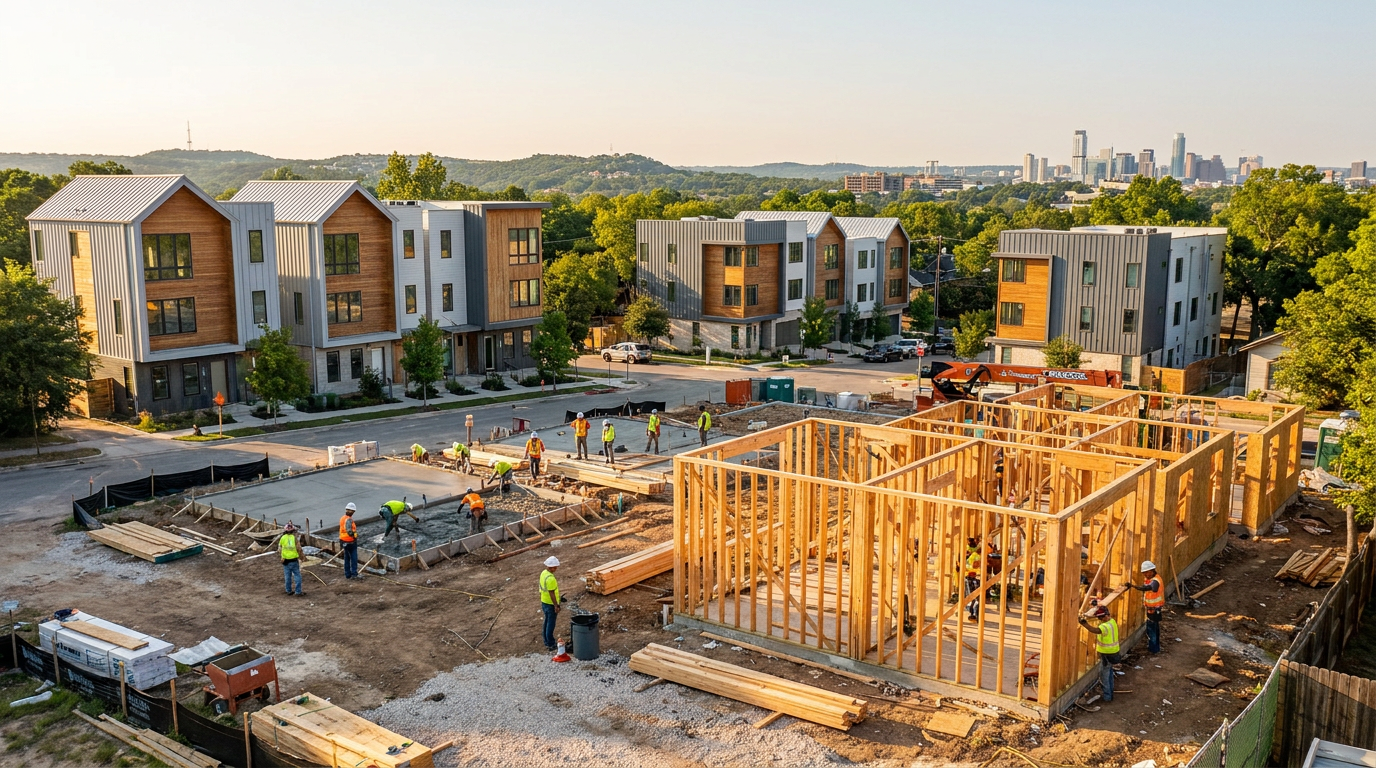
- Housing Economists
- Focus on the empirical data and the mechanisms of market expectations and filtering.
- Supply-Side Advocates
- Argue that removing regulatory barriers is the primary solution to the housing affordability crisis.
- Policy Analysts
- Synthesize the data to provide actionable blueprints for municipal governments.
What's not represented
- · Low-Income Housing Developers
- · Suburban Commuters
Why this matters
For years, the debate over housing affordability relied on competing theories. Now, hard data from major cities proves that changing local zoning laws to allow more construction directly stabilizes rents, offering a proven blueprint for solving the global housing crisis.
Key points
- Austin, Texas added 120,000 new homes between 2015 and 2024, leading to a 16% drop in median rent by early 2026.
- Auckland's 2016 upzoning reform generated an estimated 43,500 additional housing permits, stabilizing rental costs compared to other New Zealand cities.
- Economic analysis of the Minneapolis 2040 Plan reveals that eliminating single-family zoning kept rents up to 34% lower than projected counterfactuals.
- Data confirms the 'filtering' effect, where new market-rate construction successfully lowers demand and prices for older, working-class apartments.
For decades, the debate over how to solve the global housing affordability crisis has been dominated by a simple, yet fiercely contested hypothesis: if cities make it legal to build more homes, the cost of living will go down. While the economic theory of supply and demand is straightforward, housing markets are notoriously complex, leading skeptics to argue that new construction only induces demand or exclusively benefits wealthy developers.[6]
But in 2026, the debate is shifting from theoretical models to hard empirical evidence. A decade after a handful of pioneering cities enacted sweeping zoning reforms—stripping away restrictions that mandated single-family homes and large lot sizes—the data is finally maturing.[6]
The verdict is increasingly clear: upzoning works. By analyzing comprehensive datasets from Auckland, Austin, and Minneapolis, economists are documenting how regulatory reforms directly stimulate construction, alter market expectations, and ultimately drive down rents for everyday tenants.[1][3][5]

The most dramatic evidence of upzoning's capacity to physically transform a housing market comes from New Zealand. In 2016, facing a severe population boom and a chronic housing shortage, Auckland implemented a radical policy experiment, upzoning approximately three-quarters of its residential land to allow for medium- and high-density housing.[5]
The results were unprecedented. According to a landmark study published in the Journal of Urban Economics, the zoning reform approximately doubled the rate of new dwelling permits per capita within five years.[2]
Researchers utilizing a synthetic control method—comparing Auckland to a weighted average of similar, non-reformed cities—found that the policy generated an estimated 43,500 additional housing permits. This means that nearly half of all housing permits issued in Auckland since 2016 were directly attributable to the upzoning initiative.[2]

Crucially, this supply surge translated into price stabilization. While housing in Auckland remains expensive, rental price growth decelerated significantly relative to other major New Zealand cities. Between 2016 and 2023, rents in Auckland rose by roughly 20%, while other regional centers experienced substantially higher growth, proving that supply constraints had been a primary driver of the city's affordability crisis.[5]
Crucially, this supply surge translated into price stabilization.
While Auckland proves that upzoning stimulates construction, the American city of Austin, Texas, demonstrates how a massive supply surge can actively drive down nominal rents. During the 2010s, Austin was a victim of its own economic success; lured by high-tech jobs, the population exploded, and rents skyrocketed by nearly 93% between 2010 and 2019.[1][4]
In response, Austin policymakers initiated a sustained campaign to remove regulatory barriers. Beginning in 2015, the city implemented targeted rezoning for large apartment buildings near transit, reduced parking minimums, and cut restrictions on accessory dwelling units (ADUs). More recently, Austin enacted a 'single-stair' rule for buildings up to five stories, drastically reducing construction costs for mid-sized infill projects.[1][4]
The cumulative effect of these reforms was a historic construction boom. From 2015 to 2024, Austin added 120,000 units to its housing stock—a 30% increase that outpaced the national growth rate by more than a factor of three.[1][4]
As the new supply hit the market, prices plummeted. According to data compiled by The Pew Charitable Trusts, Austin's median rent fell from a peak of $1,546 in December 2021 to $1,296 by January 2026. In inflation-adjusted terms, city rents fell by an astonishing 19% over that four-year period.[1]

Skeptics of upzoning often argue that building luxury apartments does nothing for lower-income residents. However, the Austin data illustrates the economic concept of 'filtering.' As higher-income renters moved into the new, market-rate developments, demand for older units evaporated. Consequently, rents in older, non-luxury buildings—often referred to as Class C apartments—fell by approximately 11%, providing immediate financial relief to working-class tenants.[1][4]
Even in cities where zoning reform does not trigger an immediate, massive construction boom, the policy can still successfully stabilize prices by altering market expectations. In December 2018, Minneapolis became the first major U.S. city to eliminate single-family zoning citywide through its 2040 Plan.[3]
A 2025 economic analysis of the Minneapolis 2040 Plan utilized a synthetic control model to compare the city against 83 similar metropolitan areas. The researchers found that while the reform did not immediately flood the market with new units, it fundamentally shifted the trajectory of housing costs. Over the subsequent five years, rents in Minneapolis were 17.5% to 34% lower than they would have been in a counterfactual scenario without the reform.[3]

Economists suggest that by legally allowing more density, Minneapolis softened speculative housing demand. Investors and landlords adjusted their pricing strategies based on the expectation that future supply could easily be brought online if prices rose too high, effectively capping rent growth.[3][6]
While zoning reform is not a panacea—policymakers emphasize that direct subsidies remain necessary to house extremely low-income populations—the empirical evidence from 2026 is definitive. By dismantling the regulatory barriers that make it illegal to build, cities can successfully unlock housing supply, halt runaway inflation, and restore accessibility to the housing market.[1][6]
How we got here
2016
Auckland upzones approximately 75% of its residential land to allow for medium- and high-density housing.
Dec 2018
Minneapolis passes the 2040 Plan, becoming the first major U.S. city to eliminate single-family zoning.
Dec 2021
Austin's median rent peaks at $1,546 following a decade of explosive population growth.
Jan 2026
Austin's median rent falls to $1,296 following a massive, reform-driven surge in housing construction.
Viewpoints in depth
Supply-Side Advocates
Argue that removing regulatory barriers is the primary solution to the housing affordability crisis.
Pro-housing advocates, often associated with the YIMBY (Yes In My Back Yard) movement, point to Austin and Auckland as definitive proof that supply constraints are artificial. They argue that outdated zoning laws, parking minimums, and complex permitting processes serve only to protect incumbent homeowners' property values at the expense of renters. By legalizing diverse housing types like ADUs and mid-rise apartments, they believe cities can build their way out of the affordability crisis.
Housing Economists
Focus on the empirical data and the mechanisms of market expectations and filtering.
Academic researchers emphasize the nuanced mechanisms behind upzoning. They note that while immediate construction booms (as seen in Austin) directly lower rents through 'filtering,' reforms can also work by altering market psychology. As demonstrated in Minneapolis, simply making it legal to build more housing can soften speculative demand and cap rent growth, even if physical construction lags due to macroeconomic factors like high interest rates.
Neighborhood Preservationists
Express concern over the loss of local control and the potential for gentrification.
While not represented in the cited economic studies, local resistance groups frequently argue against upzoning. They contend that blanket zoning reforms strip communities of their ability to manage neighborhood character and infrastructure strain. Furthermore, some skeptics argue that without strict affordability mandates, developers will only build luxury units, potentially accelerating gentrification and displacing long-term, lower-income residents before the benefits of filtering can materialize.
What we don't know
- How long the rent-stabilization effects will last if construction costs and interest rates remain elevated.
- Whether smaller, mid-sized cities will see the same dramatic price drops as high-growth tech hubs like Austin.
Key terms
- Upzoning
- Changing local zoning codes to allow for higher-density development, such as duplexes or apartment buildings, on land previously restricted to single-family homes.
- Synthetic control
- A statistical method used by economists to evaluate policy impacts by comparing a treated city to a weighted average of similar, untreated cities.
- Missing middle housing
- House-scale buildings with multiple units—such as duplexes, fourplexes, and townhomes—that bridge the gap between single-family homes and large apartment blocks.
- Filtering
- The process by which new, market-rate housing construction frees up older, more affordable units as higher-income renters move into the new buildings.
Frequently asked
Does building luxury apartments lower rent for everyone?
Yes. Evidence from Austin shows that as high-income renters move into new market-rate buildings, demand for older apartments drops, causing rents in older, non-luxury buildings to fall by roughly 11%.
Did Minneapolis experience a massive construction boom?
Not exactly. While construction increased slightly, economists found that the zoning reform primarily softened housing demand by altering market expectations, which still resulted in significantly lower rents compared to similar cities.
Can zoning reform solve the housing crisis on its own?
No. While upzoning stabilizes market rates and lowers costs for the middle class, researchers note that direct subsidies are still required to build housing for extremely low-income households.
Sources
Source coverage
6 outlets
3 viewpoints surfaced





[1]The Pew Charitable TrustsSupply-Side Advocates
Austin's Surge of New Housing Construction Drove Down Rents
Read on The Pew Charitable Trusts →[2]Journal of Urban EconomicsHousing Economists
The impact of upzoning on housing construction in Auckland
Read on Journal of Urban Economics →[3]SSRNHousing Economists
Zoning Reforms and Housing Affordability: Evidence from the Minneapolis 2040 Plan
Read on SSRN →[4]Smart Cities DiveSupply-Side Advocates
How housing policy reform drove down rents in Austin, Texas
Read on Smart Cities Dive →[5]Royal Society Te ApārangiHousing Economists
Auckland's upzoning experiment: housing supply outstrips demand
Read on Royal Society Te Apārangi →[6]Factlen Editorial TeamPolicy Analysts
Synthesis by Factlen editorial team
Read on Factlen Editorial Team →
Every angle. Every day.
Get real estate stories with full source coverage and perspective breakdowns delivered to your inbox.