
The Rise of Local Open-Source AI: Running Powerful Models on Your Own Hardware
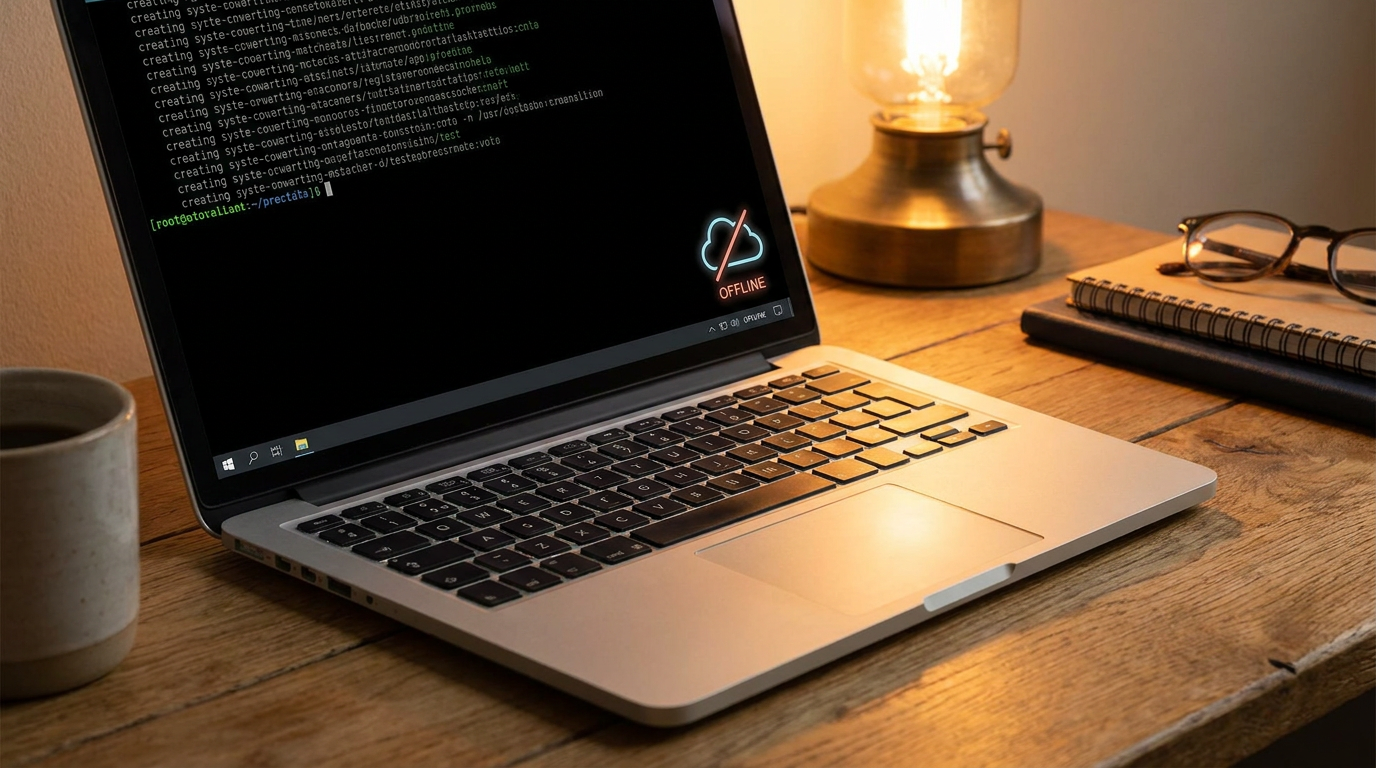
Open-source language models have become efficient enough to run entirely offline on consumer laptops, offering a private, free, and highly capable alternative to cloud-based AI.
By Factlen Editorial Team
- Open-Source Developers
- Values the freedom to tinker, build, and run models without API costs or vendor lock-in.
- Privacy & Enterprise IT
- Focuses on data sovereignty, regulatory compliance, and protecting sensitive corporate information.
- Neutral Analysts
- Evaluates the broader ecosystem, balancing the benefits of local AI with the sheer power of cloud models.
What's not represented
- · Hardware manufacturers balancing battery life with AI compute demands
- · Everyday consumers who find command-line tools too complex
Why this matters
By running AI models locally, users and enterprises eliminate API costs, ensure absolute data privacy, and gain the ability to work entirely offline. This shift democratizes access to artificial intelligence, moving control from centralized cloud providers directly to the user's desktop.
Key points
- Open-source AI models can now run entirely offline on consumer laptops, ensuring absolute data privacy.
- Quantization techniques compress massive neural networks to fit within the standard RAM of mid-range computers.
- Tools like Ollama and LM Studio have eliminated the need for complex command-line setups.
- Local inference carries zero API costs, making it ideal for heavy users and automated agentic workflows.
- While highly capable, local models are constrained by hardware memory limits and cannot match frontier cloud models in massive context processing.
For the first two years of the generative AI boom, interacting with a powerful language model meant renting time on someone else's supercomputer. Users typed prompts into a browser, and the data was sent to massive server farms owned by tech giants. But in 2026, a quiet revolution has inverted that dynamic. Open-source artificial intelligence has become efficient enough to run entirely offline on consumer laptops, shifting power from centralized cloud providers directly to the user's desktop.[7]
This transition from cloud-only to local execution is not merely a hobbyist curiosity; it has matured into a legitimate production strategy. Industry data indicates that over 40% of enterprise AI workloads now incorporate a local inference component, driven by a 320% year-over-year increase in downloads for compressed model weights. For many developers, writers, and researchers, the default workflow no longer involves a paid API key, but rather a locally hosted model that operates with zero latency and absolute privacy.[1][4]
The foundation of this shift lies in a technique called quantization, popularized by the open-source project llama.cpp. In their raw state, large language models (LLMs) are massive files; a standard 70-billion parameter model might require over 140 gigabytes of memory to run, placing it far beyond the reach of standard consumer hardware. Quantization solves this by mathematically compressing the model's neural weights—often reducing their precision from 16-bit to 4-bit formats—trading a barely perceptible fraction of accuracy for a massive reduction in file size.[3][6]
This compression is standardized through the GGUF file format, which has become the universal language of local AI. Thanks to GGUF, a highly capable 8-billion parameter model can now be squeezed into just 5 to 8 gigabytes of space. This means the "brain" of the AI can comfortably load into the standard RAM of a mid-range laptop, allowing the computer's CPU or integrated graphics to generate text without crashing the system.[3][6]

While llama.cpp provides the raw engine, a new ecosystem of user-friendly runtimes has made the technology accessible to non-programmers. The most prominent of these is Ollama, a lightweight application that functions like a package manager for AI. With a single terminal command, users can download and run models from Meta, Google, Mistral, and Alibaba. Ollama operates quietly in the background, exposing a local server that seamlessly connects to coding environments, chat interfaces, and automation tools.[1][3][4]
For users who prefer a graphical interface over the command line, tools like LM Studio have emerged as the iTunes of local AI. LM Studio provides a visual marketplace where users can search for models, check hardware compatibility, and chat with the AI in a familiar, multi-tabbed window. These applications abstract away the complex command-line arguments, allowing anyone to experiment with different models by simply clicking "download" and "chat."[3][6]
The hardware landscape has also evolved to meet the demands of local inference, with Apple Silicon emerging as a particularly powerful platform. Unlike traditional PC architectures that separate system RAM from graphics memory (VRAM), Apple's M-series chips utilize a "unified memory" architecture. This allows the CPU and GPU to share the exact same pool of memory without the latency of transferring data back and forth.[5]
To capitalize on this, Apple introduced the MLX framework, an open-source machine learning library specifically optimized for Apple Silicon. In early 2026, Ollama deeply integrated MLX into its runtime, resulting in massive speedups for Mac users. By plugging directly into the unified memory architecture, local models on Apple hardware now exhibit significantly faster "time to first token" and generation speeds, making local AI feel as responsive as cloud-based alternatives.[3][5]
To capitalize on this, Apple introduced the MLX framework, an open-source machine learning library specifically optimized for Apple Silicon.
On the PC side, the NVIDIA RTX 4090 has become the benchmark consumer GPU for local AI enthusiasts. With 24 gigabytes of dedicated VRAM, it can comfortably run larger 27-billion to 32-billion parameter models at high speeds. However, even entry-level machines with 8 to 16 gigabytes of standard RAM can run smaller, highly optimized models, democratizing access to AI capabilities that were previously gatekept by expensive hardware.[1][6]

The models themselves have seen a dramatic leap in quality. In 2026, the open-weight ecosystem is dominated by highly efficient models like Meta's Llama 4, Google's Gemma 4, and Alibaba's Qwen 3.5. These models are not just chatbots; they are capable reasoning engines. Smaller variants, such as the 4-billion to 9-billion parameter models, excel at drafting text, summarizing documents, and answering questions, while larger variants rival proprietary models in complex coding and mathematical tasks.[1][2]
The primary driver behind the adoption of local AI is not just cost savings, but absolute data privacy. When a user queries a cloud-based model like ChatGPT or Claude, their prompt—which may contain proprietary code, sensitive patient notes, or confidential legal contracts—is transmitted to external servers. Local AI fundamentally alters this dynamic: the model runs entirely offline, and the data never leaves the device.[4][6]
This architectural privacy is becoming increasingly critical in the corporate sector. The European Union's AI Act, which entered full enforcement in early 2026, places strict requirements on organizations to document data flows and maintain audit trails for AI processing. Running models locally simplifies compliance dramatically, as companies retain complete control over the model version, the input data, and the output generation, without relying on third-party vendor promises.[1]
Furthermore, local AI offers a distinct advantage in reliability and cost. Cloud APIs charge per token, meaning that heavy users or automated agentic workflows can quickly rack up substantial bills. Local inference, by contrast, has zero marginal cost; once the hardware is purchased and the model is downloaded, generating ten words costs the same as generating ten million. It also functions perfectly in air-gapped environments, on airplanes, or during internet outages.[4][6]

Despite these advantages, the local AI ecosystem still faces significant limitations. The most pressing constraint is the context window—the amount of text the model can "remember" in a single session. While cloud models can process entire books simultaneously, local models are strictly bound by the user's available RAM. Pushing a local model to read a massive document often results in out-of-memory errors or severe slowdowns.[3]
Additionally, local models on consumer hardware struggle with batching. While a cloud server can process hundreds of user requests simultaneously, tools like Ollama are generally optimized for a single user, processing one request at a time. This makes consumer-grade local AI perfect as a personal assistant, but insufficient for hosting a service for multiple concurrent users without upgrading to enterprise-grade inference servers.[3]
Battery consumption is another practical reality. Running a neural network at full capacity pushes the CPU and GPU to their limits, rapidly draining laptop batteries and generating significant heat. Users relying on local AI for continuous, background agentic tasks often find themselves tethered to a power outlet, mitigating some of the portability benefits of running models on a laptop.[7]

Finally, there is an inherent ceiling to what compressed models can achieve. While a 4-bit quantized 8-billion parameter model is astonishingly capable for everyday tasks, it cannot match the deep reasoning, broad world knowledge, or creative nuance of a trillion-parameter frontier model running in a data center. For the most complex, cutting-edge problems, cloud AI remains the undisputed champion.[4]
Nevertheless, the gap between cloud and local AI has narrowed to a point where the distinction no longer matters for the vast majority of daily tasks. By combining efficient open-weight models, quantization techniques, and optimized runtimes, the open-source community has successfully decentralized artificial intelligence. For millions of users, the most trusted AI is no longer a service they subscribe to, but a file they own and run on their own machine.[1][4][7]
How we got here
Early 2023
Meta leaks the original LLaMA model weights, sparking the open-source AI movement.
Late 2023
The release of llama.cpp and the GGUF format makes it possible to run compressed models on standard CPUs.
Mid 2024
Tools like Ollama and LM Studio launch, providing user-friendly interfaces for local AI deployment.
Early 2025
Open-weight models like Llama 3 and Qwen 2 achieve parity with early proprietary cloud models.
Early 2026
The EU AI Act enters full enforcement, accelerating enterprise adoption of local, privacy-first AI solutions.
March 2026
Apple's MLX framework is deeply integrated into local runtimes, unlocking massive speedups for Apple Silicon users.
Viewpoints in depth
Privacy Advocates & Enterprise IT
Focuses on data sovereignty and compliance as the primary drivers for local AI adoption.
For corporate IT departments and privacy advocates, the appeal of local AI has little to do with cost and everything to do with control. Sending proprietary code, patient records, or unannounced financial data to a third-party cloud provider introduces unacceptable security risks and complicates compliance with frameworks like the EU AI Act. By running models entirely offline, enterprises guarantee that their data never leaves their hardware, effectively neutralizing the risk of third-party data breaches or unauthorized model training.
Open-Source Developers
Champions the democratization of AI and the elimination of API gatekeepers.
The open-source community views local inference as a fundamental shift in software ownership. Developers argue that relying on cloud APIs creates vendor lock-in and stifles innovation due to rate limits and per-token costs. By downloading open-weight models and running them via tools like Ollama, developers gain the freedom to fine-tune models, build autonomous agents, and experiment endlessly without watching a meter tick up. This camp prioritizes flexibility, offline capability, and the democratization of compute power.
Cloud AI Providers
Argues that local AI is a complementary tool, but not a replacement for frontier cloud models.
Proponents of centralized cloud AI acknowledge the utility of local models for basic drafting and privacy-sensitive tasks, but emphasize the hard physical limits of consumer hardware. They argue that the most advanced reasoning, massive context windows, and multi-agent orchestrations require the massive memory and compute clusters found only in data centers. In this view, local AI serves as a lightweight daily assistant, while the cloud remains the necessary engine for heavy-duty, cutting-edge artificial intelligence.
What we don't know
- Whether future frontier models will become too massive to ever be effectively compressed for consumer hardware.
- How hardware manufacturers will alter future laptop architectures specifically to accommodate local AI workloads.
- The long-term impact of extreme quantization on the subtle reasoning capabilities of large language models.
Key terms
- Quantization
- A mathematical compression technique that reduces the file size and memory requirements of an AI model by lowering the precision of its neural weights.
- GGUF
- A standardized file format designed specifically for running quantized AI models efficiently on consumer hardware.
- Inference
- The process of running live data through a trained AI model to generate an output or prediction.
- Unified Memory
- A hardware architecture (used in Apple Silicon) where the CPU and GPU share the exact same pool of memory, eliminating data transfer delays.
- Open-weight model
- An AI model where the underlying neural network weights are publicly available for anyone to download, run, and modify.
- Context window
- The maximum amount of text or data an AI model can process and "remember" at one time during a single session.
Frequently asked
Can I run these models completely offline?
Yes. Once the model file and the runtime software (like Ollama) are downloaded, the AI runs entirely on your device's hardware without needing any internet connection.
Is a local AI as smart as ChatGPT?
For everyday tasks like drafting emails, summarizing text, and basic coding, top open-source models are highly competitive. However, for the most complex reasoning and massive document analysis, frontier cloud models still hold an advantage.
Will running an AI model damage my laptop?
No, but it is highly computationally intensive. Running a model will cause your computer's fans to spin up, generate heat, and drain the battery significantly faster than normal web browsing.
Do I need an expensive graphics card to run local AI?
Not necessarily. While a dedicated GPU (like an NVIDIA RTX) or Apple Silicon makes generation much faster, smaller quantized models can run successfully on a standard modern CPU with 8 to 16 gigabytes of RAM.
Sources
Source coverage
7 outlets
3 viewpoints surfaced







[1]AI MagicxPrivacy & Enterprise IT
Local AI in 2026: The Best Models to Run on Your Own Hardware
Read on AI Magicx →[2]Hugging FaceOpen-Source Developers
Best Open-Source LLMs in 2026
Read on Hugging Face →[3]MindStudioOpen-Source Developers
The Local AI Stack: Ollama, MLX, and llama.cpp
Read on MindStudio →[4]MemXPrivacy & Enterprise IT
Run an LLM locally with Ollama so your data stays offline
Read on MemX →[5]Markus SchallOpen-Source Developers
Integration of MLX: Local AI as the new standard
Read on Markus Schall →[6]TecholyzePrivacy & Enterprise IT
Run Open-Source LLMs Offline in 2025 — Private, Fast & Free
Read on Techolyze →[7]Factlen Editorial TeamNeutral Analysts
Synthesis by Factlen editorial team
Read on Factlen Editorial Team →

Every angle. Every day.
Get ai stories with full source coverage and perspective breakdowns delivered to your inbox.