
The Rise of Astrotourism: How the Search for Dark Skies is Reshaping Global Travel
As light pollution obscures the stars for the vast majority of the global population, travelers are driving a multi-billion-dollar boom in astrotourism to experience pristine night skies.
By Factlen Editorial Team
- Conservationists & Astronomers
- Focus on the ecological and scientific necessity of dark skies, viewing astrotourism primarily as a vehicle for funding conservation.
- Hospitality & Tourism Industry
- View the night sky as a premium, highly marketable asset that differentiates properties and drives significant revenue.
- Local Communities
- Balance the economic windfall of astrotourism with the burden of enforcing strict lighting ordinances and managing visitor traffic.
What's not represented
- · Indigenous communities whose cultural heritage is tied to the stars
- · Lighting manufacturers tasked with designing dark-sky compliant fixtures
Why this matters
As light pollution erases the stars for 83% of the global population, the booming astrotourism industry is proving that preserving natural darkness isn't just an ecological necessity—it's a multi-billion-dollar economic engine. This shift offers a rare, replicable model where environmental conservation directly drives local prosperity.
Key points
- Astrotourism has evolved into a $1.18 billion global market, driven by travelers seeking pristine night skies.
- Approximately 83% of the global population now lives under skies obscured by artificial light pollution.
- DarkSky International recently certified its 250th protected location, requiring strict lighting ordinances and community education.
- The trend provides massive economic incentives for rural communities to actively reduce light pollution.
- Protecting natural darkness is critical for the survival of the 70% of mammal species that are nocturnal.
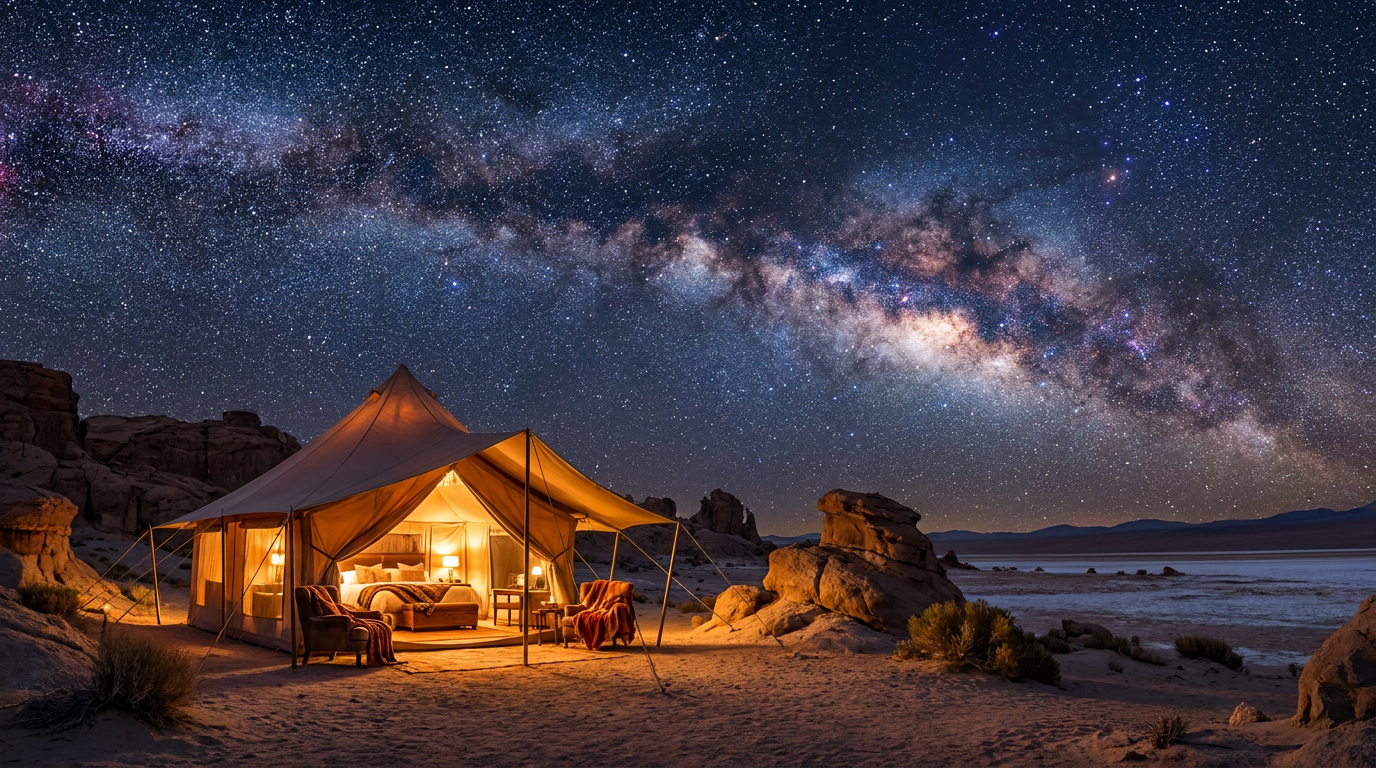
In 2026, luxury hotels and remote lodges are no longer just selling ocean views, infinity pools, or spa treatments; they are increasingly selling darkness. Astrotourism—a specialized form of travel focused on stargazing, astronomy education, and experiencing pristine night skies—has evolved from a niche hobby for amateur astronomers into a multi-billion-dollar global travel trend. Properties from the Atacama Desert in Chile to the remote highlands of Iceland are bringing in resident astronomers, constructing private observatories, and installing glass ceilings over beds so guests can sleep under the Milky Way. The night sky has quietly become one of the most sought-after and highly marketable features in the modern hospitality industry.[1][2]
The driving force behind this massive shift in consumer travel behavior is a profound, collective sense of loss. As urbanization expands, true darkness is rapidly becoming an endangered resource. Today, approximately 83 percent of the global population lives under skies obscured by artificial light. The statistics are even more stark in developed nations; for roughly 80 percent of North Americans and 99 percent of people in the United States and Europe, the Milky Way is entirely invisible from their homes. What was once a universal human experience—looking up at a star-filled cosmos—has become a luxury that requires a passport and a plane ticket.[2][7]
Travelers are responding to this loss by actively seeking out the world's remaining dark pockets. Recent industry data indicates that 62 percent of travelers are now prioritizing darker-sky destinations and "noctourism" experiences when planning their vacations. This surge in interest is not limited to hardcore astronomy enthusiasts equipped with expensive telescopes; it is largely driven by everyday travelers seeking mindfulness, quiet, and a sense of perspective that only a vast, unpolluted night sky can provide.[1][2]
To understand the mechanics of the astrotourism boom, one must first understand the mechanics of the threat it seeks to escape: light pollution. Unlike chemical spills or plastic waste, light pollution is an ephemeral pollutant—it disappears the moment a switch is flipped—but its reach is incredibly vast. It primarily manifests as "skyglow," the ambient, orange-hued dome of diffuse light that hovers over urban centers and scatters through the atmosphere, washing out the stars for hundreds of miles in every direction.[5][8]

Beyond skyglow, light pollution is compounded by "glare," which is the direct, blinding light from unshielded fixtures, and "light trespass," where unwanted illumination spills into adjacent properties or natural habitats. Driven by the rapid global transition to cheap, bright LED lighting, these factors have caused the average night-sky brightness to increase by nearly 9.6 percent annually over the last decade. The sky is literally closing in, making the preservation of dark enclaves an urgent environmental priority.[1][5]
The severity of this atmospheric pollution is measured using the Bortle Scale, a nine-level numeric system developed by astronomers. A Level 9 represents a heavily polluted inner-city sky where only the moon and the brightest planets can pierce the glare. Conversely, a Level 1 denotes a pristine, naturally dark sky where the Milky Way is so brilliant it casts distinct shadows on the ground. The entire astrotourism industry is essentially built around the pursuit of Level 1 and Level 2 skies.[8]
The vanguard of protecting these pristine skies is DarkSky International, a recognized nonprofit organization that certifies locations actively mitigating light pollution. In late 2025, the organization celebrated a major conservation milestone: certifying its 250th International Dark Sky Place with the designation of the Lapalala Wilderness Nature Reserve in South Africa. These 250 locations collectively protect over 196,000 square kilometers of land across six continents.[4]
The certification process to become an International Dark Sky Place is notoriously rigorous. A destination cannot simply happen to be dark; it must prove a sustained, codified commitment to preserving that darkness. This involves retrofitting local municipal and commercial infrastructure with shielded, low-color-temperature lighting that directs illumination strictly downward. It also requires ongoing community education and the implementation of strict local lighting ordinances to prevent future degradation.[4][7]
The certification process to become an International Dark Sky Place is notoriously rigorous.
DarkSky categorizes these protected areas into distinct tiers based on their accessibility and fragility. "Dark Sky Parks" are typically accessible public lands, such as Utah's Arches National Park or California's Joshua Tree, which offer robust public astronomy programs. "Dark Sky Sanctuaries," by contrast, are the most remote and ecologically fragile locations on Earth—such as the island nation of Niue or New Zealand's Stewart Island—where conservation is the absolute priority over mass visitation.[4]
The economic incentives for regions to achieve and maintain these rigorous certifications are staggering. The global astrotourism market, valued at $1.18 billion in 2025, is projected to nearly triple, reaching $3.47 billion by 2034. This growth is driven by the fact that astrotourists tend to stay longer and spend more money than traditional day-trippers, as the core activity requires overnight lodging and specialized guided experiences.[2]

In the United States, the National Park Service has recognized night-sky dependent recreation as a massive economic engine for rural gateway communities. The Colorado Plateau, which boasts the highest concentration of certified dark skies in North America, expects astrotourists to spend $5.8 billion over the next decade. This influx of capital is projected to generate billions in higher wages and create thousands of new local jobs, transforming darkness into a highly lucrative natural resource.[3]
The hospitality sector is aggressively capitalizing on this influx. Properties in prime viewing areas are redesigning their entire guest experience around the nocturnal environment. Because stargazing offers a rare combination of high guest appeal and relatively low operational complexity—requiring little more than clear skies, comfortable seating, and a knowledgeable guide—it has become a highly profitable revenue stream that aligns perfectly with broader corporate sustainability goals.[1][2]
However, the benefits of dark sky preservation extend far beyond human economics and aesthetic wonder. Natural darkness is a critical, often overlooked component of global ecosystems. For billions of years, life on Earth evolved to a predictable rhythm of light and dark, and the sudden introduction of artificial light has thrown countless species into ecological chaos.[5][8]
Approximately 70 percent of all mammal species are nocturnal, relying on the cover of darkness to hunt, mate, and navigate. Artificial light disrupts these fundamental behaviors. Furthermore, skyglow can severely disorient migrating birds that navigate by the stars, drawing them away from their natural routes and into urban centers where they face exhaustion and fatal collisions with illuminated buildings. Protecting the dark sky is fundamentally an act of wildlife conservation.[3][5]

Human health is also intrinsically tied to the natural cycle of light and dark. Exposure to artificial light at night—particularly the blue-rich light emitted by modern LEDs and screens—disrupts the body's circadian rhythms and suppresses the production of melatonin. Public health researchers increasingly link this chronic disruption to a rise in sleep disorders, fatigue, and broader metabolic issues, making the pursuit of natural darkness a wellness imperative as much as a travel trend.[5][8]
Despite the clear ecological and economic benefits, the astrotourism industry faces a central, unavoidable paradox: the very act of bringing tourists to remote, dark locations threatens the fragile resource they came to see. As a destination grows in popularity, the demand for infrastructure inevitably follows, creating a tension between accessibility and preservation.[6][7]
Increased tourism necessitates new hotels, expanded roads, larger parking lots, and more restaurants—all of which require lighting for safety and navigation. If this development is not meticulously managed and strictly regulated, the resulting light pollution can quickly degrade a pristine Level 1 sky into a washed-out Level 3 or 4. This degradation not only harms the local ecosystem but can ultimately strip a destination of its Dark Sky certification, killing the very industry that drove the growth.[6]

Academic studies on community self-efficacy in emerging tourism destinations reveal that economic motivation alone is rarely sufficient to enforce strict lighting regulations over the long term. Successful, sustainable mitigation requires deep community buy-in. Residents and local businesses must share a collective understanding that the night sky is a fragile heritage that requires active, daily protection, rather than just a backdrop for tourist photos.[6]
Ultimately, the rapid rise of astrotourism represents a profound shift in how humanity values the night. By transforming darkness from a source of fear or an empty void into a protected, celebrated, and economically viable destination, the movement offers a rare blueprint for environmental conservation. It proves that with careful management, preserving the natural world can be just as lucrative as developing it, ensuring that future generations can still look up and see the stars.[8]
How we got here
2001
Flagstaff, Arizona becomes the world's first International Dark Sky City.
2007
Natural Bridges National Monument in Utah becomes the first certified Dark Sky Park.
2020
Niue becomes the first entire country to be designated a Dark Sky Sanctuary.
Late 2025
DarkSky International certifies its 250th protected place globally.
2026
Astrotourism emerges as a top global travel trend, driven by the solar maximum and a desire for pristine environments.
Viewpoints in depth
Conservationists & Astronomers
Focus on the ecological and scientific necessity of dark skies.
For this camp, light pollution is a critical environmental threat that disrupts nocturnal ecosystems and severs humanity's cultural connection to the cosmos. They view astrotourism primarily as a vehicle for funding conservation and raising global awareness. Their primary concern is that without strict, scientifically backed lighting ordinances, the very habitats that support nocturnal wildlife will be permanently degraded.
Hospitality & Tourism Industry
Focus on the commercial viability and marketability of the night sky.
The hospitality sector views darkness as a premium, highly marketable asset that differentiates properties and drives significant revenue. Their priority is creating immersive, luxury guest experiences—such as private observatories and guided stargazing—while maintaining just enough compliance to keep their dark-sky certifications. They argue that by monetizing the dark sky, they provide the financial incentive necessary to protect it.
Local Communities
Focus on the balance between economic growth and livability.
While rural gateway communities welcome the jobs and revenue generated by astrotourism, they are often burdened by the strict lighting ordinances required to maintain dark-sky status. Residents must navigate the infrastructural strain of increased visitor traffic while retrofitting their own homes and businesses to comply with low-glare, downward-facing lighting regulations. For them, astrotourism is a delicate balancing act between prosperity and preservation.
What we don't know
- Whether the economic incentives of astrotourism will be enough to convince rapidly growing urban centers to adopt dark-sky lighting ordinances.
- How the increasing deployment of low-earth orbit satellite mega-constellations will impact the viability of ground-based astrotourism.
- The long-term carrying capacity of fragile Dark Sky Sanctuaries before visitor infrastructure inevitably degrades the darkness.
Key terms
- Astrotourism
- A specialized form of travel focused on stargazing, astronomy education, and experiencing pristine night skies free from artificial light.
- Skyglow
- The ambient, diffuse dome of light that hovers over urban areas, caused by artificial light scattering in the atmosphere.
- Light Trespass
- Unwanted artificial light that spills over property lines into areas where it is not intended, such as a neighbor's window or a natural habitat.
- Circadian Rhythm
- The natural, internal 24-hour clock that regulates the sleep-wake cycle in humans and animals, heavily influenced by natural light and darkness.
- Bortle Scale
- A standardized nine-level scale used to quantify the darkness of the night sky and the interference of light pollution.
Frequently asked
What is the Bortle Scale?
A nine-level numeric scale used by astronomers to measure the brightness of the night sky. Level 1 represents the darkest, most pristine skies, while Level 9 represents heavily light-polluted inner-city skies.
What is the difference between a Dark Sky Park and a Sanctuary?
Dark Sky Parks are typically accessible public lands that offer dark skies and astronomy programs. Sanctuaries are the most remote, fragile, and darkest places on Earth, often with limited public access.
How does light pollution affect human health?
Exposure to artificial light at night, particularly blue light, disrupts the body's circadian rhythms and suppresses melatonin production, which researchers link to sleep disorders and metabolic issues.
Can I see the Milky Way from a city?
Generally, no. Due to skyglow and light clutter, the Milky Way is invisible to approximately 80 percent of North Americans and 99 percent of people living in the US and Europe.
Sources
Source coverage
8 outlets
3 viewpoints surfaced








[1]ForbesHospitality & Tourism Industry
The Rise Of Astrotourism: 25 Hotels Leading The Stargazing Trend
Read on Forbes →[2]Market InteloHospitality & Tourism Industry
Astro Tourism Market Research Report 2034
Read on Market Intelo →[3]National Park ServiceConservationists & Astronomers
Night Skies: An Economic Value
Read on National Park Service →[4]DarkSky InternationalConservationists & Astronomers
DarkSky International celebrates the certification of the 250th International Dark Sky Place
Read on DarkSky International →[5]MDPIConservationists & Astronomers
Light Pollution Beyond the Visible: Insights from People's Perspectives
Read on MDPI →[6]Taylor & FrancisLocal Communities
Exploring Community Self-efficacy to Light Pollution Mitigation in A Tourism Destination
Read on Taylor & Francis →[7]TWordHospitality & Tourism Industry
Astrotourism: The Fight Against Light Pollution
Read on TWord →[8]Factlen Editorial Team
Synthesis by Factlen editorial team
Read on Factlen Editorial Team →
Every angle. Every day.
Get travel stories with full source coverage and perspective breakdowns delivered to your inbox.