
The Heads-Up Pool: How Augmented Reality and Biometrics Are Rewriting Swimming Training
The integration of AR smart goggles and wearable sensors is transforming swimming from a sensory-deprived sport into a data-driven science, democratizing elite training tools for athletes at all levels.
By Factlen Editorial Team
- Data-Driven Athletes & Coaches
- Embrace AR and biometrics for precision training, threshold pacing, and biomechanical refinement.
- Governing Bodies
- Balance innovation with fair competition by allowing data collection for training but banning live AR displays during races.
- Traditionalists & Purists
- Warn against information overload and emphasize the importance of maintaining a natural 'feel' for the water.
What's not represented
- · Recreational Swimmers
- · Budget-Constrained Programs
Why this matters
For decades, swimming has relied on analog pace clocks and guesswork. The arrival of augmented reality and biometric wearables is democratizing elite-level training, allowing anyone from Olympians to fitness swimmers to optimize their technique, prevent injuries, and swim faster with real-time data.
Key points
- Augmented reality (AR) goggles project real-time metrics like pace and heart rate directly into a swimmer's field of view.
- New 2026 models have dropped to a $149 price point, making the technology accessible to everyday athletes.
- Temple-based optical sensors have solved the historical challenge of accurately tracking heart rate in the water.
- Wearable accelerometers are helping coaches optimize the 'fifth stroke' (underwater dolphin kick) by measuring velocity decay.
- World Aquatics bans AR displays during races, meaning athletes must rely on muscle memory built during tech-assisted training.
For decades, competitive swimming has been a sport defined by sensory deprivation. Athletes plunge their faces into the water, staring at a black line painted on the bottom of the pool for hours on end. The only feedback loop has traditionally been the analog pace clock mounted on the pool deck, requiring swimmers to break their rhythm, crane their necks, and do rapid mental math to calculate their split times. It was a system that demanded an innate, almost mystical 'feel' for the water, where pacing was largely a guessing game until the grueling set was finally over.[7]
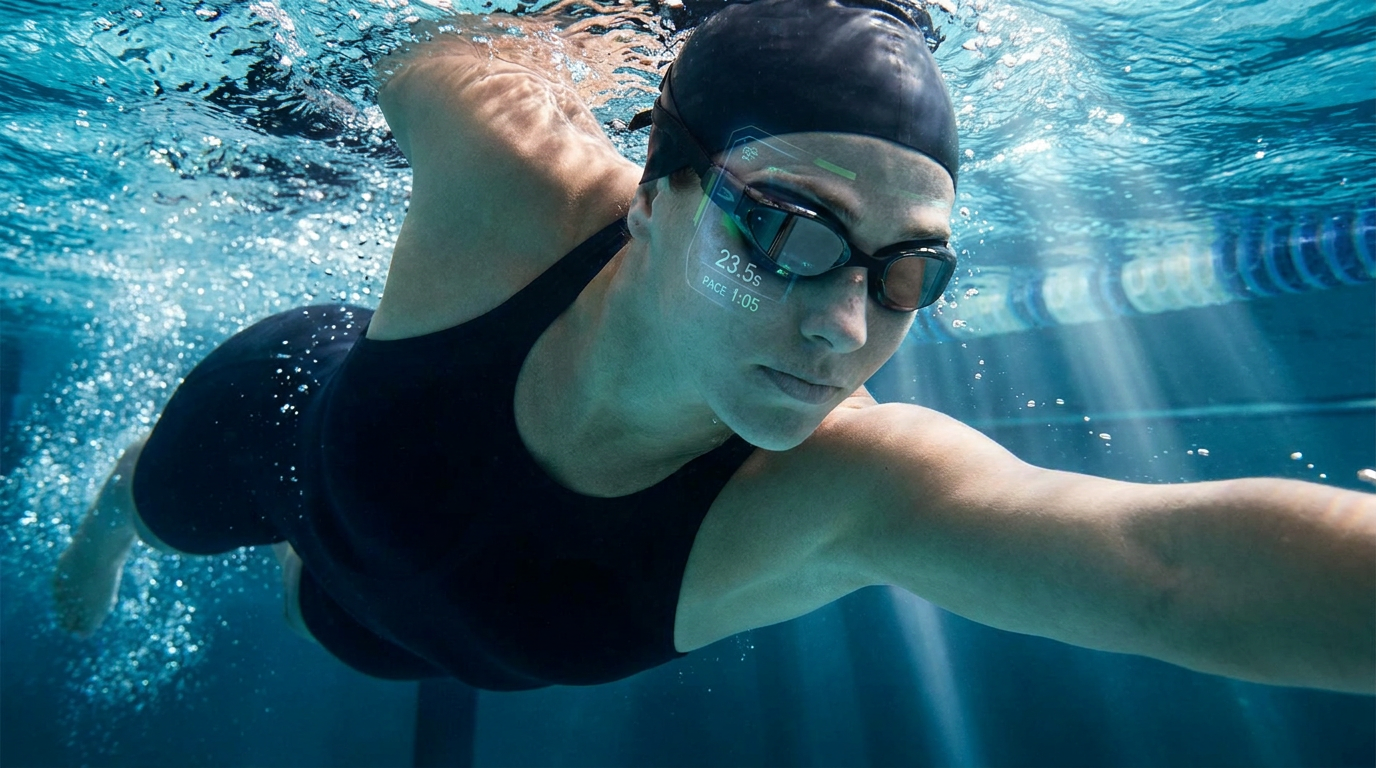
But the black line is no longer the only thing swimmers are looking at. The integration of augmented reality (AR) and advanced biometric sensors has transformed the swimming goggle from a simple piece of plastic into a sophisticated heads-up display. By projecting real-time data directly into the athlete's field of view, wearable technology is rewriting the biomechanics of pool training. Swimmers can now monitor their pace, stroke rate, and heart rate without ever missing a stroke, bringing the precision of a laboratory directly into the aquatic environment.[2][7]
The mechanism behind this revolution relies on AR waveguide technology. A miniaturized display, often no larger than a grain of rice, sits inside the goggle's casing. It projects light through a specialized lens that bends the image directly into the wearer's retina. The result is a crisp, glowing digital readout that appears to float in the water a few feet ahead of the swimmer. Because the display is entirely transparent, it does not obstruct the physical view of the pool, the approaching wall, or the competitors in the adjacent lanes.[6][7]
To generate the data, these smart goggles rely on a suite of onboard sensors. High-frequency accelerometers and gyroscopes track the precise movement of the swimmer's head in three-dimensional space. By analyzing these micro-movements, the onboard algorithms can instantly detect when a swimmer pushes off the wall, takes a breath, or executes a rapid flip turn. This allows the device to automatically count laps, calculate distance per stroke, and measure the exact duration of the underwater glide with a level of accuracy that a human coach with a stopwatch simply cannot match.[1][6]

Historically, the barrier to entry for this technology was steep, with early models priced as luxury items reserved for elite triathletes and well-funded Olympians. However, the landscape shifted significantly in the spring of 2026. Companies like FORM introduced streamlined models, such as the Smart Swim 2 LT, which brought the AR experience down to a highly accessible $149 price point. By stripping away some of the heavier onboard sensors while retaining the core waveguide display and lap-tracking algorithms, the technology has rapidly democratized, reaching age-group competitors, high school teams, and everyday fitness swimmers.[1][2]
Beyond pacing, the most significant breakthrough in aquatic wearables is the accurate measurement of exertion. Tracking heart rate in the water has always been a biomechanical nightmare for sports scientists. Traditional chest straps inevitably slip down the torso during explosive push-offs, and optical wrist monitors struggle to read through the constant flow of water and the intense flexing of the forearm muscles. The solution, engineered into premium smart goggles, is the use of temple-based optical sensors. These sensors bypass the turbulence of the extremities entirely, focusing on a highly stable pulse point.[1][5]
By pressing a sensor directly against the temporal artery—which sits just beneath the skin next to the eye—smart goggles can capture a highly accurate, uninterrupted pulse rate. For the first time, swimmers can execute 'threshold training' with the exact same precision as track runners or cyclists. If a coach prescribes an endurance set at 160 beats per minute, the swimmer can watch their heart rate climb in real-time on their lens, adjusting their physical effort mid-lap to stay perfectly within the targeted physiological zone.[1]
For the first time, swimmers can execute 'threshold training' with the exact same precision as track runners or cyclists.
This real-time feedback loop is particularly crucial for mastering swimming's 'fifth stroke'—the underwater dolphin kick. Depending on the event, the underwater phase can account for 30 to 60 percent of a short-course race. It is the absolute fastest a swimmer will travel, capitalizing on the momentum of the dive or turn while operating beneath the surface drag. Yet, because it happens entirely underwater amidst a cloud of bubbles, it has historically been the hardest phase for coaches to analyze and correct from the pool deck.[4][7]

Modern biometric analysis has revealed that the optimal dolphin kick requires a narrow amplitude, typically between 120 and 155 degrees of knee flexion, driven entirely by the core rather than the legs. Wearable accelerometers can now measure the exact velocity decay during this crucial underwater phase. If a swimmer takes one too many dolphin kicks and begins to decelerate before breaking the surface, the data will instantly flag the inefficiency. Swimmers can use their AR displays to experiment with different breakout timings, instantly seeing which strategy yields the fastest split.[4]
The data revolution extends far beyond the controlled environment of the pool and into the unpredictable open water. Marathon swimming introduces chaotic variables: shifting currents, crashing waves, and extreme temperatures. In recent years, sports scientists have deployed ingestible electronic capsules that transmit core body temperature to external monitors. During events where water temperatures fluctuate wildly, these biometric pills have recorded internal body temperatures exceeding 105.8 degrees Fahrenheit. This invisible data stream allows medical teams to intervene before an athlete suffers catastrophic heatstroke or hypothermia.[3]
For open water navigation, AR goggles have introduced digital compasses that fundamentally change race strategy. 'SwimStraight' technologies project a live bearing onto the lens, allowing triathletes to lock onto a distant buoy and maintain a perfectly straight line through choppy water. By eliminating the need to constantly lift their heads to 'sight' their target—a disruptive movement that drops the hips and creates massive hydrodynamic drag—swimmers conserve significant energy over a multi-kilometer race. This navigational aid can shave minutes off a long-distance swim simply by preventing athletes from zigzagging off course.[6]
Despite the clear training advantages, the sport's governing bodies have drawn a hard line on race day. World Aquatics, the international federation for water sports, strictly prohibits the use of any technology that transmits live data to the athlete during a competition. While they have recently updated their rules to allow certain biometric sensors—like GPS trackers and heart rate monitors—to be worn for post-race analysis, devices acting as 'receivers,' such as AR goggles, remain universally banned in official pool races.[3]

This regulatory stance ensures that competitive racing remains a pure test of human instinct and tactical awareness, rather than a robotic execution of a computer algorithm. However, it creates a fascinating dichotomy for the modern athlete: they train in a hyper-quantified, augmented reality, but must strip away their digital dashboards when they step onto the starting block. They must internalize the pacing and technique they learned from the screen, relying entirely on muscle memory when the medals are on the line.[7]
There is also a growing philosophical debate within the swimming community about the psychological cost of constant quantification. Sports psychologists and veteran coaches warn of 'information overload.' When every stroke, breath, and heartbeat is measured and projected directly into the eye, athletes can become overly fixated on the metrics. A study from the University of Copenhagen highlighted that excessive reliance on fitness data can increase anxiety and lead to obsessive behaviors in endurance athletes, potentially stripping the joy out of the sport.[5]
The most successful programs in 2026 are finding a healthy middle ground. Coaches are treating AR goggles and wearable sensors as diagnostic tools rather than permanent fixtures. They use the technology for specific 'test sets' to dial in pacing and technique, but regularly mandate 'blind' swims where athletes must rely entirely on their internal metronome. The goal is not to replace the swimmer's natural feel for the water, but to calibrate it with unprecedented precision. By balancing data with intuition, athletes can harness the benefits of biomechanical tracking without becoming dependent on a screen.[5][7]

As the technology continues to shrink in size and drop in price, the connected pool is undeniably becoming the new standard. The black line on the bottom of the pool will always be there, but it is no longer the only guide. By merging fluid dynamics with augmented reality, swimming has finally entered the data age, allowing athletes of all levels to see exactly what it takes to move faster, train smarter, and unlock their full potential in the water.[7]
How we got here
2019
The first generation of AR smart swim goggles is launched, introducing real-time metrics to the pool.
2023
World Triathlon approves the use of smart goggles in official races, diverging from pool swimming rules.
2025
World Aquatics updates rules to allow certain biometric sensors, like ingestible thermometers, in marathon swimming for safety.
May 2026
Next-generation AR goggles launch at mainstream price points, democratizing access to elite training tools.
Viewpoints in depth
Data-Driven Athletes & Coaches
Advocates for using AR and biometrics to achieve unprecedented precision in training.
For data-driven programs, the pool has become a laboratory. Coaches argue that AR goggles eliminate the guesswork from pacing and allow for true threshold training, where athletes can hold a specific heart rate zone without stopping to check a clock. By analyzing the velocity decay of the underwater dolphin kick, they can optimize breakout timings down to the hundredth of a second, finding free speed that was previously invisible to the naked eye.
Traditionalists & Purists
Warns against the psychological toll of constant quantification and the loss of natural intuition.
Traditionalists caution that swimming is fundamentally a sensory sport, and that projecting a digital dashboard into an athlete's eye can lead to 'information overload.' Sports psychologists note that excessive reliance on real-time metrics can increase anxiety and strip the joy from the sport. Purists argue that athletes must learn to 'feel' the water and internalize their pacing, rather than becoming dependent on a screen that they won't be allowed to use on race day.
Governing Bodies
Focuses on balancing technological innovation with fair, unassisted competition.
Organizations like World Aquatics have embraced technology for safety and post-race analysis, allowing ingestible thermometers and GPS trackers in certain marathon events. However, they maintain a strict ban on 'receivers'—devices that transmit live data to the athlete during a race. This regulatory stance is designed to ensure that while training can be augmented by algorithms, the race itself remains a pure test of human instinct, tactical awareness, and physical endurance.
What we don't know
- Whether World Aquatics will eventually relax its ban on in-race AR displays for pool swimming.
- The long-term psychological impacts of constant data tracking on youth swimmers' development and burnout rates.
- How quickly the technology will miniaturize further, potentially moving from goggles to smart contact lenses.
Key terms
- AR Waveguide Display
- A technology that bends light to project digital information onto a transparent lens, allowing swimmers to see data without blocking their vision.
- Distance Per Stroke (DPS)
- A metric measuring how far a swimmer travels with each arm pull, used to gauge mechanical efficiency.
- Underwater Dolphin Kick
- The undulating, wave-like motion used off starts and turns, often referred to as swimming's 'fifth stroke.'
- Temple-Based Heart Rate
- Sensors that measure pulse through the temporal artery, providing accurate readings despite water flow and muscle flexion.
Frequently asked
Can swimmers wear smart goggles in official races?
No. World Aquatics bans devices that transmit live data to the swimmer during a race, though some biometric trackers are allowed for post-race analysis.
How do smart goggles track laps without GPS?
They use built-in accelerometers and gyroscopes to detect the distinct head movements associated with push-offs and flip turns.
Do smart goggles work for open water swimming?
Yes. Many models feature digital compasses for straight-line navigation or pair with GPS watches to display real-time distance.
How do the goggles measure heart rate in the water?
Premium models use optical sensors pressed against the temporal artery, bypassing the inaccuracies of wrist-based monitors in the pool.
Sources
Source coverage
7 outlets
3 viewpoints surfaced







[1]FORM SwimData-Driven Athletes & Coaches
Smart Swim 2 LT: The Simplest Way to Start
Read on FORM Swim →[2]Endurance SportswireData-Driven Athletes & Coaches
FORM announces the launch of Smart Swim 2 LT
Read on Endurance Sportswire →[3]Daily News of Open Water SwimmingGoverning Bodies
World Aquatics Allows Wearables
Read on Daily News of Open Water Swimming →[4]National Institutes of HealthGoverning Bodies
Wearable technology and biomechanical analysis in sports performance
Read on National Institutes of Health →[5]Swimming World MagazineTraditionalists & Purists
The Relationship Between Swimming and Wearable Technology
Read on Swimming World Magazine →[6]The 5k RunnerData-Driven Athletes & Coaches
FORM Smart Swim 2 LT Review
Read on The 5k Runner →[7]Factlen Editorial TeamGoverning Bodies
Synthesis by Factlen editorial team
Read on Factlen Editorial Team →

More in sports
See all 14 stories →Tactics
Spain's 2026 World Cup Tactical Evolution: How Luis de la Fuente Modernized La Roja
0 sources

Preview
USMNT 2026 World Cup Preview: Expectations, Tactics, and the Path to the Quarterfinals
0 sources

Roster
Trevoh Chalobah Receives Dramatic Late World Cup Call-Up for England
0 sources

Ski Mountaineering
The Anatomy of SkiMo: Inside the Olympics' Most Exhausting New Sport
0 sources

Every angle. Every day.
Get sports stories with full source coverage and perspective breakdowns delivered to your inbox.