
The Evidence Pack: How Empty Offices Are Becoming Affordable Housing in 2026
With over 90,000 units in the pipeline, adaptive reuse is transforming hollowed-out commercial districts into vibrant residential neighborhoods.
By Factlen Editorial Team
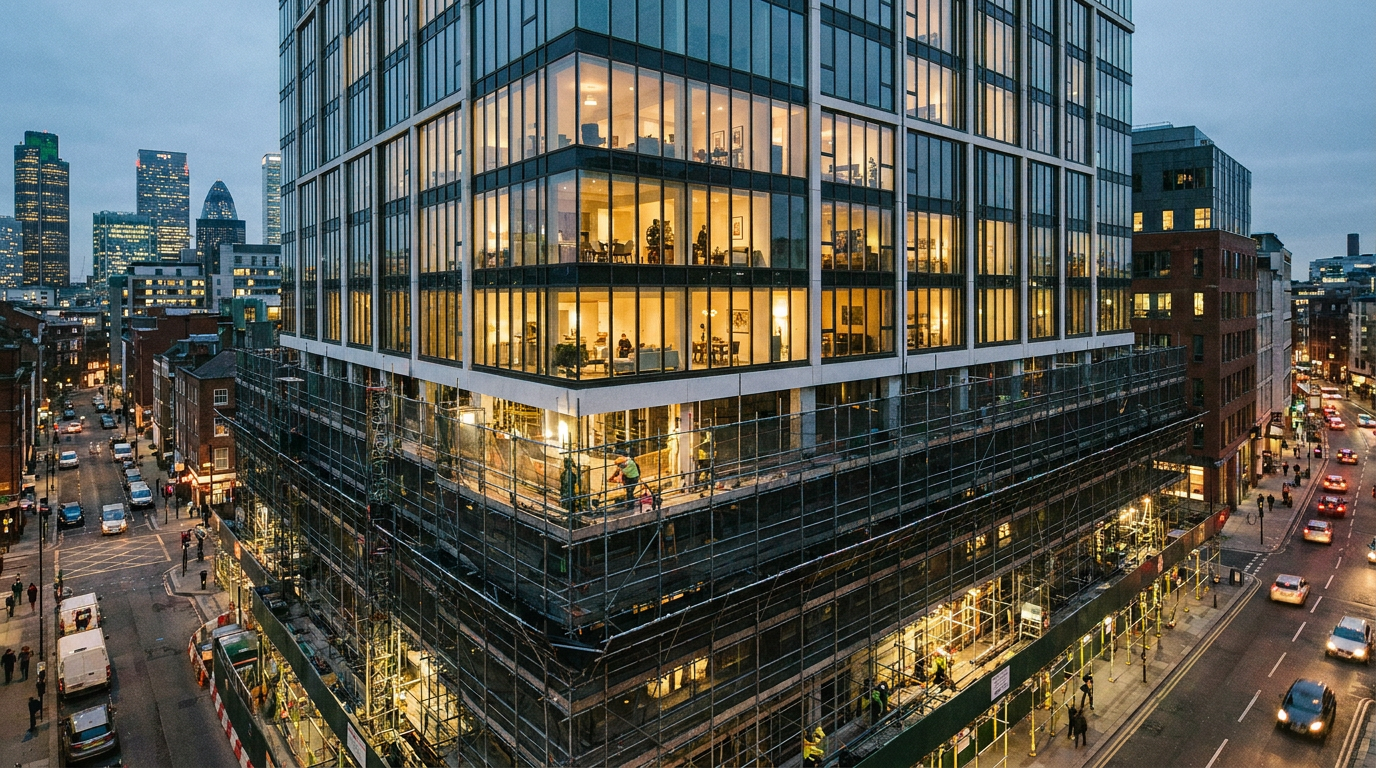
- Urban Planners & Policymakers
- City officials view conversions as a dual-purpose tool to rescue plummeting commercial tax revenues and inject life into hollowed-out downtowns.
- Real Estate Developers
- The private sector approaches conversions strictly through the lens of financial feasibility and structural risk.
- Environmental Advocates
- Sustainability experts champion adaptive reuse as a critical strategy for decarbonizing the built environment.
What's not represented
- · Current Office Tenants
- · Neighborhood Small Business Owners
Why this matters
As cities face a dual crisis of empty downtowns and severe housing shortages, office conversions offer a rare win-win. Understanding the economics and environmental benefits of this trend reveals how urban centers will evolve over the next decade.
Key points
- The U.S. office-to-residential conversion pipeline reached a record 90,300 units in early 2026.
- Only about 11% of existing office buildings possess the structural dimensions required for residential conversion.
- Adaptive reuse produces 50% to 75% fewer embodied carbon emissions than new construction.
- Converting offices to co-living spaces can cut per-unit development costs by more than half.
- Most projects still require local tax incentives or zoning reforms to achieve financial feasibility.
The shift to hybrid work has left downtowns across the United States grappling with hollowed-out commercial districts, while a severe housing shortage simultaneously prices millions out of the market. The seemingly obvious solution—turning empty desks into apartments—is finally moving from architectural theory to measurable reality in 2026.
According to early 2026 data from Yardi Matrix and RentCafe, the pipeline of office-to-residential conversions has surged to 90,300 units nationwide. This represents a 28% year-over-year increase and nearly four times the volume seen in 2022, signaling a structural shift in how developers view distressed commercial assets.[6]
CBRE Research corroborates this acceleration, tracking 81 million square feet of planned and active conversion projects across 44 U.S. markets. Yet, despite the record-breaking pace, the data reveals a complex reality: not every empty office can become a home, and the economics require a precise alignment of structural, financial, and regulatory factors.[3]

The most immediate constraint is physical suitability. A comprehensive assessment by the National Bureau of Economic Research (NBER) concluded that only about 11% of all office buildings nationwide possess the structural characteristics necessary for a viable residential conversion.[1]
The primary bottleneck is floorplate depth. Modern office buildings are often massive, windowless in the center, and structurally hostile to residential layouts, which require natural light and ventilation for every bedroom to meet standard building codes.[1][8]
However, older, pre-war buildings—often classified as Class B or C office space—feature narrower floorplates and operable windows, making them prime candidates. The National Association of Realtors found that Class B buildings account for 77% of successful housing conversions, as their layouts naturally lend themselves to apartment corridors.[7]
When a building is physically suitable, conversions offer substantial cost and time savings compared to new construction. A 2025 analysis by The Pew Charitable Trusts evaluated the economics of adaptive reuse, finding that converting an office into a co-living apartment costs roughly $240,000 per unit, compared to $500,000 for a newly built studio in high-cost markets like Los Angeles.[4]

When a building is physically suitable, conversions offer substantial cost and time savings compared to new construction.
Architecture firm Gensler identified a specific mechanism for these savings: utilizing existing centralized plumbing from office restrooms and kitchens, rather than routing new plumbing to every individual unit. This "flexible co-living" model reduces construction costs by 25% to 35% per square foot.[5]
Beyond capital expenditure, adaptive reuse drastically compresses development timelines. Developers and urban planners report that repurposing an existing structure can shave six to twelve months off a construction schedule by bypassing lengthy excavation and foundation phases.[8]
The environmental dividend of this approach is quantifiable and significant. The NBER study highlights that rehabilitating an existing building produces 50% to 75% fewer embodied carbon emissions than demolishing it and constructing a new residential tower.[1]
By preserving the concrete and steel superstructure—the most carbon-intensive components of any high-rise—cities can add residential density without the massive environmental toll typically associated with urban growth and suburban sprawl.[1][8]

Despite these advantages, financial feasibility remains fragile without public intervention. The math of acquiring a building, gutting it, and leasing it out does not always pencil out for private developers. The Brookings Institution, in a joint study with the Department of Housing and Urban Development, examined six major U.S. cities and found a persistent "feasibility gap."[2]
In markets where Class A apartment rents do not significantly outpace Class B office rents, developers struggle to secure financing. Brookings notes that successful conversions almost universally rely on local policy levers, such as tax abatements, historic preservation credits, or density bonuses, to bridge the gap between acquisition costs and projected returns.[2][7]
For instance, New York City's "City of Yes" zoning reforms and Washington D.C.'s "Office to Anything" program have catalyzed millions of square feet of conversions by removing regulatory friction and offering financial sweeteners to developers willing to take on the risk.[2][3]

A lingering uncertainty is whether this trend can meaningfully dent the national housing crisis. While the 90,300 units currently in the pipeline represent a historic high, they remain a fraction of the estimated 4.5 million home deficit in the United States.[6][8]
Furthermore, the Brookings study cautions that conversions are not a one-size-fits-all remedy. A strategy that revitalizes downtown Pittsburgh or Winston-Salem may not translate seamlessly to the sprawling, isolated office parks of suburban Houston or Dallas.[2]
Ultimately, the evidence suggests that office-to-residential conversions are a highly effective, environmentally sound tool for urban revitalization, rather than a silver bullet for national housing affordability. As the 2026 data shows, when the right building meets the right zoning and the right incentives, the transformation is both profitable and profoundly beneficial to the surrounding community.[8]
How we got here
2020–2021
The pandemic normalizes remote work, causing a historic plunge in downtown office occupancy.
2022–2023
Commercial property values begin to slide as long-term leases expire and companies downsize their footprints.
2024
Cities like New York and Washington D.C. introduce aggressive zoning reforms and tax incentives to spur adaptive reuse.
Early 2026
The national pipeline of office-to-residential conversions hits a record 90,300 units, proving the model's viability at scale.
Viewpoints in depth
Urban Planners & Policymakers
City officials view conversions as a dual-purpose tool to rescue plummeting commercial tax revenues and inject life into hollowed-out downtowns.
For municipal governments, the stakes of the "urban doom loop" are existential. Empty office buildings mean plummeting commercial property assessments, which directly threaten city budgets and public services. Planners argue that subsidizing conversions through tax abatements is not a handout to developers, but a necessary defensive measure to preserve the tax base. By replacing 9-to-5 commuters with 24/7 residents, cities hope to organically support ground-floor retail, increase transit ridership, and create safer, more vibrant neighborhoods that attract future investment.
Real Estate Developers
The private sector approaches conversions strictly through the lens of financial feasibility and structural risk.
Developers caution that adaptive reuse is often more complex than building from scratch. Unforeseen structural issues, the high cost of retrofitting HVAC systems, and the challenge of coring through decades-old concrete to install residential plumbing can quickly erase profit margins. This camp emphasizes that without significant drops in commercial acquisition prices—often requiring current owners to accept massive losses—and without aggressive public subsidies, the math simply does not work. They advocate for "by-right" zoning changes that allow conversions without years of discretionary community review.
Environmental Advocates
Sustainability experts champion adaptive reuse as a critical strategy for decarbonizing the built environment.
The green building community argues that "the greenest building is the one that is already built." Because the manufacturing of steel and concrete accounts for a massive share of global greenhouse gas emissions, preserving a building's superstructure avoids the massive carbon penalty of demolition and new construction. Environmental advocates push for policies that prioritize adaptive reuse over new sprawl, noting that placing dense housing near existing transit hubs compounds the climate benefits by reducing residents' reliance on automobiles.
What we don't know
- Whether the pace of conversions will accelerate enough to meaningfully offset the estimated 4.5 million home deficit in the U.S.
- How suburban office parks, which lack the walkability and transit access of downtowns, will fare in the adaptive reuse landscape.
Key terms
- Adaptive Reuse
- The process of repurposing an existing building for a use other than what it was originally designed for, such as turning an office into apartments.
- Floorplate
- The total leasable square footage and physical layout of a single floor in a commercial building.
- Embodied Carbon
- The total greenhouse gas emissions generated by the manufacturing, transportation, and assembly of building materials.
- Class B/C Office Space
- Older, less modern commercial buildings that lack the premium amenities of top-tier (Class A) properties, making them prime candidates for conversion.
- Feasibility Gap
- The financial shortfall between the cost of acquiring and converting a building and the expected return on investment, often requiring public subsidy to close.
Frequently asked
Can any empty office building be turned into apartments?
No. Only about 11% of U.S. office buildings are physically suitable. Buildings with massive, deep floorplates struggle to provide the natural light and ventilation required for residential bedrooms.
Does converting an office building cost less than building a new one?
Yes, under the right conditions. Utilizing existing structures and centralized plumbing can reduce construction costs by 25% to 35% and shave up to a year off development timelines.
Will office conversions solve the housing shortage?
While helpful, conversions are not a silver bullet. The 90,300 units currently in the pipeline are a fraction of the estimated 4.5 million homes needed nationwide, but they provide crucial density in urban centers.
Why do developers need government subsidies to do this?
The cost of acquiring a commercial building and gutting it often exceeds the projected rental income. Subsidies like tax abatements or historic credits bridge this "feasibility gap" to make the projects profitable.
Sources
Source coverage
8 outlets
3 viewpoints surfaced








[1]National Bureau of Economic ResearchEnvironmental Advocates
Converting Brown Offices to Green Apartments
Read on National Bureau of Economic Research →[2]The Brookings InstitutionUrban Planners & Policymakers
Understanding office-to-residential conversion: Lessons from six U.S. case studies
Read on The Brookings Institution →[3]CBRE ResearchReal Estate Developers
Strong Office Conversion Pipeline Will Boost Business-Centric Downtowns
Read on CBRE Research →[4]The Pew Charitable TrustsUrban Planners & Policymakers
How adaptive reuse can help solve the housing crisis
Read on The Pew Charitable Trusts →[5]GenslerEnvironmental Advocates
Redefining Affordability Through Inclusive Living
Read on Gensler →[6]RentCafeReal Estate Developers
Office-to-Residential Conversion Pipeline Reaches 90,300 Units in 2026
Read on RentCafe →[7]National Association of RealtorsReal Estate Developers
Analysis and Case Studies on Office-to-Housing Conversions
Read on National Association of Realtors →[8]Factlen Editorial Team
Synthesis by Factlen editorial team
Read on Factlen Editorial Team →
Every angle. Every day.
Get real estate stories with full source coverage and perspective breakdowns delivered to your inbox.