
The Evidence Behind the Office-to-Residential Conversion Boom
With nearly 100,000 units in the development pipeline, adaptive reuse is scaling rapidly across U.S. cities. Data reveals the environmental and economic realities of turning empty offices into housing.
By Factlen Editorial Team
- Urban Planners & Environmentalists
- Advocates for adaptive reuse as a dual solution to housing shortages and climate change.
- Real Estate Developers
- Focused on the architectural feasibility and zoning incentives required to make projects pencil out.
- Cautious Lenders
- Financial institutions weighing the high costs of construction against uncertain economic conditions.
What's not represented
- · Existing commercial tenants facing displacement from buildings slated for conversion.
- · Affordable housing advocates concerned that most conversions result in luxury, market-rate units.
Why this matters
Transforming vacant commercial real estate into housing addresses two of the decade's biggest urban challenges simultaneously. For renters and buyers, it means a potential influx of centrally located homes that produce significantly fewer carbon emissions than new construction.
Key points
- The national pipeline for office-to-apartment conversions reached over 90,000 units in early 2026.
- Office space slated for demolition or conversion now outpaces new commercial construction.
- Research indicates only about 11 percent of U.S. office buildings are physically suitable for residential conversion.
- Rehabilitating existing structures produces 50 to 75 percent fewer carbon emissions than ground-up construction.
- High interest rates and complex construction logistics remain the primary hurdles for developers.
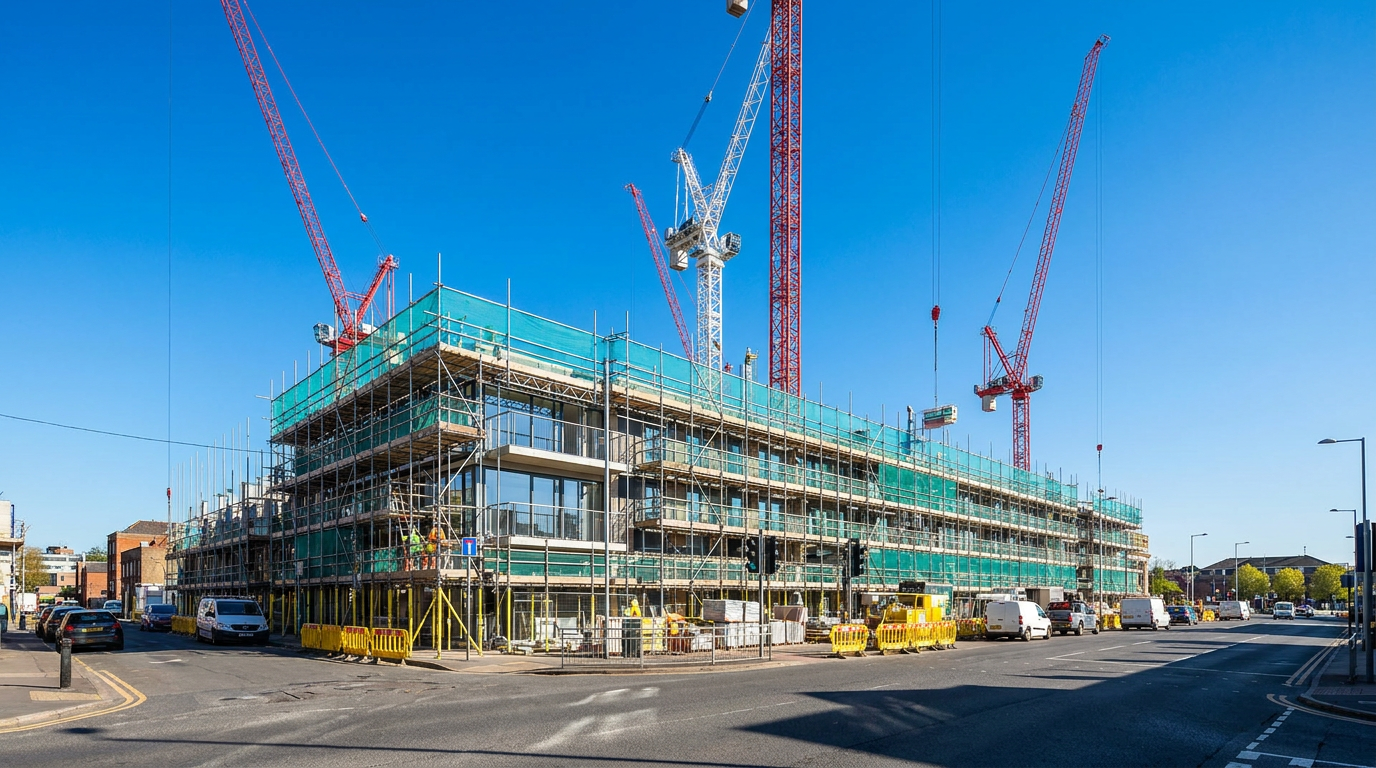
The American downtown is undergoing a structural metamorphosis. With national office vacancy rates hovering near 20 percent in early 2026, millions of square feet of commercial real estate sit underutilized. Simultaneously, the United States faces an acute housing shortage, with home prices having outpaced median incomes by a two-to-one margin since 2019. In response, a once-niche architectural strategy—adaptive reuse—has rapidly scaled into a primary mechanism for urban revitalization.[1][6][7]
The evidence points to a historic pivot in how cities manage their built environments. According to early 2026 data from RentCafe, the national pipeline for office-to-apartment conversions has surged to nearly 100,000 units. Specifically, 90,300 units were in the process of conversion at the start of the year, representing a 28 percent year-over-year increase and a volume nearly four times higher than in 2022.[1]
This surge has inverted a long-standing real estate paradigm. For the first time in modern commercial history, the amount of office space disappearing from the market has eclipsed new construction. Industry tracking reveals that more than 23 million square feet of office space was slated for conversion or demolition in 2025, vastly outpacing the 12.7 million square feet of new office supply delivered to the market.[4]

Office conversions now account for 47 percent of all future adaptive-reuse projects nationwide, easily outpacing hotel and industrial redevelopments. The momentum is particularly visible in major metropolitan hubs that have aggressively updated their zoning codes. In New York City, for instance, office-to-residential conversion starts more than doubled in 2024, and by late 2025, over 4.1 million square feet of conversions had commenced in just an eight-month window.[1][2]
However, the empirical data also tempers expectations regarding the sheer scale of the solution. Not every vacant office tower can seamlessly become an apartment building. A comprehensive working paper from the National Bureau of Economic Research (NBER) established a rigorous set of criteria to identify commercial properties physically suitable for residential conversion. The study concluded that only about 11 percent of all office buildings across the United States fit the necessary architectural and geographic parameters.[3]
The primary candidates are older, Class B and Class C buildings—often referred to as "brown" offices. These structures typically feature smaller floor plates, operable windows, and lower acquisition costs, making the complex geometry of residential plumbing and natural light requirements financially viable. If all suitable buildings were converted, the NBER model estimates it could add approximately 400,000 new apartments to the national housing stock.[3][7]
The primary candidates are older, Class B and Class C buildings—often referred to as "brown" offices.
Beyond expanding the housing supply, the evidence heavily favors adaptive reuse on environmental grounds. The construction sector is a massive contributor to global carbon emissions, primarily through the production of concrete and steel. The NBER research highlights that rehabilitating existing structures produces 50 to 75 percent fewer carbon emissions than ground-up new construction.[3]
Upgrading these older, energy-inefficient office buildings into modern, green apartments offers a dual climate benefit. The NBER model projects that a widespread conversion strategy could decrease greenhouse gas emissions by 1.5 million tons, representing an 80 percent reduction compared to the baseline emissions of the existing obsolete structures.[3]

Despite the clear architectural and environmental viability, financial friction remains the primary bottleneck. While developers are eager to capitalize on relaxed zoning rules—such as New York's "City of Yes" initiative or Los Angeles's updated adaptive reuse ordinances—securing capital is complex. Lenders remain cautious, citing elevated borrowing costs, scarce equity, and the inherent unpredictability of retrofitting mid-century structures.[4][5]
In markets like Los Angeles, local transfer taxes and construction costs have created a "slow burn" rather than an immediate explosion of new housing. While the city has incentivized reuse, banking executives note that conversion loans still represent a small fraction of their daily requests, as the economic math requires precise alignment of low acquisition costs and high projected rents to satisfy cautious credit committees.[5]
Yet, demographic realities continue to force the market's hand. The traditional path to homeownership has fundamentally altered. By 2025, the share of first-time homebuyers had plummeted to 21 percent of the market, down from 44 percent in the early 1980s, while the median age of a first-time buyer reached a record high of 40.[6]

With traditional single-family homes increasingly out of reach for younger demographics, builders and urban planners are pivoting toward mixed-density solutions. Adaptive reuse projects offer a critical release valve, providing high-quality, centrally located rental and condominium options for a generation of renters who are priced out of the suburban housing market but still desire urban amenities.[6][7]
Ultimately, the evidence suggests that office-to-residential conversions are not a silver bullet for the nation's 4.5 million home deficit. However, they represent a highly effective, environmentally sound wedge strategy. By transforming obsolete commercial liabilities into vibrant residential assets, cities are simultaneously addressing their tax base, their carbon footprint, and their housing crisis in a single, concrete stroke.[3][7]
How we got here
2020–2022
The shift to remote work empties downtown office districts, causing commercial vacancies to spike.
August 2023
The NBER publishes a landmark study detailing the physical and financial viability of converting 'brown' offices to 'green' apartments.
2024
New York City sees office-to-residential conversion starts double as zoning reforms take effect.
2025
For the first time, the volume of U.S. office space slated for conversion or demolition outpaces new construction.
Early 2026
The national conversion pipeline surpasses 90,000 units, a fourfold increase from 2022 levels.
Viewpoints in depth
Urban Planners & Environmentalists
Advocates for adaptive reuse as a dual solution to housing shortages and climate change.
This camp views the commercial real estate downturn as a generational opportunity to correct urban misallocations. By repurposing existing structures, cities can preserve 'embodied carbon'—the emissions already spent to manufacture the building's steel and concrete. They point to NBER data showing that conversions can reduce greenhouse gas emissions by up to 80 percent compared to demolishing and rebuilding, all while bringing 24/7 foot traffic back to hollowed-out downtowns.
Real Estate Developers
Focused on the architectural feasibility and zoning incentives required to make projects pencil out.
Developers emphasize that conversions are highly complex surgical operations, not simple renovations. They argue that only a narrow slice of the market—specifically older Class B and C buildings with smaller floor plates—are physically viable for residential plumbing and natural light requirements. For this camp, the success of the trend relies entirely on local governments continuing to slash red tape, offer tax abatements, and fast-track zoning approvals to offset the massive capital risks.
Cautious Lenders
Financial institutions weighing the high costs of construction against uncertain economic conditions.
Banks and private equity firms remain the primary bottleneck for the conversion boom. Lenders point out that retrofitting mid-century structures often uncovers hidden structural issues, leading to budget overruns. Combined with elevated interest rates and local transfer taxes in cities like Los Angeles, credit committees argue that the economic math only works when developers can acquire the empty office buildings at steep, distressed discounts.
What we don't know
- How many of the proposed conversion projects will secure the necessary financing to break ground in a tight lending environment.
- Whether the influx of luxury and market-rate conversions will meaningfully lower rents for middle- and low-income urban residents.
- How long local governments will sustain the tax incentives and zoning waivers currently fueling the boom.
Key terms
- Adaptive Reuse
- The process of repurposing an existing building for a use other than what it was originally designed for, such as turning an office into apartments.
- Class B and C Offices
- Older, less modern commercial buildings that lack premium amenities, making them prime candidates for residential conversion.
- Embodied Carbon
- The greenhouse gas emissions associated with the manufacturing, transportation, and installation of building materials.
- Floor Plate
- The total leasable square footage of a single floor in a commercial building, which dictates how easily natural light can reach interior spaces.
Frequently asked
Can any empty office building become an apartment?
No. Research shows only about 11 percent of U.S. office buildings are physically suitable. Buildings with massive, deep floor plates struggle to provide natural light and ventilation to interior residential units.
Is it cheaper to convert an office or build from scratch?
Conversions are often highly expensive due to the complex plumbing and structural retrofits required. However, developers save on the core structure and foundation, and conversions are significantly better for the environment.
Will this solve the housing crisis?
Not entirely. While conversions could add hundreds of thousands of units to the market, the U.S. is currently facing a shortage of roughly 4.5 million homes. It is a helpful tool, but not a complete solution.
Sources
Source coverage
7 outlets
3 viewpoints surfaced





[1]RentCafeReal Estate Developers
Office-to-Apartment Conversions Surge as Pipeline Nears 100,000 Units
Read on RentCafe →[2]Cushman & WakefieldReal Estate Developers
Office to Residential Conversions Surge to Record Levels in New York City
Read on Cushman & Wakefield →[3]National Bureau of Economic ResearchUrban Planners & Environmentalists
Converting Brown Offices to Green Apartments
Read on National Bureau of Economic Research →[4]CommercialSearchCautious Lenders
Office Conversions, Demolitions Outpace New Construction
Read on CommercialSearch →[5]Los Angeles Business JournalCautious Lenders
Adaptive Reuse Is a Slow Burn
Read on Los Angeles Business Journal →[6]Chicago Agent MagazineReal Estate Developers
Housing trends in 2026: What builders are seeing
Read on Chicago Agent Magazine →[7]Factlen Editorial TeamUrban Planners & Environmentalists
Synthesis by Factlen editorial team
Read on Factlen Editorial Team →
Every angle. Every day.
Get real estate stories with full source coverage and perspective breakdowns delivered to your inbox.