
The Dual Revolution Rewriting the Track and Field Record Books
A combination of carbon-plated "super spikes" and the data-driven Norwegian double-threshold training method is pushing human endurance to unprecedented speeds.
By Factlen Editorial Team
- Physiologists & Coaches
- Attribute the leap in performance to smarter, data-driven training protocols that build larger aerobic engines without overtraining.
- Sports Biomechanists
- Focus on the quantifiable mechanical advantages of advanced footwear, viewing the record boom primarily as a technological evolution.
- Athletics Analysts
- View the current era as a perfect synergy where protective footwear enables the massive training volume required by modern coaching.
What's not represented
- · Traditionalist coaches who prefer feel-based training over data
- · Athletes from developing nations with less access to expensive tech and testing gear
Why this matters
The intersection of biomechanical engineering and precise physiological monitoring has fundamentally altered our understanding of human limits. For everyday runners and fans of the sport, this dual revolution offers both a blueprint for personal improvement and a thrilling new era of athletic achievement.
Key points
- Track and field records are falling rapidly due to a combination of new shoe technology and advanced training methods.
- Carbon-plated 'super spikes' improve a runner's metabolic efficiency by roughly 2 percent.
- The 'Norwegian Method' involves doing two controlled interval workouts in a single day to maximize aerobic volume.
- Athletes use portable blood lactate meters during workouts to ensure they do not exceed their anaerobic threshold.
- The protective foam in modern spikes allows athletes' legs to handle the massive volume required by the Norwegian training style.
Track and field is currently experiencing a golden age of shattered records and redefined human limits. Across middle and long-distance events, times that were once considered untouchable are being routinely dismantled by a new generation of athletes. This sudden leap in human performance is not a biological anomaly, nor is it the result of a single breakthrough. Instead, it is the spectacular collision of two distinct revolutions: a hardware upgrade in the form of advanced footwear technology, and a software update in how the human engine is trained.[6]
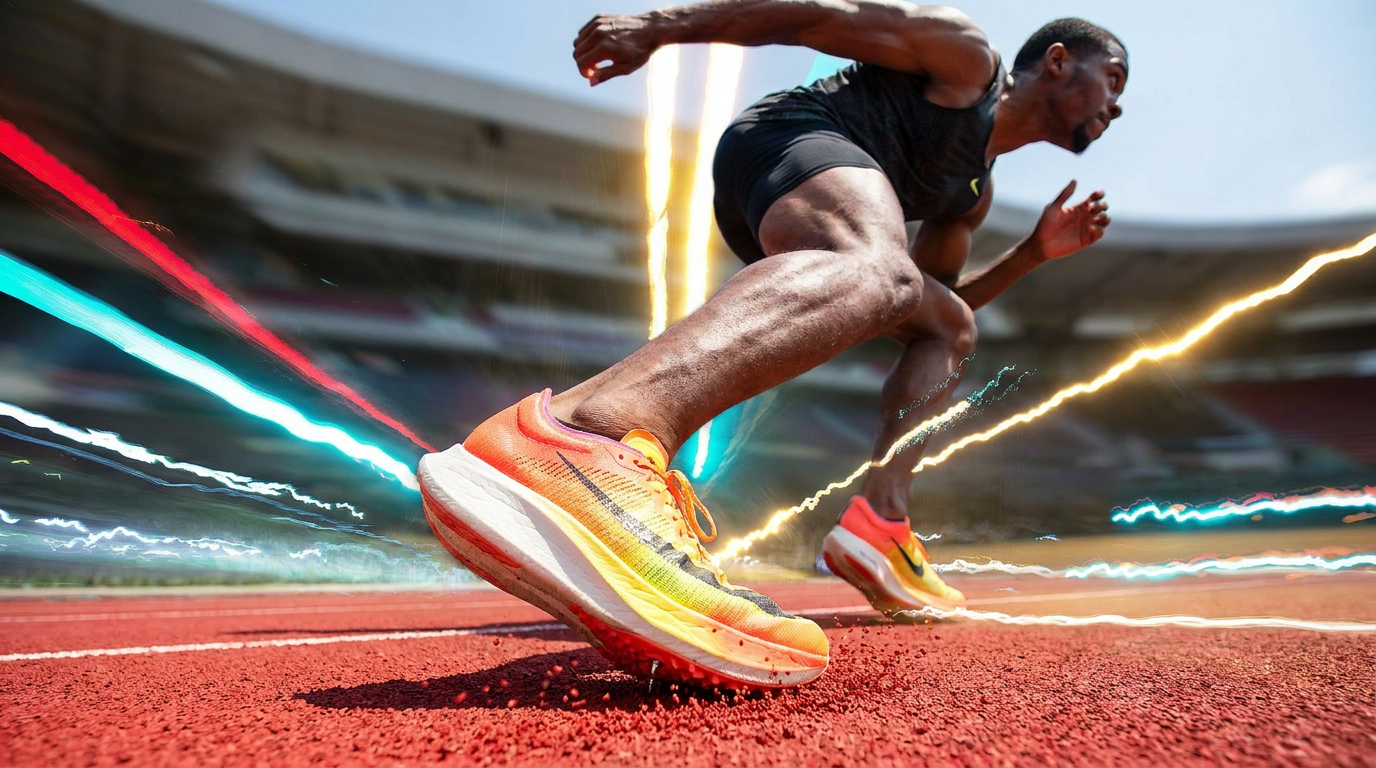
The hardware revolution arrived on the track in the form of "super spikes." Following the seismic impact of carbon-plated marathon shoes on road racing, manufacturers brought the same fundamental architecture to the oval. Traditional track spikes were minimalist, featuring a thin layer of dense foam and a hard plastic plate designed purely for traction and minimal weight. Super spikes, however, completely reimagined the tool. They incorporate ultra-lightweight, highly resilient foams—often made of PEBA (polyether block amide)—paired with a stiff carbon-fiber or synthetic plate embedded within the midsole.[3]
The scientific community has spent the last few years quantifying exactly what this new architecture does to the human stride. Researchers at the University of Massachusetts Amherst and the University of Michigan conducted rigorous metabolic testing to measure the "running economy" of athletes wearing these new spikes. Running economy is the measure of how efficiently a runner's body utilizes oxygen at a given pace. The results were definitive: super spikes provide a measurable, undeniable physiological advantage.[1][2]
According to the biomechanical data, runners wearing top-tier super spikes experience roughly a 2 percent improvement in running economy compared to those in traditional spikes. This increased efficiency occurs because the resilient foam and stiff plate act as a highly tuned spring system, returning more energy to the runner with each footstrike. Interestingly, researchers noted that the athletes did not take faster steps to achieve this efficiency; rather, the shoes allowed them to take slightly longer, more powerful strides with less metabolic cost.[1]

In the unforgiving math of track and field, a 2 percent boost in economy is monumental. Sports physiologists calculate that this translates to a 1 to 1.5 percent improvement in actual race times. For an elite athlete running a 10,000-meter race in 30 minutes, that efficiency gain shaves off approximately 25 seconds. In a sport where Olympic medals and world records are decided by fractions of a second, this technological leap represents the difference between standing atop the podium and failing to qualify for the final.[2]
In the unforgiving math of track and field, a 2 percent boost in economy is monumental.
But shoes alone do not break records; they must be powered by an engine capable of sustaining blistering paces. This brings us to the software revolution: the "Norwegian Method." Popularized by Olympic champion Jakob Ingebrigtsen and his brothers, and rooted in the early experiments of Norwegian runner and physician Marius Bakken, this training philosophy has completely upended traditional endurance coaching. It replaces the old paradigm of "no pain, no gain" gut-busting track workouts with a highly controlled, data-driven approach to building aerobic capacity.[4][5]
The cornerstone of the Norwegian Method is "double threshold" training. Traditionally, elite runners might perform one grueling interval session a day, pushing themselves to the point of severe lactic acid buildup and requiring days of easy running to recover. The Norwegian approach splits the workload. Athletes perform two interval sessions in a single day—typically on Tuesdays and Thursdays—but strictly cap the intensity of both sessions so they remain just below the anaerobic threshold.[4]
To ensure they do not run too fast, athletes utilizing this method rely on constant physiological feedback. Between intervals, runners prick their fingers or earlobes to measure their blood lactate concentration using a portable meter. The goal is to keep the lactate levels hovering in a specific "goldilocks" zone—often targeting around 2.5 millimoles per liter (mmol/L) in the morning session and slightly higher, around 3.5 mmol/L, in the evening session. If the lactate reading spikes too high, the athlete is forced to slow down, regardless of how good they feel.[4][5]

By meticulously controlling the intensity, the Norwegian Method allows athletes to accumulate a massive volume of high-quality work without frying their central nervous system or causing excessive muscular damage. A runner might complete five miles of threshold work in the morning and another six miles in the evening. Over the course of a season, this sub-maximal volume builds an aerobic engine of unprecedented size and efficiency, allowing the athlete to clear lactate faster and sustain higher speeds before fatigue sets in.[4]
What makes this era truly unique is the powerful synergy between the two revolutions. The massive volume required by the double-threshold method places an immense mechanical load on the legs. In the era of traditional, minimalist spikes, attempting such high-volume track sessions would almost certainly lead to stress fractures or Achilles injuries. The thick, compliant foam of modern super spikes absorbs a significant portion of that impact, protecting the lower legs and allowing athletes to handle the rigorous demands of the Norwegian training load.[3][6]

This dual revolution is no longer confined to the elite ranks of Olympic champions. The principles of the Norwegian Method are rapidly trickling down to collegiate programs, high school teams, and dedicated recreational runners who are learning to prioritize controlled, high-volume threshold work over sporadic, all-out efforts. Simultaneously, super spike technology is now widely available from nearly every major footwear brand, democratizing the biomechanical advantages once reserved for sponsored professionals.[2][5]
Ultimately, the current explosion of track and field records is a testament to human ingenuity. By combining the precise, data-driven discipline of modern exercise physiology with cutting-edge materials engineering, athletes are unlocking levels of performance that were biologically impossible a decade ago. It is a thrilling reminder that the limits of human potential are not fixed, but are continually expanding as we learn to train smarter and engineer better tools.[6]
How we got here
Late 1990s
Norwegian runner Marius Bakken begins experimenting with blood lactate testing and double-threshold days.
2019
Carbon-plated 'super shoe' technology, which revolutionized road marathons, begins migrating to track spikes.
Summer 2021
Jakob Ingebrigtsen wins Olympic gold in the 1500m, bringing global attention to the Norwegian training method.
July 2024
University of Michigan researchers publish data confirming super spikes improve running economy by 2 percent.
Viewpoints in depth
Sports Biomechanists
Focus on the quantifiable mechanical advantages of advanced footwear.
For biomechanists and sports engineers, the current era of record-breaking is primarily a story of materials science. By replacing traditional EVA foams with highly resilient PEBA and embedding stiff carbon-fiber plates, engineers have fundamentally altered the physics of the human stride. Researchers point to metabolic testing that proves these shoes reduce the oxygen cost of running by 2 percent. From this perspective, the athletes haven't necessarily evolved; rather, the tools they use to transfer their power into the track have become drastically more efficient, literally springing them forward with less effort.
Physiologists & Coaches
Attribute the leap in performance to smarter, data-driven training protocols.
Exercise physiologists and modern endurance coaches argue that the engine matters more than the tires. They point to the widespread adoption of the Norwegian Method as the true catalyst for the current distance running boom. By shifting away from exhausting, "all-out" track sessions and instead using blood lactate meters to carefully govern intensity, athletes are able to log unprecedented volumes of quality work. This sub-maximal approach builds a massive aerobic base without the neuromuscular burnout that plagued previous generations, allowing runners to sustain faster paces for longer durations.
Athletics Analysts
View the current era as a perfect synergy of protective footwear and massive training volume.
Many observers of the sport believe that the shoe revolution and the training revolution cannot be separated; they are symbiotic. The Norwegian Method requires athletes to run massive volumes of threshold intervals, a load that would historically destroy an athlete's lower legs if attempted in minimalist, hard-plastic spikes. The thick, compliant foam of modern super spikes absorbs the punishing impact of the track, effectively acting as armor for the calves and Achilles tendons. This allows athletes to safely execute the grueling double-threshold days that build world-record-breaking fitness.
What we don't know
- Whether the long-term use of highly stiff carbon plates alters foot and lower-leg biomechanics in ways that could introduce new types of injuries.
- Exactly how much of the recent record boom is attributable to the shoes versus the training, as both variables changed simultaneously.
- If World Athletics will eventually tighten regulations on track spike stack heights if records continue to fall at the current unprecedented rate.
Key terms
- Running Economy
- A measure of how efficiently a runner's body uses oxygen at a given pace; better economy means less energy is wasted.
- Blood Lactate
- A byproduct of glucose metabolism during exercise; measuring its concentration in the blood helps athletes pinpoint their exact exertion level.
- Anaerobic Threshold
- The exercise intensity at which lactic acid begins to accumulate in the blood faster than the body can clear it, leading to rapid fatigue.
- PEBA Foam
- Polyether block amide, an ultra-lightweight and highly resilient plastic foam used in modern running shoes to maximize energy return.
Frequently asked
What exactly makes a track shoe a 'super spike'?
Super spikes combine a highly resilient, lightweight foam midsole (often PEBA) with a stiff carbon-fiber or synthetic plate. This acts like a tuned spring, returning more energy to the runner than traditional thin foam spikes.
What is the Norwegian double threshold method?
It is a training protocol where an athlete performs two interval workouts in a single day. The key is that the intensity of both sessions is strictly capped below the anaerobic threshold, allowing for massive volume without severe fatigue.
Why do runners prick their fingers during practice?
Runners use a portable meter to test their blood lactate concentration. This real-time data ensures they are running at the correct physiological intensity and not pushing too hard during threshold workouts.
Are super spikes legal in the Olympics?
Yes, but they are regulated. World Athletics rules mandate that track spikes for events under 800 meters cannot have a stack height (midsole thickness) greater than 20 millimeters, and 25 millimeters for longer events.
Sources
Source coverage
6 outlets
3 viewpoints surfaced






[1]University of Massachusetts AmherstSports Biomechanists
New research shows super spikes give runners a 2% edge
Read on University of Massachusetts Amherst →[2]University of Michigan NewsSports Biomechanists
Research suggests controversial super spikes do make runners faster
Read on University of Michigan News →[3]National Institutes of HealthSports Biomechanists
The recent and rapid developments in track spike innovation
Read on National Institutes of Health →[4]Runner's WorldPhysiologists & Coaches
How to Use Norwegian Double-Threshold Training to Get Faster
Read on Runner's World →[5]Athletics WeeklyPhysiologists & Coaches
The Norwegian Method – The Culture, Science and Humans Behind the Groundbreaking Approach
Read on Athletics Weekly →[6]Factlen Editorial TeamAthletics Analysts
Synthesis by Factlen editorial team
Read on Factlen Editorial Team →

More in sports
See all 10 stories →Preview
England's 2026 World Cup Outlook: Inside Thomas Tuchel's High-Stakes Group L Campaign
0 sources

College Baseball
Troy Trojans Complete Historic Cinderella Run to Reach First Men's College World Series
0 sources

MLB Preview
San Diego Padres Look to Snap Road Skid Against Baltimore Orioles in Interleague Clash
0 sources

Grassroots Tech
How 'Drop-In' Sports Apps Are Rewiring Urban Communities and Fighting Loneliness
0 sources

Every angle. Every day.
Get sports stories with full source coverage and perspective breakdowns delivered to your inbox.