
The Chemistry of Tea: How Processing and L-Theanine Alter the Health and Cognitive Effects of Camellia Sinensis
Every true tea originates from a single plant species. The profound differences in flavor, health benefits, and cognitive effects come down to enzymatic oxidation and a unique amino acid synergy.
By Factlen Editorial Team
- Nutritional Biochemists
- Focus on the molecular transformations during processing, such as catechin oxidation and theaflavin synthesis.
- Cognitive Neuroscientists
- Focus on the nootropic synergy of L-theanine and caffeine on brain waves and attention.
- Traditional Tea Producers
- Focus on the artisanal control of temperature, humidity, and time to craft flavor profiles.
What's not represented
- · Clinical Dietitians
- · Agricultural Botanists
Why this matters
Understanding the biochemistry of tea allows you to select the right beverage for your specific needs—whether you want the cellular antioxidant support of green tea, the cardiovascular benefits of black tea, or the focused, jitter-free energy provided by L-theanine.
Key points
- All true teas—including green, black, white, and oolong—are derived from the leaves of a single plant species, Camellia sinensis.
- The primary difference between tea types is enzymatic oxidation, which converts antioxidant catechins into complex theaflavins and thearubigins.
- While green tea is rich in EGCG for cellular health, black tea's theaflavins offer distinct cardiovascular benefits.
- The combination of caffeine and L-theanine in tea creates a synergistic effect, improving sustained attention while mitigating caffeine-induced jitters.
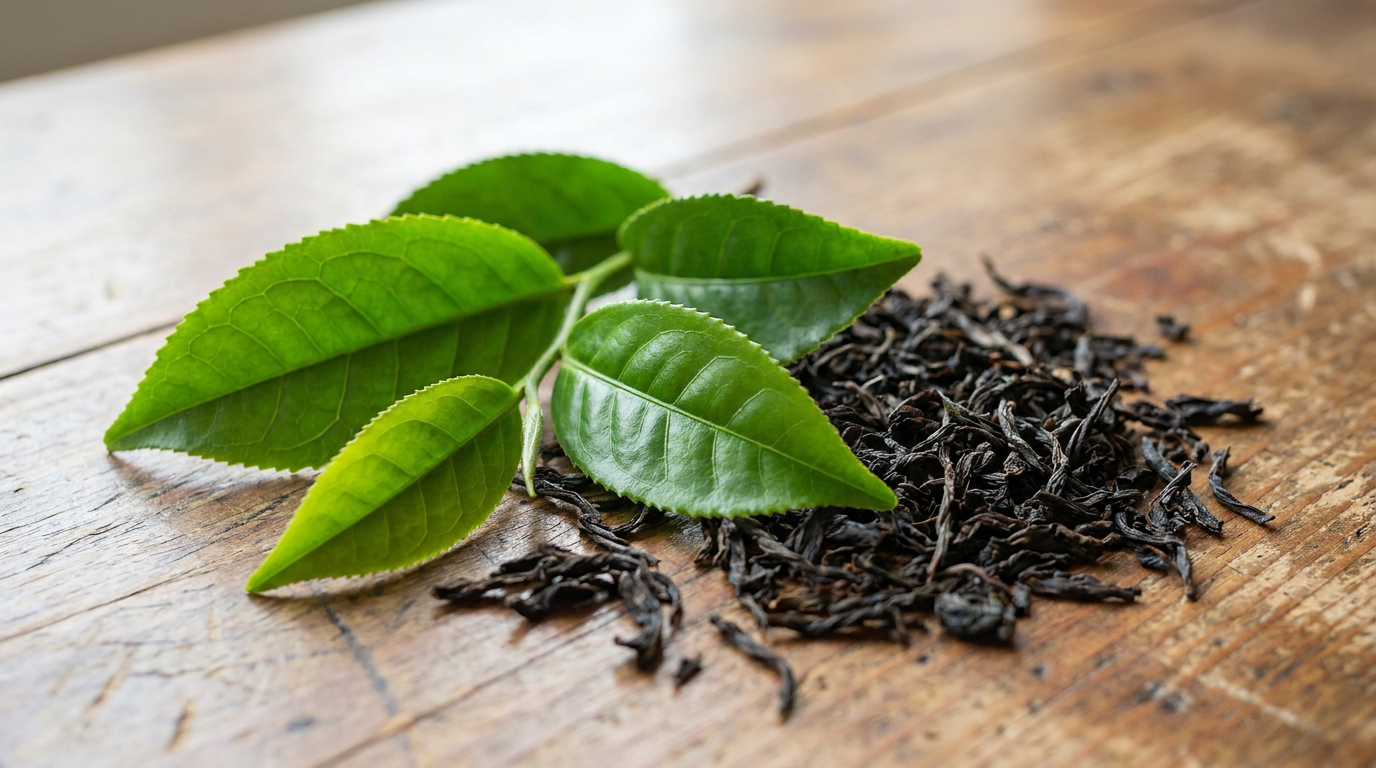
The global consumption of tea is second only to water, yet a persistent misconception surrounds its origins. Many assume that green, black, oolong, and white teas are harvested from entirely different plants. In reality, every true tea originates from the exact same botanical source: the Camellia sinensis shrub. The profound differences in color, flavor, and physiological effects across tea types are not a matter of agriculture, but of applied biochemistry. By manipulating how the harvested leaves interact with oxygen and heat, tea producers fundamentally alter the plant's molecular structure, creating a diverse spectrum of beverages from a single raw material.[1][7]
The defining variable that separates a delicate green tea from a robust black tea is enzymatic oxidation—a process historically, though inaccurately, referred to in the tea industry as fermentation. When a tea leaf is plucked, its cellular structure begins to break down, exposing its internal chemical compounds to oxygen in the air. How tea producers manage this oxygen exposure dictates the final chemical profile of the beverage, fundamentally altering both its nutritional properties and its taste profile. This controlled decay is the central pillar of tea processing.[1][2]
At the heart of this transformation is an enzyme called polyphenol oxidase (PPO). In the fresh Camellia sinensis leaf, the dominant bioactive compounds are a class of polyphenols known as catechins. The most famous and abundant of these is epigallocatechin gallate (EGCG), which has been heavily researched for its potent antioxidant properties. In green tea production, the freshly plucked leaves are rapidly heated—either by steaming or pan-firing—in a crucial step called "kill-green." This sudden application of heat denatures the PPO enzyme, halting oxidation entirely and locking the catechins in their original, unoxidized state.[1][3]
Black tea production takes the exact opposite approach. The leaves are intentionally rolled, crushed, or torn to maximize cellular disruption, then left in a climate-controlled environment with high humidity to oxidize fully. During this period, PPO catalyzes a massive chemical shift. The simple catechins bind together, oxidizing into larger, more complex molecules called theaflavins and thearubigins. This process can take anywhere from a few hours to a full day, depending on the specific temperature and humidity parameters set by the producer.[1][2]

This catechin-to-theaflavin shift is what gives black tea its characteristic dark amber color, brisk astringency, and robust body. Theaflavins are bright yellow-orange dimers, while thearubigins are large, complex brown polymers that can account for up to 60 percent of the dry weight of a black tea extract. Oolong teas sit in the middle of this spectrum, undergoing partial oxidation that leaves a carefully calibrated balance of both raw catechins and newly formed theaflavins.[1][2]
This biochemical divergence complicates the common consumer question of whether tea is "healthy." The widespread claim that green tea is nutritionally superior rests largely on its high EGCG content. Evidence consistently links EGCG to reduced cellular oxidative stress, improved metabolic support, and anti-inflammatory effects. However, the oxidation process that destroys EGCG to create black tea does not eliminate the health benefits of the leaf; it merely changes their mechanism of action.[1][3]
Theaflavins, the primary bioactive compounds synthesized during black tea oxidation, have demonstrated their own unique cardiovascular benefits. Research indicates that these larger molecules can help regulate blood lipid levels, support endothelial function, and reduce cholesterol absorption. The primary uncertainty in tea nutrition lies with thearubigins. Because they are a highly heterogeneous mixture of massive polymers, their exact chemical structures and specific physiological mechanisms remain poorly understood compared to the well-mapped catechins of green tea.[1][2]
Theaflavins, the primary bioactive compounds synthesized during black tea oxidation, have demonstrated their own unique cardiovascular benefits.
While the polyphenol profile of tea shifts dramatically depending on how it is processed, another crucial set of compounds remains relatively stable across all true teas: the cognitive engine of caffeine and L-theanine. This unique chemical combination is responsible for the distinct mental state that tea drinkers have reported for centuries, often described in literature and anecdotal reports as an "alert calm."[4][5]
Caffeine is a well-understood central nervous system stimulant. Its primary mechanism of action is acting as an antagonist to adenosine, a neurotransmitter that accumulates in the brain throughout the day to promote sleepiness and relaxation. By binding to adenosine receptors without activating them, caffeine effectively blocks the brain's signal for fatigue, resulting in increased wakefulness, faster reaction times, and elevated physical energy.[4][6]
However, caffeine alone is a blunt instrument. It triggers a sympathetic nervous system response that can lead to jitteriness, elevated heart rate, anxiety, and a subsequent steep energy crash when the chemical wears off. This is where L-theanine, an amino acid found almost exclusively in Camellia sinensis and a select few species of mushrooms, fundamentally changes the neurological equation of the beverage.[4][5]

L-theanine is capable of crossing the blood-brain barrier, where it exerts a profound modulating effect on neurotransmitters. It promotes the release of gamma-aminobutyric acid (GABA), an inhibitory neurotransmitter that calms neural activity. Simultaneously, it stimulates the production of dopamine and serotonin, while increasing the prevalence of alpha brain waves—a neurological state associated with relaxed, meditative focus rather than hyper-arousal or stress.[4][5]
The interaction between caffeine and L-theanine is a classic example of biochemical synergy, where the combined effect is greater and more refined than the sum of its individual parts. Clinical evidence from randomized controlled trials demonstrates that L-theanine actively mitigates the vasoconstrictive and jittery side effects of caffeine. Instead of a spiked sympathetic response, the body maintains a more regulated heart rate and blood pressure while still benefiting from increased alertness.[4][6]
Cognitively, this synergy produces measurable improvements over caffeine consumption alone. Studies comparing the combination to isolated caffeine show that while caffeine speeds up reaction time, it can simultaneously increase errors on complex tasks. The addition of L-theanine improves both speed and accuracy, enhancing sustained attention, reducing mind-wandering, and improving the brain's ability to ignore distracting stimuli during demanding cognitive work.[5][6]

Despite the robust clinical evidence for this natural nootropic stack, there is a significant caveat regarding dosage. The most pronounced cognitive benefits in clinical trials are typically observed at doses of 100 to 200 milligrams of L-theanine, often paired with caffeine in a 2:1 ratio. A standard cup of brewed green or black tea, however, generally contains only 20 to 60 milligrams of L-theanine, meaning the effect of a single cup is relatively subtle.[5]
This gap between clinical doses and real-world consumption means that consumers seeking therapeutic cognitive thresholds must adjust their intake. Many turn to matcha—a powdered green tea where the entire leaf is consumed, yielding higher concentrations of both L-theanine and caffeine—or they rely on the cumulative effect of drinking multiple cups of high-quality green or oolong tea throughout a working day to reach the studied effective range.[5]
The agricultural environment also plays a critical role in this chemical balance. Tea plants grown in heavy shade, such as those used for high-grade matcha and gyokuro, produce significantly more L-theanine. When exposed to direct sunlight, the plant naturally converts L-theanine into catechins to protect its leaves from UV radiation. Thus, the very cultivation techniques that maximize the calming amino acid inherently reduce the antioxidant polyphenols, showcasing the constant trade-offs in tea agriculture.[3][5]

Ultimately, the mastery of tea production is a sophisticated manipulation of plant chemistry. Whether a producer is rapidly steaming leaves to preserve EGCG, carefully oxidizing them to synthesize theaflavins, or shading the plants to boost L-theanine, they are engineering specific physiological outcomes. Understanding these mechanisms allows consumers to choose their tea not just for flavor, but for the precise physical and cognitive state they wish to achieve.[1][5][7]
How we got here
Plucking
Fresh leaves are harvested, containing peak levels of raw catechins and L-theanine.
Withering
Leaves are laid out to lose moisture, beginning the breakdown of cell walls.
Kill-Green
Rapid heating denatures PPO enzymes, halting oxidation to preserve EGCG in green tea.
Oxidation
Leaves are crushed to expose enzymes to oxygen, converting catechins to theaflavins for black tea.
Firing
Final heat application reduces moisture to below 5%, stabilizing the chemical profile for brewing.
Viewpoints in depth
Nutritional Biochemists
Focus on the molecular transformations during processing, such as catechin oxidation and theaflavin synthesis.
For biochemists, tea is a fascinating case study in enzymatic reactions. They view the "kill-green" step in green tea production not just as a traditional technique, but as a precise thermal denaturing of polyphenol oxidase. Their research emphasizes that black tea is not nutritionally void compared to green tea; rather, its complex theaflavins and thearubigins offer a different set of cardiovascular and metabolic benefits that are still being mapped out in clinical literature.
Cognitive Neuroscientists
Focus on the nootropic synergy of L-theanine and caffeine on brain waves and attention.
Neuroscientists are primarily interested in tea as a natural cognitive enhancer. They study how the combination of caffeine and L-theanine alters brain wave patterns, specifically the increase in alpha waves that denote a state of relaxed alertness. Their clinical trials demonstrate that this synergy improves sustained attention and target-distractor discriminability far better than isolated caffeine, making tea a unique subject in the study of natural nootropics and focus.
Traditional Tea Producers
Focus on the artisanal control of temperature, humidity, and time to craft flavor profiles.
For the artisans who grow and process Camellia sinensis, the chemistry is understood through sensory experience and generational knowledge. They manipulate oxidation by feeling the texture of the withering leaves and smelling the shift from grassy to floral to malty aromas. Their goal is to balance astringency, body, and aroma, viewing the chemical transformations of catechins and theaflavins as the tools to craft a perfectly balanced cup rather than isolated health compounds.
What we don't know
- The exact chemical structures and specific physiological mechanisms of thearubigins, the massive polymers that make up the bulk of black tea extracts.
- The precise long-term neurological impacts of daily L-theanine and caffeine consumption on age-related cognitive decline.
Key terms
- Camellia sinensis
- The single plant species from which all true teas (green, black, white, oolong) are derived.
- Enzymatic oxidation
- The oxygen-driven chemical reaction, catalyzed by enzymes, that darkens tea leaves and alters their polyphenol profile.
- Catechins
- A family of antioxidant polyphenols, most abundant in unoxidized green tea, notably EGCG.
- Theaflavins
- Larger, complex polyphenol molecules created when catechins oxidize, responsible for black tea's color and briskness.
- L-theanine
- A unique amino acid found in tea that promotes relaxation and alpha brain waves without causing drowsiness.
- Polyphenol oxidase (PPO)
- The primary enzyme in tea leaves responsible for catalyzing the oxidation of catechins.
Frequently asked
Does black tea have the same health benefits as green tea?
They have different benefits. Green tea is rich in EGCG catechins for cellular health, while black tea contains theaflavins which support cardiovascular function.
Why does tea give me a different energy boost than coffee?
Tea contains L-theanine, an amino acid that synergizes with caffeine to smooth out the stimulant effect, reducing jitters and promoting a state of calm focus.
Which type of tea has the most L-theanine?
Shade-grown green teas, particularly matcha and gyokuro, contain the highest levels of L-theanine because avoiding sunlight prevents the plant from converting the amino acid into polyphenols.
Do herbal teas contain L-theanine and caffeine?
No. Herbal teas (tisanes) like chamomile or peppermint do not come from the Camellia sinensis plant and naturally lack both caffeine and L-theanine.
Sources
Source coverage
7 outlets
3 viewpoints surfaced







[1]National Institutes of HealthNutritional Biochemists
Enzymatic Oxidation of Catechins and Their Transformation in Tea
Read on National Institutes of Health →[2]MDPINutritional Biochemists
Optimization of Black Tea Fermentation Processing Parameters
Read on MDPI →[3]ResearchGateNutritional Biochemists
Changes in major catechins, caffeine, and antioxidant activity during CTC processing of black tea
Read on ResearchGate →[4]HMN24Cognitive Neuroscientists
Caffeine and L-Theanine: The Ultimate Nootropic Stack
Read on HMN24 →[5]O2H TeaCognitive Neuroscientists
Tea for focus: The science of L-theanine and caffeine
Read on O2H Tea →[6]NeuroactiveCognitive Neuroscientists
The Synergy of Caffeine and L-Theanine
Read on Neuroactive →[7]Factlen Editorial TeamTraditional Tea Producers
Synthesis by Factlen editorial team
Read on Factlen Editorial Team →


Every angle. Every day.
Get food drink stories with full source coverage and perspective breakdowns delivered to your inbox.