
The 2026 Guide to Buying Lab-Grown vs. Natural Diamonds
Lab-grown diamonds now account for over 55% of the engagement ring market as prices fall 88% from their 2020 peak. This explainer breaks down the science, the economics, and the resale realities of choosing between manufactured and mined stones.
By Factlen Editorial Team
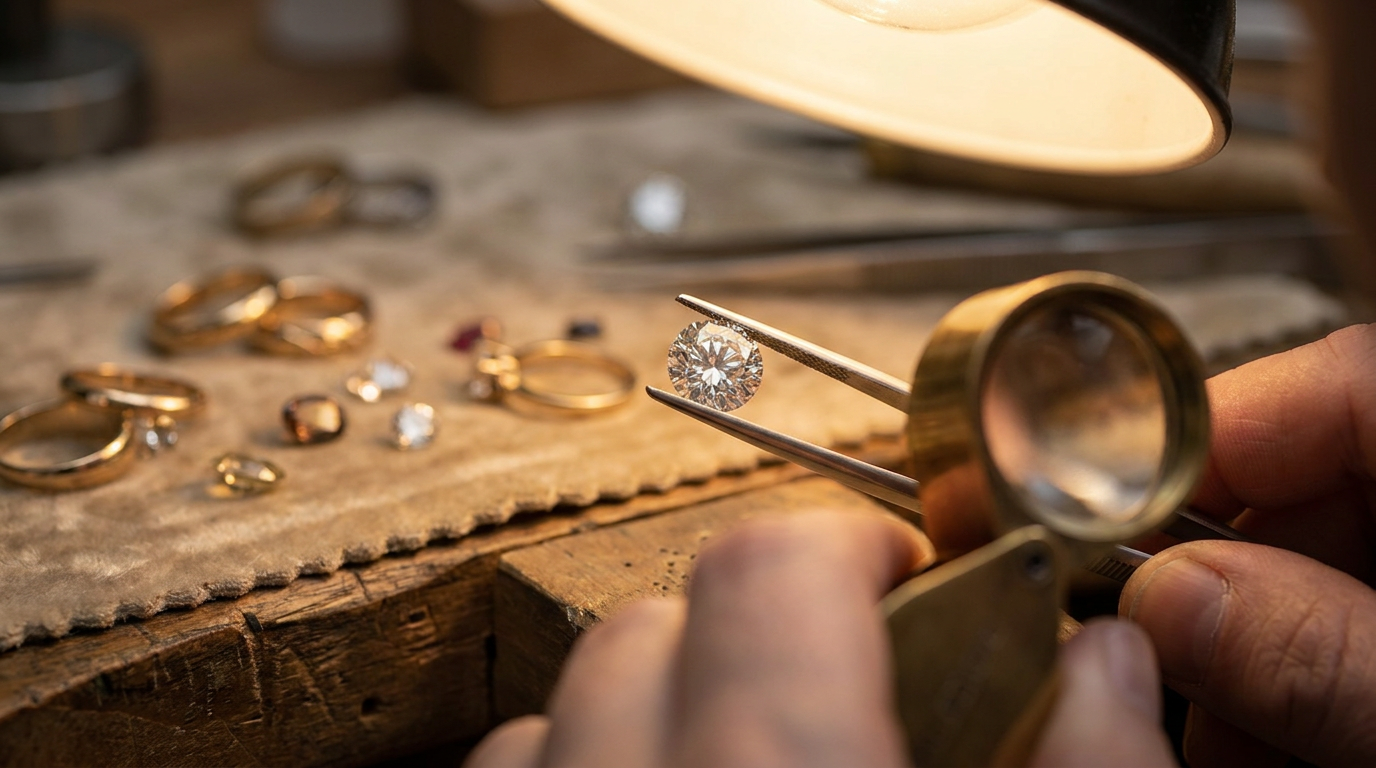
- Value & Size Maximizers
- Prioritize budget efficiency and maximum carat size, viewing diamonds as beautiful jewelry rather than financial assets.
- Heirloom Traditionalists
- Value the billion-year geological rarity and long-term wealth retention of mined stones.
- Conscious Consumers
- Focus on the ethical and environmental footprint of their purchase, weighing conflict-free origins against energy consumption.
What's not represented
- · Pawn shop owners and secondary market diamond buyers
- · Diamond miners in Botswana and Canada
Why this matters
For decades, buying a diamond meant navigating a rigid, expensive market based on geological scarcity. Today, understanding the science and economics of lab-grown diamonds allows buyers to double their carat size on a fixed budget—provided they understand the trade-offs in long-term resale value.
Key points
- Over 55% of engagement rings purchased in 2026 feature lab-grown diamonds.
- Lab-grown diamond prices have fallen roughly 88% since 2020 due to scaled manufacturing.
- Natural and lab-grown diamonds are chemically and optically identical, both scoring a 10 on the Mohs hardness scale.
- Natural diamonds retain 20% to 60% of their resale value, while lab-grown stones depreciate rapidly.
- The two primary lab-growth methods are High Pressure High Temperature (HPHT) and Chemical Vapor Deposition (CVD).
For decades, the diamond industry was anchored by a single, unshakeable premise: geological scarcity. But entering 2026, the jewelry market has fundamentally flipped. According to recent industry data, over 55% of all engagement rings purchased this year feature a lab-grown center stone, marking the first time manufactured diamonds have decisively overtaken their mined counterparts. This shift is not merely a change in consumer taste; it is the result of a technological maturation that has shattered traditional pricing models and forced buyers to rethink what makes a gemstone valuable.[3][6]
The most striking transformation is financial. In 2020, a 1-carat lab-grown diamond retailed for an average of $3,410. By early 2026, that same stone—chemically and optically identical—can be purchased direct-to-consumer for roughly $400 to $800. This represents an 88% collapse in price over six years, driven by a massive scale-up in global manufacturing capacity, particularly in China and India.[1]
Meanwhile, natural diamonds have maintained their luxury premium. A 1-carat natural round brilliant diamond of high quality (D color, VVS2 clarity) currently retails for between $4,200 and $4,600 in the United States. Natural diamond prices experienced a modest 11% correction through late 2025, but have since stabilized, anchored by the hard costs of mining and the enduring appeal of geological rarity. The price gap between the two is now structural, stable, and vast.[2][6]

To navigate this new landscape, buyers must first understand the science. A lab-grown diamond is not a simulant like cubic zirconia or moissanite. It is pure crystallized carbon. It shares the exact same chemical composition, the same refractive index that creates brilliance, and the same perfect 10 on the Mohs hardness scale as a stone pulled from the earth. Even an experienced gemologist cannot distinguish a lab-grown diamond from a natural one with the naked eye or a standard jeweler's loupe.[4]
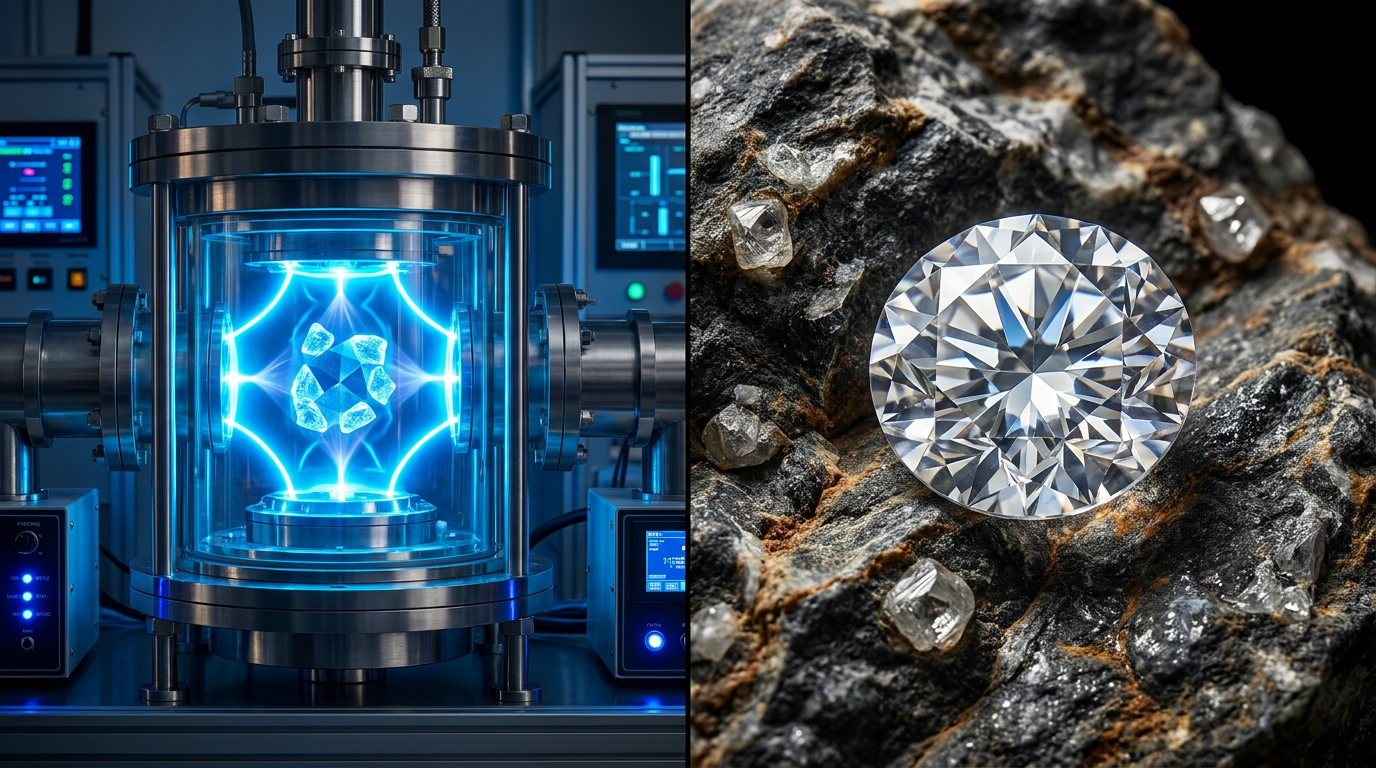
The only difference is origin, which dictates the two primary methods of creation: High Pressure High Temperature (HPHT) and Chemical Vapor Deposition (CVD). HPHT mimics the brutal conditions of the Earth's mantle. A tiny diamond seed is placed in a carbon flux and subjected to crushing pressure—up to 6 gigapascals—and temperatures exceeding 1,400 degrees Celsius. This method grows diamonds rapidly and is highly effective at producing completely colorless stones, though it can occasionally leave microscopic metallic inclusions from the press.[5]
CVD, conversely, relies on a vacuum chamber rather than brute force. Methane and hydrogen gases are pumped into the chamber and ignited into a plasma state using microwaves. The carbon atoms separate from the gas and rain down onto a seed plate, building the diamond atom by atom, layer by layer. CVD diamonds generally have fewer inclusions and no metallic remnants, making them highly sought after for premium engagement rings, though they sometimes require post-growth heat treatment to remove subtle brown tints.[4][5]

CVD, conversely, relies on a vacuum chamber rather than brute force.
When shopping in 2026, the grading certificate is the buyer's most critical tool. The International Gemological Institute (IGI) has become the dominant grading authority for lab-grown stones, and their reports explicitly state whether a diamond was grown via CVD or HPHT. Industry experts advise that when buying an HPHT stone, buyers should prioritize color grades (D-F), while CVD buyers should focus on clarity (VS1 or higher) to ensure maximum visual performance.[5]
But the dramatic affordability of lab-grown diamonds comes with a significant financial caveat: they are a depreciating asset. Because they are essentially products of technology, they follow a trajectory similar to consumer electronics. Wholesale production costs continue to fall, meaning a lab-grown diamond purchased today for $1,500 may cost $300 to replace in five years. Consequently, lab-grown stones have virtually zero resale value, with many jewelers and pawn shops refusing to buy them back.[4]
Natural diamonds, by contrast, function as a store of wealth. While they are not traditional investments like equities or gold, they retain intrinsic value over time due to their finite supply and the ongoing closure of legacy mines. A natural diamond typically retains 20% to 60% of its retail value on the secondary market, allowing buyers to trade them in or upgrade them decades later. For buyers, the decision often comes down to whether they view the ring as a financial asset or a sunk-cost piece of jewelry.[2][3][6]
The environmental and ethical calculations have also grown more complex. Lab-grown diamonds are universally celebrated as conflict-free, entirely bypassing the human rights concerns historically associated with diamond mining. However, the 'eco-friendly' label is increasingly scrutinized. Creating the immense heat and pressure required for HPHT and CVD reactors demands massive amounts of electricity. Because the majority of lab-grown diamonds are manufactured in regions heavily reliant on coal-powered grids, a mass-produced lab stone can sometimes carry a higher carbon footprint than a responsibly mined natural diamond.[3][4]

Natural diamond mining, while undeniably disruptive to local ecosystems, is now strictly regulated by the Kimberley Process. Modern mining operations require mandatory land rehabilitation and often inject vital infrastructure and capital into developing nations like Botswana. Conscious consumers in 2026 are increasingly demanding transparency from both sectors, seeking out lab-grown brands powered by renewable energy or natural diamonds with fully traceable, blockchain-verified origins.[4][6]
Ultimately, the lab-grown revolution has permanently altered consumer expectations around size. Freed from the exponential pricing curve of natural diamonds, buyers are scaling up. The average center stone for an engagement ring has jumped from 1.2 carats in 2019 to over 2.5 carats in 2026. Designers are now working with massive, flawless stones that would have previously been reserved for royalty or billionaires.[3]
The 2026 diamond market offers a clear, if stark, choice. Buyers prioritizing maximum visual impact, guaranteed ethical origins, and budget efficiency are overwhelmingly choosing lab-grown stones. Those who value geological romance, rarity, and long-term financial retention continue to invest in natural diamonds. Neither choice is objectively wrong, provided the buyer understands exactly what they are—and are not—paying for.[6]
How we got here
1 to 3 billion years ago
Natural diamonds crystallize in the Earth's mantle under extreme heat and pressure.
1954
General Electric creates the first commercially successful synthetic diamonds for industrial use.
2018
The Federal Trade Commission removes the word 'natural' from its definition of a diamond.
2022
Lab-grown diamond prices drop 36% in a single year as global production capacity scales.
2026
Lab-grown diamonds surpass 55% market share for engagement rings, establishing a new industry norm.
Viewpoints in depth
Value & Size Maximizers
This camp prioritizes budget efficiency and maximum visual impact, viewing diamonds as beautiful jewelry rather than financial assets.
For modern couples and jewelry enthusiasts, the lab-grown price collapse is a pure consumer victory. By removing the scarcity premium of mined stones, buyers can acquire 2.5-carat, flawless center stones that would have previously cost tens of thousands of dollars. This perspective argues that since a diamond is chemically and optically identical regardless of its origin, paying a 500% markup for a natural stone is an irrational financial decision. They accept that the stone will not retain resale value, treating the purchase like a luxury vacation or a high-end piece of furniture—money spent for immediate enjoyment rather than future returns.
Heirloom Traditionalists
This viewpoint values the billion-year geological rarity and long-term wealth retention of mined stones.
Traditional jewelers and luxury purists maintain that a diamond's true value is inextricably linked to its rarity and the immense geological time required to form it. From this perspective, lab-grown diamonds are technological commodities—essentially consumer electronics that depreciate rapidly as reactor efficiency improves. They point to the fact that natural diamonds have historically retained 20% to 60% of their retail value on the secondary market, whereas lab-grown stones are often rejected by pawn shops and estate buyers. For these buyers, an engagement ring is a multi-generational store of value, not a disposable accessory.
Conscious Consumers
This camp focuses on the ethical and environmental footprint of their purchase, weighing conflict-free origins against energy consumption.
The ethical debate surrounding diamonds has evolved significantly. While lab-grown diamonds successfully eliminate the human rights abuses and cartel dynamics historically associated with 'blood diamonds,' environmentally conscious buyers are increasingly scrutinizing the carbon footprint of the laboratories themselves. Because HPHT and CVD reactors require massive, sustained electricity—often drawn from coal-heavy grids in India and China—the 'eco-friendly' marketing label is heavily contested. This camp advocates for radical transparency, pushing for lab-grown stones produced exclusively with renewable energy, or natural diamonds with blockchain-verified, conflict-free provenance.
What we don't know
- Whether the wholesale price floor for lab-grown diamonds has truly been reached, or if prices will continue to slide toward the cost of raw carbon.
- How the secondary market will adapt if consumers eventually attempt to resell millions of lab-grown engagement rings.
- Whether renewable-energy-powered diamond reactors will become the industry standard to offset current carbon footprint concerns.
Key terms
- CVD (Chemical Vapor Deposition)
- A diamond growth method that uses microwave energy to break down carbon-rich gases in a vacuum chamber, depositing carbon atoms layer by layer.
- HPHT (High Pressure High Temperature)
- A diamond growth method that mimics the Earth's mantle by subjecting a carbon seed to extreme heat and crushing mechanical pressure.
- Mohs Scale
- A scientific scale used to measure the hardness of minerals, on which diamonds score a perfect 10.
- IGI (International Gemological Institute)
- The dominant grading authority for lab-grown diamonds, providing certificates that detail the stone's 4Cs and growth method.
- Carbon Flux
- A metal alloy solvent used in the HPHT process to lower the temperature required for carbon to crystallize into a diamond.
Frequently asked
Can a jeweler tell the difference between lab-grown and natural?
Not with the naked eye or a standard loupe. Specialized laboratory equipment is required to detect the distinct growth patterns and trace elements.
Do lab-grown diamonds get cloudy over time?
No. Because they are pure crystallized carbon with a hardness of 10, they will never fade, cloud, or change color over time.
Are lab-grown diamonds a good financial investment?
No. Lab-grown diamonds depreciate rapidly as manufacturing technology improves, meaning they have virtually zero resale value on the secondary market.
Which is better: CVD or HPHT?
Neither is objectively better. CVD often produces stones with fewer metallic inclusions, while HPHT is highly effective at creating completely colorless (D-F) diamonds.
Sources
Source coverage
6 outlets
3 viewpoints surfaced






[1]Edahn Golan Diamond ResearchValue & Size Maximizers
Lab Diamond Price Decline 2020 to 2026: The Full Data Report
Read on Edahn Golan Diamond Research →[2]Rapaport / OM Jewels IncHeirloom Traditionalists
Lab-Grown Diamonds: The Price Floor Has Arrived
Read on Rapaport / OM Jewels Inc →[3]The Knot / Tashvi AIValue & Size Maximizers
2026 Market Update: Lab Grown vs Natural Diamonds
Read on The Knot / Tashvi AI →[4]Zizov Diamonds AnalysisHeirloom Traditionalists
The Resale Reality: Lab-Grown vs Natural
Read on Zizov Diamonds Analysis →[5]IGI / Dvik JewelsConscious Consumers
CVD vs HPHT: What the Certificate Actually Tells You
Read on IGI / Dvik Jewels →[6]Factlen Editorial TeamConscious Consumers
Synthesis by Factlen editorial team
Read on Factlen Editorial Team →
Every angle. Every day.
Get shopping stories with full source coverage and perspective breakdowns delivered to your inbox.