
SpaceX Debuts on Nasdaq at $2.2 Trillion Valuation, Making Elon Musk the First Trillionaire
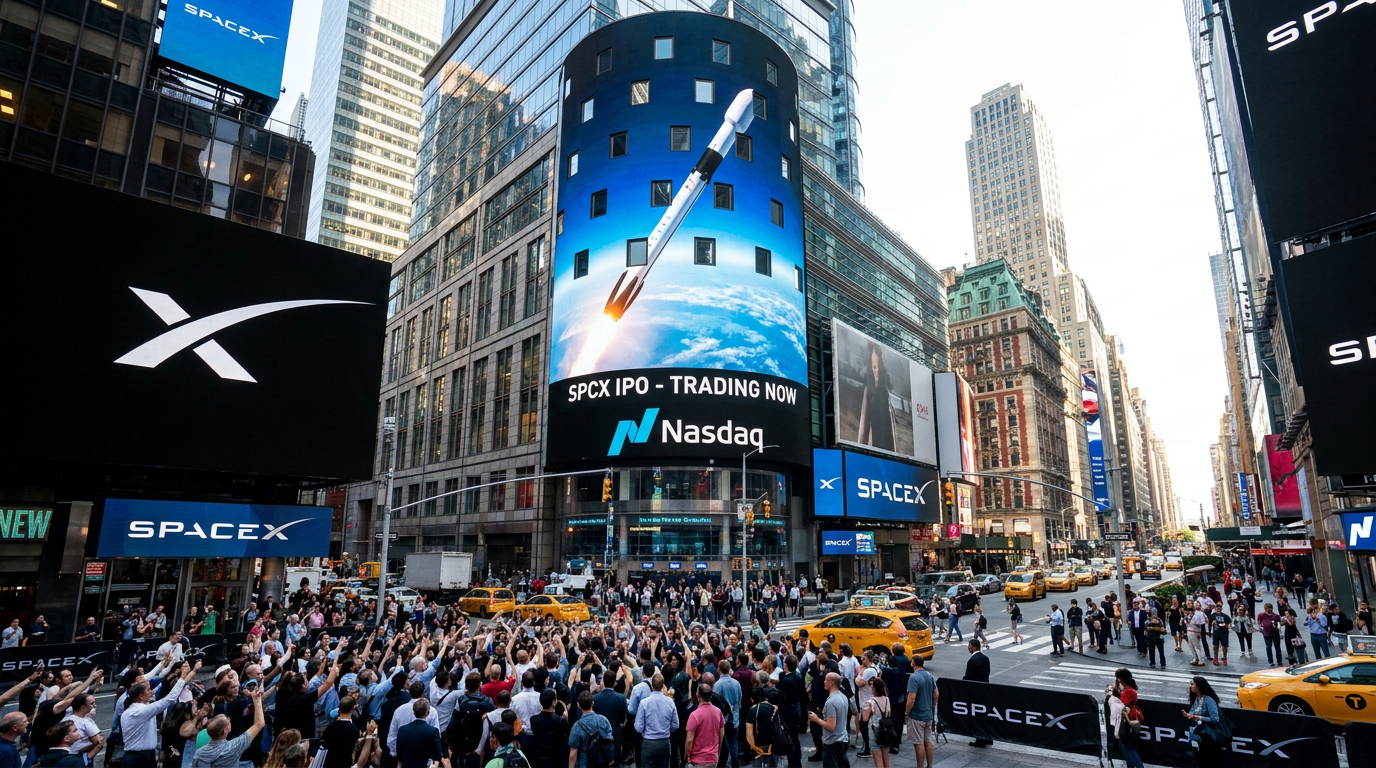
SpaceX shares surged on their first day of trading, propelling the aerospace giant to a historic $2.2 trillion market capitalization. The landmark IPO generated unprecedented wealth, officially pushing CEO Elon Musk's net worth past the $1 trillion mark.
By Factlen Editorial Team
- Retail & Tech Optimists
- View the IPO as a historic democratization of the space economy and a validation of Musk's long-term vision.
- Institutional Value Analysts
- Express caution over the unprecedented valuation multiples and the company's ongoing capital expenditures.
- Market Historians
- Focus on the macroeconomic impact of the listing and the sheer scale of the wealth generated.
What's not represented
- · Legacy Aerospace Contractors
- · Space Policy Advocates
Why this matters
The SpaceX IPO is the largest wealth-creation event in modern financial history, opening the previously private space economy to everyday investors. It proves that public markets are willing to fund multi-decade, capital-intensive engineering bets, setting a new precedent for how humanity finances its expansion into space.
Key points
- SpaceX debuted on the Nasdaq under the ticker SPCX, opening at $150 per share and achieving a $2.2 trillion market capitalization.
- The massive public offering pushed CEO Elon Musk's net worth to an estimated $1.11 trillion, making him the world's first verified trillionaire.
- Starlink's satellite internet business drove the valuation, accounting for roughly 60% of the company's $18.7 billion revenue in 2025.
- Retail investors were allocated an unprecedented 30% of the IPO float, driving massive day-one buying pressure.
- Despite its massive valuation, SpaceX posted a $4.9 billion GAAP net loss in 2025 due to heavy investments in Starship and its recent xAI merger.
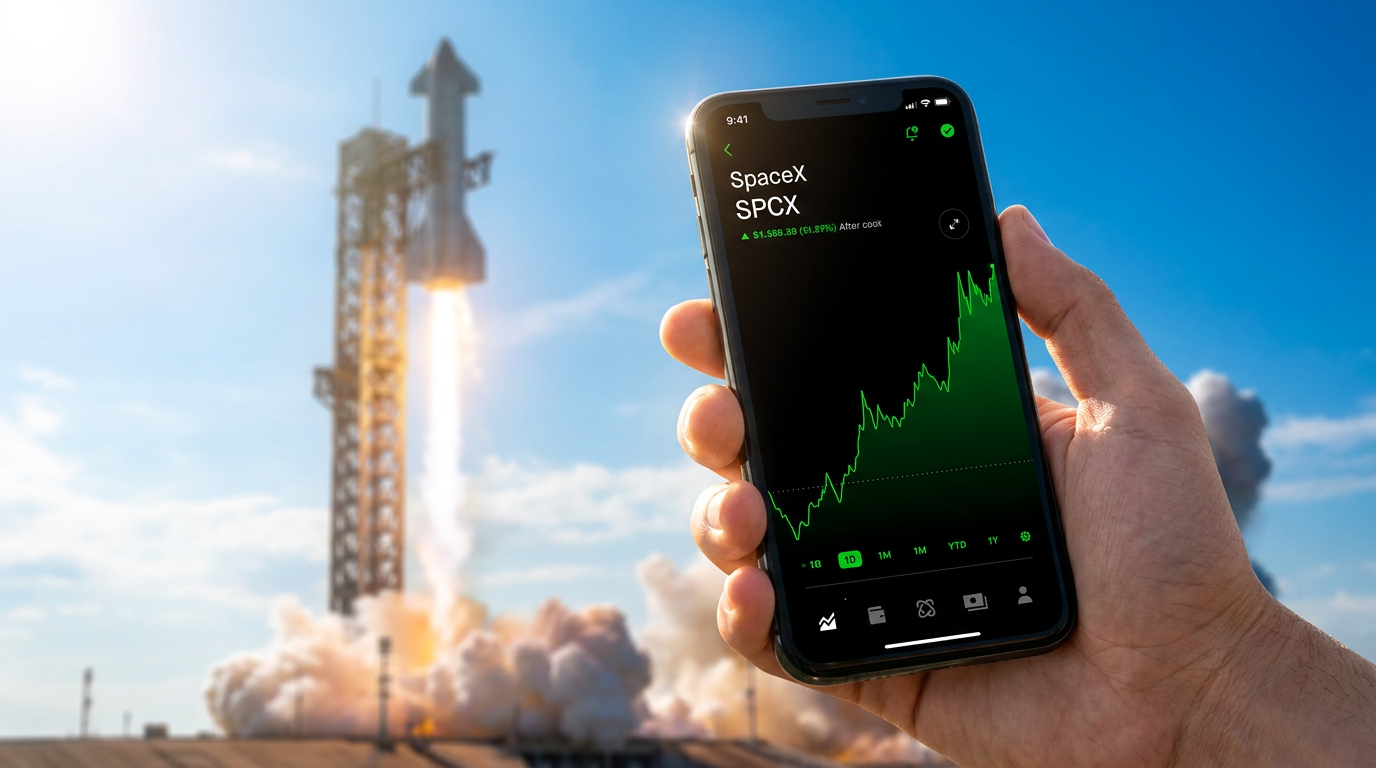
The long-awaited moment finally arrived on Friday as SpaceX officially transitioned from the world's most valuable private startup to a publicly traded juggernaut. Debuting on the Nasdaq under the ticker symbol SPCX, shares opened at $150—a significant bump from the $135 IPO pricing—propelling the aerospace company to a staggering market capitalization of $2.2 trillion.[1][2]
The sheer scale of the listing immediately rewrote the record books. With a single ring of the opening bell, SpaceX bypassed the valuations of Meta and Amazon, joining the exclusive multi-trillion-dollar club alongside Apple, Microsoft, and Nvidia. The debut also triggered a historic personal milestone: Elon Musk's net worth surged by $188 billion overnight, reaching an estimated $1.11 trillion to make him the first verified trillionaire in financial history.[1][2][7]
"Elon Musk's ascent to a $1 trillion fortune represents a milestone once considered unimaginable," noted Forbes, highlighting how rapidly wealth can scale in the modern technology sector. Musk retains a commanding 42% equity stake in SpaceX, alongside 85% of its voting power, ensuring his absolute control over the company's strategic direction even as it answers to public shareholders.[1][7]

The path to a $2.2 trillion valuation was paved by the explosive success of Starlink, SpaceX's satellite internet constellation. Originally pitched as a supplementary revenue stream to fund Mars exploration, Starlink has become the company's financial engine. By the end of 2025, the service had amassed 9 million subscribers globally, generating roughly 60% of SpaceX's $18.7 billion in annual revenue.[4][7]
Starlink's growth has fundamentally altered the economics of the space industry. The division achieved its first net profitability in 2024 and recorded an 86% increase in adjusted EBITDA through 2025. This recurring subscription revenue provides a stable financial base that traditional aerospace contractors, reliant on lumpy government contracts, have historically lacked.[4]
Launch services, the business that made SpaceX famous, remains a critical pillar. The company set its sixth consecutive annual launch record with 170 orbital missions in 2025, maintaining a near-monopoly on commercial access to space. By flying its reusable Falcon 9 rockets at an unprecedented cadence, SpaceX has driven down the cost of reaching orbit while simultaneously launching its own Starlink hardware at cost.[7]
Launch services, the business that made SpaceX famous, remains a critical pillar.
Despite the top-line triumphs, the company's S-1 prospectus revealed the immense capital intensity required to maintain its lead. SpaceX posted a GAAP net loss of $4.9 billion in 2025, a figure that raised eyebrows among institutional value investors. The deficit is largely driven by massive depreciation schedules for the Starlink constellation, stock-based compensation, and the staggering research and development costs associated with the next-generation Starship rocket.[4][7]

The financial picture grew even more complex following SpaceX's February 2026 merger with xAI, Musk's artificial intelligence venture. The integration transformed SpaceX into a dual space-and-AI behemoth, but it also added an estimated $2.5 billion in quarterly AI infrastructure losses to the balance sheet. Morningstar analysts noted that Starlink's success is effectively subsidizing xAI's extensive compute expenditures, taking the consolidated company deeper into the red.[4][7]
These losses have not deterred the market, which has priced SpaceX based on its future monopoly potential rather than its current bottom line. At its $2.2 trillion debut valuation, the company is trading at roughly 94 times its 2025 revenue. For context, that multiple has virtually no precedent among mega-cap technology stocks, signaling that investors are betting heavily on SpaceX capturing the lion's share of a space economy projected to reach $1.8 trillion by 2035.[7]
To fuel this demand, the IPO was structured with an unusually populist tilt. Goldman Sachs, the lead underwriter, allocated an unprecedented 30% of the float directly to retail investors—three times the standard allocation for a mega-cap listing. This strategy capitalized on the immense brand loyalty SpaceX commands among the general public, ensuring massive day-one buying pressure that helped drive the stock from its $135 pricing to its $150 open.[3][6][7]
The successful listing provides a massive liquidity event for the venture capital firms that backed SpaceX during its two decades as a private company. Early investors like Founders Fund, Craft Ventures, and Sequoia Capital are seeing historic payouts, with the IPO generating more exit value than all venture-backed public offerings of the last decade combined.[4]

Industry analysts predict the SpaceX IPO will serve as a catalyst for the broader aerospace sector. With the public markets demonstrating a willingness to assign multi-trillion-dollar valuations to space infrastructure, rival private ventures like Blue Origin and Sierra Space may find it easier to raise capital or pursue their own public listings.[2][5]
Looking ahead, the newly public SpaceX faces a gauntlet of ambitious milestones. The company is preparing for Starship's first crewed lunar landings under NASA's Artemis program, while simultaneously expanding the Starlink constellation toward a planned 15,000 satellites. With the scrutiny of quarterly earnings calls now a reality, Musk will have to balance the demands of Wall Street with his ultimate, capital-intensive goal of establishing a human settlement on Mars.[5]
How we got here
2002
Elon Musk founds Space Exploration Technologies Corp. (SpaceX) with the ultimate goal of reducing space transportation costs to enable the colonization of Mars.
2024
Starlink achieves its first year of net profitability, proving the viability of the satellite internet business model.
December 2025
A private tender offer values SpaceX at approximately $800 billion, setting the stage for a massive public offering.
February 2026
SpaceX merges with Musk's artificial intelligence startup, xAI, creating a dual space-and-AI technology conglomerate.
June 11, 2026
SpaceX prices its initial public offering at $135 per share, raising $75 billion in the largest IPO in history.
June 12, 2026
Shares begin trading on the Nasdaq at $150, pushing the company's valuation past $2 trillion and making Musk the first trillionaire.
Viewpoints in depth
Retail & Tech Optimists
View the IPO as a historic democratization of the space economy and a validation of Musk's long-term vision.
For retail investors and technology bulls, the SpaceX listing is the ultimate success story. By allocating 30% of the float to retail buyers, the company allowed the public to participate in a wealth-creation event usually reserved for elite venture capital firms. Proponents argue that the $2.2 trillion valuation is entirely justified, viewing SpaceX not just as a rocket manufacturer, but as an emerging monopoly in global telecommunications (via Starlink) and the foundational infrastructure for the future space economy.
Institutional Value Analysts
Express caution over the unprecedented valuation multiples and the company's ongoing capital expenditures.
Traditional financial analysts point to the stark reality of SpaceX's balance sheet: despite $18.7 billion in revenue, the company posted a $4.9 billion GAAP net loss in 2025. Skeptics argue that pricing a company at 94 times its revenue leaves no room for execution errors. They are particularly concerned about the recent merger with xAI, which added billions in artificial intelligence infrastructure costs to an already capital-intensive aerospace business, potentially delaying consistent profitability for years.
Market Historians
Focus on the macroeconomic impact of the listing and the sheer scale of the wealth generated.
Market observers view the SpaceX IPO as a generational liquidity event that will reshape venture capital and the broader aerospace sector. The listing generated more exit value than all VC-backed IPOs of the previous decade combined, providing massive windfalls to early backers. Furthermore, Elon Musk's elevation to the world's first trillionaire reignites discussions about extreme wealth concentration, while simultaneously proving that the public markets are willing to underwrite multi-decade, capital-intensive engineering bets.
What we don't know
- How public market shareholders will react to the massive, ongoing capital expenditures required for the Starship Mars colonization program.
- Whether the 94x revenue multiple can be sustained once the initial retail buying frenzy subsides and venture capital lock-up periods expire.
- How the integration of the xAI business will impact SpaceX's long-term profitability and regulatory scrutiny.
Key terms
- Float
- The number of a company's shares that are available for the public to buy and sell on the open market.
- Adjusted EBITDA
- A measure of a company's financial performance that strips out non-cash expenses like depreciation, which is particularly high for companies building massive physical infrastructure like satellite constellations.
- Revenue Multiple
- A valuation metric that compares a company's total market capitalization to its annual sales, used to gauge how expensive a stock is relative to the cash it brings in.
- GAAP Net Loss
- A company's total financial loss calculated using Generally Accepted Accounting Principles, which includes all operating expenses, taxes, and non-cash costs.
Frequently asked
What is SpaceX's stock ticker symbol?
SpaceX trades on the Nasdaq exchange under the ticker symbol SPCX.
Is SpaceX a profitable company?
SpaceX generates positive adjusted EBITDA, largely driven by Starlink, but reported a GAAP net loss of $4.9 billion in 2025 due to heavy investments in the Starship program and its recent xAI merger.
How much of SpaceX does Elon Musk own?
Following the IPO, Musk retains approximately a 42% equity stake in the company and controls 85% of its voting power.
Why did the valuation jump so high?
The $2.2 trillion valuation was driven by Starlink's explosive growth to 9 million subscribers, the integration of the xAI business, and massive retail investor demand on opening day.
Sources
Source coverage
7 outlets
3 viewpoints surfaced







[1]ForbesRetail & Tech Optimists
Forbes Declares Elon Musk As The World's First Trillionaire
Read on Forbes →[2]BloombergMarket Historians
Elon Musk Reaches Historic $1.11 Trillion Net Worth Amid SpaceX Nasdaq Listing
Read on Bloomberg →[3]ReutersRetail & Tech Optimists
Explainer: How can retail investors buy shares in SpaceX's IPO?
Read on Reuters →[4]MorningstarInstitutional Value Analysts
6 Charts on SpaceX's Pre-IPO Financials
Read on Morningstar →[5]PM InsightsMarket Historians
SpaceX Valuation Analysis: Latest Market Insights & Trends
Read on PM Insights →[6]The InformationInstitutional Value Analysts
Inside SpaceX's Strange, Stratospheric IPO
Read on The Information →[7]BitMEX ResearchInstitutional Value Analysts
SpaceX IPO Guide: S-1 Breakdown, Valuation & Trading Strategy
Read on BitMEX Research →

Every angle. Every day.
Get business stories with full source coverage and perspective breakdowns delivered to your inbox.