
Snapdragon X Elite vs. Apple Silicon: The 2026 ARM Laptop Comparison
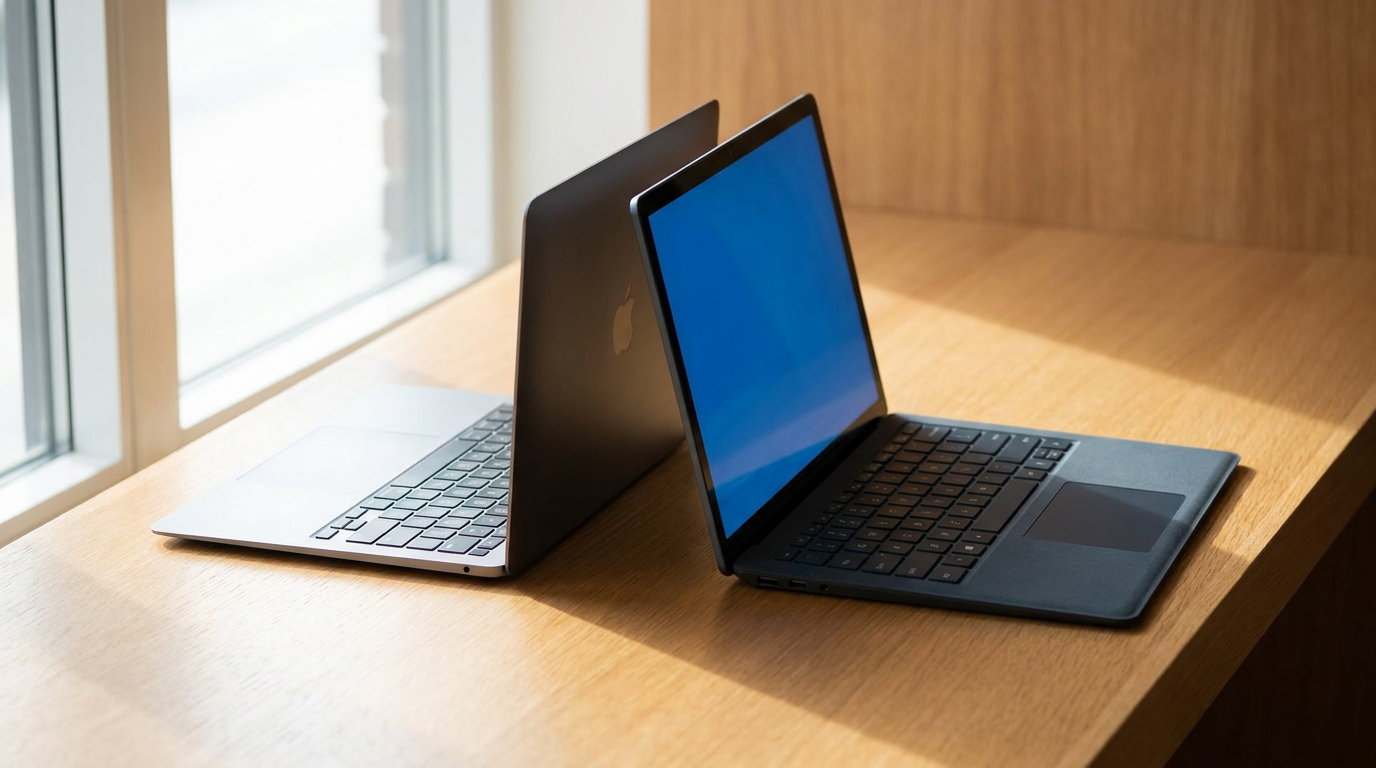
Qualcomm's Snapdragon X Elite has finally brought Apple-level battery life and performance to Windows laptops, breaking the traditional x86 monopoly. Here is how the two ARM architectures compare in real-world testing, software compatibility, and daily use.
By Factlen Editorial Team
- Windows Ecosystem Advocates
- Value hardware flexibility, touchscreen form factors, and native Microsoft enterprise compatibility.
- Apple Silicon Loyalists
- Prioritize absolute single-core speed, fanless silent operation, and seamless integration with iOS devices.
- Hardware Agnostic Reviewers
- Focus purely on benchmark data, battery life metrics, and thermal efficiency regardless of the operating system.
What's not represented
- · Intel and AMD Executives
- · PC Gamers
Why this matters
For the first time in computing history, Windows users do not have to sacrifice battery life to get top-tier performance. Understanding the trade-offs between these two ARM platforms empowers you to make a smarter, longer-lasting laptop purchase.
Key points
- Snapdragon X Elite chips bring Apple-level battery life to Windows laptops.
- Both platforms easily deliver 15 to 16 hours of real-world productivity.
- Apple M4 maintains a lead in single-core speed and graphics performance.
- Snapdragon matches or beats Apple in multi-core processing tasks.
- Microsoft's Prism emulator allows legacy Windows apps to run smoothly on ARM.
- Niche hardware drivers and heavy gaming remain the biggest hurdles for Windows on ARM.
For decades, buying a laptop meant choosing between Intel and AMD processors, both built on the traditional x86 architecture. Apple shattered that binary in 2020 with the M1 chip, moving to an ARM-based architecture that delivered unprecedented battery life and silent operation. This shift left the rest of the industry scrambling to catch up, fundamentally changing consumer expectations for how long a thin-and-light computer should last on a single charge.[6]
For years, Windows users looked on with envy as MacBooks routinely lasted two days away from an outlet. Microsoft attempted to launch Windows on ARM several times, but early iterations were plagued by sluggish emulation, poor application support, and underwhelming hardware. The experience often felt like using a smartphone processor trapped inside a laptop chassis, forcing most power users to stick with traditional, power-hungry x86 machines.[3][6]
That dynamic fundamentally changed with the arrival of Qualcomm's Snapdragon X Elite and X Plus processors. Built specifically to rival Apple's M-series, these chips have finally delivered the long-awaited "M1 moment" for the Windows ecosystem. By breaking the x86 monopoly, Qualcomm has provided a genuine, high-performance alternative to Apple Silicon, allowing Windows manufacturers to build laptops that are just as thin, quiet, and long-lasting as their macOS counterparts.[1][3]
The most immediate and noticeable battleground is battery life. Laptops powered by the Snapdragon X Elite are now routinely crossing the 20-hour threshold in local video playback tests. The HP OmniBook 5, for instance, clocked an astonishing 28 hours of continuous runtime in laboratory conditions, while Microsoft's Surface Laptop 7 comfortably cleared 22 hours. These figures finally place Windows machines on equal footing with Apple's M4 MacBooks, which average around 20 hours in similar playback scenarios.[2][5]

However, continuous video playback is one of the least demanding tasks a modern computer can perform. When shifted to real-world productivity—involving dozens of browser tabs, video calls, compiling code, and spreadsheet calculations—both platforms settle into a more realistic, yet still remarkable, 15 to 16 hours of sustained use. This means a user can comfortably leave their charger at home for a full workday and still have power left over for evening entertainment.[2][4]
In these mixed-use scenarios, Apple's M3 and M4 chips maintain a slight edge in performance-per-watt efficiency. The MacBook Air M4 can deliver its full processing power while running entirely on battery, whereas some Windows laptops still experience minor performance throttling when unplugged to preserve longevity. Nevertheless, the Snapdragon X Elite demonstrates a massive 21 to 24 percent efficiency gain over comparable Intel chips at 35 watts, proving that ARM is the future of mobile computing.[4][5]
When evaluating raw processing power, the comparison becomes a tale of two distinct design philosophies. The Snapdragon X Elite utilizes a homogeneous core design, meaning all of its processing cores can handle high-performance workloads. This architectural choice allows Qualcomm's silicon to match, and sometimes exceed, the Apple M3 and M4 in multi-core benchmarks, making it incredibly capable for heavy multitasking and data processing.[1][5]
When evaluating raw processing power, the comparison becomes a tale of two distinct design philosophies.
Conversely, Apple retains absolute dominance in single-core speeds and integrated graphics. The M4 chip routinely scores above 3,700 in single-core tests, making it exceptionally snappy for opening applications, navigating the operating system, and running complex scripts. Furthermore, Apple's highly optimized Metal framework gives MacBooks a distinct advantage in GPU-heavy tasks like video editing, color grading, and 3D rendering.[1][5]

Hardware is only half the equation; software compatibility dictates the actual user experience. Apple's transition is now fully mature. Almost all major creative and productivity applications run natively on macOS ARM, and the Rosetta 2 translation layer seamlessly handles the few remaining Intel-based legacy apps without noticeable lag or excessive battery drain.[6]
Windows on ARM has made massive strides, largely thanks to Microsoft's new "Prism" emulation layer. Prism operates with nearly the same efficiency as Rosetta 2, allowing legacy x86 Windows applications to run smoothly. Mainstream applications like Google Chrome, Microsoft 365, Zoom, and Adobe Photoshop now feature native ARM versions, meaning the vast majority of users will never notice they are running on a new architecture.[3][6]
Yet, the Windows transition is not entirely complete. Users relying on specialized hardware drivers for older printers, niche enterprise software, or kernel-level anti-cheat systems for competitive gaming may still encounter roadblocks on a Snapdragon machine. While the ecosystem is rapidly adapting, these edge cases require buyers to verify their specific software needs before making a switch.[6]
When evaluating Apple Silicon, the "for" argument centers on absolute single-core dominance, superior integrated graphics, and a flawlessly mature software ecosystem. The "against" argument highlights the rigid, non-upgradable hardware, the lack of touchscreen options, and the steep premium charged for additional memory and storage. The evidence shows M4 chips leading the industry in efficiency, but locked within a highly controlled walled garden.[4][6]

When evaluating the Snapdragon X Elite, the "for" argument is the long-awaited arrival of multi-day battery life on Windows, competitive multi-core speeds, and a vast array of hardware designs, including 2-in-1 convertibles. The "against" argument remains the lingering reliance on Prism emulation for legacy software and weaker GPU performance. The evidence points to devices like the Surface Laptop 7 delivering 22 hours of runtime, yet struggling with heavy gaming compared to traditional x86 machines.[2][3]
Ultimately, Apple Silicon fits well when a user relies heavily on creative suites like Final Cut Pro or Logic, demands fanless silent operation, or is deeply entrenched in the broader iOS ecosystem. It does not fit when a user requires native Windows applications, prefers touchscreen interfaces, or needs to run legacy enterprise software that lacks macOS support.[6]
Conversely, the Snapdragon X Elite fits well when a user needs maximum battery life for web-based productivity, prefers convertible tablet-laptop hybrid designs, or relies on Microsoft Office natively. It does not fit when a user needs to run niche x86 hardware drivers, heavy local PC gaming, or specialized audio-production plugins that currently lack ARM support.[6]
How we got here
Nov 2020
Apple introduces the M1 chip, beginning the transition of MacBooks away from Intel to ARM architecture.
Oct 2022
Microsoft releases early Windows on ARM devices, but they struggle with sluggish emulation and poor app support.
Apr 2024
Qualcomm announces the Snapdragon X Elite, promising to match Apple's M-series performance and efficiency.
May 2024
Microsoft unveils the 'Prism' emulation layer, dramatically improving legacy app performance on Windows ARM.
Early 2026
Snapdragon-powered laptops routinely cross the 20-hour battery life mark, establishing true parity with Apple Silicon.
Viewpoints in depth
Windows Ecosystem Advocates
Value hardware flexibility, touchscreen form factors, and native Microsoft enterprise compatibility.
This camp argues that the true potential of ARM architecture is only realized when paired with hardware diversity. Unlike Apple's rigid product stack, the Windows ecosystem allows users to choose 2-in-1 convertibles, dual-screen devices, and varying price points. They emphasize that Microsoft's Prism emulator has largely solved the compatibility issues that plagued earlier generations, making Snapdragon laptops the definitive choice for enterprise and general productivity users.
Apple Silicon Loyalists
Prioritize absolute single-core speed, fanless silent operation, and seamless integration with iOS devices.
Supporters of Apple's ecosystem point out that while Qualcomm has closed the battery gap, Apple still holds the crown for single-core performance and graphics processing. They highlight the maturity of macOS on ARM, noting that creative professionals can rely on native support for industry-standard applications without the performance overhead of emulation. For this group, the seamless interoperability between MacBooks, iPads, and iPhones remains an unmatched advantage.
Hardware Agnostic Reviewers
Focus purely on benchmark data, battery life metrics, and thermal efficiency regardless of the operating system.
Independent testers and benchmark analysts view the current landscape as a massive win for consumers. They focus on the empirical data: 20-plus hours of video playback and 15 hours of real-world productivity across both platforms. This camp notes that the real losers in the ARM revolution are traditional x86 manufacturers, as both Apple and Qualcomm have proven that high performance no longer requires massive power draw or loud cooling fans.
What we don't know
- How quickly niche enterprise software developers will release native ARM versions for Windows.
- Whether future generations of Snapdragon chips will close the gap in integrated graphics performance.
- How traditional x86 manufacturers like Intel and AMD will adjust their long-term mobile strategies to compete with ARM efficiency.
Key terms
- ARM Architecture
- A type of computer processor design known for high efficiency and low power consumption, originally used in smartphones.
- x86 Architecture
- The traditional processor design used by Intel and AMD for decades, known for high performance but typically higher power draw.
- Emulation Layer
- Software that translates code designed for one type of processor so it can run on a completely different architecture.
- System-on-Chip (SoC)
- An integrated circuit that combines the CPU, GPU, memory, and other essential components onto a single piece of silicon.
- Single-Core Performance
- A measure of how fast a processor can complete a task using only one of its processing units, crucial for everyday app responsiveness.
Frequently asked
Can Snapdragon laptops run regular Windows apps?
Yes. Most major apps have native ARM versions, and Microsoft's Prism emulator smoothly translates older x86 applications to run on Snapdragon chips.
Is the Apple M4 faster than the Snapdragon X Elite?
The Apple M4 wins in single-core speed and graphics performance, while the Snapdragon X Elite matches or slightly beats it in multi-core processing.
Can I play PC games on a Snapdragon laptop?
Casual gaming works well, but heavy 3D titles or games requiring kernel-level anti-cheat software often struggle or fail to run through emulation.
Do these ARM laptops have cooling fans?
The MacBook Air is entirely fanless and silent. Most Snapdragon laptops have fans, but they run quietly and rarely spin up during normal productivity tasks.
Sources
Source coverage
6 outlets
3 viewpoints surfaced






[1]QualcommHardware Agnostic Reviewers
Snapdragon X Elite Performance and Battery Life Benchmarks
Read on Qualcomm →[2]CNETHardware Agnostic Reviewers
Laptops with the longest battery life in 2026
Read on CNET →[3]Laptop MagWindows Ecosystem Advocates
Can Windows on Arm finally go toe-to-toe with Apple silicon?
Read on Laptop Mag →[4]Digital DigestApple Silicon Loyalists
What does 'All-day battery' mean in 2026
Read on Digital Digest →[5]MashableWindows Ecosystem Advocates
The Windows laptops that can keep pace with MacBooks
Read on Mashable →[6]Factlen Editorial TeamHardware Agnostic Reviewers
Synthesis by Factlen editorial team
Read on Factlen Editorial Team →

More in shopping
See all 7 stories →Display Tech
OLED vs. Mini-LED in 2026: Choosing the Right TV Display Technology
0 sources

Recommerce Boom
The $560 Billion Pivot: How Refurbished and Resale Became 2026's Smartest Way to Shop
0 sources

Appliance Tech
How Heat Pump Dryers Compare to Traditional Vented Models in 2026
0 sources
Retail Wars
Walmart, Amazon, and Target Collide in Unprecedented June Summer Sales Event
0 sources

Every angle. Every day.
Get shopping stories with full source coverage and perspective breakdowns delivered to your inbox.