
The $560 Billion Pivot: How Refurbished and Resale Became 2026's Smartest Way to Shop
Driven by inflation and sustainability goals, the global resale market has crossed $560 billion, with major retailers standardizing 'certified pre-owned' deals across tech, apparel, and luxury.
By Factlen Editorial Team
- Value-Driven Consumers
- Shoppers utilizing the secondhand market primarily to maximize purchasing power and combat inflation.
- Traditional Retailers
- Primary market brands adapting to the trend by launching in-house resale programs.
- Recommerce Platforms
- Tech-enabled marketplaces scaling the logistics and authentication of secondhand goods.
- Sustainability Advocates
- Groups focused on the environmental benefits of extending product lifecycles.
What's not represented
- · Independent thrift store owners facing increased competition from tech-enabled platforms.
- · Raw material suppliers experiencing shifts in demand due to the circular economy.
Why this matters
Buying used is no longer a gamble or a compromise. With standardized warranties, AI-verified authentication, and massive brand participation, consumers can now access flagship technology and premium apparel at 40% to 60% discounts without sacrificing quality or peace of mind.
Key points
- The global resale and refurbished market has reached a valuation of $560 billion in 2026.
- Major recommerce platforms achieved historic profitability and break-even milestones in Q1 2026.
- Refurbished electronics represent a $90 billion segment, offering flagship tech at steep discounts.
- Original manufacturers are increasingly launching their own in-house 'certified pre-owned' programs.
- AI technology has automated the complex logistics of grading, pricing, and authenticating used goods.
- New EU regulations are pushing more overstock inventory into resale and repair channels.
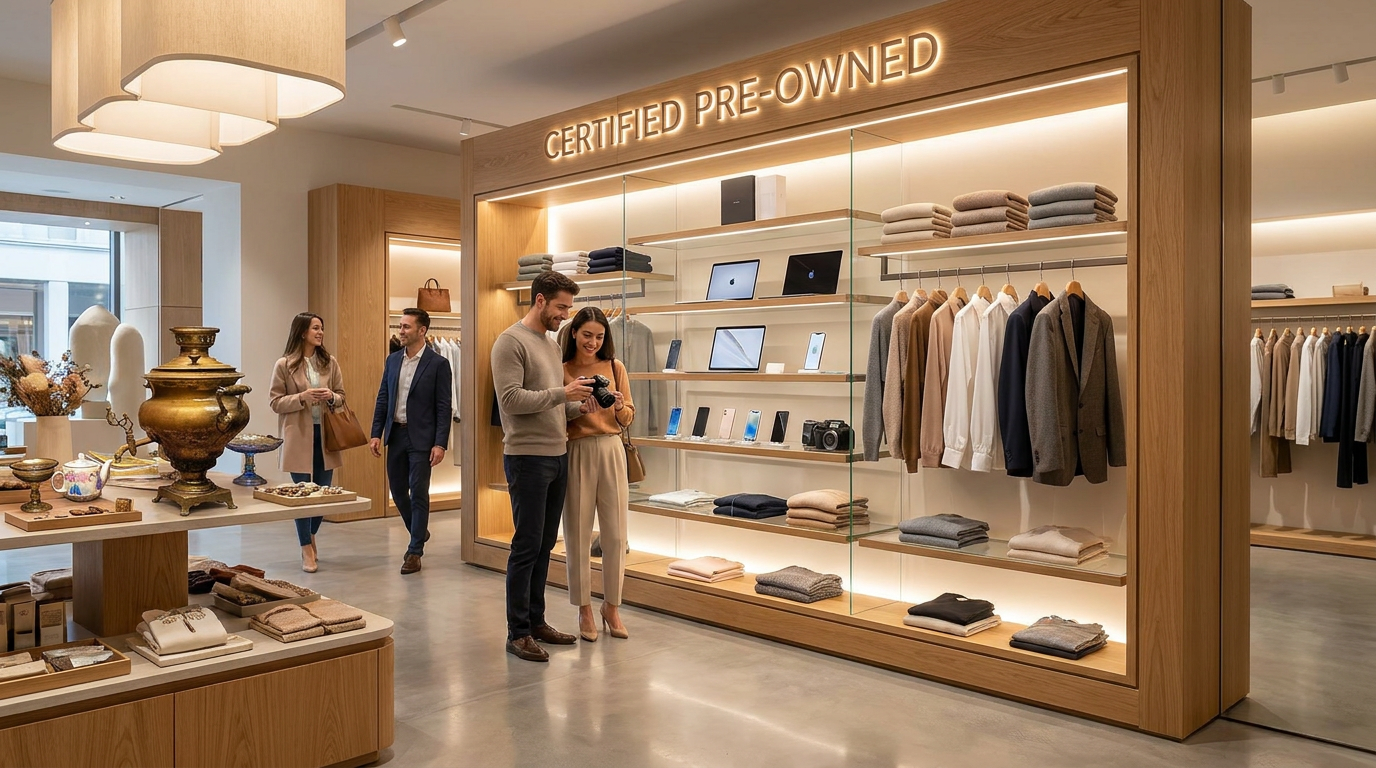
For decades, the pursuit of a great deal often meant compromising on quality, navigating sketchy third-party sellers, or digging through disorganized clearance bins. But in 2026, the landscape of discount shopping has undergone a radical, premium transformation. The global resale and refurbished market has officially crossed the $560 billion mark, growing at twice the rate of traditional retail. What was once a stigmatized "thrift" experience is now a standardized, highly professionalized sector where consumers routinely score flagship products at steep discounts.[4]
The financial milestones of early 2026 prove that the recommerce model has matured from a niche eco-trend into a retail juggernaut. In the first quarter alone, refurbished electronics giant Back Market reported over $3.5 billion in Gross Merchandise Value (GMV) and reached global break-even profitability. Similarly, luxury authenticator The RealReal crossed $2.13 billion in GMV while posting positive adjusted earnings, and apparel platform ThredUp achieved positive annual cash flow for the first time in its history. These milestones signal that the logistics of selling secondhand goods have finally been mastered at scale.[3]
This shift is fundamentally altering how consumers approach major purchases. Shoppers are no longer just hunting for extreme bargains; they are embedding resale into their regular financial lives to combat macroeconomic cost pressures. According to industry data, the secondhand apparel market alone accounts for $252 billion of the global total, while refurbished electronics make up a massive $90 billion segment. In these categories, buying "certified pre-owned" is increasingly viewed as the smartest financial move a consumer can make.[2][4]

The electronics sector has been particularly transformative for deal-seekers. Historically, buying a used laptop or smartphone carried the risk of degraded batteries or hidden hardware faults. Today, the refurbished market is dominated by rigorous certification processes. Devices are diagnostically tested, repaired with original parts, and sold with warranties that rival or match those of brand-new products. This professionalization allows consumers to purchase top-tier technology at mid-tier prices, entirely removing the traditional anxiety of the secondhand market.[3][6]
Recognizing the massive consumer appetite for these deals, traditional brands are no longer leaving the secondary market to third-party platforms. The defining trend of 2026 is "branded resale," where original manufacturers bring refurbished sales in-house. Samsung recently expanded its Certified Re-Newed phone program across major European markets, while IKEA scaled its second-hand marketplace to six countries. By controlling the resale of their own goods, brands can capture new, price-sensitive customers while maintaining strict quality control.[1][3]
Recognizing the massive consumer appetite for these deals, traditional brands are no longer leaving the secondary market to third-party platforms.
This integration is turning resale into a seamless feature of the everyday shopping experience. Retailers are embedding trade-in options directly at the point of sale and inside their loyalty programs. A customer buying a new winter coat or tablet is now routinely offered a guaranteed buyback price for their old item, creating a "resale flywheel" that subsidizes the cost of new purchases while feeding high-quality inventory back into the brand's refurbished ecosystem.[1][2]
Behind the scenes, artificial intelligence is the engine making this massive scale possible. Historically, the "dirty work" of resale—intaking unique items, grading their condition, pricing them accurately, and verifying their authenticity—was prohibitively labor-intensive. In 2026, AI computer vision and machine learning algorithms have automated these bottlenecks. Systems can now instantly grade a garment's wear or verify a luxury handbag's stitching against a database of millions of data points, drastically reducing overhead costs and passing those savings on to the buyer.[1]

AI is also revolutionizing how consumers actually find these deals. The proliferation of AI shopping agents—autonomous tools that research, compare, and recommend products—has made cross-referencing new versus refurbished prices effortless. Instead of manually checking multiple tabs, a shopper can simply ask their AI assistant to find the best reliable deal on a specific camera model. The agent instantly scans structured data across primary retailers and certified recommerce platforms, frequently surfacing a pristine refurbished option that the buyer might have otherwise missed.[5]
Beyond the immediate financial benefits, the surge in recommerce is heavily supported by a global push toward a circular economy. Environmental sustainability is no longer just a marketing talking point; it is becoming codified into law. The European Union's recent disclosure rules regarding the destruction of unsold goods are actively pushing massive volumes of pristine, overstock inventory into resale and repair channels. This regulatory pressure ensures a steady supply of high-quality goods entering the discount market.[3]
Demographically, younger consumers are the driving force behind this normalization. For Gen Z and Millennials, the stigma of buying used is entirely dead. In fact, finding a high-quality secondhand piece is often viewed as a badge of honor—a sign of savvy consumerism and environmental consciousness. These cohorts treat resale platforms not as an alternative to primary shopping, but as their first stop.[2]

Even the luxury sector, once fiercely protective of its exclusivity, has embraced the movement. The luxury resale market has ballooned to $45 billion, driven by consumers who now factor in an item's future resale value before making a primary purchase. High-end watches, jewelry, and iconic handbags are increasingly treated as liquid assets, with transparent secondary market pricing guiding consumer behavior.[1][4]
As 2026 progresses, the line between the primary and secondary markets will continue to blur. The infrastructure of recommerce has evolved to the point where buying a refurbished item feels indistinguishable from buying new—complete with slick packaging, fast shipping, and robust customer support. For the everyday consumer, this convergence represents the ultimate win: the ability to access the world's best products at a fraction of the cost, all while participating in a more sustainable global economy.[1][2][3]
How we got here
2021
Major acquisitions, such as eBay purchasing Depop, signal early mainstream validation of the resale market.
2024
Inflationary pressures drive a massive spike in consumer adoption of refurbished electronics and secondhand apparel.
2025
AI computer vision tools are widely deployed to automate the authentication and grading of used goods.
Q1 2026
Leading recommerce platforms like Back Market and ThredUp achieve landmark profitability and cash-flow milestones.
Mid 2026
The global resale market officially crosses the $560 billion valuation mark.
Viewpoints in depth
Value-Driven Consumers
Shoppers focused on maximizing purchasing power amid inflation.
For this demographic, the appeal of the resale market is purely mathematical. Facing persistent macroeconomic pressures, these consumers view refurbished electronics and secondhand apparel as a necessary strategy to maintain their standard of living. They rely heavily on standardized grading systems and robust warranties, viewing 'certified pre-owned' as a risk-free way to bypass the premium pricing of brand-new goods while still acquiring flagship quality.
Traditional Retailers
Primary market brands adapting to the secondhand boom.
Legacy brands initially viewed the resale market as a threat that cannibalized their primary sales. However, the perspective has shifted dramatically in 2026. Retailers now see 'branded resale' as a critical customer retention tool. By bringing trade-ins and refurbished sales in-house, brands can control the secondary market experience, capture revenue that would otherwise go to third-party platforms, and acquire younger, price-sensitive customers who may eventually graduate to buying new.
Sustainability Advocates
Consumers and policymakers focused on the circular economy.
This camp views the financial success of the recommerce market as a secondary benefit to its environmental impact. They champion the reduction of e-waste and textile pollution, arguing that extending the lifecycle of existing products is essential for global climate goals. This perspective is heavily supported by new European Union regulations that penalize the destruction of unsold inventory, forcing more goods into the circular economy.
What we don't know
- How traditional fast-fashion brands will survive as consumers increasingly prefer high-quality secondhand apparel over cheap new garments.
- Whether the supply of high-quality used goods can keep pace with the surging global demand over the next decade.
Key terms
- Recommerce
- The selling of previously owned, new, or used products, typically facilitated by digital platforms and standardized grading.
- Circular Economy
- An economic model focused on eliminating waste by continually reusing, repairing, and recycling existing products.
- Gross Merchandise Value (GMV)
- The total monetary value of all goods sold through a marketplace over a specific period.
- Branded Resale
- Programs where original manufacturers buy back, refurbish, and directly sell their own secondhand products to consumers.
Frequently asked
Are refurbished electronics as reliable as new ones?
Yes. 'Certified refurbished' items undergo rigorous diagnostic testing, are repaired with original parts, and typically come with warranties that match those of brand-new products.
Why are traditional brands selling used items?
Brands are launching their own resale programs to retain customers, control their brand experience, and capture revenue that would otherwise go to third-party marketplaces.
How much can I save by shopping secondhand?
Depending on the category, consumers typically save 40% to 60% on refurbished electronics and up to 80% on secondhand apparel compared to primary retail prices.
How do platforms ensure luxury items aren't fake?
Modern recommerce platforms use a combination of expert human authenticators and advanced AI computer vision to verify stitching, materials, and hardware against massive databases of genuine products.
Sources
Source coverage
6 outlets
4 viewpoints surfaced





[1]ForbesTraditional Retailers
Why Resale Is Becoming Basic To Retail In 2026
Read on Forbes →[2]ThredUpValue-Driven Consumers
2026 Resale Market and Consumer Trend Report
Read on ThredUp →[3]New Market PitchRecommerce Platforms
Q1 2026 Resale Market Insights: Acquisitions, Profitability, and Growth
Read on New Market Pitch →[4]AccioRecommerce Platforms
Global Resale Market Size and Projections 2026
Read on Accio →[5]Fast CompanyValue-Driven Consumers
AI is already helping people find the stuff they need to buy. Next year, we might just let it buy it on our behalf.
Read on Fast Company →[6]IMARC GroupSustainability Advocates
Global Refurbished Retail Market Report 2026-2034
Read on IMARC Group →



Every angle. Every day.
Get shopping stories with full source coverage and perspective breakdowns delivered to your inbox.