
The Democratization of VFX: How Independent Filmmakers Are Building Cinematic Worlds with AI
The rapid advancement of open-source AI video models in 2026 is allowing independent filmmakers to generate broadcast-quality 4K visual effects on consumer hardware. By bypassing expensive proprietary APIs, solo creators are building expansive cinematic worlds that once required massive studio budgets.
By Factlen Editorial Team
- Independent Filmmakers
- Argue that accessible AI tools democratize high-end VFX, allowing solo creators to build cinematic worlds without massive budgets.
- Open-Source Advocates
- Value local hosting, transparency, and the ability to fine-tune models without restrictive API limits or censorship.
- Commercial AI Studios
- Emphasize the turnkey reliability, native 4K resolution, and synchronized audio capabilities of proprietary models.
What's not represented
- · Traditional VFX Artists
- · Hollywood Studio Executives
Why this matters
The ability to generate photorealistic video locally fundamentally changes the economics of the entertainment industry. It empowers independent creators to compete visually with major Hollywood studios, ensuring that the best stories—not just the best-funded ones—can reach audiences.
Key points
- Independent filmmakers are increasingly using AI video models to generate broadcast-quality VFX on consumer hardware.
- Proprietary models like Veo 3.1 now offer native 4K resolution and synchronized 48kHz audio.
- Open-source models like Tencent's HunyuanVideo and Alibaba's Wan 2.2 provide powerful, locally hosted alternatives.
- The Mixture-of-Experts (MoE) architecture allows open-source models to render complex details without spiking computational costs.
- Creators are moving beyond simple text prompts, utilizing node-based interfaces like ComfyUI for precise camera and character control.
For decades, the barrier to entry for science fiction, fantasy, and visually ambitious filmmaking was largely insurmountable for independent creators. The staggering cost of practical visual effects, massive rendering farms, and dedicated animation teams meant that expansive world-building was exclusively the domain of major Hollywood studios with multi-million dollar budgets. Independent directors were often forced to scale back their scripts, relying on implied action or contained, single-room dramas to keep production costs manageable. The visual spectacle was a luxury that simply could not be afforded on an indie budget.[6]
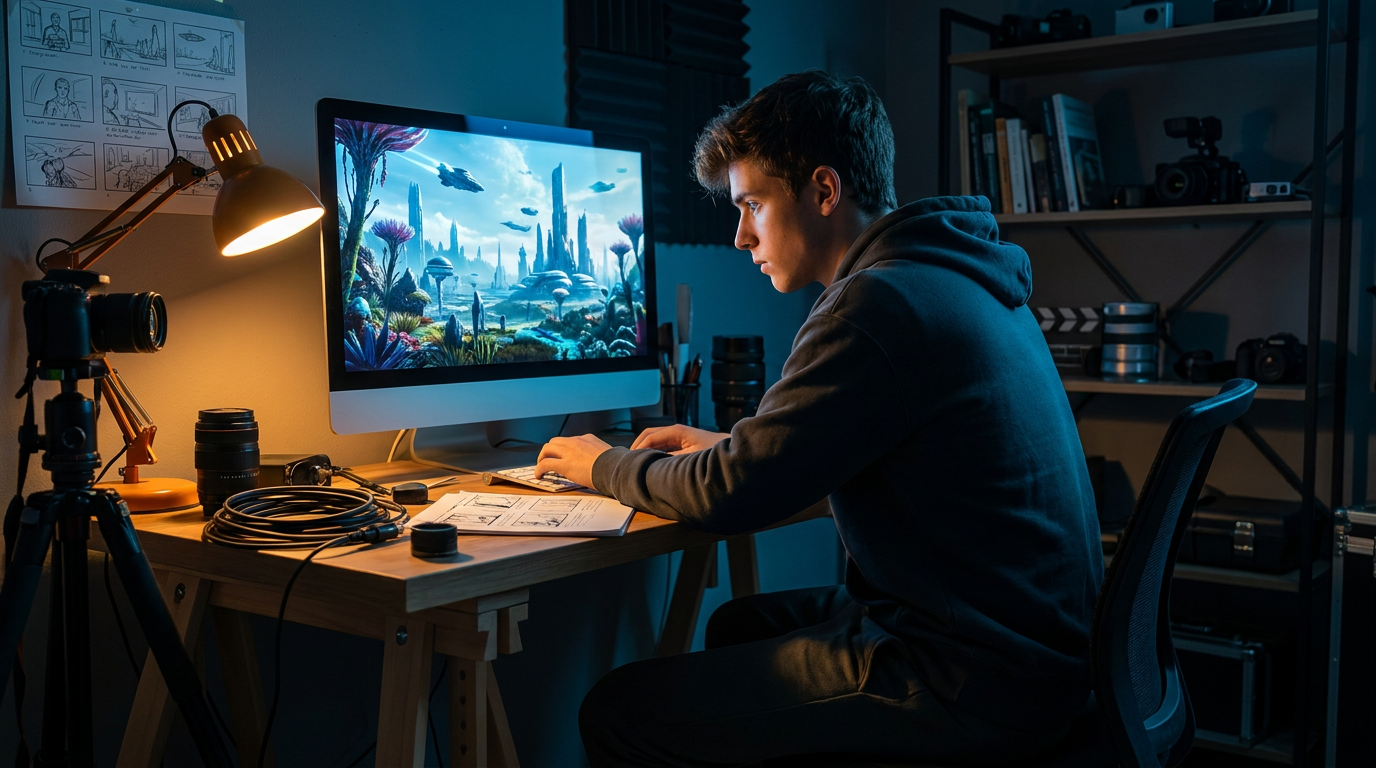
In 2026, that historical paradigm has fundamentally shifted, marking a new era of creative democratization. A solo creator equipped with a high-end consumer graphics card and a compelling script can now generate broadcast-quality, 4K cinematic sequences directly from their bedroom desk. The financial moat that once protected high-end visual effects has evaporated, replaced by accessible software that translates natural language and reference images into photorealistic motion. This shift is empowering a new generation of storytellers to visualize worlds that previously existed only in their imaginations.[6]
The primary catalyst for this democratization is the rapid maturation and deployment of generative AI video models. What began just a few years ago as a fascinating but flawed novelty—characterized by flickering textures, morphing limbs, and low-resolution outputs—has rapidly evolved into a sophisticated, reliable ecosystem of production-ready tools. These systems now understand complex physics, object permanence, and cinematic lighting, allowing them to serve as a genuine extension of the filmmaker's toolkit rather than a mere experimental toy.[4]
At the top end of the market, proprietary giants have established a breathtaking new baseline for cinematic realism and ease of use. Closed-ecosystem models like OpenAI's Sora 2 and Google's Veo 3.1 are currently leading the charge in high-fidelity output, offering turnkey solutions for creators who need immediate, flawless results. These platforms have effectively solved the "temporal consistency" problem, ensuring that characters and environments remain stable and recognizable across extended, multi-minute generation sequences.[5]

Google's Veo 3.1, in particular, has solved one of the most persistent and frustrating challenges in the AI video generation pipeline: synchronized sound. The model is now capable of generating 48kHz lip-synced dialogue and rich ambient audio in a single pass, perfectly timed to the native 4K video output. This eliminates the need for creators to painstakingly match separately generated audio tracks to the video's mouth movements, drastically reducing post-production friction.[3]
Meanwhile, platforms like Runway Gen-4.5 have focused heavily on providing directors with granular, professional-grade control over the generated output. With features like "Director Mode" and advanced motion brushes, filmmakers can dictate precise camera movements, adjust focal lengths, and define the exact blocking of characters within a scene. By offering this level of spatial control, Runway allows creators to treat the AI less like a randomized slot machine and more like a highly responsive digital backlot.[4]
However, these powerful proprietary tools come with significant trade-offs that can hinder independent production. They operate entirely behind closed APIs, subjecting creators to strict, sometimes opaque content moderation filters that can arbitrarily block creative prompts. Furthermore, the pricing structures can be prohibitively expensive for feature-length projects or high-volume experimentation. Sora 2, for instance, charges approximately $0.75 per second of generated footage, a cost that quickly accumulates when generating multiple takes and variations for a single scene.[5]
In direct response to these corporate restrictions and high costs, a robust "open-source rebellion" has emerged, providing independent filmmakers with powerful, locally hosted alternatives. By releasing the underlying model weights to the public, developers are allowing creators to run these sophisticated video generators on their own hardware, entirely free from subscription fees, API rate limits, and external censorship. This open ecosystem has become the beating heart of the indie AI filmmaking community, fostering rapid innovation and collaborative problem-solving.[1]
This open ecosystem has become the beating heart of the indie AI filmmaking community, fostering rapid innovation and collaborative problem-solving.
Leading this open-source charge is Tencent's HunyuanVideo, a massive 13-billion-parameter model that directly rivals the cinematic realism and physical accuracy of the closed systems. Because the weights are open, filmmakers can fine-tune HunyuanVideo on their own custom datasets—such as concept art, specific actor faces, or unique architectural styles—ensuring that the generated footage perfectly matches the specific aesthetic requirements of their film, a level of customization impossible on closed platforms.[2]

Alibaba's Wan 2.2 has also pushed the boundaries of what is possible within the open-source architecture, introducing highly efficient structural innovations. It stands as the industry's first open-source video generation model to successfully utilize a Mixture-of-Experts (MoE) framework, a design previously reserved for advanced text-based large language models. This architectural leap allows the model to generate incredibly detailed scenes without requiring a supercomputer to run.[1]
The Mixture-of-Experts architecture represents a profound technical breakthrough for video synthesis. Instead of routing every single prompt through one massive, computationally expensive neural network, the system intelligently employs specialized sub-networks, or "experts." A high-noise expert manages the initial spatial layout and broad composition of the video, while a separate low-noise expert takes over to refine the intricate textures, lighting, and micro-details in the later stages of generation.[1]
This intelligent division of labor allows the Wan 2.2 model to vastly expand its total creative capacity and generate highly complex, dynamic scenes without proportionally increasing the computational cost or the time it takes to render the video. For the independent filmmaker rendering scenes on a home workstation, this efficiency is the difference between waiting days for a single shot and iterating multiple versions in a single afternoon.[1]

Raw generation speed is another critical factor driving the adoption of open-source models in indie workflows. Models like Lightricks' LTX-Video have prioritized rapid iteration over absolute maximum resolution, capable of generating smooth, 30 frames-per-second video faster than real-time on capable consumer hardware. This immediate feedback loop fundamentally changes how a director approaches the creative process, encouraging bold experimentation.[2]
This unprecedented speed allows filmmakers to rapidly prototype complex storyboards, test drastically different lighting setups, and experiment with unconventional camera angles before committing the necessary compute power to a final, high-resolution 4K render. It effectively serves as an infinitely flexible pre-visualization tool, allowing directors to "shoot" and review an entire scene in low resolution before finalizing the visual effects. This saves both time and money.[2]
The actual workflow for AI filmmaking in 2026 has matured far beyond simply typing a text prompt into a web box and accepting the first result that appears. Professional creators are integrating these open-source models into complex, node-based graphical interfaces like ComfyUI, which allow for a highly modular and deeply customizable production pipeline. These environments provide the granular control required for true cinematic production.[6]

Through these advanced interfaces, directors can utilize supplementary tools like ControlNet to dictate the exact skeletal movement of a character, map the precise path of a virtual camera through a 3D space, and ensure strict temporal consistency across multiple disparate shots. The AI is no longer a black box; it is a highly tunable instrument that responds to the precise, technical demands of the filmmaker.[6]
While the underlying technology is undeniably breathtaking, the true revolution lies in the shifting economics and accessibility of visual storytelling. High-end visual effects, sweeping cinematic landscapes, and complex crowd simulations are no longer a luxury reserved for the elite; they are a commodity accessible to anyone with a compelling vision and the dedication to learn the tools. The playing field has been leveled in a way that was unimaginable just a decade ago.[4]
As these open-source models continue to evolve and consumer hardware grows ever more powerful, the traditional gatekeepers of cinematic spectacle are losing their monopoly. The next great, visually groundbreaking cinematic universe is increasingly likely to emerge not from a sprawling studio lot in Los Angeles, but from an independent creator armed with open weights, a consumer GPU, and an uncompromising imagination.[6]
How we got here
Early 2024
OpenAI announces Sora, demonstrating the immense potential of text-to-video generation but keeping access heavily restricted.
Mid 2025
Platforms like Runway Gen-3 and Luma Dream Machine introduce advanced camera controls and physics-aware motion to the public.
Late 2025
Tencent releases HunyuanVideo, a 13-billion-parameter open-source model that rivals the cinematic realism of closed systems.
Early 2026
Alibaba launches Wan 2.2, the first open-source video model to successfully utilize a highly efficient Mixture-of-Experts architecture.
Mid 2026
Native 4K generation with synchronized audio becomes the industry standard, bridging the gap between AI output and broadcast television.
Viewpoints in depth
Independent Filmmakers
Focus on the democratization of visual effects and storytelling.
For independent directors, the primary value of AI video generation is economic liberation. They argue that the traditional studio system acts as a gatekeeper, where only safe, established intellectual properties receive the funding necessary for high-end visual effects. By utilizing open-source models on consumer hardware, solo creators can bypass this financial bottleneck entirely. They emphasize that AI does not replace the director's vision; rather, it serves as an infinitely scalable digital backlot, allowing them to visualize ambitious sci-fi and fantasy narratives that would otherwise remain unproduced.
Open-Source Advocates
Champion the release of open weights for transparency and creative freedom.
The open-source community argues that true creative freedom cannot exist within the walled gardens of corporate APIs. They point out that proprietary models often impose arbitrary content filters, alter prompts to fit corporate safety guidelines, and charge prohibitive per-second fees. By championing models like HunyuanVideo and Wan 2.2, these advocates prioritize local hosting and the ability to fine-tune the underlying weights. They believe that the future of AI filmmaking relies on a decentralized ecosystem where creators have absolute ownership over their production pipelines and data.
Commercial AI Studios
Emphasize the turnkey reliability and cutting-edge features of proprietary models.
Proponents of closed-ecosystem models like Sora 2 and Veo 3.1 argue that proprietary platforms offer an unmatched level of polish and reliability necessary for professional production. They highlight features like native 4K resolution, 48kHz synchronized audio, and guaranteed temporal consistency as technical hurdles that are difficult to overcome with consumer hardware. For high-volume marketing agencies and commercial studios, the predictable, turnkey nature of these APIs justifies the subscription costs, as it eliminates the need for complex local setups and constant troubleshooting.
What we don't know
- How traditional Hollywood labor unions will adapt their contracts to account for the widespread use of AI-generated visual effects.
- Whether future copyright legislation will impact the ability of independent creators to commercialize films generated with open-source models.
- How quickly consumer GPU hardware will scale to allow real-time, 4K generation of complex MoE architectures locally.
Key terms
- Mixture-of-Experts (MoE)
- A machine learning architecture that divides tasks among specialized sub-networks, improving efficiency and detail without increasing computational cost.
- Open Weights
- AI models where the underlying mathematical parameters are publicly available, allowing users to run and modify the software locally.
- ComfyUI
- A node-based graphical interface that allows creators to build complex, customized workflows for AI image and video generation.
- Temporal Consistency
- The ability of an AI video model to keep characters, objects, and environments stable and recognizable across multiple frames of a video.
Frequently asked
Can I run these AI video models on my home computer?
Yes, open-source models like CogVideoX-5B and Wan 2.2 can be run locally on high-end consumer GPUs, though the most massive models may require cloud hosting.
Do AI video generators produce sound?
In 2026, top-tier proprietary models like Google's Veo 3.1 generate synchronized 48kHz dialogue and ambient audio alongside the video in a single pass.
How much does it cost to generate a short film using proprietary AI?
Costs vary widely depending on the platform; models like Sora 2 charge around $0.75 per second, while budget-friendly options like Veo 3.1's fast mode cost $0.15 per second.
Sources
Source coverage
6 outlets
3 viewpoints surfaced






[1]SiliconFlowOpen-Source Advocates
Ultimate Guide - The Top Open Source AI Video Generation Models in 2026
Read on SiliconFlow →[2]PixazoOpen-Source Advocates
Best Open Source AI Video Generation Models in 2026
Read on Pixazo →[3]PinggyCommercial AI Studios
Best Video Generation AI Models in 2026
Read on Pinggy →[4]Reset MediaIndependent Filmmakers
Sora vs Runway Gen-3: Which AI Wins the Future of Filmmaking?
Read on Reset Media →[5]AI PerksCommercial AI Studios
Best AI Video Generators 2026: Sora 2 vs Veo 3.1 vs Kling 3.0 vs Runway
Read on AI Perks →[6]Factlen Editorial TeamIndependent Filmmakers
Synthesis by Factlen editorial team
Read on Factlen Editorial Team →

Every angle. Every day.
Get ai stories with full source coverage and perspective breakdowns delivered to your inbox.