
At-Home Brain Implant and AI Voice Synthesizer Restore Speech for Man with ALS
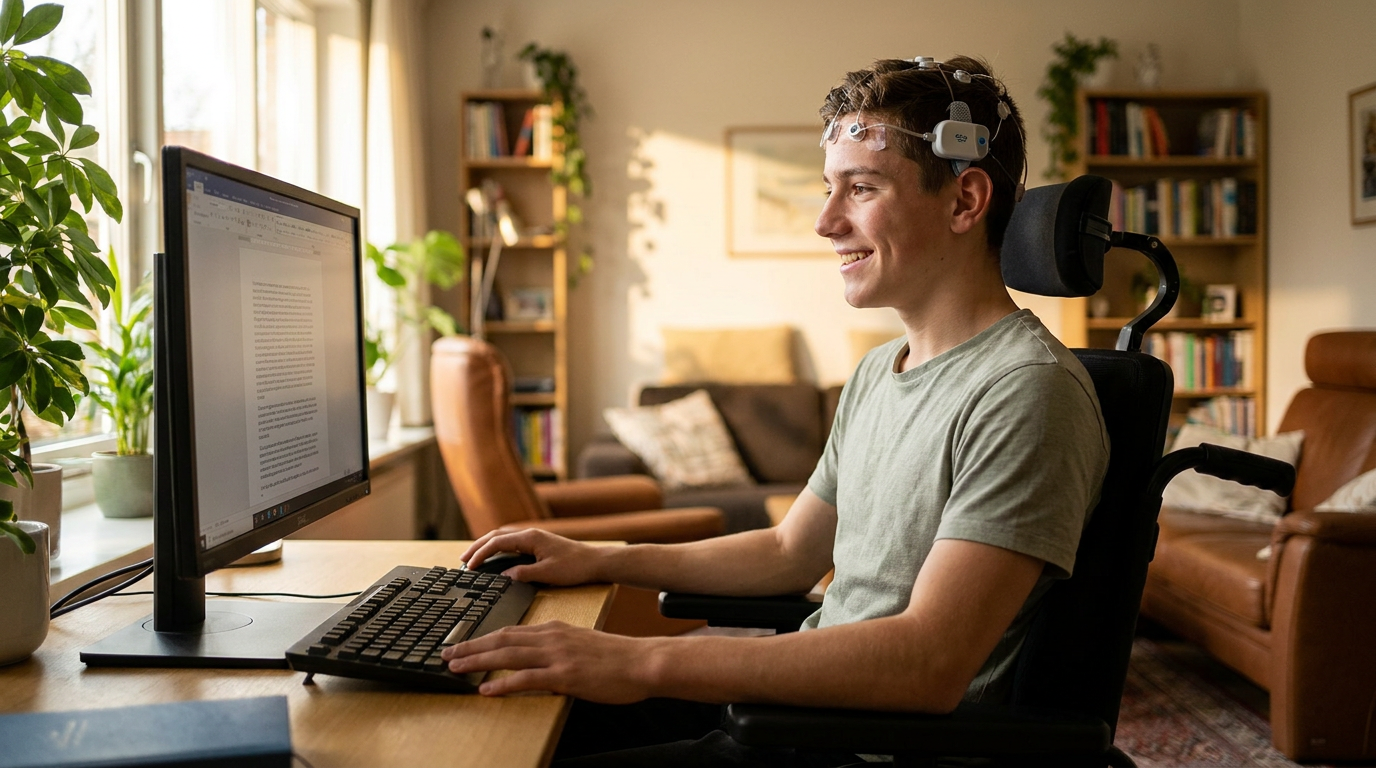
A groundbreaking brain-computer interface has allowed a 45-year-old man with ALS to communicate independently at home using his natural voice. The system translates neural signals into speech with 97.5 percent accuracy, marking a major leap from lab-bound prototypes to real-world medical technology.
By Factlen Editorial Team
- Neuroprosthetic Researchers
- Focuses on the technological leap from lab to home use and the unprecedented decoding accuracy.
- ALS Patients & Advocates
- Emphasizes the restoration of dignity, independence, and the emotional impact of reconnecting with loved ones.
- Clinical Skeptics
- Highlights the long-term uncertainties, including progressive brain atrophy and the barriers to commercial scalability.
What's not represented
- · Medical Insurance Providers
- · Bioethicists
Why this matters
For decades, severe paralysis and neurodegenerative diseases like ALS have condemned patients to locked-in syndrome, stripping away their ability to communicate. This breakthrough proves that the brain's intention to speak can be reliably decoded in a daily home environment, paving the way for technologies that restore agency, dignity, and connection to thousands of people.
Key points
- A 45-year-old man with ALS successfully used a brain-computer interface to communicate independently at home for nearly two years.
- The system translates neural signals into phonemes, achieving 97.5 percent accuracy with a 125,000-word vocabulary.
- An AI voice synthesizer trained on the patient's pre-ALS audio recordings allows him to speak in his natural voice with emotional intonation.
- The breakthrough proves that high-density microelectrode arrays can function reliably outside of controlled laboratory environments.
For Casey Harrell, a 45-year-old climate activist diagnosed with amyotrophic lateral sclerosis (ALS), the progressive loss of his voice felt like being trapped inside his own mind. But a groundbreaking study published in the journal Nature on June 15, 2026, details how an advanced brain-computer interface (BCI) has successfully restored his ability to speak. Unlike previous experimental devices that were strictly confined to laboratory settings, Harrell has used this neuroprosthesis independently in his own home for nearly two years. The evidence presented in the study marks a profound milestone in medical technology, demonstrating that severe paralysis does not have to mean the end of natural, real-time communication.[1][2]
The primary clinical claim of the Nature evidence pack is that intracortical microelectrode arrays can reliably decode attempted speech in a real-world environment over an extended period. For decades, BCIs required teams of researchers to calibrate the machinery daily, making them impractical for daily life. Harrell’s case shatters this limitation. Over the course of the trial, he logged more than 3,800 hours of independent use, operating the system on a near-daily basis to converse with his family, send emails, and continue his professional advocacy work.[1][2]
The hardware evidence centers on the surgical implantation of four microelectrode arrays manufactured by Blackrock Neurotech. In July 2023, neurosurgeons at UC Davis placed these sensors—comprising 256 individual intracortical electrodes—into Harrell’s left precentral gyrus. This specific region of the brain's frontal lobe is responsible for coordinating the complex voluntary muscle movements required for speech. By targeting this area with a high density of electrodes, the research team was able to capture a vastly richer stream of neural data than earlier, lower-resolution implants could achieve.[2][5][6]
Crucially, the system does not read Harrell’s private thoughts or inner monologue. Instead, the software intercepts the electrical commands his brain is actively trying to send to his paralyzed lips, tongue, larynx, and jaw. A sophisticated machine-learning algorithm processes these neural signals every 80 milliseconds, decoding them into phonemes—the fundamental building blocks of sound. This approach bypasses the damaged spinal nerves entirely, tapping directly into the brain's intact motor planning centers to reconstruct the intended speech.[3][5]

The translation from neural data to audible speech relies on a custom AI voice synthesizer. Researchers utilized audio recordings of Harrell from before his ALS diagnosis to train the software, allowing the computer to output speech that sounds exactly like his natural voice. The evidence shows that the system is sensitive enough to detect subtle neural variations, enabling Harrell to modulate his intonation, emphasize specific words, and even sing simple melodies. This paralinguistic capability transforms the output from a robotic monotone into a deeply human expression.[3][6]
The quantitative data regarding communication speed illustrates the magnitude of the breakthrough. Prior to the surgery, Harrell relied on an expert human interpreter who could decipher his residual, strained vocalizations at a painstaking rate of roughly six to seven words per minute. With the BCI active, his communication speed surged to between 32 and 56 words per minute. While still slower than the average conversational rate of 150 words per minute, this speed allows Harrell to participate dynamically in discussions and interrupt naturally.[2][6][7]

The quantitative data regarding communication speed illustrates the magnitude of the breakthrough.
The vocabulary metrics further validate the system's efficacy. By the second day of use, the AI model had achieved 90 percent accuracy with a staggering 125,000-word vocabulary. Over the subsequent eight months of rigorous data collection, the system maintained a 97.5 percent sustained decoding accuracy. This expansive lexicon ensures that Harrell is not limited to basic requests; he can express complex philosophical ideas, crack spontaneous jokes, and engage in the nuanced dialogue required for his environmental activism.[4][5][7]
The human impact of this technological evidence is perhaps the most compelling aspect of the trial. Harrell’s daughter, Aya, was an infant when his ALS symptoms first emerged, and she had no memory of his natural voice. When the system was first activated in their home, Harrell was able to speak directly to her in his true voice—a moment that brought his family and the attending researchers to tears. The device has fundamentally restored his agency, allowing him to parent, socialize, and work with a renewed sense of independence.[4][6][7]
Despite the overwhelming success of Harrell's case, the Nature publication and accompanying clinical editorials maintain transparent uncertainty regarding the long-term durability of the implant. Dr. Edward Chang, a prominent neurosurgeon at UCSF, noted that progressive brain atrophy is a hallmark of ALS. As the disease advances, the physical structure of the brain degrades, which can eventually shift the position of the electrodes or destroy the targeted neurons, potentially rendering the interface ineffective after years of successful use.[6]
Hardware limitations present another layer of uncertainty. The current iteration of the Blackrock Neurotech array requires a physical pedestal to protrude through the patient's scalp, connecting the internal electrodes to external processing computers via wires. This transcutaneous connection carries an inherent, ongoing risk of infection and requires meticulous daily care. The ultimate goal for the field is a fully implantable, wireless system—similar to a pacemaker—but achieving the necessary bandwidth for speech decoding without overheating the brain remains a formidable engineering challenge.[5][6]

Commercial viability and accessibility also remain highly speculative. The bespoke nature of the surgery, combined with the hundreds of hours required to train the personalized AI models, makes this intervention astronomically expensive. Currently, the technology is strictly confined to clinical trials funded by research grants. Scaling this solution to the hundreds of thousands of patients worldwide suffering from severe dysarthria due to ALS, strokes, or traumatic brain injuries will require massive reductions in both cost and calibration time.[6][7]
Looking forward, researchers are actively exploring strategies to mitigate these risks. Future trials may attempt to interface with different brain regions that are less susceptible to ALS-induced degeneration, ensuring a longer lifespan for the implant. Meanwhile, competing neurotech firms, including Synchron and Neuralink, are rapidly iterating on wireless designs and endovascular delivery methods that could eliminate the need for open brain surgery entirely, potentially accelerating the path to regulatory approval.[5][6]
For now, the evidence pack presented by the UC Davis and Brown University consortium stands as a definitive proof of concept. It confirms that high-density intracortical recordings, paired with advanced machine learning, can safely and effectively restore naturalistic speech in a home environment. The data proves that the neural blueprints for speech remain intact long after the physical ability to speak has vanished, waiting only for the right technology to unlock them.[1][2][5]
Ultimately, Casey Harrell’s experience redefines the boundaries of locked-in syndrome. By bridging the gap between an active mind and a paralyzed body, the BCI has dismantled the isolation that typically accompanies late-stage ALS. While the scientific community grapples with the engineering and economic hurdles of mass adoption, the immediate reality is that a father has reclaimed his voice, offering a profound glimpse into a future where neurological silence is no longer permanent.[4][7]
How we got here
2019
Casey Harrell begins experiencing early symptoms of ALS shortly after the birth of his daughter.
2020
Harrell is officially diagnosed with ALS and begins losing his ability to speak clearly.
July 2023
Neurosurgeons at UC Davis implant four microelectrode arrays into Harrell's brain.
August 2023
The BCI system is activated, allowing Harrell to communicate in his own voice for the first time in years.
June 2026
Results of the multi-year at-home trial are published in Nature, demonstrating sustained accuracy and independence.
Viewpoints in depth
Neuroprosthetic Researchers
Focuses on the technological leap from lab to home use and the unprecedented decoding accuracy.
For the scientists and engineers behind the BrainGate consortium, Harrell’s case is a watershed moment in neuroprosthetics. For decades, the field struggled with the 'lab-to-home' transition, as BCIs required constant recalibration by experts to function. By achieving 97.5 percent sustained accuracy over eight months of independent home use, researchers argue they have crossed a critical threshold. They view the integration of high-density microelectrode arrays with predictive AI language models as the definitive blueprint for future assistive technologies, proving that the brain's motor planning centers remain highly active and readable long after physical paralysis sets in.
ALS Patients & Advocates
Emphasizes the restoration of dignity, independence, and the emotional impact of reconnecting with loved ones.
From the perspective of the ALS community, the metrics of words-per-minute are secondary to the profound restoration of human connection. Advocates highlight that losing the ability to speak often leads to severe isolation and a loss of agency. For patients like Harrell, the BCI is not just a medical device; it is a lifeline that allows him to parent his young daughter, express his personality through humor, and continue his life's work as a climate activist. This camp argues that prioritizing funding for communication neuroprostheses is a moral imperative, as it directly addresses the most devastating psychological symptom of neurodegenerative disease.
Clinical Skeptics
Highlights the long-term uncertainties, including progressive brain atrophy and the barriers to commercial scalability.
While acknowledging the breakthrough, cautious clinical voices point to the inherent limitations of the current technology. Neurologists note that ALS causes progressive brain atrophy, which can eventually degrade the neural signals and render the implant useless over time. Furthermore, skeptics emphasize the immense barriers to scaling this intervention. The requirement for invasive open-brain surgery, the infection risks associated with wired transcutaneous pedestals, and the astronomical costs of bespoke AI training mean that this technology is years, if not decades, away from being a standard, accessible treatment for the average patient.
What we don't know
- How long the microelectrode arrays will remain effective before progressive brain atrophy from ALS degrades the neural signals.
- When fully wireless, implantable versions of the technology will be available to eliminate the infection risks of transcutaneous wires.
- How the immense costs of bespoke brain surgery and personalized AI training can be reduced to make the device commercially accessible.
Key terms
- Amyotrophic Lateral Sclerosis (ALS)
- A progressive neurodegenerative disease that attacks nerve cells in the brain and spinal cord, leading to loss of muscle control and paralysis.
- Brain-Computer Interface (BCI)
- A system that translates brain activity into commands for external devices, bypassing the need for physical movement.
- Precentral Gyrus
- A region in the brain's frontal lobe responsible for executing voluntary motor movements, including the coordination of speech muscles.
- Phoneme
- The smallest unit of sound in speech that distinguishes one word from another, such as the 'p' sound in 'tap'.
- Microelectrode Array
- A tiny grid of sensors implanted into the brain to record the electrical activity of individual neurons.
Frequently asked
Does the brain implant read the patient's thoughts?
No. The device only intercepts the electrical commands the brain attempts to send to the muscles of the lips, tongue, and jaw. It cannot read internal monologues or private thoughts.
How does the computer sound like the patient?
Researchers used audio recordings of the patient from before his ALS diagnosis to train a custom AI voice synthesizer, allowing the system to output speech in his natural voice.
Is this technology available to the public?
Not yet. The system is currently part of an ongoing clinical trial. Widespread commercial availability is likely years away due to the need for invasive surgery and bespoke AI training.
Can the patient use the device without scientists present?
Yes. Unlike earlier prototypes that required a lab setting, this system was designed for independent at-home use, and the patient has logged over 3,800 hours operating it in his daily life.
Sources
Source coverage
7 outlets
3 viewpoints surfaced







[1]NatureNeuroprosthetic Researchers
At-home brain implant gives man with motor neuron disease his daily life back
Read on Nature →[2]UC Davis HealthNeuroprosthetic Researchers
Brain-computer interface enables independent, accurate communication for man living with ALS
Read on UC Davis Health →[3]Singularity HubClinical Skeptics
AI-Guided Brain Implant Restores ALS Patient’s Voice in Real Time
Read on Singularity Hub →[4]The GuardianALS Patients & Advocates
Casey Harrell: The climate activist fighting BlackRock while battling ALS
Read on The Guardian →[5]Blackrock NeurotechNeuroprosthetic Researchers
Breakthrough Accuracy in Speech BCI
Read on Blackrock Neurotech →[6]ReutersClinical Skeptics
Text-to-speech brain implant restores ALS patient's voice
Read on Reuters →[7]Inc. MagazineALS Patients & Advocates
Brain Implants Are Giving ALS Patients Their Voices Back
Read on Inc. Magazine →

Every angle. Every day.
Get science stories with full source coverage and perspective breakdowns delivered to your inbox.