
The Amazon Can Survive Climate Change—If We Stop Cutting It Down
A landmark Earth system study reveals that the Amazon rainforest is highly resilient to global warming, but only if humanity halts deforestation and protects its internal moisture-recycling system.
By Factlen Editorial Team
- Earth System Scientists
- Focus on the empirical data, the mechanics of atmospheric moisture tracking, and the precise thresholds where the forest loses its ability to generate its own rainfall.
- Conservation Advocates
- Emphasize the actionable hope in the findings: that halting land clearing and restoring degraded areas can actively save the biome from climate-driven collapse.
- Agricultural & Economic Stakeholders
- Highlight the severe economic risks of forest dieback, particularly the threat to South American agricultural yields if the Amazon's rainfall generation fails.
What's not represented
- · Local Indigenous communities living within the affected regions
- · Commercial logging and agribusiness operators driving the land clearing
Why this matters
For years, the narrative around the Amazon has been fatalistic, suggesting climate change had already doomed the ecosystem. This new evidence proves that local, actionable conservation—stopping deforestation—can actively save the biome and protect global agricultural stability.
Key points
- A new Earth system model reveals the Amazon rainforest is highly resilient to global warming if its trees remain intact.
- Halting deforestation would allow the forest to withstand global temperature increases of up to 3.7 to 4.0°C.
- If land clearing reaches 22 to 28 percent, the forest's internal rain-making system will collapse.
- Under high deforestation, current warming levels (1.5 to 1.9°C) are enough to turn two-thirds of the Amazon into a dry savanna.
- Roughly 17 to 18 percent of the Amazon has already been cleared, making immediate conservation efforts critical.
The prevailing narrative about the Amazon rainforest has long been tinged with fatalism—a sense that global warming has already locked the world's largest biodiverse ecosystem into an irreversible decline. However, a landmark study published in the journal Nature fundamentally rewrites this trajectory, offering a surprisingly hopeful, actionable path forward.[1][2]
The research, led by the Potsdam Institute for Climate Impact Research (PIK), provides the most detailed quantification to date of how the forest responds to the dual pressures of rising temperatures and land clearing. The core finding is a revelation of resilience: if humanity can halt deforestation, the Amazon can withstand significantly higher levels of global warming than previously assumed.[2][3]
"Deforestation makes the Amazon far less resilient than we previously anticipated," explains Nico Wunderling, the lead author of the PIK study. By isolating the variables, the researchers discovered that the forest's vulnerability is not primarily driven by the ambient temperature of the planet, but by the physical removal of its trees.[3][4]
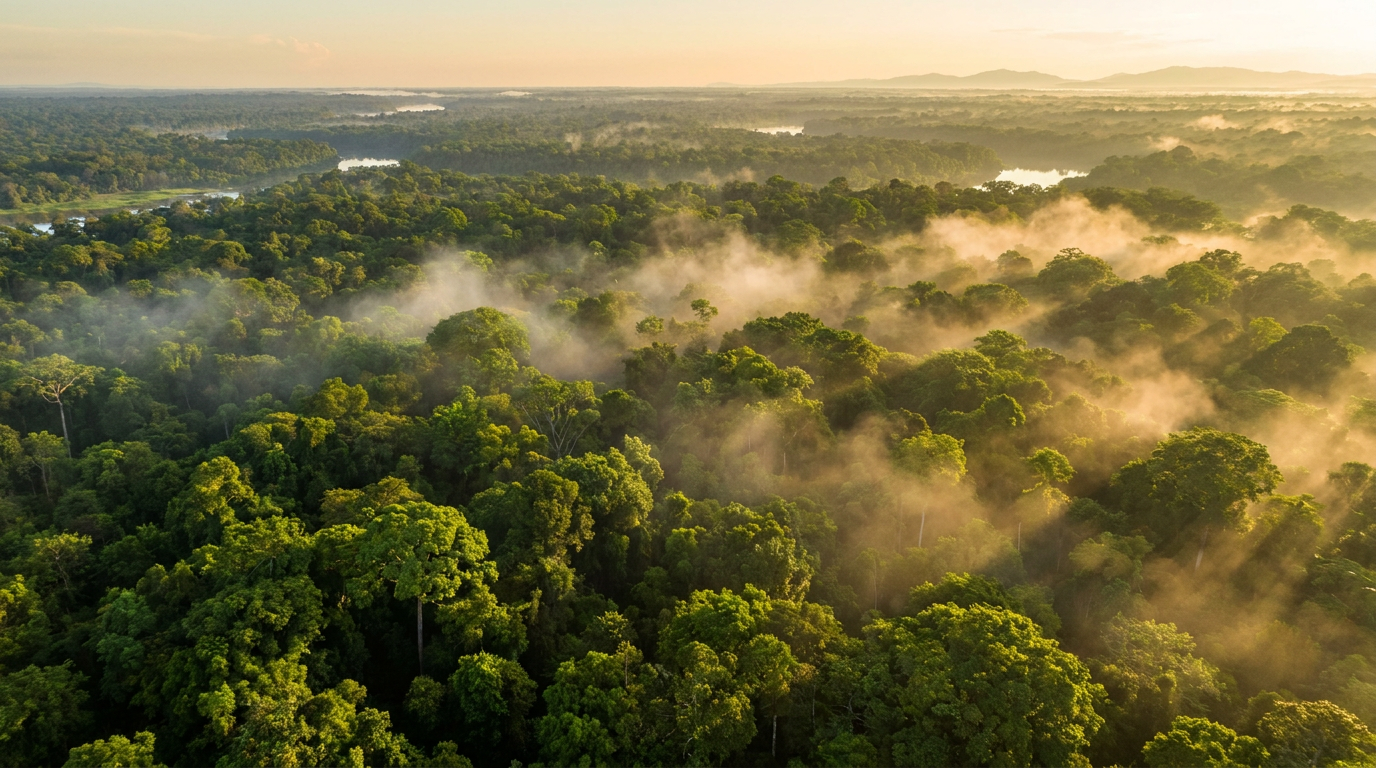
To understand this mechanism, scientists utilized a Lagrangian atmospheric moisture tracking model known as UTrack, which traces the three-dimensional movement of water from evaporation to precipitation. The Amazon is famous for generating its own weather; up to half of the basin's rainfall comes from water recycled by the trees themselves.[3][6]

This internal recycling is what allows the Amazon to sustain its lush, hyper-humid environment even during dry seasons. Trees act as massive biological pumps, drawing groundwater up through their roots and exhaling it through their leaves in a process called transpiration. A single large canopy tree can release hundreds of gallons of water into the air every day, collectively forming atmospheric rivers that transport moisture across the continent.[5][7]
When vast tracts of forest are cleared, this biological moisture pump is severed. "When deforestation interrupts moisture transport in one area of the Amazon, entire regions hundreds or even thousands of kilometers away can also lose resilience through cascading drought effects," notes Arie Staal, a co-author from Utrecht University.[3][5]
The evidence pack presented by the researchers outlines two starkly different futures. In the first scenario, where deforestation continues to climb to between 22 and 28 percent of the basin, the forest's internal moisture recycling collapses. Under these conditions, a global temperature rise of just 1.5 to 1.9 degrees Celsius above pre-industrial levels would be enough to trigger a massive dieback.[4][8]
The evidence pack presented by the researchers outlines two starkly different futures.
In this high-deforestation scenario, up to two-thirds of the Amazon could rapidly transition into a degraded, savanna-like ecosystem. Given that the planet has already warmed by approximately 1.4 degrees Celsius, and roughly 17 to 18 percent of the Amazon has already been cleared, this dangerous threshold is uncomfortably close.[5][6]

But the second scenario—the one that has energized conservationists and policymakers—demonstrates the profound power of human agency. The models show that if deforestation is completely halted, the Amazon's internal moisture recycling remains robust enough to buffer the ecosystem against extreme heat.[1][4]
Without the compounding stress of land clearing, the forest would not face a large-scale tipping point until global temperatures reach a staggering 3.7 to 4.0 degrees Celsius. While such a temperature would be catastrophic for global climate systems, the finding proves that the Amazon itself is not inherently doomed by the warming already baked into the pipeline.[3][6]
"In that way, it is a positive scenario, as it shows we need to reach a very high level of warming before we see these partial system-wide Amazon Rainforest transition risks," Wunderling noted, emphasizing that the crisis can absolutely be turned around if land clearing is tempered.[4]
This scientific consensus shifts the burden of saving the Amazon from the abstract challenge of global atmospheric carbon down to the highly concrete, solvable problem of regional land management. It aligns perfectly with recent political momentum, particularly in Brazil, which houses the majority of the rainforest.[1][2]
An editorial accompanying the study in Nature highlighted that Brazilian President Luiz Inácio Lula da Silva is showing initial success in curbing deforestation rates. However, the editorial stressed that Brazil cannot bear this burden alone; the international community must provide the structural support necessary to make forest preservation economically viable.[1][7]

The financial architecture required to support this shift is already being debated on the global stage. At recent climate summits, nations have discussed mechanisms to pay tropical countries for the ecosystem services their forests provide. If the Amazon's carbon storage and rainfall generation are properly valued by global markets, keeping the trees standing becomes far more profitable than clearing them for cattle ranching or soy production.[7][8]
The stakes extend far beyond biodiversity. The PIK researchers warn that a transition to a savanna state would not only erase the planet's most biodiverse habitat but also devastate agricultural yields across South America due to disrupted rainfall patterns. Furthermore, the Amazon would shift from being a massive carbon sink to a major carbon source, accelerating the very warming that threatens it.[3][5][8]
Ultimately, the data presents a clear mandate. The Amazon's survival is not contingent on miraculously reversing global warming overnight, but on an immediate, concerted effort to stop cutting it down. By restoring degraded lands and protecting the remaining canopy, humanity can buy the rainforest the resilience it needs to weather the coming century.[1][2][7]
How we got here
2021
More than 100 countries sign the Glasgow Leaders' Declaration at COP26, committing to halt and reverse forest loss by 2030.
2023
Global temperatures reach approximately 1.4°C above pre-industrial levels, increasing heat stress on tropical biomes.
May 2026
The Potsdam Institute for Climate Impact Research publishes a landmark study quantifying the combined risks of warming and deforestation.
June 2026
Nature publishes an editorial highlighting early successes in curbing Brazilian deforestation and calling for global financial support.
Viewpoints in depth
Earth System Scientists
Focus on the empirical data and the mechanics of atmospheric moisture tracking.
For climatologists and modelers, the breakthrough lies in isolating the variables of temperature and land use. Using the UTrack Lagrangian moisture model, researchers mapped exactly how the Amazon generates its own weather. They argue that the forest's vulnerability is primarily mechanical: removing trees severs the biological moisture pump that recycles water inland. Their data proves that the ecosystem is remarkably heat-resistant, provided its physical structure remains intact to sustain this internal water cycle.
Conservation Advocates
Emphasize the actionable hope and the urgent need to halt land clearing.
Environmental groups view this data as a powerful antidote to climate fatalism. Rather than accepting the Amazon's demise as an inevitable consequence of global emissions, they point to the study as proof that local, immediate action can save the biome. Their focus is on holding governments accountable to zero-deforestation pledges, enforcing protections for Indigenous lands, and securing international funding to make forest preservation economically viable.
Agricultural & Economic Stakeholders
Highlight the severe economic risks of forest dieback and disrupted rainfall.
For the agricultural sector and regional economists, the study is a stark warning about the bottom line. The Amazon acts as a massive irrigation engine for South America; if it transitions to a savanna, the resulting drought would devastate crop yields across the continent. These stakeholders emphasize that protecting the forest is no longer just an environmental crusade, but a critical necessity for maintaining regional food security and economic stability.
What we don't know
- Exactly how quickly the transition to a savanna state would occur if the 22-28% deforestation threshold is crossed.
- Whether international financial commitments will be sufficient to offset the economic incentives driving illegal logging and agricultural expansion.
- How localized micro-climates within the vast Amazon basin might resist or accelerate the drying effects.
Key terms
- Tipping point
- A critical threshold where a small change pushes a system into a completely new, often irreversible state.
- Lagrangian moisture tracking
- A complex modeling technique that traces the physical path of water vapor as it moves through the atmosphere from evaporation to rainfall.
- Biological moisture pump
- The process by which vast forests draw water from the ground and release it into the air, driving regional weather patterns and rainfall.
- Savanna-like ecosystem
- A dry, grassy landscape with widely spaced trees, which supports far less biodiversity and stores significantly less carbon than a dense rainforest.
- Carbon sink
- A natural environment, like a forest or ocean, that absorbs more carbon dioxide from the atmosphere than it releases.
Frequently asked
Is the Amazon rainforest already doomed by climate change?
No. Recent modeling shows that if we completely halt deforestation, the Amazon can withstand global temperature increases up to 3.7°C, proving it is highly resilient if left physically intact.
How does the Amazon create its own rain?
Trees draw water from the soil and release it into the atmosphere as vapor through their leaves. This moisture forms clouds that travel inland, creating a continuous cycle of rainfall across the basin.
What happens if deforestation reaches 22 to 28 percent?
At that level of land clearing, the forest's moisture recycling system breaks down. Combined with current global warming, this could trigger a massive dieback, turning up to two-thirds of the forest into a dry savanna.
How much of the Amazon has already been deforested?
Scientists estimate that roughly 17 to 18 percent of the Amazon basin has already been cleared, placing the ecosystem uncomfortably close to the critical danger threshold.
Sources
Source coverage
8 outlets
3 viewpoints surfaced







[1]NatureEarth System Scientists
The Amazon can be saved — with concerted action inside and outside Brazil
Read on Nature →Deforestation-induced drying lowers Amazon climate threshold
Read on Nature →[3]Potsdam Institute for Climate Impact ResearchEarth System Scientists
Deforestation lowers threshold for Amazon degradation to below 2°C warming
Read on Potsdam Institute for Climate Impact Research →[4]MongabayConservation Advocates
Deforestation coupled with climate change is rapidly pushing the Amazon Rainforest toward a perilous tipping point
Read on Mongabay →[5]Down To EarthAgricultural & Economic Stakeholders
As warming and deforestation intensify, the Amazon could begin driving its own collapse, study warns
Read on Down To Earth →[6]Hindustan TimesAgricultural & Economic Stakeholders
Amazon rainforest may hit tipping point at 1.9°C global warming: Study
Read on Hindustan Times →[7]REDD-MonitorConservation Advocates
A tipping point could be reached at 1.5 to 1.9°C global heating
Read on REDD-Monitor →[8]Outlook BusinessAgricultural & Economic Stakeholders
Amazon Rainforest Could Face Critical Ecological Breakdown at Lower Warming Levels, Says Study
Read on Outlook Business →


Every angle. Every day.
Get science stories with full source coverage and perspective breakdowns delivered to your inbox.