
Smart Ring vs. Smartwatch: The 2026 Health Tracking Trade-Off
As wearable technology splits into two distinct form factors, consumers face a choice between the passive, sleep-focused smart ring and the active, feature-rich smartwatch.
By Factlen Editorial Team
- Digital Minimalists
- Users who prefer passive health tracking without the distraction of screens and notifications.
- Active Athletes
- Fitness enthusiasts who demand real-time workout metrics, GPS, and active coaching.
- Sleep Optimizers
- Individuals focused on recovery who prioritize overnight comfort and clinical-grade sleep data.
What's not represented
- · Traditional watch enthusiasts who wear smart rings specifically so they can continue wearing mechanical timepieces.
- · Medical professionals evaluating consumer wearables for remote patient monitoring.
Why this matters
Choosing the wrong wearable is a $300 to $500 mistake that often results in the device sitting unused in a drawer. Understanding the fundamental trade-offs between active wrist computers and passive finger sensors ensures you invest in a tool that actually improves your daily health habits.
Key points
- Smart rings excel at passive sleep tracking due to their lightweight design and stable finger sensor placement.
- Smartwatches dominate active workout tracking, offering real-time GPS, heart rate zones, and pacing data.
- Clinical studies show smart rings generally outperform wrist wearables in detecting deep sleep and wakefulness.
- Battery life heavily favors rings, which can last up to a week compared to the daily charging required for most watches.
- Smart rings often require ongoing monthly subscriptions to unlock full data, increasing their long-term cost.
- The choice ultimately depends on whether a user prioritizes digital minimalism or active, on-demand smartphone integration.
The wearable health technology market in 2026 has officially bifurcated into two distinct philosophies: the active wrist computer and the passive finger sentinel. For years, the smartwatch was the default answer for anyone looking to quantify their daily activity, monitor their heart rate, and track their sleep. However, the rapid maturation of the smart ring category has transformed the buying decision. Consumers are no longer just choosing between brands like Apple and Samsung; they are choosing between fundamentally different relationships with their personal health data. Making the right choice requires understanding the deep trade-offs between a device that demands your attention and one that silently observes.
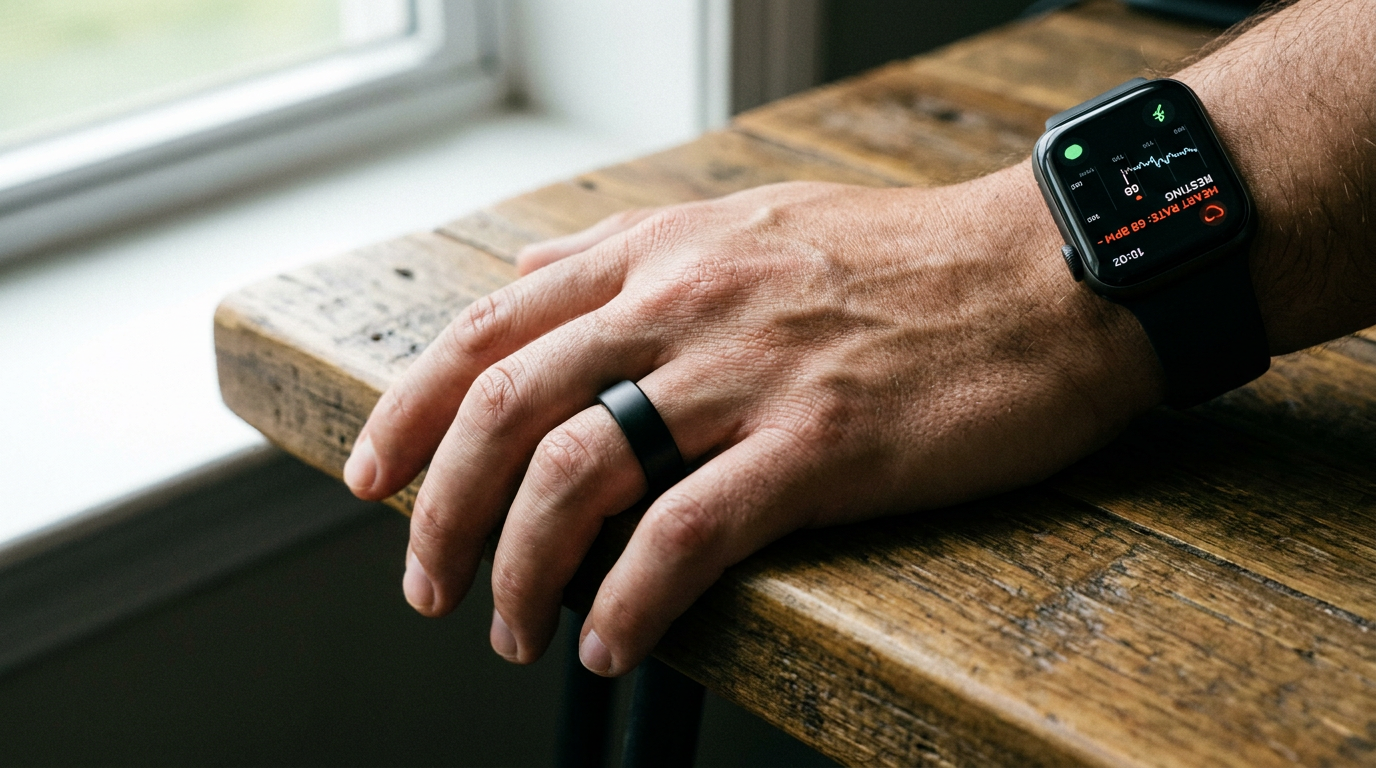
The core difference between these two form factors lies in how they interact with the user. Smartwatches are designed as extensions of the smartphone, featuring bright OLED screens, haptic notifications, and on-demand applications. They are built for active engagement. Smart rings, weighing a mere three to seven grams, have no screens and offer zero notifications. Their entire surface area is dedicated to housing advanced biometric sensors that collect data continuously in the background. This philosophical divide dictates where each device excels and where it inevitably falls short in daily use.[7]
When evaluating these devices for sleep tracking, the trade-off analysis strongly favors the ring form factor. The primary argument for smart rings centers on overnight comfort and sensor placement. The finger provides a denser capillary network closer to the skin's surface than the wrist, yielding cleaner photoplethysmography (PPG) signals with less noise from ambient light or movement. The main argument against rings in this category is simply the lack of a display, requiring users to open a smartphone app upon waking to view their recovery metrics.[7]
The clinical evidence heavily supports the smart ring's dominance in overnight monitoring. A 2024 validation study published by the National Institutes of Health compared consumer wearables against medical-grade polysomnography. The evidence showed that the Oura Ring achieved 79.5 percent sensitivity for deep sleep detection, significantly outperforming wrist-based alternatives like the Apple Watch, which registered at 50.5 percent sensitivity. Furthermore, sleep publications note that the lightweight nature of rings results in much higher user compliance, as many people find bulky smartwatches too uncomfortable to wear consistently to bed.[3][4]

However, the smartwatch is not entirely outclassed in the bedroom. Recent testing by The Wall Street Journal, as reported by 9to5Mac, found that the Apple Watch Series 11 matched clinical lab results down to the exact minute for total sleep duration. While it may struggle slightly with granular sleep staging compared to a ring, the smartwatch provides a highly accurate big-picture view of total rest. For users who can tolerate wearing a watch overnight, the data remains robust enough for general wellness tracking.[5]
However, the smartwatch is not entirely outclassed in the bedroom.
Shifting the trade-off analysis to active workout tracking, the arguments for smartwatches become overwhelming. Devices like the Apple Watch Series 11 and Samsung Galaxy Watch 7 offer real-time pacing, built-in GPS for outdoor runs, and immediate heart-rate zone alerts. The arguments against smart rings for exercise focus on their physical limitations: they lack screens for mid-workout feedback, and gripping heavy barbells or kettlebells can scratch the ring's exterior or cause physical discomfort.[1][2]
The evidence from field testing confirms this stark divide in active performance. Reviewers at CNET and Wareable consistently report that smart rings struggle to accurately capture high heart rates during intense indoor cycling, high-intensity interval training, or weightlifting. The optical sensors on a finger are highly susceptible to noise when the hand is gripping an object tightly. In contrast, smartwatches excel across almost every athletic activity, providing reliable cardiovascular data and seamless integration with third-party fitness platforms like Strava.[1][2]
In the battery life and digital minimalism trade-off, smart rings present a highly compelling case. The argument for rings is their ability to run for nearly a week without needing a charge. The Samsung Galaxy Ring, for example, lasts up to six days on a single charge and includes a wireless charging case that eliminates battery anxiety entirely. The argument against smartwatches is the constant need for daily charging and the cognitive load of wrist-based notifications, which can contribute to screen fatigue.[1][6]

The evidence of user behavior suggests that battery anxiety is a primary reason people abandon their wearables. A device that requires charging every 24 to 48 hours inevitably spends time off the body, creating gaps in health data. The invisible nature of a smart ring ensures continuous, uninterrupted data collection. Furthermore, many users report that removing the smartwatch eliminates the stress of constant wrist vibrations, allowing them to engage with their health metrics only when they actively choose to open their smartphone app.[2][7]
Cost and long-term ownership present another critical point of comparison. The argument for smartwatches is that they generally represent a one-time hardware purchase, with comprehensive health suites included out of the box. The argument against smart rings is the prevalence of subscription models. While the upfront cost of a ring might be lower, platforms often lock detailed sleep and recovery insights behind a monthly fee, which can add hundreds of dollars to the total cost of ownership over a few years. However, newer entrants like RingConn and Samsung are beginning to challenge this by offering subscription-free models.[1][7]
Ultimately, the smart ring fits well when a user prioritizes sleep optimization, values digital minimalism, and wants a device that disappears into the background of their life. It is the ideal choice for individuals who want rigorous, continuous health data without the distraction of another screen. It does not fit when a user requires real-time workout metrics, standalone GPS for running, or the ability to triage smartphone notifications without reaching into their pocket.[6][7]

Conversely, the smartwatch fits well when an individual is an active athlete who needs on-demand coaching, values deep ecosystem integration, and wants a true extension of their smartphone on their wrist. It is the ultimate tool for real-time performance tracking and connectivity. It does not fit when a user finds wrist wearables uncomfortable during sleep, suffers from notification fatigue, or is unwilling to commit to a strict daily charging routine. For those who refuse to compromise, wearing both—a watch for the day and a ring for the night—is becoming an increasingly popular, albeit expensive, solution.[1][2]
How we got here
2015
Oura launches its first-generation smart ring, pioneering the finger-based sleep tracking category.
2022
Clinical studies validate that finger-based photoplethysmography (PPG) sensors rival medical-grade electrocardiography for resting heart rate.
2024
Samsung enters the smart ring market with the Galaxy Ring, validating the form factor for mainstream Android users.
2026
The wearable market firmly bifurcates, with consumers actively choosing between screen-heavy smartwatches and screenless smart rings.
Viewpoints in depth
Digital Minimalists
Users who prefer passive health tracking without the distraction of screens and notifications.
This camp argues that modern life is already saturated with screens and notifications. They view smartwatches as a source of anxiety rather than wellness, pointing out that constant wrist vibrations disrupt focus. For these users, smart rings offer the perfect compromise: rigorous biometric tracking that operates silently in the background, allowing them to review their health data on their own terms without being tethered to a secondary display.
Active Athletes
Fitness enthusiasts who demand real-time workout metrics, GPS, and active coaching.
Runners, cyclists, and weightlifters heavily favor smartwatches for their active utility. They argue that a wearable must provide immediate feedback—such as heart rate zones, GPS pacing, and interval timers—to be genuinely useful during training. They also highlight the physical drawbacks of rings, noting that gripping heavy barbells or kettlebells with a smart ring is uncomfortable and risks damaging the device's internal sensors.
Sleep Optimizers
Individuals focused on recovery who prioritize overnight comfort and clinical-grade sleep data.
This group prioritizes overnight comfort and clinical-grade sleep staging above all else. They cite studies showing that the finger's dense capillary network provides superior photoplethysmography (PPG) signals compared to the wrist. Because rings are lightweight and unobtrusive, this camp achieves much higher overnight wear compliance, arguing that a health tracker is only valuable if it is actually worn consistently during sleep.
What we don't know
- Whether future smart rings will successfully integrate haptic feedback or payment systems without sacrificing their multi-day battery life.
- How upcoming non-invasive blood glucose monitoring technology will be divided between wrist and finger form factors.
Key terms
- Photoplethysmography (PPG)
- An optical measurement technique used by wearables to detect blood volume changes in the microvascular bed of tissue, commonly used to calculate heart rate.
- Polysomnography (PSG)
- A comprehensive sleep study used as the medical gold standard for diagnosing sleep disorders and validating wearable accuracy.
- Heart Rate Variability (HRV)
- The measure of the time variation between consecutive heartbeats, used as a key indicator of physical recovery and stress.
Frequently asked
Can I wear a smart ring while lifting weights?
It is generally not recommended. Gripping heavy metal barbells or dumbbells can scratch the ring's exterior, cause physical discomfort, and potentially damage the internal sensors.
Do smart rings require a monthly subscription?
Many leading models, such as the Oura Ring, require a monthly fee to access detailed health insights. However, some alternatives like the Samsung Galaxy Ring and RingConn offer subscription-free models.
Which device is better for tracking runs?
A smartwatch is significantly better for running. It provides built-in GPS for route tracking, a screen for real-time pacing, and more accurate high-intensity heart rate monitoring.
Can a smart ring wake me up with an alarm?
Most smart rings do not have built-in vibration motors or speakers, so they cannot wake you up directly. You will still need to rely on your smartphone or a smartwatch for morning alarms.
Sources
Source coverage
7 outlets
3 viewpoints surfaced







[1]CNETActive Athletes
Samsung Galaxy Ring Review: Health and Fitness Tracking on Your Finger
Read on CNET →[2]WareableDigital Minimalists
Galaxy Ring vs Galaxy Watch: Which Samsung Wearable is Right for You?
Read on Wareable →[3]Sleep ReviewSleep Optimizers
Oura Ring Outperforms Apple Watch and Fitbit in Sleep Staging Accuracy
Read on Sleep Review →[4]National Institutes of HealthSleep Optimizers
Validation of Consumer Wearables for Sleep Tracking
Read on National Institutes of Health →[5]9to5MacActive Athletes
Here's how Apple Watch Series 11 stacks up against Oura, Fitbit, and Whoop
Read on 9to5Mac →[6]SamsungSleep Optimizers
Smart ring vs smartwatch: Which is best for fitness & health tracking?
Read on Samsung →[7]AskVoraDigital Minimalists
Smart Ring vs Smartwatch: The 2026 Wearable Decision Guide
Read on AskVora →
Every angle. Every day.
Get shopping stories with full source coverage and perspective breakdowns delivered to your inbox.