
US and Iran Reach Peace Deal to Reopen Strait of Hormuz, Easing Global Inflation Fears
A preliminary agreement to end the U.S.-Iran conflict has triggered a sharp drop in oil prices and a global stock market rally. The deal paves the way for the Strait of Hormuz to reopen, though logistical and diplomatic hurdles remain.
By Factlen Editorial Team
- Macroeconomic Optimists
- Focuses on the immediate relief the deal provides to global inflation and central bank interest rate policies.
- Energy Logistics Experts
- Emphasizes the physical reality that mine-clearing and infrastructure repair will take months, delaying a full supply recovery.
- Geopolitical Analysts
- Highlights the fragility of the 60-day diplomatic window and unresolved disputes over Iran's nuclear program and transit fees.
What's not represented
- · Consumer advocacy groups focused on household energy bills
- · Environmental organizations monitoring the impact of maritime conflict
Why this matters
The reopening of the Strait of Hormuz removes the immediate threat of $120+ oil, which was driving up the cost of gasoline, manufacturing, and food worldwide. This relief gives central banks room to pause interest rate hikes, directly impacting mortgage rates and borrowing costs for consumers.
Key points
- The U.S. and Iran have reached a preliminary agreement to end hostilities and reopen the Strait of Hormuz.
- Brent crude oil prices dropped 5% to below $83 a barrel following the announcement.
- The Federal Reserve is now expected to hold interest rates steady, easing fears of further hikes.
- Mine-clearing operations in the strait could take up to seven weeks to complete.
- The interim deal establishes a 60-day window to negotiate a permanent treaty on Iran's nuclear program.
- Global oil stockpiles must now be refilled, which is expected to keep prices from falling to pre-war levels.
After more than 100 days of the most severe energy supply disruption in modern history, the global economy is breathing a collective sigh of relief. The United States and Iran have reached a preliminary peace agreement to end their military conflict and reopen the Strait of Hormuz. The breakthrough, announced over the weekend, immediately deflated a geopolitical risk premium that had choked global supply chains and threatened to tip the world into a recession.[2][3][7]
The financial response was instantaneous and euphoric. Brent crude, the international benchmark for oil prices, tumbled 5% to below $83 a barrel in early trading—a dramatic retreat from the crisis peak of $126 a barrel. Global equities surged in tandem, with the Dow Jones Industrial Average hitting a record high and Japan's Nikkei 225 soaring 5.5%. Investors are rapidly pricing in a scenario where the worst of the war-driven inflation has passed.[1][2][6]
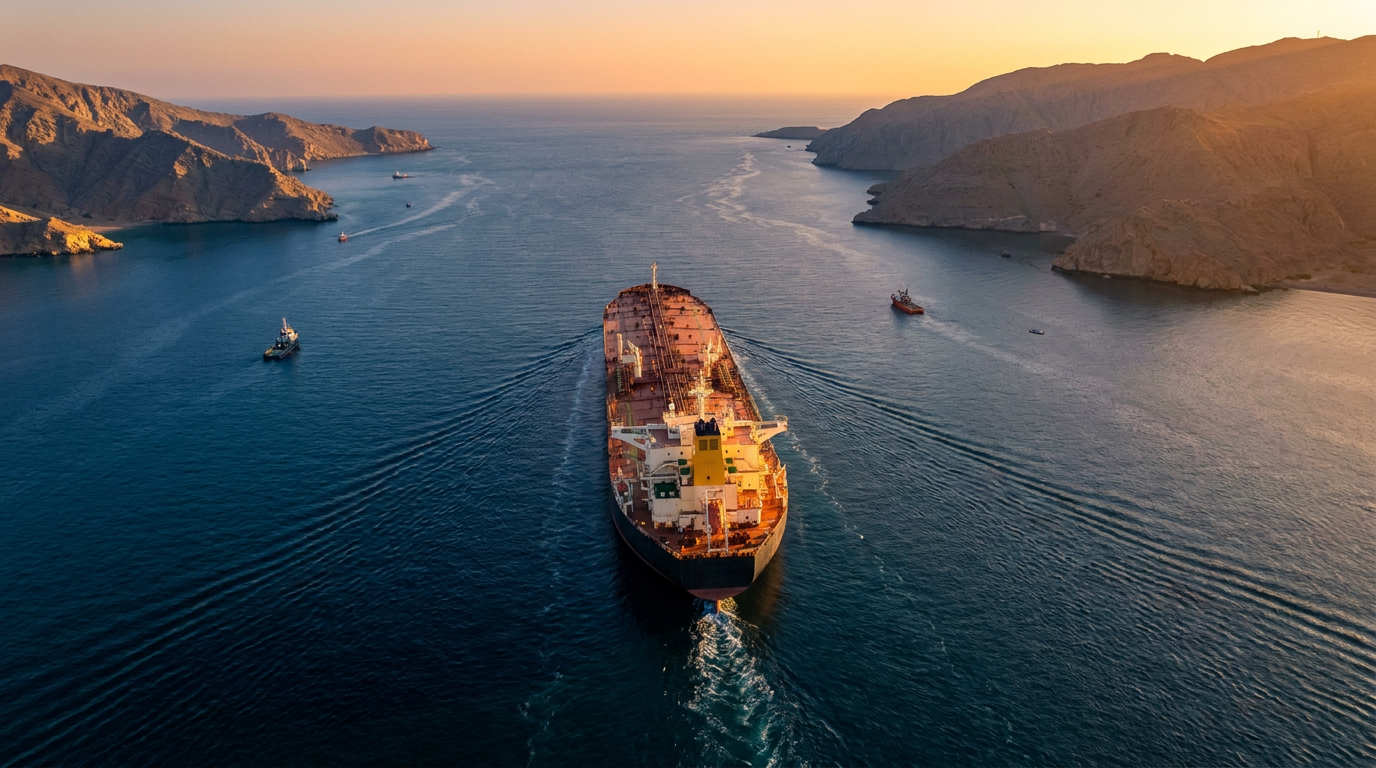
The core mechanism of this economic crisis has been the closure of the Strait of Hormuz, a narrow maritime chokepoint between the Persian Gulf and the Gulf of Oman. Under normal conditions, the strait handles roughly one-fifth of global oil consumption and serves as a critical artery for liquefied natural gas. Its blockade created a daily shortfall of approximately 14 million barrels of oil, forcing nations to drain their strategic petroleum reserves at a historic pace just to keep their economies functioning.[3][6]

U.S. President Donald Trump celebrated the breakthrough on social media, declaring the deal complete and authorizing the removal of the U.S. naval blockade. "Ships of the World, start your engines. Let the oil flow!" he wrote. The tentative agreement, brokered with the help of Pakistani Prime Minister Shehbaz Sharif, establishes a 60-day memorandum of understanding that includes a permanent cessation of hostilities across all fronts, including Lebanon.[2][3][7]
The diplomatic framework is expected to be formally signed at a ceremony in Switzerland on Friday. In exchange for the U.S. lifting its blockade and unfreezing an estimated $24 billion in Iranian assets, Tehran has agreed to halt its nuclear weapons development for the duration of the 60-day window. This period is designed to give negotiators time to hammer out a permanent treaty regarding sanctions relief and nuclear oversight.[2][3][6]
For central bankers, the diplomatic breakthrough arrives at a critical moment. The Federal Reserve, led by newly appointed Chair Kevin Warsh, convenes this week to set U.S. monetary policy. Prior to the agreement, Warsh faced mounting pressure to raise interest rates to combat a resurgence in inflation, which jumped to a three-year high of 4.2% in May due to soaring energy and transportation costs.[5]
The sudden drop in crude prices fundamentally alters the Fed's calculus. Markets now widely expect the Federal Open Market Committee to hold its benchmark federal funds rate steady at a range of 3.50% to 3.75%. By removing the immediate threat of a prolonged energy shock, the peace deal gives policymakers the flexibility to maintain a "wait-and-see" approach rather than aggressively tightening credit and risking a domestic recession.[1][5]

The sudden drop in crude prices fundamentally alters the Fed's calculus.
This relief extends far beyond Washington. The Bank of England, which also meets this week, is similarly expected to hold its interest rates at 3.75%. European and Asian economies, which are highly dependent on imported energy, have spent the last three months grappling with surging manufacturing and fertilizer costs. A sustained drop in wholesale gas and oil prices is the most direct mechanism for cooling this imported inflation.[2][3]
However, the transition from a diplomatic signature to normalized global trade is fraught with logistical hurdles. Energy logistics experts warn that the physical supply recovery will be significantly slower than the instantaneous price reaction seen in financial markets. The Strait of Hormuz cannot simply be switched back on overnight.[4][6]
The immediate obstacle is maritime security. The waters must undergo extensive mine-clearing operations, a delicate process that military analysts estimate could take up to seven weeks. Shipping companies and maritime insurers are also demanding clear security protocols and guarantees of safe passage before they risk sending multi-million-dollar vessels and crews back into the corridor.[2][6]

Furthermore, the region's energy infrastructure requires substantial rehabilitation. Oil fields and export terminals that were shut in or damaged during the conflict cannot instantly resume full-capacity production. Industry officials caution that bringing these facilities back online and clearing the massive backlog of waiting vessels will take months of coordinated effort.[3][4][6]
There is also the reality of depleted global stockpiles. Because countries spent the spring aggressively drawing down their emergency reserves to mitigate the blockade, buyers will now race to refill those tanks. This surge in baseline demand is expected to create a price floor, likely keeping crude oil between $80 and $90 a barrel for the remainder of the year, preventing an immediate return to the pre-war average of $69.[2]
The diplomatic foundation of the reopening also contains unresolved friction points. While the U.S. has demanded a "toll-free" reopening of the strait, Iranian officials have publicly stated their intention to charge a "service fee" for navigation, environmental protection, and maritime insurance. Disputes over these tanker fees could easily disrupt the fragile flow of commerce.[2][4]

Ultimately, the global economy remains tethered to the success of the 60-day negotiation window. If the interim agreement collapses and hostilities resume, the market will rapidly price the geopolitical risk premium back into every barrel of oil and every shipping container.[6][7]
For now, the worst-case economic scenarios—a prolonged global recession triggered by $150-a-barrel oil—appear to have been averted. The focus now shifts from the battlefield to the negotiating table in Switzerland, and to the complex, unglamorous work of clearing mines and repairing pipelines in the Persian Gulf.[2][3][6]
How we got here
Late Feb 2026
Military conflict escalates, leading to the effective closure of the Strait of Hormuz.
Spring 2026
Brent crude prices peak at $126 a barrel, forcing historic drawdowns of strategic petroleum reserves.
June 14, 2026
President Trump and Iranian officials announce a preliminary peace agreement.
June 15, 2026
Global stock markets rally and oil prices tumble to a three-month low.
June 19, 2026
The formal memorandum of understanding is scheduled to be signed in Switzerland.
Viewpoints in depth
Macroeconomic Optimists
Focuses on the immediate relief the deal provides to global inflation and central bank interest rate policies.
Financial analysts and equity investors view the peace deal as the ultimate pressure release valve for the global economy. By removing the threat of $150-a-barrel oil, the agreement effectively caps the war-driven inflation that has plagued the first half of 2026. This camp argues that central banks, particularly the Federal Reserve and the Bank of England, now have the runway they need to pause interest rate hikes, averting a policy-induced recession and allowing equity markets to thrive.
Energy Logistics Experts
Emphasizes the physical reality that mine-clearing and infrastructure repair will take months, delaying a full supply recovery.
While financial markets react instantly, physical commodity markets move at the speed of ships and pipelines. Energy sector analysts caution that the Strait of Hormuz cannot simply be switched back on. They point to the complex, multi-week process of maritime mine-clearing and the necessity of establishing robust security protocols before insurers will underwrite tanker voyages. Furthermore, repairing shut-in oil fields and clearing the backlog of vessels means the actual flow of oil will remain constrained well into the summer.
Geopolitical Analysts
Highlights the fragility of the 60-day diplomatic window and unresolved disputes over Iran's nuclear program and transit fees.
Foreign policy experts remain highly cautious, noting that a memorandum of understanding is not a permanent treaty. This camp emphasizes the precarious nature of the 60-day negotiation window, during which deeply entrenched issues—such as Iran's nuclear enrichment program and the permanent lifting of sanctions—must be resolved. They also point to immediate friction points, such as Iran's stated intention to charge "service fees" for vessels transiting the strait, which directly contradicts the U.S. demand for a toll-free corridor.
What we don't know
- Whether the 60-day negotiation window will result in a permanent treaty regarding Iran's nuclear program.
- Exactly how long mine-clearing operations will take before commercial shipping insurers deem the strait safe.
- How the dispute over Iran's proposed 'service fees' for transiting tankers will be resolved.
Key terms
- Strait of Hormuz
- A narrow waterway between the Persian Gulf and the Gulf of Oman through which roughly 20% of the world's oil supply passes.
- Brent Crude
- The primary international benchmark price for purchasing oil worldwide.
- Strategic Petroleum Reserve
- Emergency stockpiles of crude oil maintained by governments to mitigate severe supply disruptions.
- Federal Funds Rate
- The target interest rate set by the U.S. Federal Reserve, which influences borrowing costs for mortgages, credit cards, and business loans.
- Memorandum of Understanding
- A formal, written agreement between two or more parties that establishes a framework for cooperation, often preceding a final, binding treaty.
Frequently asked
When will gasoline prices go down?
Wholesale oil prices have already dropped significantly, but it typically takes several weeks for these savings to reach the consumer at the pump. Furthermore, prices may not return to pre-war lows because countries are now racing to refill their depleted emergency stockpiles.
Why was the Strait of Hormuz closed?
The strait was effectively closed in late February 2026 due to the military conflict between the U.S. and Iran, which included a U.S. naval blockade and the presence of maritime mines.
Will the Federal Reserve cut interest rates now?
While the drop in oil prices eases inflation fears, the Federal Reserve is expected to hold rates steady at 3.50% to 3.75% for now, adopting a "wait-and-see" approach rather than cutting rates immediately.
What happens after the 60-day agreement?
The 60-day window is designed to give negotiators time to finalize a permanent treaty regarding Iran's nuclear program and the lifting of economic sanctions. If talks fail, hostilities could resume.
Sources
Source coverage
7 outlets
3 viewpoints surfaced







[1]BloombergMacroeconomic Optimists
Worst of US Inflation May Be Over If Iran Peace Deal Sticks
Read on Bloomberg →[2]The GuardianGeopolitical Analysts
Oil prices hit three-month low and markets rally amid Iran deal breakthrough
Read on The Guardian →[3]Al JazeeraGeopolitical Analysts
Stock markets soar, oil falls as US and Iran announce framework to end war
Read on Al Jazeera →[4]CNBCEnergy Logistics Experts
How the Strait of Hormuz reopening could unfold if the U.S.-Iran deal is implemented
Read on CNBC →[5]KiplingerMacroeconomic Optimists
Iran peace deal has big implications for the Fed
Read on Kiplinger →[6]World OilEnergy Logistics Experts
Oil prices fall further as markets weigh U.S.-Iran Hormuz agreement
Read on World Oil →[7]SBS NewsMacroeconomic Optimists
Trump says 'let the oil flow'. But will the US-Iran peace deal bring Australians relief?
Read on SBS News →

More in business
See all 5 stories →Strait of Hormuz
US-Iran Framework Agreement Aims to Reopen Strait of Hormuz, Easing Global Oil Markets
0 sources
Skills-Based Hiring
How the Corporate World is Tearing Down the 'Paper Ceiling' in 2026
0 sources

Strait of Hormuz
US-Iran Ceasefire Reopens Strait of Hormuz, Triggering Global Market Rally and Oil Price Drop
0 sources
Every angle. Every day.
Get business stories with full source coverage and perspective breakdowns delivered to your inbox.