
European Club Handball Final Standings: Barça Reclaims Champions League Crown as Magdeburg Dominates Bundesliga
The 2025/26 European club handball season has concluded, with FC Barcelona securing a record-extending EHF Champions League title and SC Magdeburg capturing the German Bundesliga championship.
By Factlen Editorial Team
- FC Barcelona & Metz Supporters
- Celebrating historic European triumphs, sustained dominance, and breakthrough maiden titles.
- Füchse Berlin Camp
- Finding pride in reaching two major finals and Mathias Gidsel's historic scoring, despite the heartbreak of dual runner-up finishes.
- Neutral Handball Analysts
- Focusing on the tactical shifts, unprecedented individual brilliance, and the implications of the upcoming format changes.
What's not represented
- · Aalborg Håndbold Supporters
- · Györi Audi ETO KC Supporters
Why this matters
The conclusion of the European club season establishes the global hierarchy of handball for the next year. These final standings highlight the sport's shifting power dynamics, setting the stage for domestic and international rivalries ahead of the upcoming format changes.
Key points
- FC Barcelona won their 12th Men's EHF Champions League title by defeating Füchse Berlin 37-34.
- Mathias Gidsel set a new Champions League single-season scoring record with 161 goals.
- SC Magdeburg dominated the German Handball-Bundesliga, winning the title with 64 points.
- Metz Handball became the first French club to win the Women's EHF Champions League.
The curtain has fallen on the 2025/26 European club handball season, finalizing the standings across the continent's premier competitions and crowning the definitive champions of the sport. In a thrilling climax to the year, FC Barcelona reclaimed their position at the summit of the men's game, while Metz Handball etched their name into the history books on the women's side. These definitive results cap off a grueling ten-month campaign that tested the physical and tactical limits of the world's best rosters, establishing the global hierarchy of the sport heading into the summer off-season and setting the stage for future rivalries.[1][4]
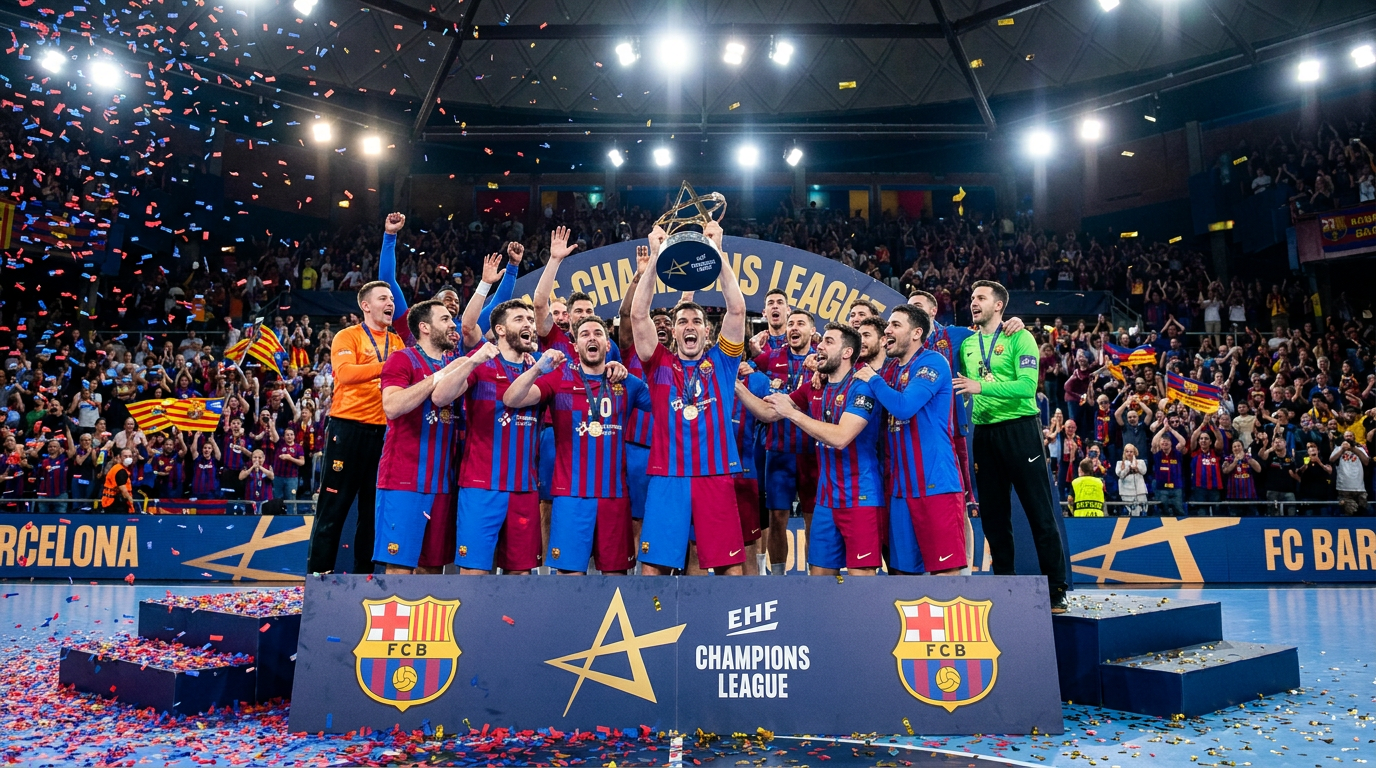
The TruckScout24 EHF FINAL4 in Cologne served as the ultimate proving ground for the men's European hierarchy, bringing together the absolute best teams for a winner-takes-all weekend. On Sunday, FC Barcelona secured a record-extending 12th EHF Champions League trophy—their 13th European crown overall—by dispatching German contenders Füchse Berlin with a final score of 37-34. The victory reaffirmed the Catalan club's status as the most decorated and dominant force in the history of club handball, adding yet another chapter to their storied legacy on the international stage. Head coach Carlos Ortega claimed his ninth total title with the club, having won six as a player and now three from the sidelines.[3][4]
The Catalan giants controlled the tempo from the opening whistle, heavily relying on the heroics of Danish goalkeeper Emil Nielsen. In his final match for Barça before a scheduled move to Veszprém, Nielsen delivered a clinical first-half performance, saving 10 shots and allowing his team to build a commanding 20-16 lead by the break. This defensive anchor enabled Barcelona to execute their signature fast-paced transition game, punishing Berlin's offensive misfires with rapid counter-attacks that kept the German side constantly on the back foot.[4]

Despite a valiant second-half surge from Berlin, Barcelona's offensive depth and tactical discipline proved insurmountable in the closing minutes. Slovenian centre back Domen Makuc orchestrated the attack brilliantly, scoring five crucial goals and earning the FINAL4 MVP award in his own farewell appearance before transferring to THW Kiel. The collective effort from the Spanish side, which included key scoring contributions from Aleix Gómez and Luis Frade, ensured that Berlin's late attempts to narrow the deficit were swiftly neutralized. Gómez's performance was particularly notable, as he became the all-time top scorer in the history of the Cologne FINAL4, further cementing his individual legacy alongside the team's collective triumph.[4]
For Füchse Berlin, the final standings represent a bittersweet conclusion to an otherwise remarkable and highly competitive campaign. The German club finished as runners-up in both the EHF Champions League and the domestic Handball-Bundesliga, falling just short of the ultimate prizes despite fielding the most lethal attacking weapon in the sport. While the dual second-place finishes undoubtedly sting in the immediate aftermath of the Cologne final, the season undeniably establishes Berlin as a genuine continental heavyweight capable of going toe-to-toe with the traditional aristocrats of the game. The experience gained from navigating two grueling championship races simultaneously will likely serve as vital fuel for their future ambitions.[2][5]
For Füchse Berlin, the final standings represent a bittersweet conclusion to an otherwise remarkable and highly competitive campaign.
Danish superstar Mathias Gidsel provided a massive silver lining for Berlin, finishing the season with a staggering 161 goals in the Champions League. Gidsel shattered the previous single-season scoring record of 141 goals, set by his compatriot Mikkel Hansen a decade earlier, cementing his status as the premier offensive force in global handball. His unprecedented scoring output, achieved against the tightest defenses in Europe, highlights a historic individual achievement that will be remembered long after the sting of the final defeat fades.[2][4]

Back in Germany, the final domestic standings painted a picture of absolute dominance by SC Magdeburg, who successfully defended their crown against a deep field of challengers. The reigning champions retained their Handball-Bundesliga title with a commanding total of 64 points, finishing a comfortable nine points clear of second-place Füchse Berlin. Magdeburg's ability to maintain an elite level of performance week after week in what is widely considered the most physically demanding domestic league in the world underscores their incredible roster depth, tactical resilience, and unwavering focus under pressure.[5]
Magdeburg's domestic supremacy was built on a foundation of relentless consistency, as they recorded 31 wins, two draws, and just a single loss across the 34-game season. They capped off their year by securing third place in the Champions League, defeating Danish side Aalborg Håndbold 32-26 in the bronze-medal match. This dual success across both domestic and European fronts confirms Magdeburg's position in the upper echelon of the sport, seamlessly balancing the rigors of the Bundesliga with the high-stakes environment of continental knockout handball.[4][5]

The women's European club landscape also witnessed a seismic shift at the MVM Dome in Budapest. Metz Handball made history by defeating Hungarian powerhouse Györi Audi ETO KC 31-29, becoming the first-ever French club to lift the EHF Champions League Women trophy. The victory in front of a record-tying crowd of over 20,000 spectators marked a watershed moment for the sport, breaking the long-standing hegemony of Eastern European and Scandinavian clubs at the absolute pinnacle of the women's game.[1]
Metz's historic triumph was spearheaded by an MVP performance from French line player Sarah Bouktit, who netted 12 goals in the final to systematically dismantle the Györ defense. The victory capped a perfect European season for French women's clubs, following JDA Bourgogne Dijon's success in the EHF European League just weeks prior. This dual continental success signals a golden era for French domestic handball, reflecting years of sustained investment in youth development, coaching infrastructure, and elite competitive pathways. By overcoming a team with the pedigree of Györ on Hungarian soil, Metz has fundamentally redrawn the map of women's club handball.[1]

As the dust settles on the definitive standings of the 2025/26 campaign, the club handball world is already looking ahead to a fundamentally transformed competitive landscape. The EHF Champions League is set to introduce a revamped format for the upcoming 2026/27 season, expanding the initial group stage to 24 teams divided into six groups of four. This structural overhaul is explicitly designed to increase competitive parity, eliminate dead-rubber matches, and provide more high-stakes, win-or-go-home scenarios much earlier in the tournament calendar, ensuring that the race for the knockout stages remains intense from the very first week.[6]
The upcoming changes promise to test the depth and adaptability of Europe's top clubs in entirely new ways. For now, however, the final standings of the current era are etched in stone: Barcelona and Metz rule Europe, Magdeburg reigns in Germany, and the rest of the continent has a long summer to plot their return to the top. The historic milestones achieved this year—from Gidsel's scoring record to Metz's maiden title—will serve as the ultimate benchmark for the next generation of handball excellence.[6]
How we got here
August 2025
The 2025/26 European club handball season officially tips off across domestic leagues.
December 2025
The EHF announces a revamped 24-team format for the Champions League, set to debut in the 2026/27 season.
June 7, 2026
SC Magdeburg secures the German Bundesliga title, and Metz Handball wins the Women's EHF Champions League in Budapest.
June 14, 2026
FC Barcelona defeats Füchse Berlin in Cologne to claim their 12th Men's EHF Champions League trophy.
Viewpoints in depth
FC Barcelona & Metz Supporters
Celebrating historic European triumphs and sustained dominance.
For the fanbases of Barcelona and Metz, the 2025/26 season represents the pinnacle of club achievement. Barcelona supporters are reveling in their team's 12th Champions League title, viewing it as a testament to their unmatched pedigree and tactical evolution under Carlos Ortega. Meanwhile, Metz fans are celebrating a watershed moment for French handball, as their squad finally broke through the glass ceiling to end Györ's long-standing European monopoly.
Füchse Berlin Camp
Finding pride in reaching two major finals and Mathias Gidsel's historic scoring.
The mood in the German capital is a complex mix of immense pride and agonizing heartbreak. Reaching the finals of both the Bundesliga and the Champions League proves that Füchse Berlin belongs among the absolute elite of global handball. Supporters and internal staff are taking solace in Mathias Gidsel's unprecedented 161-goal season, viewing his individual brilliance as the foundation upon which they will build their next championship push.
Neutral Handball Analysts
Focusing on the tactical shifts and the implications of the upcoming format changes.
Independent observers are analyzing the 2025/26 season as a transitional year for the sport. Analysts point to the sheer offensive firepower displayed in Cologne and Budapest as evidence of the game's accelerating pace. Furthermore, experts are already debating how the EHF's new 24-team format in 2026/27 will alter the balance of power, potentially allowing deeper domestic leagues like the Bundesliga to exert even more influence on the European stage.
What we don't know
- How the newly expanded 24-team format for the 2026/27 EHF Champions League will impact the physical toll on players.
- Whether Füchse Berlin can retain their core roster and make another push for the Champions League title next season.
Key terms
- EHF Champions League
- The premier club handball competition in Europe, featuring the top teams from across the continent.
- Final4
- The culminating weekend of the EHF Champions League, where the semi-finals and final are played in a single host city.
- Line Player
- An attacking player who operates near the opponent's six-meter goal area, creating space and receiving close-range passes.
- Centre Back
- The primary playmaker in handball, responsible for directing the team's offense and setting up scoring opportunities.
Frequently asked
Who won the 2025/26 Men's EHF Champions League?
FC Barcelona won the title, defeating Füchse Berlin 37-34 in the final in Cologne.
What record did Mathias Gidsel break this season?
Füchse Berlin's Mathias Gidsel set a new single-season scoring record in the Men's EHF Champions League with 161 goals, surpassing Mikkel Hansen's previous mark of 141.
Who won the German Handball-Bundesliga?
SC Magdeburg won the 2025/26 Bundesliga title with 64 points, finishing nine points ahead of Füchse Berlin.
Which team won the Women's EHF Champions League?
Metz Handball defeated Györi Audi ETO KC 31-29, becoming the first French club to win the Women's Champions League.
Sources
Source coverage
6 outlets
3 viewpoints surfaced






[1]EHF Champions LeagueFC Barcelona & Metz Supporters
Metz stun Györ in Raiffeisen Bank EHF FINAL4 2026 final
Read on EHF Champions League →[2]GoHandballFüchse Berlin Camp
Gidsel dominates Champions League scoring chart
Read on GoHandball →[3]Olympics.comNeutral Handball Analysts
Handball: EHF Champions League FINAL4 2026 - Stars to watch, schedule and how to follow live from Cologne
Read on Olympics.com →[4]IHFFC Barcelona & Metz Supporters
Kings of Europe once again, as Barcelona dominate opponents in TruckScout24 EHF FINAL4
Read on IHF →[5]LivesportNeutral Handball Analysts
Team handball: Bundesliga 2025/2026 Standings
Read on Livesport →[6]PSG.FRNeutral Handball Analysts
EHF Champions League: A new format from 2026!
Read on PSG.FR →
More in sports
See all 9 stories →Women's Sports
Women's Soccer Enters the Ownership Era as Record Crowds Spark a Stadium Boom
0 sources
Standings
2026 WSL Championship Tour Standings: Brazilian Goofy-Footers and Women's Tour Veterans Command the Leaderboard
0 sources
Injury
World Cup Climbers Return to the Wall: How Hannes Van Duysen and Natalia Grossman Overcame Career-Threatening Injuries
0 sources
Standings
As the World Climbing Series Heads to Innsbruck, Anraku Sorato and Emma Hunt Dominate the 2026 Standings
0 sources
Every angle. Every day.
Get sports stories with full source coverage and perspective breakdowns delivered to your inbox.