
Do At-Home LED Light Therapy Masks Work? The Clinical Evidence, Explained
At-home LED masks promise clinical-grade skin rejuvenation and acne reduction through photobiomodulation. A review of recent dermatological studies reveals modest but measurable benefits, provided users maintain strict consistency and realistic expectations.
By Factlen Editorial Team
- Clinical Optimists
- Argue that photobiomodulation provides statistically significant, non-invasive improvements to skin structure and acne reduction.
- Dermatological Skeptics
- Emphasize that at-home results are highly modest, require unrealistic consistency, and pale in comparison to prescription topicals.
- Pragmatic Consumers
- View LED masks as a safe, convenient, and gradual addition to a broader skincare routine rather than a standalone cure.
What's not represented
- · Aesthetic Laser Technicians
- · Device Manufacturers
Why this matters
Consumers are spending hundreds of dollars on at-home LED masks hoping for clinical-grade skin improvements. Understanding the actual scientific evidence, the required time commitment, and the limitations of these devices empowers buyers to make informed decisions about their skincare investments.
Key points
- At-home LED masks utilize photobiomodulation to stimulate collagen production and reduce acne-causing bacteria.
- Clinical trials show statistically significant improvements in wrinkle depth and skin density after 16 weeks of use.
- Consumer devices have lower power output than clinical lasers, requiring strict consistency to achieve visible results.
- Dermatologists caution that results are modest and should complement, not replace, proven topical treatments.
- The therapy is non-invasive and safe, though eye protection is strongly recommended, especially when using blue light.
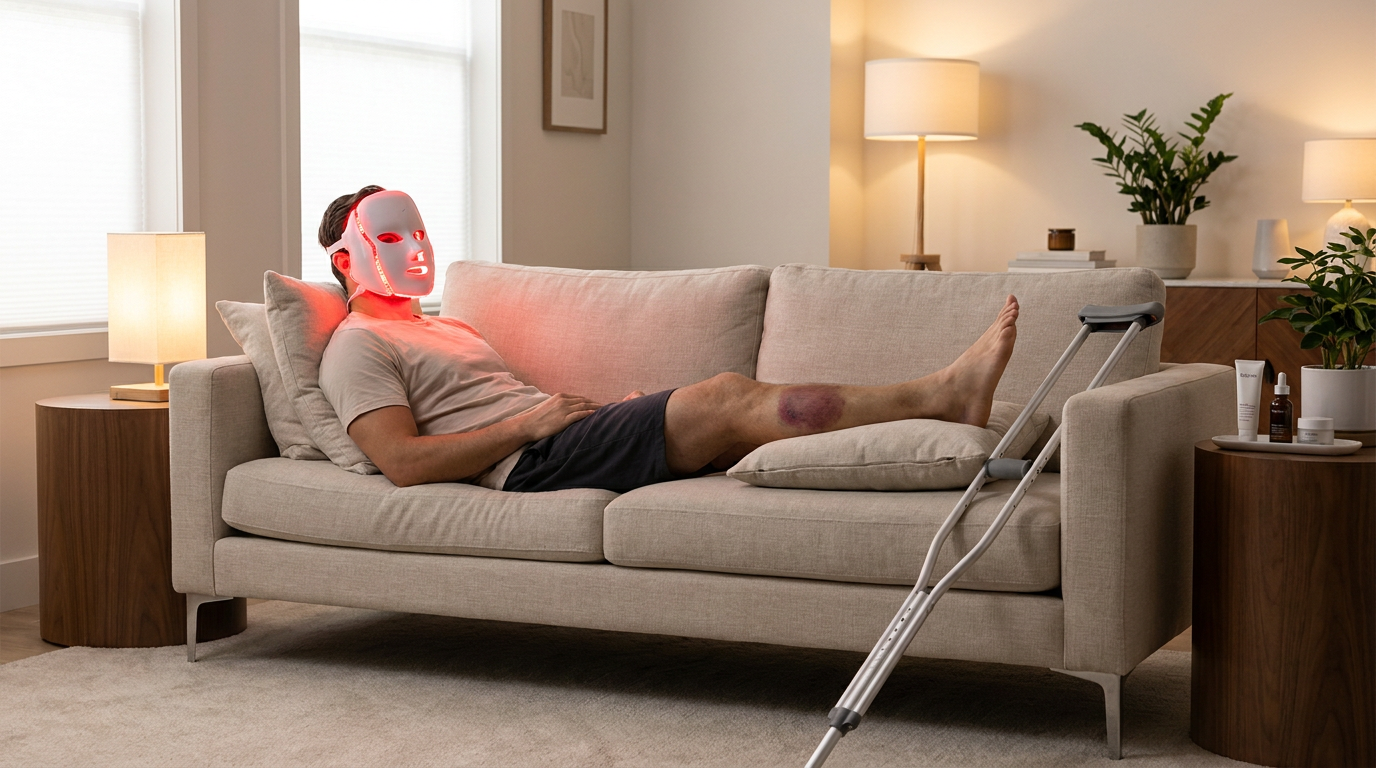
Social media feeds and beauty editorials are increasingly saturated with images of people wearing glowing, Stormtrooper-esque facial contraptions. These at-home light-emitting diode (LED) masks, which often retail for hundreds of dollars, promise to deliver clinic-level skin rejuvenation from the comfort of a living room couch.[3][5]
The underlying technology, known clinically as low-level light therapy or photobiomodulation, is not a new cosmetic fad. Originally explored by NASA in the 1980s to promote wound healing in astronauts, light therapy has been a staple in dermatologist offices for decades. What has changed is the miniaturization and commercialization of the technology, allowing consumers to bypass expensive clinical appointments.[3][4][6][8]
To understand whether these consumer devices actually work, it is necessary to look at the biological mechanism of photobiomodulation. The therapy relies on specific wavelengths of light—most commonly red light between 630 and 660 nanometers, and near-infrared light between 830 and 850 nanometers. Unlike ultraviolet light, which damages cellular DNA, or clinical lasers, which intentionally cause controlled thermal damage to trigger healing, LED therapy is entirely non-thermal and non-ablative.[4][6][7]
When these specific wavelengths penetrate the skin, they are absorbed by mitochondria, the energy-producing powerhouses within human cells. This absorption triggers a cascade of biochemical reactions, most notably an increase in the production of adenosine triphosphate (ATP). The influx of cellular energy stimulates fibroblasts, the specialized cells responsible for synthesizing collagen and elastin, which are the structural proteins that keep skin firm and youthful.[3][4][6][7]

The clinical evidence supporting red and near-infrared light for anti-aging is substantial, though nuanced. A 2025 double-blind, sham-controlled clinical trial published by the National Institutes of Health evaluated the efficacy of masks combining 630-nanometer and 850-nanometer wavelengths on adults over a 16-week period.[1][8]
The researchers found that consistent application resulted in statistically significant improvements in skin rejuvenation. Specifically, independent raters observed a nearly 70 percent improvement rate in the depth and severity of periorbital wrinkles, commonly known as crow's feet, compared to the control group.[1]
Additional clinical evaluations have demonstrated that red light therapy can increase dermal density, reduce the clinical score of facial slackening, and decrease pore diameter. Because the light stimulates the body's own structural proteins, the resulting improvements in skin texture and firmness are gradual but can persist for weeks after the treatment regimen is paused.[1][8]
Beyond anti-aging, LED masks are heavily marketed for acne management, typically utilizing a combination of red and blue light. While red light reduces the underlying inflammation of a breakout, blue light—specifically around the 415-nanometer wavelength—acts as a targeted antimicrobial agent.[2][4][6]
Beyond anti-aging, LED masks are heavily marketed for acne management, typically utilizing a combination of red and blue light.
Blue light penetrates the superficial layers of the skin and creates a toxic environment for Cutibacterium acnes, the primary bacteria responsible for inflammatory acne lesions. A study published in the Journal of Clinical and Aesthetic Dermatology found that alternating red and blue light therapy at home resulted in a 77 percent decrease in inflammatory acne lesions and a 54 percent decrease in noninflammatory lesions over several weeks.[2][6]

Despite these promising clinical metrics, dermatologists urge consumers to manage their expectations, pointing out a critical difference between in-office treatments and at-home masks: irradiance. Irradiance measures the power output of the light device. Consumer masks are intentionally capped at lower power levels to ensure they are safe for unsupervised use, meaning they deliver a fraction of the energy provided by clinical LED panels or lasers.[3][6][8]
Because the power output is lower, achieving visible results requires an immense amount of consistency. Clinical studies suggest that users must wear the masks for 10 to 30 minutes per session, three to five times a week. While some subtle improvements in skin tone might be visible after six weeks, significant changes in wrinkle depth or collagen density typically require 12 to 16 weeks of dedicated, uninterrupted use.[3][7]
This required commitment fuels skepticism among some medical professionals. Dr. Raman Madan, a dermatologist with Northwell Health, cautions that the benefits of at-home red light therapy are often overstated by marketing campaigns and social media influencers. He notes that the actual physiological changes, while measurable in a lab, translate to "very, very modest" visual improvements in the mirror.[3]
Furthermore, the landscape of clinical evidence is complicated by commercial interests. Many of the studies demonstrating the highest efficacy rates for at-home devices are funded directly by the manufacturers of those devices, a dynamic that introduces a degree of inherent bias into the literature.[3][7]
For patients seeking dramatic interventions for acne or severe photoaging, many dermatologists still prefer traditional, evidence-based topicals. Prescription medications like tretinoin, or in-office procedures like chemical peels and fractional laser resurfacing, offer a much higher magnitude of effect than low-level light therapy.[3][6]

However, where LED masks excel is in their safety profile. Because the treatment is non-invasive and generates no heat, it requires zero recovery time and carries virtually no risk of burning or scarring the skin. This makes it an attractive option for individuals with sensitive skin who cannot tolerate harsh retinoids or acidic peels.[4][6][8]
The primary safety concern raised by medical professionals involves ocular health. While red light is generally safe, intense blue light can cause eye discomfort or potential damage over time. Dermatologists strongly advise consumers to ensure their chosen device includes adequate, built-in eye protection and to avoid staring directly into the diodes.[4][7]
Additionally, light therapy is not universally suitable. Individuals taking photosensitizing medications, or those with conditions that cause light sensitivity such as lupus, are advised to avoid LED masks entirely to prevent adverse cutaneous reactions.[4]
Ultimately, the clinical consensus frames at-home LED masks not as standalone miracle cures, but as effective complementary tools. When high-quality, FDA-cleared devices are used with strict consistency alongside a robust skincare regimen of cleansing, moisturizing, and sun protection, they offer a scientifically backed method for achieving gradual, subtle improvements in skin health.[5][6][7]
Viewpoints in depth
The Clinical Optimists
Focus on the cellular science and measurable trial data supporting light therapy.
Proponents of LED therapy anchor their arguments in the biological mechanism of photobiomodulation. Because red and near-infrared light demonstrably increase ATP production and stimulate fibroblasts in a laboratory setting, they argue the technology is fundamentally sound. This camp points to double-blind clinical trials showing measurable increases in dermal density and significant reductions in acne lesions as proof that, given enough time, low-level light therapy delivers on its core promises without the thermal damage associated with clinical lasers.
The Dermatological Skeptics
Highlight the gap between laboratory science and real-world consumer results.
Skeptical medical professionals do not deny the underlying science of light therapy, but they heavily question its practical application via consumer devices. They argue that the low irradiance (power output) of at-home masks means patients must maintain near-perfect consistency for months to see results that are ultimately very subtle. Furthermore, this camp frequently points out that many of the most glowing clinical studies are funded by the device manufacturers themselves, and they advocate for steering patients toward cheaper, proven interventions like prescription tretinoin.
What we don't know
- The exact long-term efficacy of at-home devices over multiple years of use, as most clinical trials conclude after 12 to 16 weeks.
- The precise optimal dosing parameters (duration, frequency, and irradiance) required to maximize collagen production without hitting a plateau.
- The true independent efficacy of many popular consumer models, as a significant portion of the available clinical data is funded by the device manufacturers.
Key terms
- Photobiomodulation
- The process by which specific wavelengths of light stimulate cellular function and promote healing without causing heat damage.
- Fibroblasts
- Cells in the dermis responsible for producing collagen and elastin, the proteins that give skin its structure and firmness.
- Adenosine Triphosphate (ATP)
- The primary energy carrier in cells; its production is boosted when mitochondria absorb red and near-infrared light.
- Irradiance
- The power output or intensity of the light emitted by a device, which dictates how effectively the light penetrates the skin.
- Cutibacterium acnes
- The primary bacteria responsible for inflammatory acne, which can be targeted and neutralized by blue light wavelengths.
Frequently asked
Do I need to wear eye protection with an LED mask?
Yes. While red light is generally safe, intense blue light can cause eye discomfort or potential damage over time. Dermatologists strongly advise using built-in eye protection.
Should I apply skincare products before using the mask?
Devices should generally be used on clean, dry skin. Applying thick serums or moisturizers beforehand can block the light wavelengths from penetrating the skin effectively.
Can LED masks replace retinol or Botox?
No. LED therapy provides modest, gradual improvements to skin texture and tone. It is best viewed as a complementary treatment rather than a replacement for potent prescription topicals or injectables.
How often do I need to use an at-home LED mask?
Most clinical results are based on consistent use of 10 to 30 minutes per session, three to five times a week, over a period of three to six months.
Sources
Source coverage
8 outlets
3 viewpoints surfaced







[1]National Institutes of Health (NIH)Clinical Optimists
Efficacy and safety of low-level light therapy masks
Read on National Institutes of Health (NIH) →[2]Journal of Clinical and Aesthetic DermatologyClinical Optimists
Safety and Efficacy of Alternating Red and Blue Light for Acne
Read on Journal of Clinical and Aesthetic Dermatology →[3]MedPage TodayDermatological Skeptics
Are Red Light Therapy Devices More Hype Than Helpful?
Read on MedPage Today →[4]Mayo ClinicDermatological Skeptics
Are LED face masks worth it?
Read on Mayo Clinic →[5]ForbesClinical Optimists
The Best LED Face Masks, Tested And Reviewed
Read on Forbes →[6]DoctronicPragmatic Consumers
Red Light Therapy Masks: Do They Actually Work for Skin Conditions?
Read on Doctronic →[7]Boulder Medical CenterPragmatic Consumers
Dermatologist Explains At-Home Red Light Therapy Masks
Read on Boulder Medical Center →[8]Factlen Editorial Team
Synthesis by Factlen editorial team
Read on Factlen Editorial Team →


Every angle. Every day.
Get shopping stories with full source coverage and perspective breakdowns delivered to your inbox.