
Global Handball Injury Report: Recoveries, Returns, and the Science of Staying on the Court
As the 2025/2026 global handball season concludes, several top players are making strides in their injury rehabilitations. Advances in sports medicine and neuromuscular training are helping athletes return to the court stronger and faster than ever.

Share this story
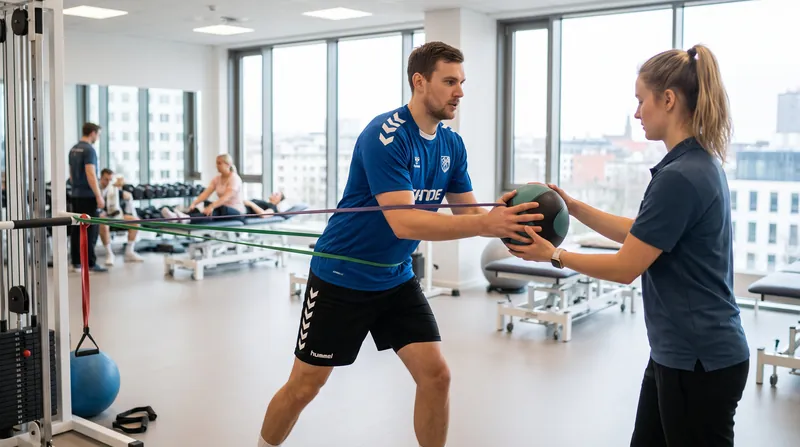
The grueling 2025/2026 global handball season has officially concluded following the EHF Champions League Final4 in Cologne, shifting the sport's focus from the arena to the treatment room. While the high-intensity, physical nature of elite handball inevitably brings injuries—ranging from muscle strains to severe ligament tears—modern rehabilitation protocols are ensuring that players return to the court stronger than before.
Across various domestic leagues and international competitions, the narrative is shifting from the despair of long-term absences to the triumph of accelerated recoveries and advanced preventative care. Medical staffs worldwide are redefining what is possible for athletes.[3]
One of the most closely monitored recoveries in the sport is that of Danish line player Lukas Jørgensen. The Flensburg-Handewitt star suffered a severe anterior cruciate ligament tear during the European Championships in January, a devastating blow that abruptly ended his tournament. Jørgensen underwent successful surgery shortly after the diagnosis and is currently deep into a structured, long-term rehabilitation program. Medical staff are prioritizing a full, stable recovery over a rushed return, ensuring that his knee regains complete structural integrity before he steps back onto the professional stage.
In Denmark, Aalborg Håndbold has navigated a complex web of medical updates during their deep postseason run. Marinus Munk was forced to undergo a minor surgical procedure following a painful crotch injury sustained in the Champions League quarter-final against Sporting CP in May. Fortunately, the operation went exactly according to plan. Team manager Martin Larsen confirmed that Munk is currently focusing on a full recovery without the need for extensive long-term rehabilitation, providing a significant morale boost for the club as they look toward the next competitive cycle.
Aalborg also witnessed a remarkable story of resilience through Thomas Arnoldsen. The 21-year-old playmaker suffered a fractured tibia earlier in the season, an injury that initial medical assessments suggested would rule him out of Euro 2026 entirely. However, Arnoldsen's recovery outpaced all expectations. Through rigorous physical therapy and sheer determination, he joined the Danish squad mid-tournament as an injury replacement, ultimately helping to secure the gold medal and proving that initial prognoses can sometimes be beaten by exceptional medical care.[4]
The mental toll of severe injuries is increasingly recognized in modern handball medicine, as physical healing is only half the battle. Swiss international Manuel Zehnder recently completed a highly successful comeback from a torn cruciate ligament that had sidelined him for months. Beyond traditional physical conditioning, Zehnder utilized sports psychology and specialized hypnosis therapy to rebuild his subconscious confidence. This holistic approach demonstrated that complete recovery encompasses the mind as well as the knee, allowing him to return to elite competition without lingering hesitation.[2]
The timing of an injury can completely alter the trajectory of a European campaign, emphasizing the fragile nature of tournament play. During the Champions League quarter-finals in May, Veszprém centre back Luka Cindrić suffered an ill-timed injury against Füchse Berlin. His sudden exit shifted the momentum of the match, disrupting Veszprém's offensive rhythm and allowing Berlin to force a penalty shootout. Berlin eventually advanced to the Final4, highlighting how a single injury can reshape the landscape of continental handball.
Conversely, sustained health is the ultimate competitive advantage in a sport as demanding as handball. Füchse Berlin's Mathias Gidsel, recently named the IHF World Player of the Year for a historic third consecutive time, credited his ongoing dominance directly to his physical durability. "I can also feel that now I'm 27, but still, hey, I'm injury-free, and I can every time enjoy playing handball," Gidsel remarked, underscoring the immense value of comprehensive load management and the sheer fortune of avoiding the surgeon's knife.[1]
To keep more players like Gidsel on the court, the sports science community is heavily investing in preventative measures and biomechanical research. A June 2026 systematic review published in the journal Sports highlighted that targeted preseason screening, shoulder-specific strength assessments, and neuromuscular training can significantly reduce the risk of both ACL ruptures and overuse injuries in elite handball players. As the sport continues to evolve, these proactive medical strategies will be just as crucial as tactical innovations in determining which teams lift the trophies at the end of the season.[3]
Key points
- Danish line player Lukas Jørgensen is undergoing long-term rehabilitation following a severe ACL tear.
- Aalborg's Thomas Arnoldsen successfully returned from a fractured tibia to help Denmark win Euro 2026.
- Mathias Gidsel credits his historic third consecutive IHF World Player of the Year award to remaining injury-free.
- Recent sports science studies emphasize the importance of preseason screening and neuromuscular training to prevent injuries.
How we got here
January 2026
Lukas Jørgensen suffers a severe ACL tear during the European Championships, ruling him out for the season.
February 2026
Thomas Arnoldsen makes a rapid return from a tibia fracture to help Denmark win Euro 2026 gold.
May 2026
Marinus Munk undergoes minor surgery following a crotch injury in the Champions League quarter-finals.
June 2026
Mathias Gidsel leads Füchse Berlin to the EHF Final4, citing his injury-free status as a key to his success.
- Medical & Rehabilitation Staff
- Focuses on the importance of structured recovery, neuromuscular training, and psychological support to prevent re-injury.
- The Players
- Emphasizes the mental resilience required during long-term rehab and the profound gratitude for playing injury-free.
- Club Management
- Prioritizes squad depth and load management to mitigate the tactical impact of losing key players during crucial tournament phases.
Perspectives this story doesn't cover
- Youth academy coaches managing early-career physical loads
- Independent sports biomechanics researchers
Sources
Source coverage
4 outlets
3 viewpoints surfaced




- [1]IHFThe Players
Perfection, self-doubt, machine-like: Gidsel reflects on third consecutive IHF World Player of the Year award
Read on IHF → - [2]Blue NewsMedical & Rehabilitation Staff
Swiss handball star: Manuel Zehnder reports back after his knee injury
Read on Blue News → - [3]MDPI SportsMedical & Rehabilitation Staff
Preseason Screening Tests and Physical Assessments as Predictors of Injury in Handball Players: A Systematic Review
Read on MDPI Sports → - [4]WikipediaThe Players
Thomas Arnoldsen - Career and International Play
Read on Wikipedia →
More in Sports
See all →Injury
Summer Handball Injury Desk: Kukic, Munk, and Wiede Navigate Critical Recoveries Ahead of 2026–27 Season
2 sources
Injury
International Handball Injury Update: High-Profile Casualties and the 35% ACL Reinjury Crisis
3 sources
Injury
Global Handball Injury Desk: Simić’s Triumphant Return and Gilme’s Non-Surgical Comeback Highlight a Summer of Resilience
6 sources
Injury
Global Handball Injury Desk: Wiede Nears Return as Sports Science Reshapes ACL Rehab
6 sources
Comments
Every angle. Every day.
Get Sports stories with full source coverage and perspective breakdowns, free every day.