
How AI Visual Dubbing is Breaking the Language Barrier in Global Cinema
New generative AI tools are digitally reshaping actors' lip movements to match translated dialogue, allowing international films to feel natively shot in any language. The technology is rapidly democratizing global distribution while introducing new frameworks for actor consent.
By Factlen Editorial Team
- Independent Filmmakers
- View AI dubbing as a democratizing tool that allows them to reach global audiences without massive localization budgets.
- Labor & Guild Representatives
- Emphasize the need for strict consent frameworks, royalties, and ethical boundaries to protect actors' likenesses.
- Localization Technologists
- Focus on the technical pipeline, scaling global content, and shifting from manual recording to AI supervision.
What's not represented
- · Traditional Voice-Over Artists
- · Subtitling and Translation Agencies
Why this matters
For decades, foreign-language films faced an uphill battle with international audiences due to distracting dubbing or subtitle fatigue. By making any movie look and sound like it was shot in the viewer's native language, this technology is opening the door for diverse global stories to achieve blockbuster success anywhere in the world.
Key points
- AI visual dubbing digitally alters an actor's mouth movements to perfectly match translated foreign-language dialogue.
- The technology eliminates the visual dissonance of traditional dubbing, making films feel natively shot in any language.
- Studios report up to a 90% reduction in localization time and a 10x decrease in costs.
- Independent filmmakers can now distribute their movies globally without the friction of language barriers.
- New labor guild agreements ensure actors must provide explicit consent and receive royalties for AI alterations.
For nearly a century, international cinema has wrestled with a stubborn compromise: the "Godzilla effect." When a film crosses borders, audiences are typically forced to choose between reading subtitles—which pulls their eyes away from the cinematography—or enduring dubbed audio that wildly mismatches the actors' on-screen mouth movements. This visual dissonance has historically kept brilliant foreign-language films confined to niche art-house theaters, limiting their global box office potential. But in 2026, a quiet revolution in generative artificial intelligence is entirely eliminating that compromise. The era of the jarring dub is over, replaced by a seamless technology that allows any film to look and sound as though it were natively shot in the viewer's exact language.[6]
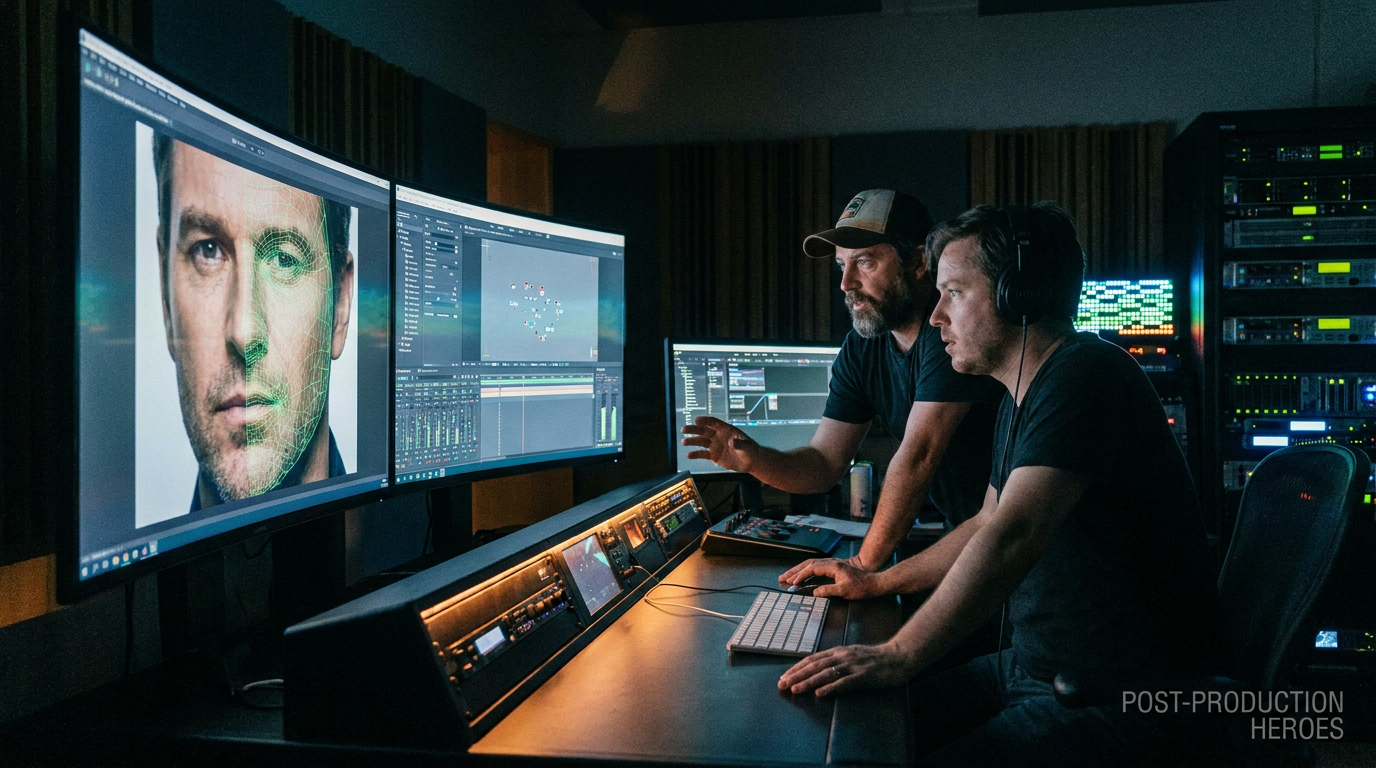
The breakthrough is known in the industry as "visual dubbing," or sometimes simply "vubbing." Unlike traditional localization, which relies solely on replacing the audio track, visual dubbing fundamentally alters the video itself. Using advanced neural networks, post-production studios can now digitally reshape an actor's lips, jawline, and lower facial muscles to perfectly match the syllables of a translated language. The result is a flawless, photorealistic performance that maintains the actor's original eye contact and upper-face emotion, while their mouth perfectly forms words they never actually spoke on set.[3][4]
The technology made its first major theatrical splash with the Swedish science-fiction film 'Watch the Skies'. When the independent UFO thriller hit American cinemas, audiences were entirely unaware that the film was originally shot in Swedish. Utilizing visual dubbing technology from the AI firm Flawless, the film's actors were digitally lip-synced to an English audio track, allowing the movie to secure a wide U.S. distribution deal that would have been nearly impossible for a subtitled indie feature.[2]

The impact is already rippling through the world's largest film markets. In India, the blockbuster action film 'War 2' became the first globally distributed movie shot on IMAX cameras to utilize AI visual dubbing. By deploying models from NeuralGarage, the studio was able to release the film simultaneously in Hindi, Telugu, and Japanese. The AI subtly altered the lead actors' facial movements to perfectly match the translated dialogue, creating a powerful illusion for regional audiences who felt the massive pan-Indian spectacle had been crafted specifically for their local theaters.[1][4]
To understand the mechanics behind the magic, one has to look at the intersection of audio analysis and spatial computing. The process begins with phoneme-to-viseme mapping. A phoneme is a distinct unit of sound, while a viseme is the corresponding visual mouth shape required to make that sound. When a script is translated and recorded in a new language, the AI dubbing engine analyzes the new audio track at the sub-frame level. It extracts the precise phonetic timing for every consonant, vowel, and breath pattern in the foreign language.[6]
Once the AI understands the audio, it generates a volumetric 3D representation of the actor's face. The system then manipulates this digital mesh, re-animating the lower half of the face to match the new visemes. Crucially, the most advanced systems preserve the actor's natural micro-expressions—the subtle jaw tension, the visibility of teeth, and the exact lighting of the original scene. It is not generating a new face; it is seamlessly warping the existing pixels to create a cohesive, broadcast-quality illusion that holds up even on a massive theater screen.[3][6]
Once the AI understands the audio, it generates a volumetric 3D representation of the actor's face.
Visual dubbing becomes even more powerful when paired with authorized voice cloning. In the past, a famous actor's performance would be entirely replaced by a local voiceover artist, often losing the original star's unique vocal timbre and emotional cadence. Today, studios can use deep learning to clone the original actor's voice—with their explicit contractual consent—and use that synthetic voice to deliver the translated dialogue. A lead actor can now deliver a tearful monologue in fluent Spanish, Mandarin, and German, utilizing their own voice and perfectly synced lips.[6]
The economic implications for the film industry are staggering. Historically, a high-quality, multi-language dubbing process for a major feature film could cost upwards of $50,000 per language and take several months of painstaking post-production work. AI-assisted dubbing platforms have collapsed both the timeline and the budget. Studios report that AI localization can reduce dubbing time by over 90%, allowing for simultaneous global releases across dozens of languages at a fraction of the traditional cost.[4][6]

This efficiency is driving a massive reallocation of studio resources. According to industry projections from Deloitte, major entertainment companies are actively shifting their operational spending toward AI-enabled localization functions. The global dubbing and voice-over market, supercharged by these new capabilities, is forecast to double in size, reaching an estimated $8.6 billion by 2034. For streaming giants like Netflix and Amazon, the technology is no longer experimental; it is a core infrastructure layer for their international expansion strategies.[5]
But the most uplifting consequence of visual dubbing is its democratizing effect on global storytelling. For decades, Hollywood has dominated the international box office largely because English-language films enjoyed a built-in distribution advantage. Now, a brilliant filmmaker from South Korea, Nigeria, or Brazil can produce a culturally rooted masterpiece on a shoestring budget and export it globally without the friction of language barriers. AI dubbing levels the playing field, ensuring that a great story can find a massive audience regardless of where it was filmed.[1][6]

As with any transformative AI technology, visual dubbing has required the rapid development of ethical guardrails. The ability to digitally alter an actor's face and clone their voice naturally triggered alarm bells regarding consent and deepfakes. In response, the European Union's AI Act categorized generative audiovisual tools as high-risk, mandating strict transparency disclosures. Simultaneously, the 2026 SAG-AFTRA agreements established firm boundaries: studios cannot alter an actor's performance or clone their voice without explicit, per-project consent and negotiated royalties.[6]
Leading technology providers have embraced these labor protections, positioning their tools as "assistive AI" rather than generative replacements. Companies like Flawless have built rights-first platforms that include cryptographic tracking systems to monitor consent and ownership for every localized version of a film. By working in collaboration with Hollywood guilds, these tech firms are ensuring that visual dubbing enhances an actor's global reach and earning potential, rather than undermining their creative control.[3][6]
The localization industry itself is also evolving rather than disappearing. While the need for traditional voice-over actors is shifting, the demand for cultural adaptation is higher than ever. AI can translate words and move lips, but it still struggles with regional idioms, cultural sensitivities, and the nuanced direction of a scene. Consequently, many former dubbing artists are transitioning into roles as AI performance directors, using their expertise to guide the algorithms and ensure the emotional core of a film translates perfectly across borders.[6]

Ultimately, the rise of AI visual dubbing represents a profound win for global empathy and shared culture. By stripping away the distracting mechanics of translation, the technology allows audiences to connect directly with the raw, human emotion of a performance, no matter where it originated. As the tools continue to refine, the concept of a "foreign film" may soon become obsolete, replaced by a truly borderless cinematic landscape where the only thing that matters is the power of the story.[6]
How we got here
2023
Streaming platforms begin testing early AI audio dubbing for documentaries, where lip-sync accuracy is less critical.
2024
Voice cloning technology achieves emotional parity with human speakers, allowing for highly expressive synthetic dialogue.
Early 2025
The Swedish film 'Watch the Skies' becomes the first theatrical release to use full visual dubbing for its US premiere.
2026
Major labor guilds establish formal consent and royalty frameworks, paving the way for widespread studio adoption.
Viewpoints in depth
Independent Filmmakers' View
A massive leveling of the global playing field.
For independent creators and non-Hollywood studios, visual dubbing is seen as the ultimate democratizer. Historically, the cost of high-quality dubbing—often exceeding $50,000 per language—meant that only massive studio tentpoles could afford simultaneous global releases. Independent filmmakers argue that by reducing these costs by up to 90%, AI tools allow culturally specific stories from smaller markets to compete directly with Hollywood blockbusters on international streaming platforms, fundamentally shifting the balance of cultural export power.
Labor Guilds' View
Protecting the human element of performance through strict consent.
While acknowledging the technology's potential, actors' unions and labor guilds approach visual dubbing with cautious pragmatism. Their primary concern is the unauthorized use of an actor's digital likeness and voice. Guild representatives argue that AI must remain an 'assistive' tool rather than a generative replacement. Through recent landmark agreements, they have established frameworks ensuring that any digital alteration of an actor's face or cloning of their voice requires explicit, per-project consent and triggers additional royalty payments, protecting the performer's economic and creative rights.
Localization Technologists' View
Scaling global distribution through automated pipelines.
For the engineers and studios building these platforms, visual dubbing is about solving the mathematical bottleneck of global distribution. Technologists view the traditional dubbing process as inherently flawed due to the physical limitations of matching translated syllables to pre-recorded mouth movements. By treating the actor's lower face as a dynamic, volumetric mesh that can be re-rendered in real-time, they argue that AI doesn't just make localization cheaper—it makes it objectively better, eliminating the visual dissonance that has historically alienated audiences from foreign content.
What we don't know
- How audiences will react long-term to knowing a performance has been digitally altered, even if visually flawless.
- Whether the cost of visual dubbing will eventually drop low enough for real-time live broadcast applications.
Key terms
- Visual Dubbing (Vubbing)
- The process of using AI to digitally alter an actor's on-screen lip and facial movements to match a translated audio track.
- Phoneme-to-Viseme Mapping
- The algorithmic process of matching a distinct unit of sound (phoneme) to the corresponding visual mouth shape (viseme) required to produce it.
- Voice Cloning
- Using deep learning to create a synthetic replica of a person's voice that can generate new dialogue while maintaining their unique tone and cadence.
- Assistive AI
- Artificial intelligence tools designed to enhance or adapt human performances with full artist consent, rather than generating content from scratch.
Frequently asked
Does visual dubbing replace the original actor?
No. The technology only alters the lower facial muscles and lips to match the new language, preserving the actor's original eye contact, upper-face emotion, and overall performance.
Do actors get paid when their voice is cloned?
Yes. Under recent guild agreements, studios must secure explicit consent to clone an actor's voice or alter their face, and actors receive per-use royalties for these localized versions.
Can audiences tell the video has been altered?
At theatrical resolution, the latest visual dubbing models are virtually undetectable to the naked eye, eliminating the jarring 'Godzilla effect' of traditional dubbing.
Sources
Source coverage
6 outlets
3 viewpoints surfaced






[1]The New Indian ExpressIndependent Filmmakers
Eureka! With AI Vubbing great Indian cinema can now go toe-to-toe with Hollywood
Read on The New Indian Express →[2]DecryptIndependent Filmmakers
Swedish Film 'Watch The Skies' Set For US Release With AI 'Visual Dubbing'
Read on Decrypt →[3]Flawless AILocalization Technologists
TrueSync: Cinematic Visual Translation
Read on Flawless AI →[4]NeuralGarageLocalization Technologists
VisualDub: Leading Generative AI & Visual Dubbing for Film
Read on NeuralGarage →[5]Deloitte InsightsLocalization Technologists
AI in Media: How the Technology Is Changing Film and Video Production
Read on Deloitte Insights →[6]Factlen Editorial TeamLabor & Guild Representatives
Synthesis by Factlen editorial team
Read on Factlen Editorial Team →
Every angle. Every day.
Get entertainment stories with full source coverage and perspective breakdowns delivered to your inbox.