
The Rise of Citizens' Assemblies: How Deliberative Democracy is Bridging the Divide
As traditional politics becomes increasingly polarized, a growing movement is using random selection and structured dialogue to help everyday citizens find consensus on complex issues.
By Factlen Editorial Team
- Deliberative Innovators
- Focus on structural reform, sortition, and formal citizens' assemblies to bypass gridlock.
- Grassroots Bridge-Builders
- Focus on interpersonal depolarization, workshops, and reducing animosity at the community level.
- Public Opinion Researchers
- Focus on data, identifying the center, and highlighting the perception gap between partisans.
- Factlen Editorial Team
- Synthesizing the evidence to explain the mechanism of consensus and its limitations.
What's not represented
- · Highly engaged partisan activists who view compromise as a moral failing.
- · Marginalized communities who may distrust formal deliberative processes.
Why this matters
With 70% of the public exhausted by political polarization, citizens' assemblies offer a proven, scalable mechanism to bypass partisan gridlock and solve complex problems. Understanding this model reveals how societies can rebuild trust and make decisions without tearing themselves apart.
Key points
- Roughly 70% of the public belongs to an 'Exhausted Majority' tired of political polarization.
- Citizens' assemblies use random selection (sortition) to create a demographically representative microcosm of society.
- Participants undergo a structured learning phase with experts before engaging in facilitated deliberation.
- While highly effective at building consensus, a major challenge remains translating assembly recommendations into binding law.
The dominant narrative of modern politics is one of irreconcilable division. Algorithms reward outrage, partisan media thrives on conflict, and electoral systems increasingly incentivize a winner-takes-all approach to governance. For the average citizen, the political landscape can feel like a perpetual state of trench warfare, where compromise is viewed as a betrayal and the opposing side is treated as an existential threat.[8]
Yet, beneath the noise of the extremes, a different reality is quietly taking shape. Public opinion researchers have identified what they call the "Exhausted Majority"—a broad coalition comprising roughly 70% of the population who are fatigued by constant polarization. This silent majority feels overlooked by political leaders and remains convinced that finding common ground on contentious issues is still possible.[1][5]
The challenge, however, is that standard democratic mechanisms are poorly equipped to harness this desire for consensus. Elections inherently divide voters into competing camps, and legislative bodies frequently succumb to gridlock. In response, a growing movement of political scientists, civic organizations, and everyday citizens is turning to an ancient concept updated for the modern era: deliberative democracy.[2][7]

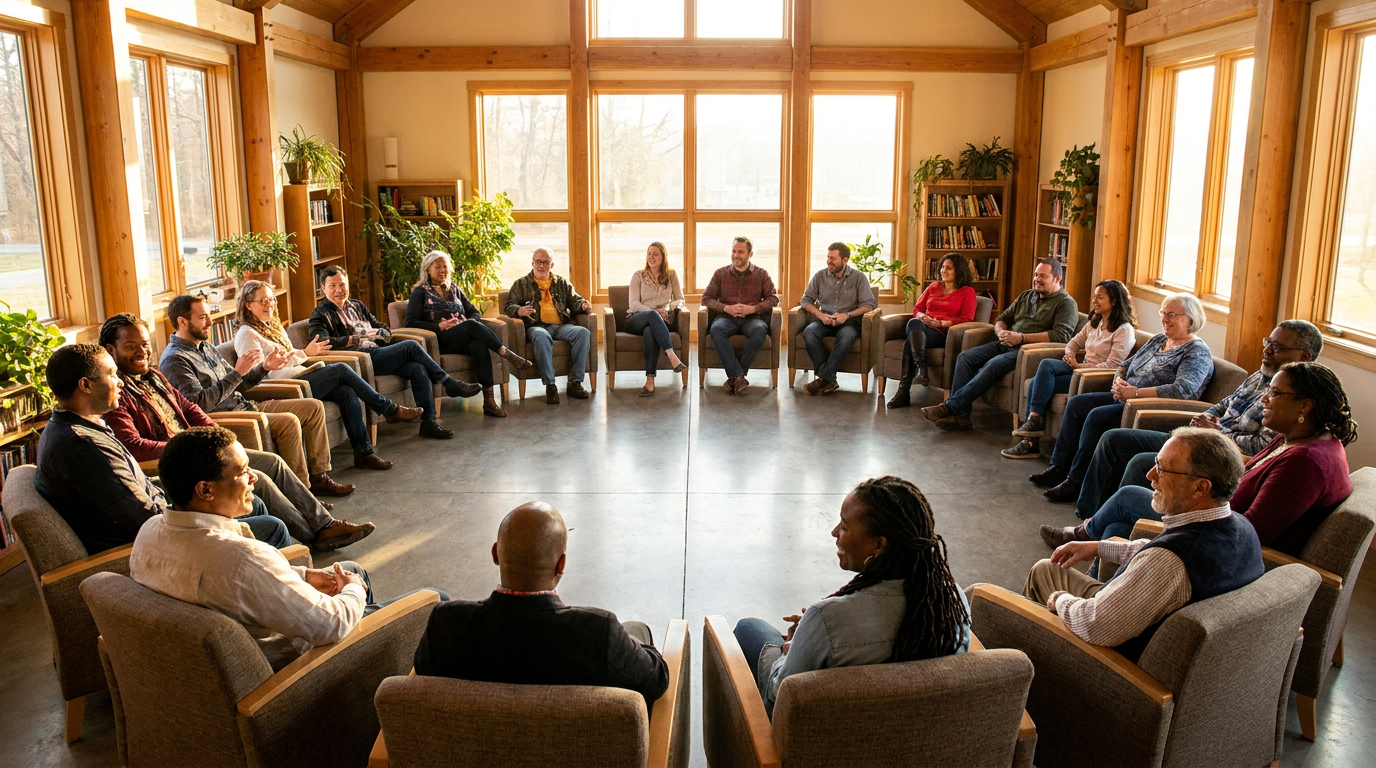
At the heart of this movement is the "Citizens' Assembly," a structured forum designed to bypass partisan combat and foster genuine dialogue. Unlike traditional town halls, which are often dominated by the loudest voices or highly organized activist groups, citizens' assemblies rely on a mechanism called "sortition."[2][3]
Sortition is essentially a democratic lottery. Organizers randomly select a group of citizens—often ranging from 50 to 150 people—and then demographically stratify the pool to ensure it accurately reflects the broader population in terms of age, gender, education, ethnicity, and geographic location. The goal is to create a microcosm of society in a single room, ensuring that marginalized and disengaged voices have an equal seat at the table.[2][7][8]
Once assembled, these citizens do not immediately begin debating. Instead, they enter a structured learning phase. Participants are presented with high-quality, balanced information from a diverse array of subject-matter experts, stakeholders, and advocates representing multiple viewpoints. This onboarding process is designed to establish a shared baseline of facts before any policy recommendations are formulated.[2][7][8]

Following the learning phase, skilled facilitators guide the assembly through rigorous deliberation. Participants are encouraged to listen empathetically, identify shared values, and work through disagreements constructively. The environment is explicitly designed to neutralize the "echo chambers" that typically fuel political polarization, allowing individuals to evaluate arguments on their merits rather than their partisan origins.[2][7]
Following the learning phase, skilled facilitators guide the assembly through rigorous deliberation.
The results of this process have been striking. When everyday people are given the time, space, and resources to deliberate, they consistently demonstrate a capacity to navigate complex, highly charged issues. In Ireland, citizens' assemblies successfully paved the way for landmark constitutional referendums on same-sex marriage and abortion—issues that had paralyzed the traditional political establishment for decades.[2][3][6]
This "deliberative wave" is now spreading globally. In Central and Eastern Europe, the number of countries implementing citizens' assemblies is expected to double by 2025, with dozens of local and national processes underway to address issues ranging from urban planning to climate change. Proponents argue that these assemblies serve as a democratic bulwark against authoritarian populism, which often relies on weaponizing divisive issues to fracture societies.[2]
In the United States, where formal, government-sponsored citizens' assemblies are less common, the principles of deliberative democracy are being championed by grassroots organizations focused on depolarization. Groups like Braver Angels have built a network of over 80,000 supporters dedicated to bridging the partisan divide through structured "Common Ground Workshops."[4]
These workshops bring together equal numbers of conservative-leaning and liberal-leaning participants—often referred to as "reds" and "blues"—for hours of facilitated dialogue. The objective is not to force anyone to abandon their core convictions, but rather to dismantle stereotypes and discover areas of unanimous agreement. Recently, Braver Angels launched a Citizens Commission on Immigration, applying this deliberative model to one of the most intractable issues in American politics.[4]

Similar efforts are taking root on college campuses, where organizations like BridgeUSA are teaching students the "lost art of constructive disagreement." By establishing ground rules for respectful dialogue and measuring the impact of these interventions on participants' open-mindedness, these programs aim to equip the next generation of leaders with the skills necessary to navigate a pluralistic society.[5]
A key psychological barrier these initiatives address is the "Perception Gap." Research consistently shows that partisans drastically overestimate the extremism of their political opponents. When individuals actually sit across a table from one another in a structured setting, they frequently experience the relief of discovering that the person on the other side is far more nuanced—and far less hostile—than their social media feeds suggested.[1][4][8]
Despite these successes, the deliberative democracy movement faces significant hurdles. The most pressing challenge is the question of power and implementation. Currently, the vast majority of citizens' assemblies serve purely in an advisory capacity. Elected officials are often reluctant to cede binding decision-making authority to unelected bodies, meaning that carefully crafted recommendations can easily be ignored once they enter the traditional political meat grinder.[6]

Furthermore, researchers are still grappling with the challenge of "spillover effects." While the 100 citizens who participate in an assembly may experience profound depolarization and build deep trust in the resulting consensus, it is incredibly difficult to transfer that trust to the millions of citizens who did not participate and merely read about the outcome in the news.[6]
To truly bridge the political divide, advocates argue that deliberative ideals must be embedded more deeply into everyday political culture, media discourses, and civic education. Deliberation cannot remain an isolated experiment; it must become a lived democratic experience that scales beyond the walls of a single community hall.[6]
Ultimately, the rise of citizens' assemblies and grassroots depolarization efforts offers a powerful counter-narrative to the prevailing sense of democratic decline. They provide empirical evidence that pluralism is a learned value, and that a society's capacity to solve complex problems does not require universal agreement, but rather a commitment to disagreeing productively. For the exhausted majority, these structured dialogues represent a tangible pathway out of the partisan trenches and toward a more functional, united republic.[1][4][5][8]
How we got here
Ancient Athens
Sortition is used to randomly select citizens for political office, forming the earliest roots of deliberative democracy.
2016
The Irish Citizens' Assembly is established, eventually leading to historic referendums on abortion and same-sex marriage.
2018
The 'Hidden Tribes' report identifies the 'Exhausted Majority,' highlighting widespread fatigue with political polarization.
2019
France launches the Citizens' Convention for Climate in response to the Yellow Vest protests.
2024-2025
A 'deliberative wave' sweeps Central and Eastern Europe, with dozens of new assemblies convened to tackle local and national issues.
Viewpoints in depth
Deliberative Innovators
Advocates who believe structural reform is necessary to bypass partisan gridlock.
This camp argues that traditional electoral systems inherently incentivize division and short-term thinking. By utilizing sortition and structured deliberation, they believe citizens' assemblies can produce more legitimate, long-term policy solutions that elected officials are often too politically constrained to touch. They point to successes in Ireland and France as proof of concept.
Grassroots Bridge-Builders
Organizations focused on interpersonal depolarization and community-level dialogue.
Rather than focusing solely on government policy, this perspective emphasizes healing the social fabric from the ground up. Groups in this camp argue that democracy requires a baseline of mutual respect. They invest in workshops and campus programs designed to dismantle the 'perception gap' and teach citizens the lost art of constructive disagreement, believing that cultural shifts must precede political ones.
Institutional Skeptics
Elected officials and traditionalists hesitant to cede power to unelected bodies.
While often supportive of the concept in theory, many institutionalists argue that citizens' assemblies lack the democratic accountability of elected legislatures. They view these forums as valuable consultative tools or advanced focus groups, but warn against giving them binding authority, noting the difficulty of translating a 100-person consensus to a nation of millions.
What we don't know
- Whether citizens' assemblies will eventually be granted binding legislative power rather than just advisory roles.
- How to effectively scale the 'spillover effect' so the broader public trusts the consensus reached by the assembly.
- If grassroots depolarization workshops can reach the most extreme partisans, or if they primarily attract those already willing to compromise.
Key terms
- Deliberative Democracy
- A form of government in which free and equal citizens justify decisions in a process in which they give one another reasons that are mutually acceptable.
- Sortition
- The use of random selection to populate a political assembly, ensuring demographic representation rather than relying on elections.
- Exhausted Majority
- The large segment of the population that feels alienated by extreme partisanship and desires constructive compromise.
- Perception Gap
- The psychological phenomenon where individuals drastically overestimate the extreme views held by members of an opposing political group.
- Spillover Effect
- The challenge of transferring the trust and consensus built inside a citizens' assembly to the broader public who did not participate.
Frequently asked
What is a citizens' assembly?
A randomly selected, demographically representative group of everyday people brought together to learn about a policy issue, deliberate, and make recommendations.
How are participants chosen?
Through a process called 'sortition,' which uses a democratic lottery to ensure the group reflects the broader population's age, gender, education, and geography.
Do these assemblies actually change laws?
In most cases, their power is advisory. However, in places like Ireland, their recommendations have directly led to successful constitutional referendums.
What is the 'Exhausted Majority'?
A term coined by researchers to describe the roughly 70% of Americans who are tired of extreme political polarization and want leaders to find common ground.
Sources
Source coverage
8 outlets
4 viewpoints surfaced








[1]More in CommonPublic Opinion Researchers
Hidden Tribes: A Study of America's Polarized Landscape
Read on More in Common →[2]DemocracyNextDeliberative Innovators
Citizens' Assemblies: Democratic Responses to Authoritarian Challenges in Central and Eastern Europe
Read on DemocracyNext →[3]Democracy InternationalDeliberative Innovators
Global citizens' assemblies - Pathways for the UN: Principles, design, and implementation
Read on Democracy International →[4]Braver AngelsGrassroots Bridge-Builders
Bridging America's Political Divide: A Conversation with Braver Angels' Citizens Commission on Immigration
Read on Braver Angels →[5]George W. Bush Presidential CenterGrassroots Bridge-Builders
How talking can build a bridge to a better America
Read on George W. Bush Presidential Center →[6]Sciences PoDeliberative Innovators
Building Trust in Politics through Deliberative Democracy: Assessing the Spillover Effects of Mini-Publics
Read on Sciences Po →[7]Democracy & Belonging ForumDeliberative Innovators
Bridging Divides Through Deliberation
Read on Democracy & Belonging Forum →[8]Factlen Editorial TeamFactlen Editorial Team
Synthesis by Factlen editorial team
Read on Factlen Editorial Team →

Every angle. Every day.
Get perspectives stories with full source coverage and perspective breakdowns delivered to your inbox.