
How Office-to-Residential Conversions Are Reshaping American Downtowns
Faced with record-high office vacancies and a chronic housing shortage, cities and developers are increasingly turning to adaptive reuse to transform empty commercial towers into vibrant residential neighborhoods.
By Factlen Editorial Team
- Urban Planners & Municipalities
- Focus on revitalizing downtowns, stabilizing tax bases, and increasing housing supply.
- Commercial Developers
- Focus on the financial feasibility, construction costs, and regulatory hurdles of conversion.
- Environmental Architects
- Focus on the sustainability benefits and the reduction of embodied carbon emissions.
What's not represented
- · Existing downtown residents concerned about construction disruptions
- · Small business owners relying on daytime office workers
Why this matters
Adaptive reuse offers a rare dual solution to two of the decade's biggest urban crises: it revitalizes hollowed-out downtowns while simultaneously injecting much-needed housing supply into the market without the massive carbon footprint of new construction.
Key points
- Adaptive reuse is shifting from a niche concept to a mainstream solution for urban housing shortages.
- Not all buildings qualify; developers seek 'Goldilocks' structures with narrow floor plates and accessible cores.
- Conversions can cost 30% less per unit than demolishing and rebuilding from scratch.
- Cities are offering tax abatements and zoning exemptions to bridge the financial feasibility gap.
- Retaining existing building structures saves 50% to 70% of embodied carbon emissions.
The American downtown is undergoing its most profound physical transformation since the postwar era. As the dust settles on the hybrid-work revolution in 2026, cities are no longer waiting for a return to the five-day office commute. Instead, they are looking at millions of square feet of vacant commercial real estate and seeing the solution to a completely different crisis: the national housing shortage.[7]
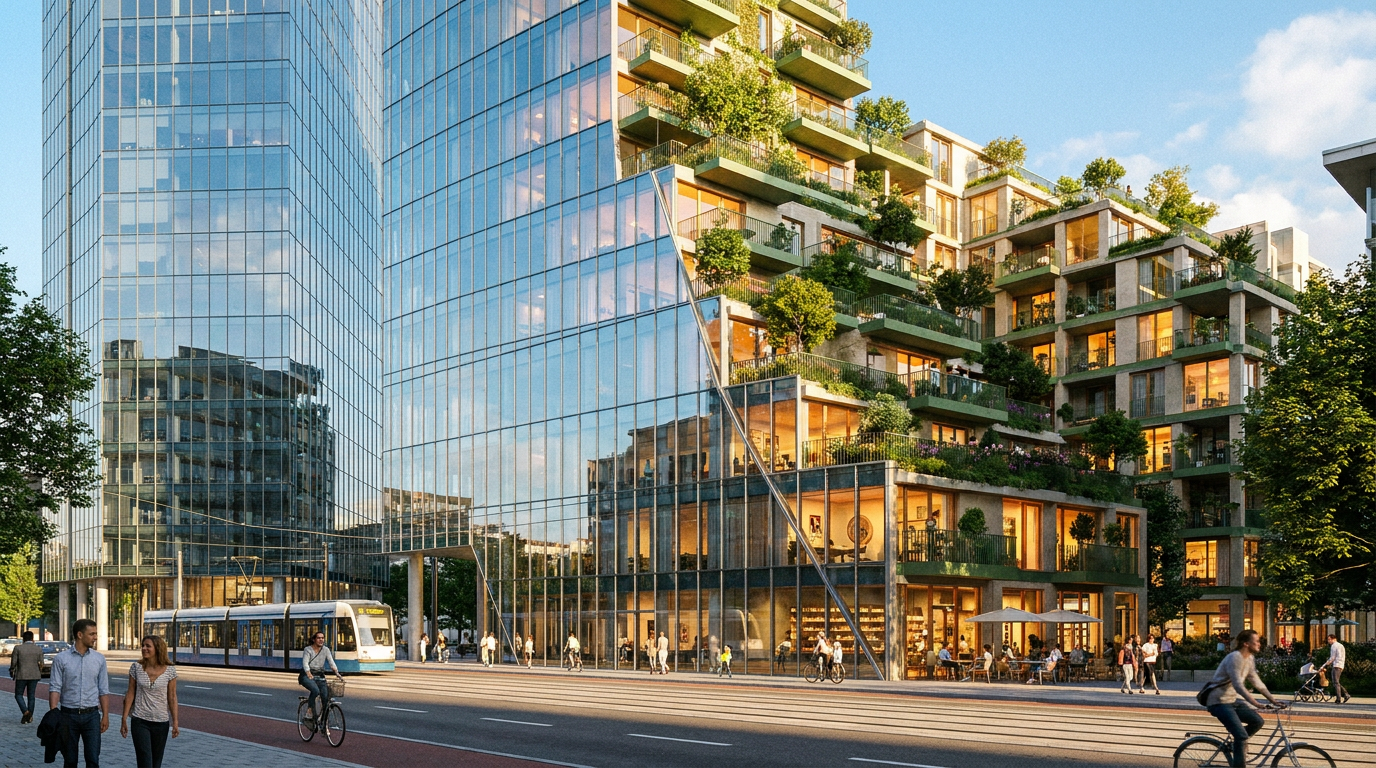
This shift has elevated "adaptive reuse"—specifically, the conversion of office buildings into residential apartments—from a niche architectural experiment to a mainstream urban development strategy. Across the country, developers are stripping aging commercial towers down to their steel bones and reimagining them as vibrant, mixed-use living spaces.[1][6]
The momentum is driven by a collision of economic realities. The national office vacancy rate has hovered near record highs of 13.8%, leaving central business districts eerily quiet and draining municipal tax bases. Simultaneously, the United States faces a chronic shortage of roughly 1.5 million housing units, driving up rents and locking millions out of homeownership.[4]
For property owners, the math is becoming unavoidable. Billions of dollars in commercial mortgages are maturing, forcing landlords of underperforming Class B and C office buildings to either restructure their debt at higher interest rates or find a new, profitable use for their assets. For many, residential conversion is the most viable lifeline.[4][6]

But transforming a corporate workspace into a livable home is a complex engineering challenge. It is not as simple as erecting drywall and moving in beds. Office buildings were designed for a fundamentally different type of human occupation, and their structural DNA dictates whether a conversion is financially and physically possible.[2]
Architects and urban planners often search for what the design firm Gensler calls the "Goldilocks" building—a structure whose dimensions are "just right" for residential life. Surprisingly, the best candidates are rarely modern, gleaming glass skyscrapers. Instead, they are often older buildings dating back to the 1970s or earlier.[3][4]
The primary hurdle is the "window-to-core" distance. Residential building codes require bedrooms and living spaces to have access to natural light and ventilation. Modern office buildings often feature massive, deep floor plates designed for sprawling cubicle farms, leaving the center of the building far too dark for residential use without carving out expensive interior courtyards.[2][3]
Residential building codes require bedrooms and living spaces to have access to natural light and ventilation.
Infrastructure presents another massive hurdle. Commercial buildings typically rely on centralized HVAC systems and clustered bathrooms located near the elevator core. Converting these spaces requires coring through thick concrete floors to install individual plumbing, electrical, and climate-control systems for dozens of separate apartments on every single level.[5]

Because of these structural constraints, the cost of an office-to-residential conversion can vary wildly, generally ranging from $100 to over $500 per square foot. This creates what economists call the "feasibility gap"—the space between the high cost of retrofitting a building and the market value of the resulting apartments.[1][4]
Despite these costs, adaptive reuse remains highly attractive compared to starting from scratch. A report from the National Association of Industrial and Office Parks found that per-unit construction costs for conversion projects can be up to 30% lower than the cost of demolishing a site and building anew. Furthermore, conversions typically bypass the lengthy excavation and foundation-laying phases, significantly shortening the timeline from project start to move-in.[4][5]
To bridge the remaining financial gaps, municipalities have aggressively stepped in. Recognizing that empty offices erode property tax revenues and hurt local businesses, city governments are treating adaptive reuse as a comprehensive urban renewal tool.[6]
Cities from Washington, D.C., to Buffalo and New York City have rolled out unprecedented incentives. These include fast-tracked zoning approvals, exemptions from density regulations, and programs like D.C.'s "Office-to-Anything," which offers up to 15 years of property tax abatements for developers who repurpose commercial towers into housing or community spaces.[5]

Beyond economics, adaptive reuse has become a cornerstone of sustainable architecture in 2026. The greenest building is often the one that already exists. By retaining a structure's foundation, steel frame, and concrete slabs, developers avoid the massive environmental toll of demolition and new material production.[3][5]
This preservation of "embodied carbon" is staggering. Adaptive reuse projects can reduce carbon emissions by 50% to 70% compared to ground-up construction. As stricter environmental, social, and governance (ESG) mandates and the 2026 Green Communities Criteria take effect, the climate benefits of conversions are making them highly attractive to green financing programs and institutional investors.[3][5]

The ultimate result of this trend is the gradual death of the monolithic, 9-to-5 central business district. As more office towers welcome full-time residents, downtowns are transforming into 24/7 neighborhoods.[6]
This influx of residents brings consistent foot traffic that supports local retail, restaurants, and grocery stores long after the traditional workday ends. It is a pragmatic, inventive evolution of the urban landscape—one that solves a modern crisis by building directly upon the foundations of the past.[6][7]
How we got here
Pre-2020
Office-to-residential conversions remain a niche, high-cost architectural endeavor.
2020–2022
The pandemic normalizes remote work, leading to a sudden and sustained drop in office occupancy.
2023–2024
Commercial mortgage maturities force property owners to explore alternative uses for vacant Class B and C buildings.
2025
Major cities launch aggressive tax incentive programs, like D.C.'s 'Office-to-Anything', to spur development.
2026
Adaptive reuse matures into a standard real estate strategy, driven by ESG mandates and housing demand.
Viewpoints in depth
Urban Planners & Municipalities
Focusing on tax revenue and neighborhood vitality.
For city governments, the primary concern is the 'doom loop' of empty downtowns. Vacant offices lead to plummeting commercial property values, which in turn decimate the municipal tax base required to fund public services. Planners view adaptive reuse not just as a housing strategy, but as an economic necessity to restore foot traffic, support local retail, and transition business districts into resilient, 24/7 mixed-use neighborhoods.
Commercial Developers
Balancing construction costs against long-term yields.
Developers approach conversions through a strict lens of financial feasibility. While they acknowledge the lower per-unit construction costs compared to ground-up builds, they remain cautious about the 'feasibility gap'—the high upfront capital required to overhaul plumbing and HVAC systems. This camp argues that without aggressive municipal tax abatements and fast-tracked zoning approvals, many structurally viable buildings simply do not make financial sense to convert.
Environmental Architects
Prioritizing the preservation of embodied carbon.
Sustainability advocates view demolition as a last resort. They argue that the greenest building is the one that already exists, pointing out that concrete and steel production are massive drivers of global emissions. By preserving the 'bones' of a structure, this camp champions adaptive reuse as a critical tool for the real estate sector to meet stringent 2026 ESG mandates and climate goals.
What we don't know
- Whether suburban office parks can be successfully converted, as current successes are largely concentrated in high-rent downtowns.
- How the influx of residential units will impact the long-term property values of existing downtown condos.
- If municipal tax incentives will be sufficient to maintain conversion momentum if interest rates rise again.
Key terms
- Adaptive Reuse
- The process of repurposing an existing building for a use other than what it was originally designed for.
- Embodied Carbon
- The total greenhouse gas emissions generated by the manufacturing, transportation, and installation of building materials.
- Feasibility Gap
- The financial shortfall when the cost of converting a building exceeds its potential market value as residential space.
- Window-to-Core Distance
- The measurement from a building's exterior windows to its central elevator and utility shaft, dictating how much natural light reaches the interior.
- Class B and C Offices
- Older, less modern commercial buildings that lack premium amenities and are currently experiencing the highest vacancy rates.
Frequently asked
Can any office building be converted into apartments?
No. Buildings with massive, deep floor plates are often unsuitable because residential codes require living spaces to have access to natural light and ventilation.
Is it cheaper to convert an office or build a new apartment?
Conversions are generally cheaper. Per-unit construction costs can be up to 30% lower than demolishing a site and building from scratch.
Why are cities offering tax breaks for these projects?
Empty offices drain municipal tax revenues and hurt local businesses. Cities offer incentives to revitalize downtowns and increase the local housing supply.
Sources
Source coverage
7 outlets
3 viewpoints surfaced







[1]Brookings InstitutionUrban Planners & Municipalities
Understanding office-to-residential conversion
Read on Brookings Institution →[2]Center for American ProgressCommercial Developers
Converting Vacant Office Space Into Housing
Read on Center for American Progress →[3]GenslerEnvironmental Architects
Design Forecast 2026: Adaptive Reuse
Read on Gensler →[4]Old Republic TitleCommercial Developers
Office-to-Residential Conversions
Read on Old Republic Title →[5]SWAEnvironmental Architects
Adaptive Reuse: The New Rules and Incentives for Office to Residential Conversions
Read on SWA →[6]New England Real Estate JournalUrban Planners & Municipalities
Navigating the next phase: How adaptive reuse will shape real estate in 2026
Read on New England Real Estate Journal →[7]Factlen Editorial Team
Synthesis by Factlen editorial team
Read on Factlen Editorial Team →
Every angle. Every day.
Get real estate stories with full source coverage and perspective breakdowns delivered to your inbox.