
At-Home Brain Implant Allows Man With ALS to Speak and Work Independently
A new brain-computer interface allows a man with severe paralysis from ALS to communicate and control a computer without researcher assistance. The system translates brain signals into speech with 99% accuracy, marking a major milestone in moving neuroprosthetics from the lab to daily life.
By Factlen Editorial Team
- Neuroprosthetics Researchers
- Engineers and neuroscientists focused on the technical milestone of achieving high-accuracy, independent BCI operation outside the lab.
- Patient Advocacy & Care
- Advocates emphasizing the psychological and practical benefits of restoring autonomy and communication to those with severe paralysis.
- Science & Technology Observers
- Analysts evaluating the broader implications, limitations, and future scalability of the technology.
What's not represented
- · Medical insurance providers evaluating the cost-benefit of covering invasive neuroprosthetics.
- · Regulatory bodies assessing the long-term safety of permanent brain implants.
Why this matters
For decades, brain-computer interfaces have been confined to highly controlled laboratory settings, requiring teams of engineers to operate. This breakthrough proves that severe paralysis does not have to mean a loss of communication or independence, paving the way for practical, daily-use neuroprosthetics.
Key points
- A new brain-computer interface allows a patient with ALS to communicate and control a computer independently at home.
- The system uses 256 microelectrodes implanted in the motor cortex to detect attempted speech.
- Algorithms translate neural signals into text and synthesized speech with 99% accuracy.
- The patient logged over 3,800 hours of unassisted use over nearly two years.
- The breakthrough marks a shift from lab-bound proof-of-concepts to practical daily-use neuroprosthetics.
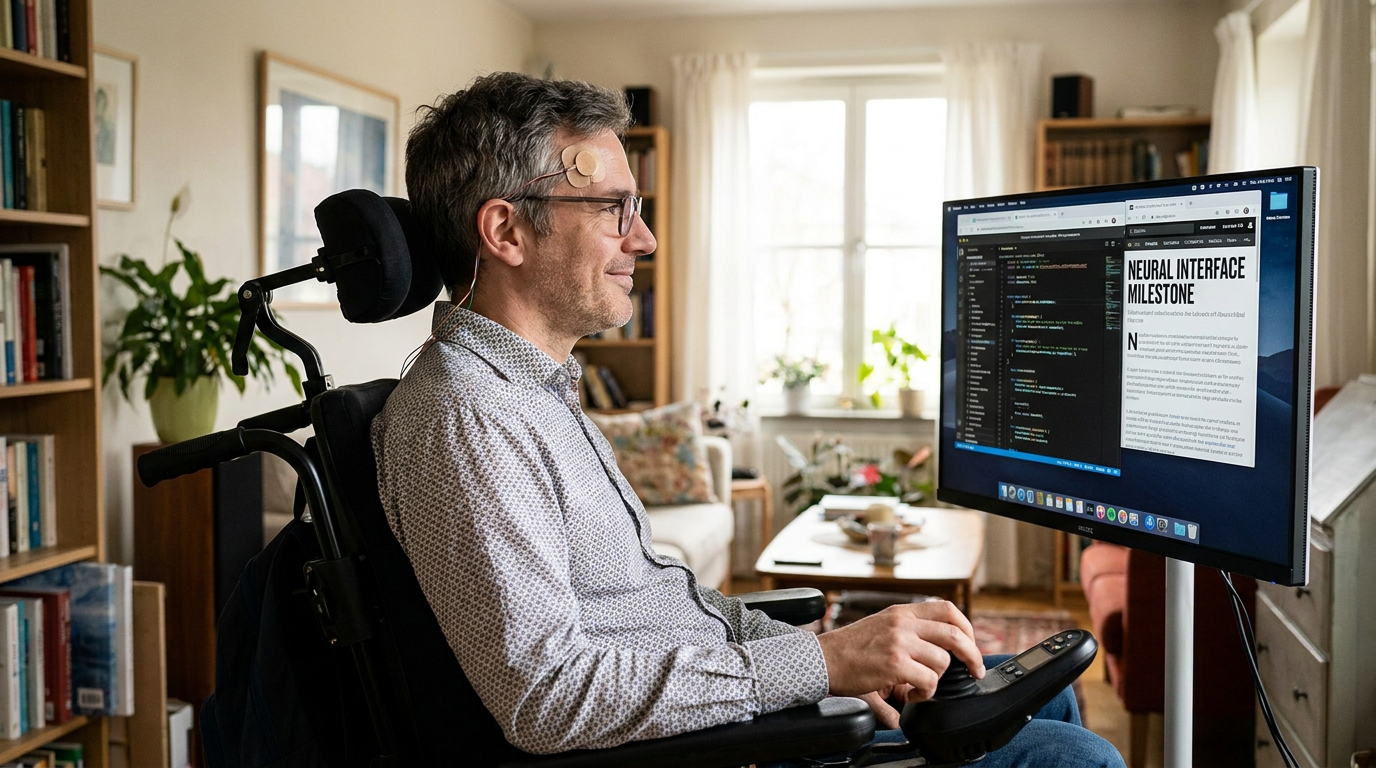
For 47-year-old Casey Harrell, the progression of amyotrophic lateral sclerosis (ALS) meant a slow, agonizing loss of connection. As the neurodegenerative disease eroded the nerve cells controlling his muscles, he developed severe dysarthria—an inability to speak clearly—leaving him functionally trapped, unable to converse with his wife or sing to his daughter.[1][4]
Today, Harrell is speaking, sending emails, and working full-time, entirely independently. According to a landmark study published June 15 in Nature Medicine, Harrell has successfully used an intracortical brain-computer interface (BCI) in his own home for nearly two years without the constant presence of a research team.[1][2]
The primary claim of the research, led by teams at UC Davis Health, Brown University, and Mass General Brigham, is that neuroprosthetics have finally crossed the threshold from experimental laboratory novelties to practical, daily-use medical devices. For decades, BCIs required a team of engineers to calibrate the system, monitor the hardware, and translate the data while the patient remained in a highly controlled clinical setting.[1][6]
The mechanism behind this newfound independence relies on a highly precise surgical intervention. In 2023, neurosurgeons implanted four microelectrode arrays into Harrell’s left precentral gyrus, a region of the brain's motor cortex responsible for coordinating the complex muscle movements of speech.[1][3]

These arrays contain 256 microscopic electrodes that penetrate the outer layer of the brain. When Harrell simply attempts to speak, his motor cortex still fires electrical signals, even though his physical muscles cannot respond. The electrodes detect these neural spikes and transmit them to a computer.[3][4]
The system's software acts as a real-time translator. Advanced decoding algorithms analyze the neural patterns and break them down into phonemes—the fundamental acoustic units of speech, like syllables. A predictive language model then assembles these phonemes into words, displaying them on a screen and reading them aloud using a synthetic voice trained on Harrell’s pre-ALS audio recordings.[3][5]
Advanced decoding algorithms analyze the neural patterns and break them down into phonemes—the fundamental acoustic units of speech, like syllables.
The evidence supporting the system's viability is unprecedented in its scale. Over the course of the trial, Harrell logged more than 3,800 hours of independent BCI use in his home. He utilized the system to communicate in self-paced, natural conversations, participating in video calls and interacting with his family on his own terms.[1][6]
Performance metrics from the study show a massive leap in accuracy. In formal testing, the BCI decoded Harrell's attempted speech with over 99 percent word accuracy across a massive 125,000-word vocabulary. This error rate of less than 1 percent puts the neuroprosthesis on par with, or even ahead of, commercial voice-to-text applications used by able-bodied individuals.[1][6]

Beyond speech, the BCI also functions as a digital navigation tool. By decoding neural activity linked to attempted hand movements, the system provides Harrell with precise cursor control. This dual-functionality—speech decoding for text input and movement decoding for mouse navigation—grants him full access to a personal computer, allowing him to maintain his employment and browse the internet unassisted.[1][2]
Despite the profound success of the BrainGate2 trial, researchers maintain transparent uncertainty about the technology's immediate scalability. The most significant limitation is the invasive nature of the procedure, which requires open-brain surgery to place the arrays directly into the cortical tissue.[4][5]
Furthermore, the longevity of the hardware remains an open question. Historically, intracortical microelectrodes can degrade over time as the brain's immune system recognizes the foreign objects and forms scar tissue around them, potentially dampening the electrical signals after several years.[5]
There is also clinical uncertainty regarding how well the decoding algorithms will generalize to other patients. Harrell’s motor cortex remains highly active and intact; it is not yet proven if the same high-resolution signals can be extracted from patients whose brain tissue has been directly damaged by severe strokes or advanced locked-in syndrome.[5]

To address these unknowns, upcoming clinical trials aim to test next-generation implants featuring up to 1,600 electrodes, which could provide even richer neural data and compensate for potential signal loss over time. Researchers are also expanding the participant pool to include individuals with a wider variety of neurological conditions.[3][5]
For now, the data confirms a monumental shift in assistive technology. By proving that a high-performance BCI can operate reliably in a living room rather than a laboratory, engineers have provided a tangible blueprint for restoring autonomy, dignity, and a voice to those silenced by paralysis.[1][4]
How we got here
2023
Casey Harrell undergoes surgery to implant four microelectrode arrays into his brain's motor cortex.
2024
Initial results show the BCI can decode Harrell's speech with high accuracy in controlled, researcher-assisted sessions.
June 2026
Nature Medicine publishes data showing Harrell has successfully used the system independently at home for over 3,800 hours.
Viewpoints in depth
Neuroprosthetics Researchers
Engineers and neuroscientists focused on the technical milestone of achieving high-accuracy, independent BCI operation outside the lab.
For the engineering teams at UC Davis and Brown University, the primary victory is crossing the threshold of independence. Historically, BCIs have been fragile, requiring constant recalibration by technicians to account for shifting neural signals. By developing advanced machine learning algorithms that adapt to the user's brain activity without manual intervention, researchers argue they have transformed the BCI from a laboratory proof-of-concept into a viable, long-term medical device. They point to the 3,800 hours of unassisted use as definitive proof of stability.
Patient Advocacy & Care
Advocates emphasizing the psychological and practical benefits of restoring autonomy and communication to those with severe paralysis.
From the perspective of ALS advocates and caregivers, the technology's value is measured in emotional and practical autonomy. Losing the ability to speak is often cited as one of the most isolating and demoralizing aspects of neurodegenerative disease. Advocates highlight that the system not only allows patients to express complex thoughts and maintain employment, but also restores their personal identity through the use of synthesized pre-illness voices. Furthermore, independent operation drastically reduces the constant burden placed on full-time caregivers.
Clinical Skeptics
Medical analysts evaluating the limitations, risks, and future scalability of the invasive technology.
While acknowledging the breakthrough, cautious clinical observers emphasize the significant hurdles remaining before widespread adoption. The procedure requires open-brain surgery, carrying inherent risks of infection and surgical complications. Furthermore, skeptics point out that the brain's natural immune response typically forms scar tissue around implanted microelectrodes, which can degrade signal quality over several years. They also caution that the current success relies on a largely intact motor cortex, leaving it uncertain whether the same results can be achieved for patients with severe brain injuries or strokes.
What we don't know
- Whether the decoding algorithms will work as effectively for patients whose motor cortex has been damaged by a stroke.
- How long the microelectrode arrays will function before the brain's natural scar tissue degrades the electrical signals.
- When this highly experimental, surgically invasive technology might become widely available or covered by insurance.
Key terms
- Amyotrophic Lateral Sclerosis (ALS)
- A progressive neurodegenerative disease that affects nerve cells in the brain and spinal cord, leading to severe muscle weakness and paralysis.
- Brain-Computer Interface (BCI)
- A system that establishes a direct communication pathway between the brain's electrical activity and an external device, such as a computer.
- Dysarthria
- A motor speech disorder characterized by poor articulation and difficult-to-understand speech, caused by muscle weakness.
- Motor Cortex
- The region of the cerebral cortex involved in the planning, control, and execution of voluntary movements.
- Phoneme
- The smallest unit of sound in speech, which the BCI algorithms decode before assembling them into complete words.
Frequently asked
How does the brain implant work?
It uses 256 microscopic electrodes implanted in the brain's motor cortex to detect electrical signals generated when the patient attempts to speak, which are then translated into words by a computer.
Does the patient need a researcher present to use it?
No. The major breakthrough of this study is that the patient was able to use the system independently at home for nearly two years.
How accurate is the speech decoding?
The system achieved over 99% word accuracy across a vocabulary of 125,000 words.
Can this cure ALS?
No. The implant does not treat or slow the progression of ALS; it is an assistive device that restores communication and computer control after paralysis has set in.
Sources
Source coverage
6 outlets
3 viewpoints surfaced






[1]UC Davis HealthNeuroprosthetics Researchers
Brain-computer interface enables independent, accurate communication for man living with ALS
Read on UC Davis Health →[2]NatureNeuroprosthetics Researchers
At-home brain implant gives man with motor neuron disease his daily life back
Read on Nature →[3]Brown UniversityNeuroprosthetics Researchers
Brain-computer interface allows man with ALS to 'speak' again
Read on Brown University →[4]ALS News TodayPatient Advocacy & Care
Brain-computer interface allows man with ALS to communicate
Read on ALS News Today →[5]ZME ScienceScience & Technology Observers
A Man Lost His Voice to ALS. A Brain Implant Helped Him Sing Again
Read on ZME Science →[6]ScienmagScience & Technology Observers
Brain-Computer Interface Empowers ALS Patient with Independent and Precise Communication
Read on Scienmag →


Every angle. Every day.
Get science stories with full source coverage and perspective breakdowns delivered to your inbox.