
JWST Observations Help Solve Cosmology's 'Chicken-or-the-Egg' Black Hole Problem
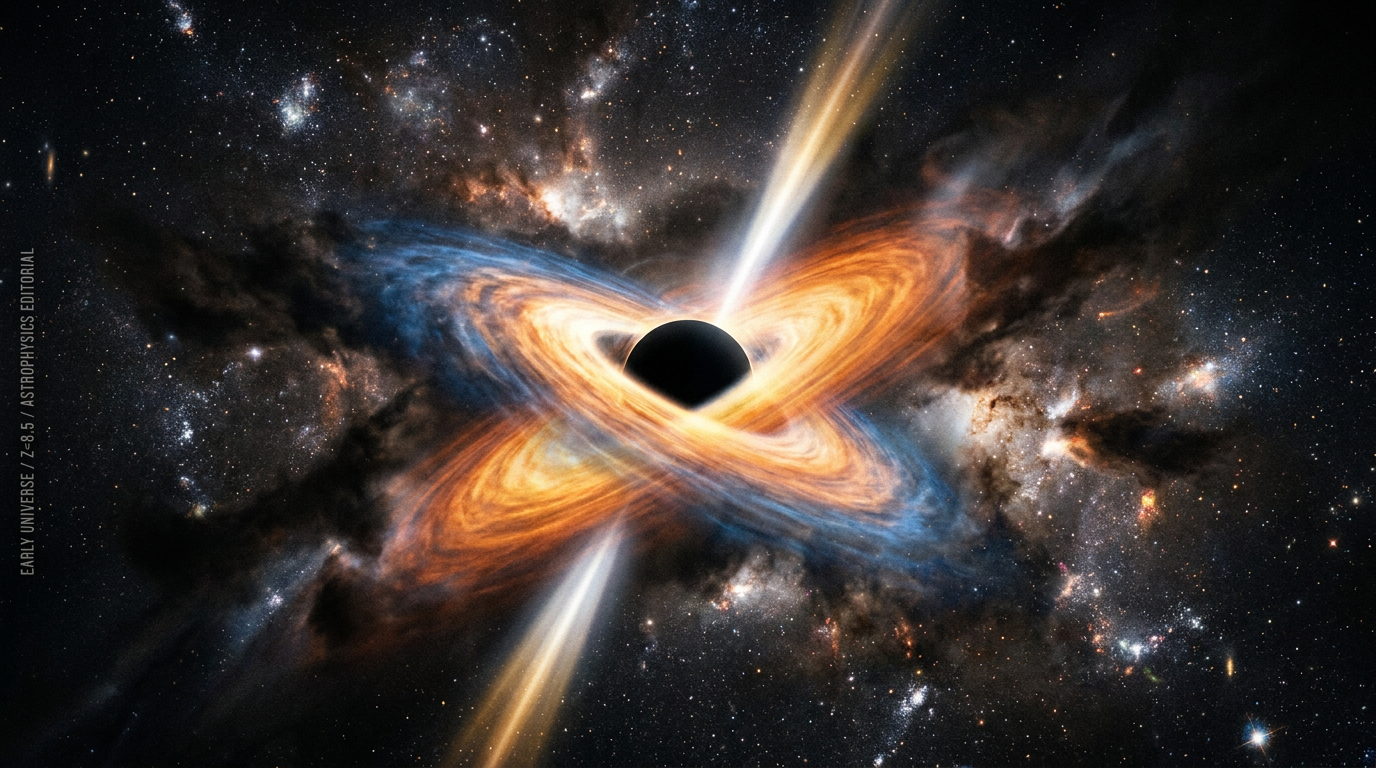
New data from the James Webb Space Telescope suggests that supermassive black holes and their host galaxies co-evolved, with early black holes acting as seeds that both accelerated and eventually halted star formation.
By Factlen Editorial Team
- Early Universe Cosmologists
- Researchers focused on the first billion years after the Big Bang who argue black holes formed via direct collapse.
- Galaxy Evolution Researchers
- Scientists studying the lifecycle of galaxies and how black hole feedback quenches star formation.
- Observational Astronomers
- Astronomers focused on gathering telescope data who emphasize the need for more deep-field surveys to confirm theoretical models.
What's not represented
- · Alternative Gravity Theorists
- · Dark Matter Researchers
Why this matters
Understanding the origins of supermassive black holes fundamentally rewrites our knowledge of how the universe evolved from a soup of primordial gas into the structured cosmos we inhabit today. It proves that the destructive forces of black holes were actually essential engines of creation for the galaxies that eventually hosted life.
Key points
- Astronomers have long debated whether galaxies or their central supermassive black holes formed first.
- JWST observations reveal that early black holes were vastly overmassive compared to their host galaxies.
- New models suggest black holes formed via direct collapse and acted as early seeds that amplified star formation.
- As these black holes grew, their intense energy output eventually blew away star-forming gas, quenching the galaxy.
- The findings indicate that black holes and galaxies co-evolved in a complex, synchronized process rather than one simply preceding the other.
For decades, astrophysicists have wrestled with a cosmic-scale chicken-or-the-egg problem: did galaxies form first, eventually spawning supermassive black holes at their centers, or did the black holes come first and build galaxies around them?[1][4]
In the local universe, the relationship between a supermassive black hole and its host galaxy is remarkably consistent. The black hole typically accounts for about 0.1% to 0.5% of the galaxy's central stellar mass, a tight correlation known as the M-sigma relation.[3][4]
This precise mathematical link strongly implies that black holes and galaxies do not evolve independently. Instead, they are locked in a synchronized dance of co-evolution, regulating each other's growth over billions of years.[4]
However, observing the modern universe is like walking into the final act of a play. To understand how the relationship started, astronomers needed to peer back to the first billion years after the Big Bang, an era previously hidden behind a thick haze of primordial gas.[5]

Historically, the prevailing theory assumed that stars and galaxies formed first. Under this model, black holes slowly coalesced later from the collapsed cores of the first generation of massive stars, gradually growing as they consumed surrounding matter.[1][5]
The launch of the James Webb Space Telescope (JWST) shattered this timeline. As JWST peered into the deep universe, it began spotting mysterious 'Little Red Dots'—compact, ancient systems existing just 500 million years after the Big Bang.[3]
The primary claim emerging from these observations is that black holes were present at the very beginning and were vastly overmassive. JWST data revealed that these early black holes were far larger than expected for their host galaxies' sizes.[3][5]
In some of these extreme cases, termed Overmassive Black Hole Galaxies (OBGs), the black hole's mass actually exceeded the entire stellar mass of the host galaxy.[3][6]
This discovery flipped the traditional model on its head. If black holes were already behemoths when their host galaxies were still in their infancy, the black holes must have formed first, or at least concurrently through a highly accelerated mechanism.[1][5]
A second major claim suggests that these early black holes acted as gigantic amplifiers of star formation. Recent cosmological simulations indicate that rather than just destroying matter, black holes functioned as early seeds for galactic growth.[5][6]
A second major claim suggests that these early black holes acted as gigantic amplifiers of star formation.
The intense gravitational forces and energetic outflows from these early black holes compressed surrounding gas clouds. This compression triggered rapid bursts of star formation, effectively building the early galaxy around the black hole.[5]
Astrophysicists now theorize that these 'seed' black holes formed via direct collapse. In this scenario, massive clouds of pristine gas collapsed directly into black holes, bypassing the star phase entirely and giving the black holes a massive head start.[3][6]

While early black holes may have seeded star formation, the evidence shows they are also responsible for shutting it down—a process known as feedback.[2][4]
As a supermassive black hole feeds, it enters an active quasar phase, releasing enormous amounts of energy. This energy heats and expels the cold gas supply that the galaxy needs to continue producing stars.[2][6]
A landmark June 2026 study in the journal Science provided direct evidence of this quenching phase. Astronomers successfully measured the mass of a dormant 6-billion-solar-mass black hole in a galaxy 10 billion light-years away.[2]
This galaxy, designated MRG-M0138, had completely ceased star formation when the universe was barely 3 billion years old. The massive, dormant black hole at its center is the smoking gun that black hole feedback starves galaxies of their star-forming fuel.[2]

By combining these observations, a unified timeline emerges: direct-collapse black holes and early star clusters emerged together from the primordial gas. The black holes initially accelerated galaxy growth, then eventually grew powerful enough to blow away the remaining gas, locking in the mass ratio we see today.[1][3][6]
Despite this breakthrough, transparent uncertainty remains regarding the exact mechanism of direct collapse. This process requires highly specific conditions—namely, the absence of heavy elements and suppression of early fragmentation—that are difficult to observe directly.[6]
How we got here
1990s-2000s
Astronomers establish the M-sigma relation, proving that supermassive black holes and their host galaxies are intimately linked in the local universe.
2004
The Hubble Ultra Deep Field reveals thousands of early galaxies, but lacks the infrared sensitivity to peer through the dust and see their central black holes.
December 2021
The James Webb Space Telescope (JWST) launches, equipped with unprecedented infrared capabilities to observe the universe's first billion years.
2023-2024
JWST discovers 'Little Red Dots' and Overmassive Black Hole Galaxies, revealing black holes that are far too large for their early host galaxies.
June 2026
A landmark study in Science directly measures a dormant 6-billion-solar-mass black hole, confirming that black hole feedback quenches star formation.
Viewpoints in depth
Early Universe Cosmologists
Researchers focused on the first billion years after the Big Bang.
This camp argues that the traditional model of stellar-mass black holes slowly growing over billions of years is mathematically impossible given the behemoths JWST has found. They champion the 'direct collapse' theory, where massive clouds of pristine hydrogen bypassed the star-formation phase entirely, collapsing directly into massive black hole seeds. In their view, these seeds were the gravitational anchors that pulled in surrounding gas, effectively birthing the first galaxies.
Galaxy Evolution Researchers
Scientists studying the lifecycle of galaxies and star formation.
For these researchers, the most critical part of the black hole-galaxy relationship is the 'feedback' mechanism. They focus on how an actively feeding supermassive black hole generates intense radiation and quasar winds that heat and expel the interstellar medium. Their models show that without this quenching mechanism, galaxies would continue producing stars indefinitely, failing to match the dormant, mature elliptical galaxies observed in the local universe.
Observational Astronomers
Astronomers focused on gathering and interpreting telescope data.
This group remains cautious about declaring the debate entirely settled. While they acknowledge the groundbreaking nature of JWST's 'Little Red Dots,' they emphasize that these objects are heavily obscured by dust and difficult to measure precisely. They argue that until a larger, more comprehensive census of early-universe black holes is completed, the direct collapse theory remains a highly plausible hypothesis rather than an established fact.
What we don't know
- Whether the 'Little Red Dots' represent the standard evolutionary path for all galaxies or are extreme outliers.
- The exact physical conditions required for a massive primordial gas cloud to undergo direct collapse into a black hole.
- How the presence of dark matter halos influenced the initial formation rates of these seed black holes.
Key terms
- Supermassive Black Hole
- A black hole containing hundreds of thousands to billions of times the mass of the Sun, typically found at the center of a galaxy.
- M-sigma Relation
- An empirical correlation observed in the local universe where a supermassive black hole's mass is tightly linked to the stellar mass of its host galaxy's central bulge.
- Quasar
- An extremely luminous active galactic nucleus powered by a supermassive black hole actively consuming a massive surrounding disk of gas.
- Black Hole Feedback
- The process by which energy and winds from an actively feeding black hole heat or expel the gas in a galaxy, halting new star formation.
- Direct Collapse
- A theoretical mechanism where a massive cloud of gas in the early universe collapses directly into a black hole, skipping the stellar lifecycle.
Frequently asked
What is the cosmic chicken-or-the-egg problem?
It is the long-standing astronomical debate over whether galaxies formed first and birthed supermassive black holes, or if black holes formed first and gathered galaxies around them.
What are the 'Little Red Dots' found by JWST?
They are compact, ancient galaxies from the early universe that appear red due to dust obscuration. JWST revealed they contain supermassive black holes that are unexpectedly large for the size of their host galaxies.
How do black holes stop galaxies from growing?
When a supermassive black hole actively consumes matter, it releases massive amounts of energy and powerful winds. This 'feedback' blows away the cold gas needed to form new stars, effectively shutting down the galaxy's growth.
What is a direct-collapse black hole?
It is a theoretical type of black hole that forms when a massive cloud of pristine gas collapses directly under its own gravity, bypassing the normal process of forming a star first.
Sources
Source coverage
7 outlets
3 viewpoints surfaced







[1]New ScientistEarly Universe Cosmologists
We may have finally solved cosmology's chicken-or-the-egg problem
Read on New Scientist →[2]ScienceGalaxy Evolution Researchers
Direct mass measurement of a dormant supermassive black hole at z=2
Read on Science →[3]Universe TodayObservational Astronomers
The Little Red Dots That Turned Out to Be Black Holes in Disguise
Read on Universe Today →[4]NASAGalaxy Evolution Researchers
The Co-Evolution of Galaxies and Black Holes
Read on NASA →[5]ScienceAlertEarly Universe Cosmologists
JWST Data Suggests Black Holes and Galaxies Emerged Together
Read on ScienceAlert →[6]The Astrophysical Journal LettersEarly Universe Cosmologists
Simulations of Direct Collapse Black Holes and Overmassive Black Hole Galaxies
Read on The Astrophysical Journal Letters →[7]NatureObservational Astronomers
Starlight from two massive galaxies hosting actively growing black holes
Read on Nature →
Every angle. Every day.
Get science stories with full source coverage and perspective breakdowns delivered to your inbox.