
The Rise of Local AI: How Powerful Models Are Moving From the Cloud to Your Laptop
Advances in neural processing hardware and model compression are allowing users to run sophisticated AI entirely offline, ensuring absolute privacy and zero subscription costs.
By Factlen Editorial Team
- Privacy Advocates & Enterprises
- Argue that cloud AI is a massive liability and champion local models for strict data sovereignty.
- Open-Source Developers
- Value the freedom to modify and run models without corporate guardrails or API rate limits.
- Hardware Manufacturers
- View local AI as the ultimate catalyst for a PC upgrade supercycle driven by NPU performance.
- Everyday Consumers
- Appreciate the ability to use capable AI tools for free, without needing an internet connection.
What's not represented
- · Cloud Infrastructure Providers
- · Cybersecurity Threat Actors
Why this matters
Running AI locally means your sensitive data, private documents, and proprietary code never leave your computer. It also eliminates monthly subscription fees and allows you to use powerful AI assistants even when you have no internet connection.
Key points
- Local AI allows users to run large language models directly on their laptops without an internet connection.
- Processing data on-device ensures absolute privacy, as sensitive information never leaves the machine.
- New Neural Processing Units (NPUs) in modern laptops provide the computing power needed for AI tasks.
- Model compression techniques like quantization allow massive AI models to run smoothly on just 8GB of RAM.
- Tools like Ollama and LM Studio have made installing and running local AI as easy as downloading a standard app.
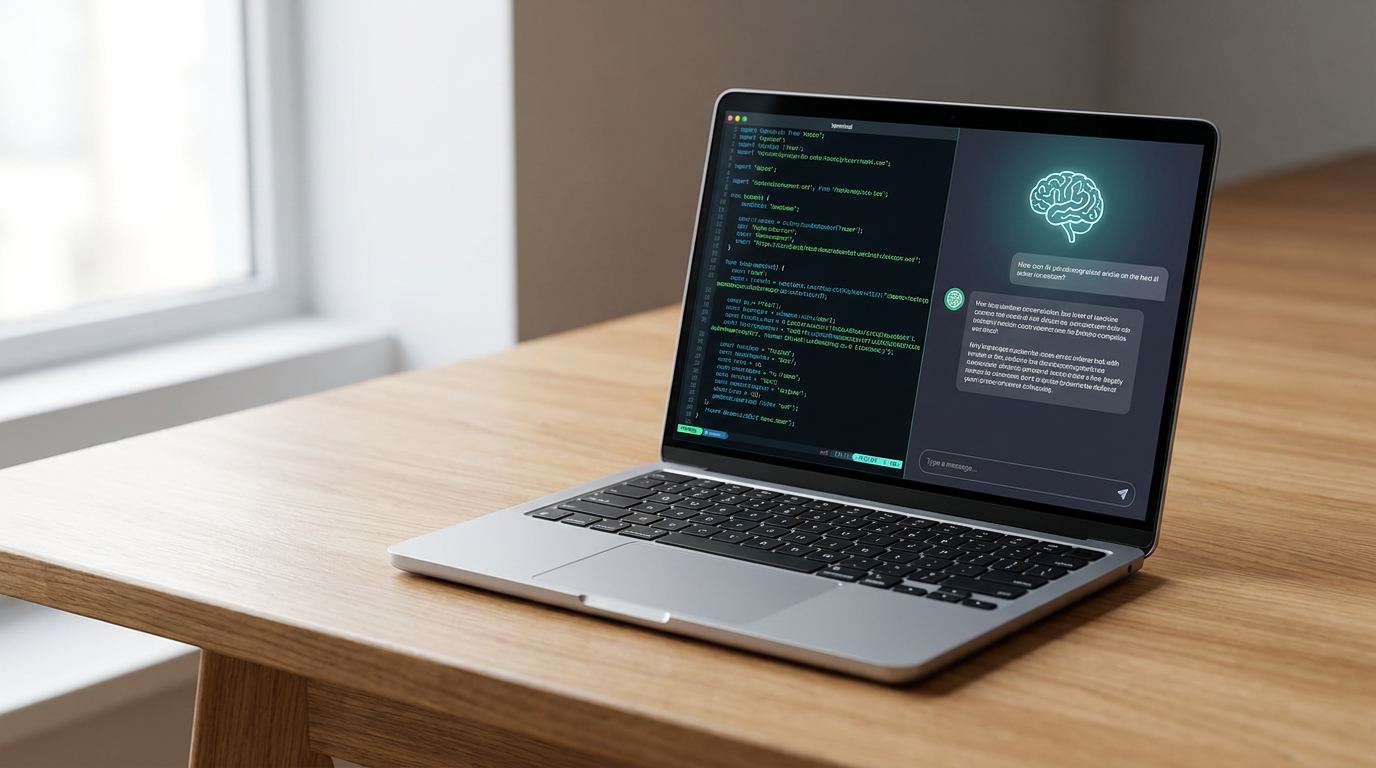
For the past three years, interacting with artificial intelligence meant sending your thoughts, code, and questions to a distant server. But in 2026, a quiet revolution has inverted that model. Powerful AI is moving out of the cloud and directly onto everyday laptops and smartphones. This shift toward "local AI" or "on-device AI" is democratizing access to large language models, allowing users to run sophisticated chatbots entirely offline.[4][6]
The push away from cloud-dependency is largely driven by privacy. When users type prompts into web-based AI services, that data traverses the internet to third-party servers, creating significant security vulnerabilities. High-profile corporate data leaks have made enterprises wary of cloud AI, especially in regulated sectors like healthcare and finance where HIPAA and GDPR compliance are mandatory. By running models locally, zero data ever leaves the machine, ensuring absolute data sovereignty.[3]
Making this possible is a fundamental change in computer hardware: the rise of the Neural Processing Unit. Unlike traditional CPUs that handle general tasks, or GPUs that render graphics, NPUs are dedicated silicon engines designed specifically for the complex mathematics of machine learning. By offloading AI tasks to the NPU, modern laptops can run AI models continuously without draining the battery or overheating the system.[1]
The hardware landscape in 2026 is highly competitive and rapidly advancing. Qualcomm's Snapdragon X2 Elite platforms now deliver up to 80 TOPS of dedicated AI performance. AMD's Ryzen AI processors and Intel's Core Ultra chips follow closely, offering 45 to 75 TOPS. This means that the baseline for a standard consumer laptop now includes enough AI compute power to run tasks that previously required massive data centers.[1][2]

Apple has also fully embraced this localized architecture with its rollout of Apple Intelligence. Built deeply into macOS and iOS, Apple's system prioritizes on-device processing for everyday tasks like summarizing emails and generating text. When a query is too complex for the local chip, it hands the task off to "Private Cloud Compute"—specialized servers that process the encrypted data without ever storing it, ensuring that even Apple cannot access the user's information.[5]
But hardware is only half the story; the software ecosystem has matured dramatically to meet the moment. Just a year ago, running a local large language model required advanced programming knowledge and complex Python environments. Today, the process is as simple as downloading a standard desktop application, opening the door for everyday consumers to take control of their AI tools.[4][7]
But hardware is only half the story; the software ecosystem has matured dramatically to meet the moment.
For developers, a tool called Ollama has become the industry standard, often described as "Docker for LLMs." It operates through a simple command-line interface, allowing users to download and run models like Meta's Llama or Google's Gemma with a single line of code. Ollama runs quietly in the background, providing an API that developers can easily plug into their own custom applications.[7]
For non-technical users, graphical interfaces like LM Studio and Jan AI have bridged the usability gap. LM Studio provides a familiar, ChatGPT-style chat window that runs entirely on the user's machine. It includes a built-in browser to search for new models, making the experience of testing different AI personalities as easy as browsing an app store.[4][7]
The secret to fitting these massive neural networks onto standard laptops is a technique called "quantization." AI models are originally trained using high-precision numbers that require massive amounts of memory. Quantization compresses these numbers—often packing them into a format known as GGUF—which shrinks the total file size by 60 to 75 percent with only a negligible drop in response quality.[4]

Because of quantization, users no longer need expensive, power-hungry graphics cards to run AI. In 2026, highly capable small language models like Microsoft's Phi-4-mini or Google's Gemma 4 can run smoothly on a standard laptop with just 8 gigabytes of RAM. While they may not possess the encyclopedic knowledge of a massive cloud model, they are remarkably adept at writing, coding, and summarizing documents.[4][6]
Beyond privacy, local AI eliminates the recurring financial burden of cloud subscriptions. Cloud-based AI services typically charge around $20 per month or bill developers per token generated. Once a local model is downloaded, it is entirely free to use, allowing users to generate infinite text without worrying about API costs or usage limits.[6]

Local AI also offers the distinct advantage of zero latency and complete offline capability. Because the processing happens on the motherboard rather than a server hundreds of miles away, the AI's responses appear instantly. Furthermore, users can access their AI assistants on airplanes, in remote locations, or within secure, air-gapped enterprise environments where Wi-Fi is strictly prohibited.[6]
The future of AI computing is increasingly looking hybrid. Everyday tasks—like drafting emails, organizing notes, and basic coding—are handled instantly and privately by the on-device NPU. Only when a user needs to solve a highly complex reasoning problem or generate a photorealistic image does the system seamlessly ping a massive cloud model.[6]
This shift represents a profound democratization of artificial intelligence. By untethering AI from corporate data centers and placing it directly into the hands of users, the technology becomes more private, more resilient, and ultimately more personal. The AI revolution is no longer just happening in the cloud; it is happening right on your desk.[8]
How we got here
Late 2022
Cloud-based AI chatbots launch, requiring massive remote data centers to process user prompts.
Mid 2023
Corporate data leaks prompt major enterprises to ban employee use of public cloud AI tools.
Early 2024
Open-source developers pioneer quantization techniques, allowing large models to be compressed.
Late 2024
User-friendly applications like LM Studio and Ollama are released, simplifying local AI installation.
2025-2026
Chipmakers integrate powerful NPUs into standard laptops, making on-device AI mainstream and highly efficient.
Viewpoints in depth
Enterprise Privacy Advocates
Argue that cloud AI is a massive liability for regulated industries.
Privacy advocates point out that sending proprietary code or patient data to third-party servers is a fundamental security risk. They cite the $4.44 million average cost of a data breach and strict GDPR and HIPAA laws as reasons why local, air-gapped LLMs are the only compliant path forward for corporate data. For these organizations, the slight drop in model intelligence is a necessary trade-off for absolute data sovereignty.
Open-Source Developers
Value the freedom to modify and run models without corporate guardrails.
The developer community champions local AI as a way to keep technology decentralized. They argue that AI should be treated as fundamental infrastructure rather than a rented service controlled by a few massive tech conglomerates. By utilizing tools like Ollama and the GGUF format, developers can build, tinker, and deploy AI applications without worrying about API rate limits, unexpected price hikes, or sudden changes to a cloud provider's terms of service.
Hardware Manufacturers
View local AI as the ultimate catalyst for a PC upgrade supercycle.
For companies like Qualcomm, AMD, Intel, and Apple, the shift toward local AI is a massive business opportunity. By integrating powerful NPUs into their silicon, they are positioning on-device AI capabilities as the primary selling point for the 2026 laptop market. They argue that hybrid computing—where the local NPU handles everyday tasks and the cloud handles the heavy lifting—is the most efficient and scalable architecture for the future of personal computing.
What we don't know
- Whether local models will eventually hit a hard performance ceiling compared to the massive parameter counts of cloud-based frontier models.
- How quickly software developers will fully optimize their legacy applications to take advantage of the new NPU hardware architectures.
Key terms
- NPU (Neural Processing Unit)
- A specialized hardware chip designed specifically to accelerate artificial intelligence tasks efficiently without draining battery life.
- Quantization
- A compression technique that shrinks the file size and memory requirements of an AI model by reducing the precision of its internal numbers.
- TOPS (Tera Operations Per Second)
- A metric used to measure the computing performance of an NPU, indicating how many trillion operations it can perform in one second.
- GGUF
- A popular file format used to store quantized AI models so they can be easily run on standard consumer hardware.
Frequently asked
Do I need an internet connection to use a local LLM?
No. Once you download the model file and the software to run it, the AI operates entirely offline, making it ideal for travel or secure environments.
What is the minimum hardware required?
Thanks to model quantization, you can run small models smoothly on a standard laptop with 8GB of RAM, though 16GB and a dedicated NPU or GPU are recommended for faster performance.
Is local AI as smart as ChatGPT?
Local models are highly capable at writing, coding, and summarizing, but they do not possess the vast encyclopedic knowledge of massive cloud models like GPT-4 due to their smaller size.
What is an NPU?
A Neural Processing Unit is a specialized chip built into modern processors designed specifically to handle the complex math required by artificial intelligence, saving battery life and freeing up the CPU.
Sources
Source coverage
8 outlets
4 viewpoints surfaced








[1]Ordinary TechHardware Manufacturers
NPU vs GPU in 2026: Which Powers Your AI Workload Better?
Read on Ordinary Tech →[2]ASUSHardware Manufacturers
Choosing the Right SoC for Your Laptop: Snapdragon X Elite
Read on ASUS →[3]Digital AppliedPrivacy Advocates & Enterprises
Why Deploy LLMs Locally for Privacy and Compliance
Read on Digital Applied →[4]AI Thinker LabOpen-Source Developers
Run AI models locally and offline on a laptop
Read on AI Thinker Lab →[5]AppleHardware Manufacturers
Apple introduces the next generation of Apple Intelligence
Read on Apple →[6]AI MagicxPrivacy Advocates & Enterprises
On-Device AI in 2026: Running LLMs Locally
Read on AI Magicx →[7]LocalChatOpen-Source Developers
The 10 Best LM Studio Alternatives for Local AI
Read on LocalChat →[8]Factlen Editorial TeamEveryday Consumers
Synthesis by Factlen editorial team
Read on Factlen Editorial Team →

Every angle. Every day.
Get ai stories with full source coverage and perspective breakdowns delivered to your inbox.