
At-Home Brain Implant Restores Digital Autonomy for Patient with Motor Neuron Disease
A landmark study reveals that a fully implanted brain-computer interface has allowed a paralyzed patient to independently control a computer for two years. The breakthrough signals the transition of neural interfaces from experimental lab technology to reliable, daily-use medical devices.
By Factlen Editorial Team
- Neurotechnology Researchers
- Focused on the underlying hardware longevity, signal-to-noise ratio, and the mathematical precision of decoding algorithms.
- Patient Advocacy Groups
- Emphasizing autonomy, quality of life, and the urgent need for accessible, affordable at-home solutions for locked-in patients.
- Commercial BCI Developers
- Prioritizing surgical scalability, wireless bandwidth, and navigating the FDA regulatory pathways for mass-market adoption.
- Independent Analysts
- Evaluating the broader societal and medical implications of the technology's transition to the market.
What's not represented
- · Health insurance providers evaluating coverage costs
- · Bioethicists studying neural data privacy
Why this matters
For decades, brain-computer interfaces were confined to laboratories, requiring teams of engineers to operate. This milestone proves that fully implanted, wireless neural devices can reliably restore communication and digital autonomy to paralyzed patients in their own homes, marking the transition from experimental science to life-changing medical care.
Key points
- A patient with motor neuron disease has successfully used an at-home brain-computer interface (BCI) for nearly two years.
- The system allowed the user to navigate the internet, send emails, and control smart devices without on-site engineering support.
- Advances in flexible microelectrodes have significantly reduced the brain's immune response, extending the lifespan of the implants.
- Machine learning algorithms and predictive language models have dramatically improved the speed and accuracy of translating neural signals into digital commands.
- While the milestone is historic, questions remain regarding the ultimate decade-long durability of the hardware and the cost of the neurosurgery.
For decades, the promise of brain-computer interfaces (BCIs) has been tethered to the laboratory. Patients with severe paralysis could control cursors or robotic arms, but only while surrounded by racks of servers and a team of graduate students calibrating the hardware. That era is officially ending. A landmark study published this week in Nature details the case of a man with motor neuron disease (MND) who has successfully used a fully implanted, at-home BCI to communicate and control his personal computer for nearly two years. This represents a profound paradigm shift: the transition of neural interfaces from experimental lab novelties to reliable, daily-use medical devices.[1]
The clinical stakes for this technology are difficult to overstate. Motor neuron diseases, including amyotrophic lateral sclerosis (ALS), progressively destroy the nerve cells responsible for voluntary muscle movement. As the disease advances, patients often reach a locked-in state—fully cognitively aware but entirely unable to move or speak. For these individuals, restoring communication is the single highest priority for quality of life. The Factlen Editorial Team has reviewed the latest clinical data, and the consensus is clear: restoring digital autonomy is no longer science fiction; it is now a solvable engineering problem.[2][6][8]
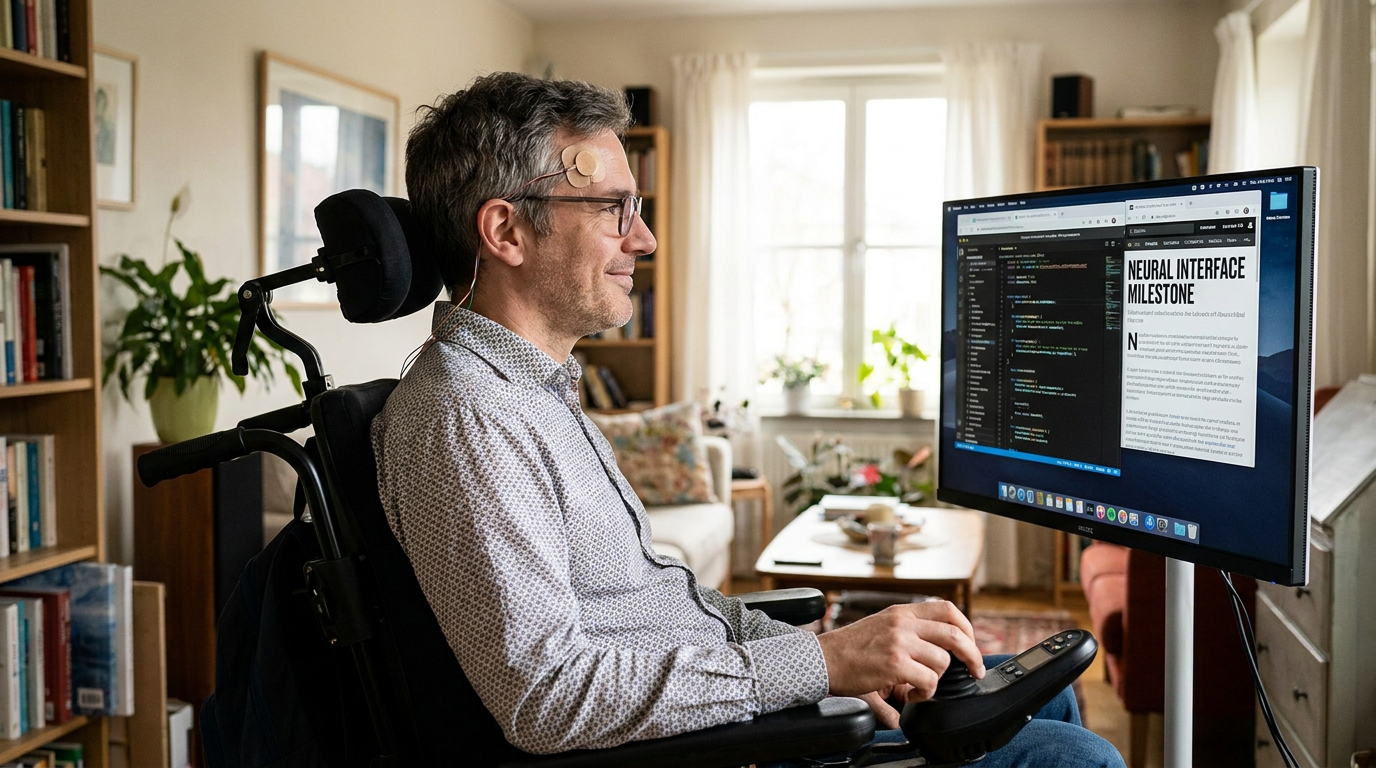
The primary evidence for this claim rests on the longitudinal data reported in the new Nature study. The patient, who lost the ability to speak and type due to MND, utilized the system daily in his own living room without on-site technical support. He navigated the internet, sent emails, and controlled smart home devices simply by intending to move his hands. This sustained, independent use shatters the previous limitation of BCIs, which historically required daily recalibration by experts to maintain accuracy.[1]
The mechanism behind this breakthrough relies on intercepting the brain's electrical signals before they reach the damaged spinal cord. When a person intends to move their hand, the motor cortex still fires a specific pattern of electrical spikes, even if the physical hand cannot respond. Microelectrode arrays implanted in or on the brain detect these microvolt-level changes. A wireless transmitter, sitting flush with the skull or implanted in the chest, sends these raw signals to an external computer, where they are translated into digital commands.[1][4]

Historically, the human body has been a hostile environment for electronics. The brain's immune system recognizes rigid silicon electrodes as foreign objects and attacks them, forming scar tissue known as gliosis. This scar tissue acts as an insulator, gradually blocking the electrical signals and rendering the implant useless after a few months or years. The uncertainty surrounding device lifespan has been the primary bottleneck preventing widespread commercial use.[7]
However, recent advances in materials science have fundamentally altered this trajectory. Newer implants utilize ultra-flexible polymers and microscopic threads that move with the brain rather than cutting through it. By matching the mechanical properties of brain tissue, these flexible substrates provoke a dramatically lower immune response. The confirmation of two years of stable, high-quality signal acquisition provides robust clinical evidence that the gliosis problem is being successfully mitigated in human patients.[1][7]
Commercial developers are echoing these academic findings. Companies like Neuralink have recently reported similar long-term stability in their own patient registries, noting that individuals with spinal cord injuries and ALS are using their implants for extended periods to play video games, design 3D models, and write code. The convergence of academic research and commercial clinical trials suggests that multi-year implant viability is now the baseline expectation rather than an outlier.[4][5]
The convergence of academic research and commercial clinical trials suggests that multi-year implant viability is now the baseline expectation rather than an outlier.
While hardware improvements capture cleaner signals, the software is what actually restores autonomy. Translating a chaotic storm of neural spikes into a smooth, precise cursor movement requires immense computational power. Early BCIs used simple linear filters, which were slow and prone to error. Today, researchers deploy advanced machine learning models, including recurrent neural networks, to predict the user's intent with astonishing speed and accuracy.[3]
These algorithms do not just map a single neuron to a single pixel; they analyze the population dynamics of thousands of neurons simultaneously. Furthermore, they incorporate predictive language models—similar to the autocomplete function on a smartphone—to drastically increase typing speeds. If the neural decoder detects the letters T-H-E, the language model anticipates the next keystroke, reducing the cognitive load on the patient and increasing the overall words-per-minute output.[3][8]

Despite these monumental leaps, transparent uncertainty remains regarding the ultimate lifespan of these devices. While two years of stable use is a historic milestone, a young patient with a spinal cord injury will need an implant that lasts for decades, not just a few years. We do not yet have 10-year or 20-year data on the current generation of flexible microelectrodes. If a device fails after five years, the prospect of repeated brain surgeries poses significant ethical and medical risks that the field must still address.[4]
Another area of active debate is surgical scalability. The device featured in the recent breakthrough, like many high-bandwidth BCIs, requires a craniotomy—removing a piece of the skull to place the electrodes directly on the cortex. While neurosurgeons perform craniotomies routinely, it is an invasive procedure with inherent risks of infection and bleeding. For BCIs to reach the hundreds of thousands of patients who need them, the surgical delivery mechanism must become as routine as a pacemaker implantation.[1][2]
Alternative approaches are actively being tested to bypass open brain surgery entirely. Endovascular BCIs, for example, are delivered through the jugular vein and deployed inside a blood vessel sitting over the motor cortex. While this approach sacrifices some signal resolution because the sensors are further from the neurons, it eliminates the need for a craniotomy and can be performed in an outpatient setting. The trade-off between surgical invasiveness and signal bandwidth will define the next decade of neurotechnology development.[4]

The economic accessibility of these devices also remains an open question. Currently, patients receive these implants as part of fully funded clinical trials. When these devices transition to the commercial market, the combined cost of the hardware, the neurosurgery, and the specialized software could easily exceed hundreds of thousands of dollars. Patient advocacy groups are already lobbying healthcare systems and insurers to ensure that once FDA approval is granted, these life-changing interfaces do not become a luxury available only to the wealthy.[6][8]
What is no longer in doubt is the profound psychological impact of the technology. For a patient with motor neuron disease, the loss of communication is often described as more terrifying than the loss of mobility. The ability to independently send a text message to a spouse, browse the news, or control the lighting in a room restores a fundamental sense of agency. It shifts the patient from being a passive recipient of care to an active participant in their own life.[1][6]
The convergence of flexible materials, advanced machine learning, and courageous early-adopter patients has pushed brain-computer interfaces past the point of no return. This milestone is not just an isolated success story; it is a proof of concept for the future of neurology. As the technology continues to miniaturize and the algorithms grow more sophisticated, the medical community is preparing for a reality where neurological damage—whether from ALS, stroke, or spinal cord injury—no longer means a permanent loss of connection to the world.[1][5][8]
How we got here
2004
The first human receives a Utah array implant, demonstrating the basic viability of reading motor cortex signals.
2016
BCIs demonstrate the ability to allow paralyzed patients to control robotic limbs in highly supervised lab settings.
2021
Flexible thread electrodes and endovascular approaches show promise in reducing scar tissue and surgical invasiveness.
June 2026
Nature publishes a milestone study detailing two years of unsupervised, at-home BCI use by a patient with motor neuron disease.
Viewpoints in depth
Neurotechnology Researchers
Focused on the underlying hardware longevity, signal-to-noise ratio, and the mathematical precision of decoding algorithms.
For academic researchers and materials scientists, the primary battleground is the brain's immune response. They argue that the true bottleneck in neurotechnology is not software, but the physical interface between silicon and biological tissue. Their evidence centers on histological studies showing how rigid electrodes degrade over time due to gliosis. This camp prioritizes the development of ultra-flexible polymers and bio-compatible coatings, arguing that until an implant can reliably last 10 to 20 years without signal loss, BCIs remain experimental rather than standard medical care.
Patient Advocacy Groups
Emphasizing autonomy, quality of life, and the urgent need for accessible, affordable at-home solutions for locked-in patients.
Advocacy groups representing patients with ALS and spinal cord injuries view BCIs through the lens of fundamental human rights and agency. They argue that the medical community often underestimates the psychological toll of losing the ability to communicate. From their perspective, even a device with a limited five-year lifespan is a life-changing miracle worth the surgical risk. Their primary concern is shifting toward accessibility and insurance coverage, warning that the high cost of neurosurgery and proprietary software could create a severe technological divide between wealthy patients and the general public.
Commercial BCI Developers
Prioritizing surgical scalability, wireless bandwidth, and navigating the FDA regulatory pathways for mass-market adoption.
Companies building the next generation of neural interfaces are focused on scaling the technology from bespoke lab experiments to mass-produced medical devices. They argue that the future of BCIs relies on eliminating open-brain surgery wherever possible, or fully automating the craniotomy process using surgical robots. Their evidence points to the success of endovascular approaches and high-density wireless chips that can be implanted in under an hour. For this camp, the ultimate goal is regulatory approval, proving to the FDA that the devices are not only effective but pose minimal risk to the patient during implantation.
What we don't know
- The ultimate lifespan of the flexible microelectrodes, as we do not yet have 10-year or 20-year data on their durability in human patients.
- How quickly the FDA will approve these fully implanted devices for widespread commercial use outside of clinical trials.
- The final out-of-pocket cost for patients once the technology transitions from funded research to the commercial healthcare market.
Key terms
- Brain-Computer Interface (BCI)
- A system that translates brain activity into commands for external devices, allowing users to control computers or robotic limbs with their thoughts.
- Motor Neuron Disease (MND)
- A group of progressive neurological disorders, including ALS, that destroy the nerve cells responsible for voluntary muscle movement.
- Gliosis
- The brain's immune response to a foreign object, which can create scar tissue and block electrical signals from reaching an implant.
- Neural Decoding
- The algorithmic process of translating raw electrical spikes from the brain into intended actions, such as moving a digital cursor.
Frequently asked
Does the patient need open brain surgery?
It depends on the specific device. Some high-bandwidth BCIs require a craniotomy to place electrodes directly on the brain, while newer endovascular models can be delivered through the jugular vein without opening the skull.
Can the device read the patient's private thoughts?
No. Current BCIs only intercept signals from the motor cortex related to intended physical movement; they cannot decode internal monologues, memories, or abstract thoughts.
How long does the implant last?
The current study demonstrates two years of stable use, but the ultimate lifespan of these newer flexible devices remains under investigation. Researchers hope they will eventually last for decades.
Sources
Source coverage
8 outlets
4 viewpoints surfaced








[1]NatureNeurotechnology Researchers
At-home brain implant gives man with motor neuron disease his daily life back
Read on Nature →[2]National Institute of Neurological Disorders and StrokePatient Advocacy Groups
Motor Neuron Diseases Fact Sheet
Read on National Institute of Neurological Disorders and Stroke →[3]arXivNeurotechnology Researchers
Advances in Machine Learning for Real-Time Neural Decoding
Read on arXiv →[4]ClinicalTrials.govCommercial BCI Developers
Long-Term Safety of Fully Implanted Brain-Computer Interfaces
Read on ClinicalTrials.gov →[5]NeuralinkCommercial BCI Developers
Pioneering Brain Computer Interfaces: 2026 Clinical Updates
Read on Neuralink →[6]Mayo ClinicPatient Advocacy Groups
Amyotrophic lateral sclerosis (ALS) - Diagnosis and treatment
Read on Mayo Clinic →[7]IEEE Transactions on Biomedical EngineeringNeurotechnology Researchers
Mitigating Gliosis in Chronic Neural Implants via Flexible Substrates
Read on IEEE Transactions on Biomedical Engineering →[8]Factlen Editorial TeamIndependent Analysts
Synthesis by Factlen editorial team
Read on Factlen Editorial Team →


Every angle. Every day.
Get science stories with full source coverage and perspective breakdowns delivered to your inbox.