
How Acoustic Enrichment and 'Super Corals' Are Rewilding the Ocean
Scientists are combining underwater soundscapes and selective breeding to accelerate coral reef restoration, offering a powerful new blueprint for marine resilience.
By Factlen Editorial Team
- Marine Technologists
- Argue that active, scalable technological interventions like acoustics and assisted evolution are the only mathematical way to outpace reef degradation.
- Local Conservationists
- Emphasize community-led stewardship and the use of indigenous knowledge to identify and protect naturally resilient coral 'hot pockets'.
- Climate Realists
- Warn that while these technologies are brilliant, they risk creating a false sense of security if global greenhouse gas emissions are not drastically reduced.
What's not represented
- · Commercial fishing industries reliant on reef recovery
- · Tourism operators facing economic losses from bleached reefs
Why this matters
Coral reefs support 25% of all marine species and underpin a $95 billion global economy. If these scalable interventions succeed, they could prevent the total collapse of coastal ecosystems, protecting global food security and the livelihoods of millions.
Key points
- Scientists are using underwater speakers to broadcast healthy reef sounds, increasing coral settlement rates by up to seven times.
- Coral larvae use tiny exterior hairs to sense and swim toward the acoustic vibrations of a thriving ecosystem.
- Researchers have successfully bred adult corals that possess enhanced resistance to marine heatwaves in just one generation.
- Gene-bank nurseries in the Pacific are cultivating pre-adapted corals that showed zero bleaching during recent heat events.
- These technologies offer a scalable way to rebuild reefs, but must be paired with global emissions reductions to succeed long-term.
Coral reefs are often described as the rainforests of the sea, supporting approximately a quarter of all marine species while covering less than one percent of the ocean floor. Yet, they are rapidly turning into underwater ghost towns. Driven by climate-induced ocean warming, acidification, and coastal pollution, the global decline of these vibrant ecosystems has been staggering. Current estimates suggest that humanity has already lost roughly half of the world's coral reefs, with projections warning that up to 90 percent could disappear by 2050 without radical intervention. For decades, the narrative surrounding coral reefs has been one of managed decline and ecological despair. But beneath the waves, a quiet revolution is taking shape, shifting the focus from passive conservation to active, technologically driven restoration.[5]
Historically, coral restoration has relied on a labor-intensive process akin to underwater gardening. Marine biologists and volunteer divers would manually fragment healthy corals, grow them in nurseries, and individually attach them to damaged reef structures. While effective on a micro-scale, the math simply does not work for global restoration. A skilled diver might plant a few hundred coral fragments in a day, but degraded reefs span thousands of square kilometers. To rebuild these ecosystems before they are lost entirely, scientists realized they needed methods that could scale exponentially, bypassing the bottleneck of manual labor and addressing the root vulnerabilities of the corals themselves.[5]
This realization has birthed a new era of "facilitated adaptation," where human ingenuity is deployed to accelerate natural biological processes. Rather than just replanting the same vulnerable species, researchers are now combining multiple cutting-edge disciplines—acoustics, genetics, and commercial aquaculture—to engineer resilience directly into the reef. The goal is no longer just to replace what was lost, but to cultivate a new generation of marine infrastructure capable of surviving the oceans of tomorrow. This synthesis of technologies represents a profound shift in marine biology, moving from observation to active ecological engineering.[7]

One of the most fascinating breakthroughs involves the auditory landscape of the ocean. A healthy coral reef is a remarkably noisy place, echoing with a persistent chorus of purrs, grunts, and clicks. This acoustic signature is generated by fish feeding, mating, and defending territories, underscored by the continuous crackling of snapping shrimp. For decades, scientists underestimated the ecological function of this noise. However, recent research has revealed that this underwater symphony acts as a vital beacon for marine life. Degraded reefs, having lost their animal populations, are eerily quiet, and it turns out that coral larvae can tell the difference.[1][2]
During their initial life stage, coral larvae are free-swimming organisms drifting through the water column, searching for a suitable place to permanently attach and mature. Scientists have discovered that these microscopic larvae are "phonotactic," meaning they actively orient and move toward sound sources. Although they lack traditional ears, the larvae are covered in tiny exterior hairs called cilia, which allow them to sense and swim toward the low-frequency vibrations of a thriving reef. When a reef dies and goes silent, it loses its ability to call in new generations of coral, creating a devastating negative feedback loop that prevents natural recovery.[2][6]
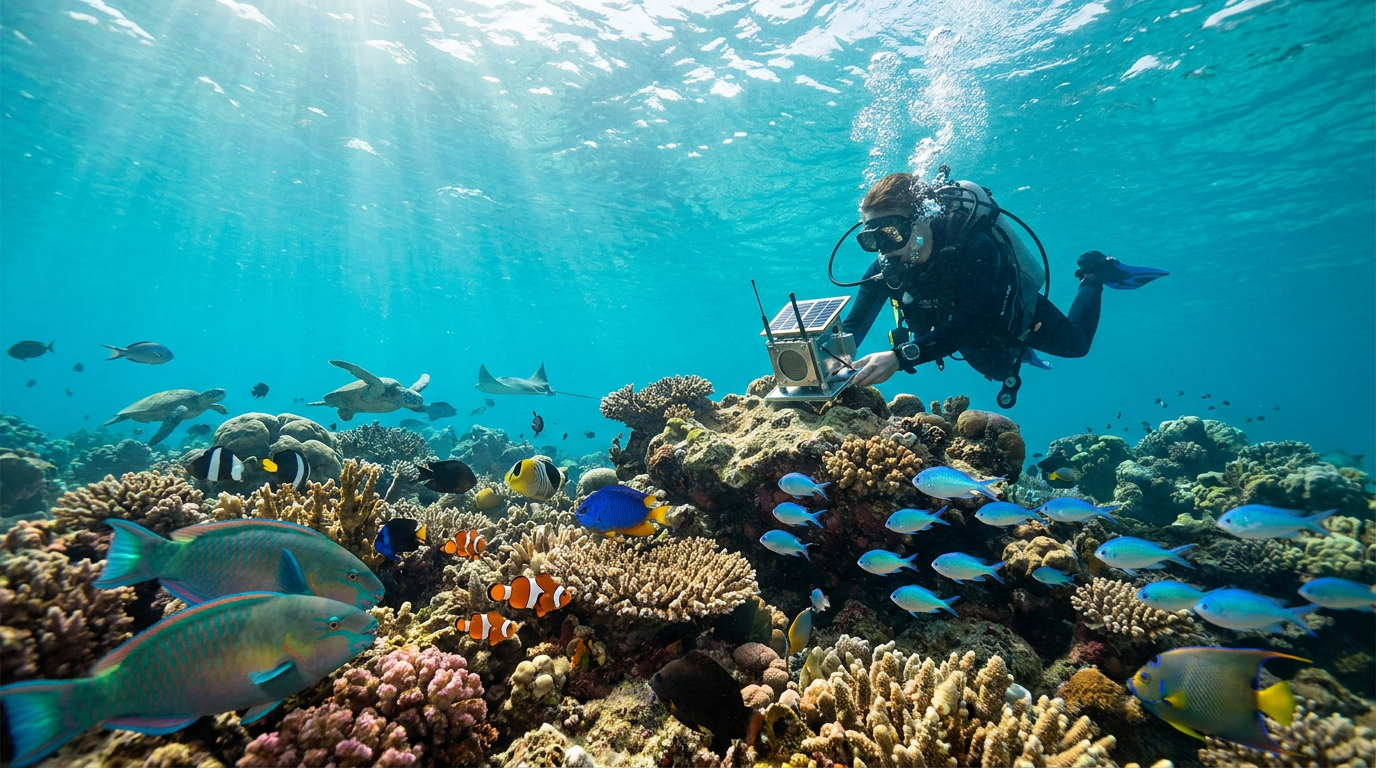
To break this cycle, researchers at the Woods Hole Oceanographic Institution (WHOI) have pioneered a technique known as "acoustic enrichment." By deploying underwater speaker systems—such as the solar-powered Reef Acoustic Playback System (RAPS)—scientists are artificially broadcasting the sounds of healthy reefs into degraded areas. In a landmark study focusing on golfball corals, the WHOI team demonstrated that broadcasting these acoustic cues effectively tricks the larvae into settling in barren zones. The timing, however, is critical. The researchers found that the larvae are highly responsive to the sound during their first 36 hours in the water column; after that window, they become desperate to settle anywhere, and the acoustic cues lose their influence.[1]
The results of acoustic enrichment in the field have been nothing short of extraordinary. Studies testing the technique on species like Porites astreoides have shown that larvae settle at significantly higher rates in acoustically enriched sites compared to silent control areas. On average, settlement rates increased by 1.7 times, with some localized areas seeing up to a seven-fold increase in successful coral attachment. Furthermore, the sound waves proved effective at drawing in larvae from considerable distances, with elevated settlement rates observed at least 30 meters away from the underwater speakers. This offers a highly scalable, low-cost method to jumpstart ecosystem recovery across vast stretches of damaged reef.[6]

The results of acoustic enrichment in the field have been nothing short of extraordinary.
Yet, enticing coral larvae to settle is only half the battle. If the surrounding water temperatures continue to break historical records, even the most densely populated new reefs will inevitably succumb to thermal stress and bleaching. Coral bleaching occurs when heat-stressed corals expel the symbiotic algae living in their tissues, starving the coral and leaving behind a stark white skeleton. Recognizing this, marine biologists have simultaneously been working to solve the temperature equation by breeding "super corals"—strains specifically cultivated to withstand the extreme marine heatwaves that are becoming the new normal.[3]
In a groundbreaking advancement, researchers at Newcastle University's Coralassist Lab recently achieved the first successful selective breeding of adult corals for enhanced heat tolerance. By subjecting various coral specimens to simulated heatwave conditions in a laboratory setting, the team identified the most resilient individuals. They then bred these survivors, proving that the resulting offspring consistently outperformed standard corals in both short-term and long-term heat exposure trials. This demonstrated that targeted selective breeding can measurably enhance thermal resistance in just a single generation, offering a vital lifeline for species on the brink.[3]
This laboratory success is being mirrored by field initiatives like the "Reefs of Hope" project, supported by the UN Environment Programme. Operating in Fiji and neighboring Pacific nations, this initiative relies on identifying natural "hot pockets"—shallow lagoons and nearshore reefs that are already approaching extreme thermal limits. The corals surviving in these punishing environments have naturally adapted to conditions that would decimate standard reefs. Conservationists carefully harvest fragments from these pre-adapted survivors and translocate them to protected gene-bank nurseries to secure their resilient lineages.[4]
The effectiveness of this localized, facilitated adaptation was starkly demonstrated during recent global bleaching events. At the Bula Reef Nursery in Fiji's Mamanuca Islands, which houses these heat-adapted strains, researchers recorded zero bleaching during the peak seasonal heat that devastated surrounding areas. By clustering diverse strains of these resilient corals together, the project ensures that when the corals naturally spawn, they crossbreed to produce highly robust, heat-adapted larvae. This approach empowers local stakeholders and indigenous communities to take active stewardship of their marine resources using accessible, science-backed methodologies.[4]

The resilience of a coral is not solely determined by the animal itself, but also by its microscopic partners. Corals rely entirely on symbiotic dinoflagellates—a type of algae known as zooxanthellae—for their food and vibrant colors. Some clades of these algae are naturally more heat-resistant than others. Advanced restoration efforts are now exploring how to inoculate young corals with these hardier algal strains, effectively upgrading the coral's internal engine to run hotter without breaking down. While complex, mastering this symbiotic relationship is considered the holy grail of climate-proofing the world's reefs.[7]
To produce these fortified corals at the necessary scale, a new industry of commercial land-based coral farming has emerged. Startups like Coral Vita in the Bahamas have pioneered facilities that utilize "assisted evolution" techniques. By gradually exposing growing corals to higher temperatures and acidity levels in controlled onshore tanks, they condition the organisms for the harsh realities of the modern ocean. Combined with micro-fragmenting techniques, these land-based farms can grow corals up to 50 times faster than they would develop in nature, transforming reef restoration from a boutique conservation effort into a scalable industrial process.[5]
The true potential of these breakthroughs lies in their synthesis. Imagine a restoration protocol where millions of selectively bred, heat-resistant "super coral" larvae are released into a degraded marine environment. Simultaneously, solar-powered acoustic playback systems broadcast the crackling, grunting soundscape of a pristine reef. The acoustic cues draw the fortified larvae down to the optimal substrate, maximizing settlement rates, while their genetic enhancements ensure they survive the next inevitable marine heatwave. This multi-pronged approach addresses both the recruitment bottleneck and the climate vulnerability of modern reefs.[7]

While the science is advancing rapidly, researchers are quick to emphasize that these technologies are not a silver bullet. Acoustic enrichment and selective breeding can buy crucial time for marine ecosystems, but they cannot outpace unchecked global warming indefinitely. Even the most robust "super corals" have absolute thermal limits, and acoustic systems cannot force larvae to settle in water that is fundamentally toxic due to severe agricultural runoff or chemical pollution. These interventions must be paired with aggressive global action to reduce greenhouse gas emissions and improve local water quality.[3]
Nevertheless, the integration of acoustic enrichment and facilitated adaptation represents a profound paradigm shift in marine conservation. We are no longer merely documenting the decline of the ocean's most biodiverse habitats. By decoding the sensory world of coral larvae and harnessing the principles of rapid evolutionary adaptation, scientists are actively designing the resilient reefs of the future. It is a testament to human ingenuity and a powerful reminder that with the right tools, it is still possible to rewild the ocean and pull these vital ecosystems back from the brink.[7]
How we got here
2010s
Early marine biology studies confirm that coral larvae exhibit phonotaxis and actively move toward sound.
2018
Scientists successfully apply CRISPR gene-editing tools to corals in early proof-of-concept studies for thermal resilience.
2024
The Woods Hole Oceanographic Institution publishes research showing acoustic enrichment increases settlement rates by up to seven times.
2025
Newcastle University successfully breeds adult corals with enhanced heat tolerance in a single generation.
2026
Projects like Reefs of Hope report zero bleaching in their heat-adapted gene-bank nurseries during peak seasonal heat.
Viewpoints in depth
Marine Technologists' view
Focuses on scaling interventions, acoustics, and assisted evolution as the only mathematical way to outpace reef degradation.
This perspective argues that traditional conservation methods are too slow to match the pace of climate change. By treating the ocean as an environment that can be actively engineered, technologists believe we can bypass the bottlenecks of manual restoration. They point to the exponential scalability of solar-powered acoustic arrays and commercial land-based coral farming, asserting that human intervention is now a prerequisite for the survival of the world's reefs.
Local Conservationists' view
Focuses on community stewardship, locally managed marine areas, and using indigenous knowledge to identify resilient corals.
For local stakeholders and indigenous groups, reef restoration is deeply tied to cultural heritage and local food security. This camp champions initiatives like the Reefs of Hope project, which relies on local knowledge to identify 'hot pockets' of naturally resilient corals. They argue that restoration technologies are most effective when decentralized and placed in the hands of the coastal communities whose daily lives depend directly on the health of the marine ecosystem.
Climate Realists' view
Argues that while these technologies are brilliant, they risk creating a false sense of security if emissions are not reduced.
Climate scientists and environmental policy advocates caution against viewing acoustic enrichment and super corals as silver bullets. They emphasize that even the most genetically fortified corals have absolute thermal limits. If global greenhouse gas emissions continue to rise unchecked, the oceans will eventually become too hot and acidic for any engineered coral to survive. They stress that these technologies merely buy time, and must not distract from the urgent need to decarbonize the global economy.
What we don't know
- Whether selectively bred 'super corals' will maintain their heat resistance over multiple generations in the wild.
- How acoustic enrichment affects the settlement patterns of other, non-coral marine invertebrates in the long term.
- The exact upper thermal limit at which even the most heat-adapted symbiotic algae will fail to support their coral hosts.
Key terms
- Acoustic Enrichment
- The practice of broadcasting the recorded sounds of a healthy reef into a degraded area to attract marine life and encourage coral larvae to settle.
- Phonotaxis
- The biological phenomenon where an organism actively orients and moves toward a sound source.
- Zooxanthellae
- Symbiotic microalgae that live inside coral tissues, providing the coral with food through photosynthesis and giving it its vibrant colors.
- Assisted Evolution
- Human intervention to accelerate natural biological adaptation, such as selectively breeding corals to increase their heat tolerance.
- Coral Bleaching
- A stress response where corals expel their symbiotic algae due to high water temperatures, leaving them stark white and highly vulnerable to starvation.
Frequently asked
How do coral larvae hear without ears?
Coral larvae are covered in tiny exterior hairs called cilia. These cilia allow them to sense and swim toward the low-frequency vibrations generated by fish and shrimp on a healthy reef.
What makes a coral a super coral?
Super corals are selectively bred from individuals that have survived extreme marine heatwaves. They possess genetic traits and hardy symbiotic algae that allow them to withstand higher ocean temperatures without bleaching.
Can acoustic enrichment save reefs on its own?
No. While acoustic enrichment dramatically increases the rate at which larvae settle, the newly attached corals still require clean water and thermal resilience to survive long-term ocean warming.
Sources
Source coverage
7 outlets
3 viewpoints surfaced







[1]Woods Hole Oceanographic InstitutionMarine Technologists
Broadcasting the sounds of healthy reefs encourages coral settlement
Read on Woods Hole Oceanographic Institution →[2]Earth.orgClimate Realists
Acoustic Enrichment: A Novel Approach to Coral Reef Restoration
Read on Earth.org →[3]Sustainability TimesClimate Realists
Scientists create heat-resistant super corals that could save entire marine ecosystems
Read on Sustainability Times →[4]UN Environment ProgrammeLocal Conservationists
Reefs of Hope: Locally driven, science-based restoration in the Pacific
Read on UN Environment Programme →[5]Nature Tech MemosClimate Realists
Why Technology Is Critical for Coral Restoration
Read on Nature Tech Memos →[6]Royal Society PublishingMarine Technologists
Acoustic enrichment facilitates coral larval settlement on degraded reefs
Read on Royal Society Publishing →[7]Factlen Editorial TeamMarine Technologists
Synthesis by Factlen editorial team
Read on Factlen Editorial Team →
Every angle. Every day.
Get environment stories with full source coverage and perspective breakdowns delivered to your inbox.