
How to Read the News Like a Fact-Checker: The SIFT Method and Lateral Reading
Traditional methods of evaluating online information are failing in the modern digital landscape. By adopting the 'lateral reading' techniques used by professional fact-checkers, anyone can verify sources and spot misinformation in under a minute.
By Factlen Editorial Team
- Media Literacy Advocates
- Educators advocating for replacing outdated checklists with lateral reading techniques in classrooms.
- Academic Researchers
- Scholars studying the cognitive psychology of information evaluation and digital reasoning.
- Fact-Checking Practitioners
- Professionals who verify claims in real-time for news organizations and platforms.
What's not represented
- · Social Media Platform Engineers
- · Content Moderation Teams
Why this matters
In an era of AI-generated content and sophisticated disinformation, relying on outdated methods to verify news leaves you vulnerable to manipulation. Mastering lateral reading allows you to confidently separate fact from fiction in seconds, protecting your worldview and your decisions.
Key points
- Traditional 'vertical reading' methods for evaluating websites are easily manipulated by modern disinformation.
- Professional fact-checkers verify sources by reading 'laterally'—opening new tabs to see what others say about a site.
- The SIFT method (Stop, Investigate, Find, Trace) makes lateral reading accessible to the general public.
- Lateral reading is faster and more accurate than deep reading when assessing an unfamiliar source's credibility.
The modern internet is an overwhelming flood of information, and the traditional tools we were taught to evaluate it are actively failing us. For decades, students and citizens were instructed to read deeply, check a website's "About" page, look for typos, and examine the domain name to determine if a source was credible. This approach, known as "vertical reading," made sense in the early days of the web. Today, however, it is a liability. Bad actors, front groups, and purveyors of disinformation can easily purchase professional web templates, write typo-free copy, and invent impressive-sounding credentials. If you stay on a deceptive webpage trying to analyze its internal logic, the creators have already won by capturing your attention and framing the debate. The solution to this modern crisis of trust isn't to read more carefully; it is to read entirely differently.[4][7]
The shift in how we should consume information was catalyzed by a landmark study from researchers at Stanford University, who now operate as the Digital Inquiry Group. The researchers set up a fascinating experiment: they pitted expert historians and Stanford undergraduates against professional fact-checkers to see who could most accurately and quickly identify credible sources online. The historians were highly educated, trained in deep textual analysis, and possessed vast historical knowledge. The fact-checkers, on the other hand, were simply professionals whose daily job was to verify claims for news organizations. The results fundamentally upended traditional media literacy education, revealing a massive gap between how academics and fact-checkers navigate the digital world.[2][8]
When presented with unfamiliar websites, the expert historians and bright undergraduates failed at an alarming rate. They applied the vertical reading techniques they had been taught: they scrolled down the page, read the articles closely, examined the site's internal credentials, and analyzed the quality of the writing. Because they stayed on the page, they were frequently fooled by sophisticated front groups funded by special interests. They wasted ten minutes or more meticulously analyzing the internal logic of websites that were fundamentally designed to deceive them. Their deep intelligence and careful reading habits were weaponized against them by the architecture of the modern web.[5][7]

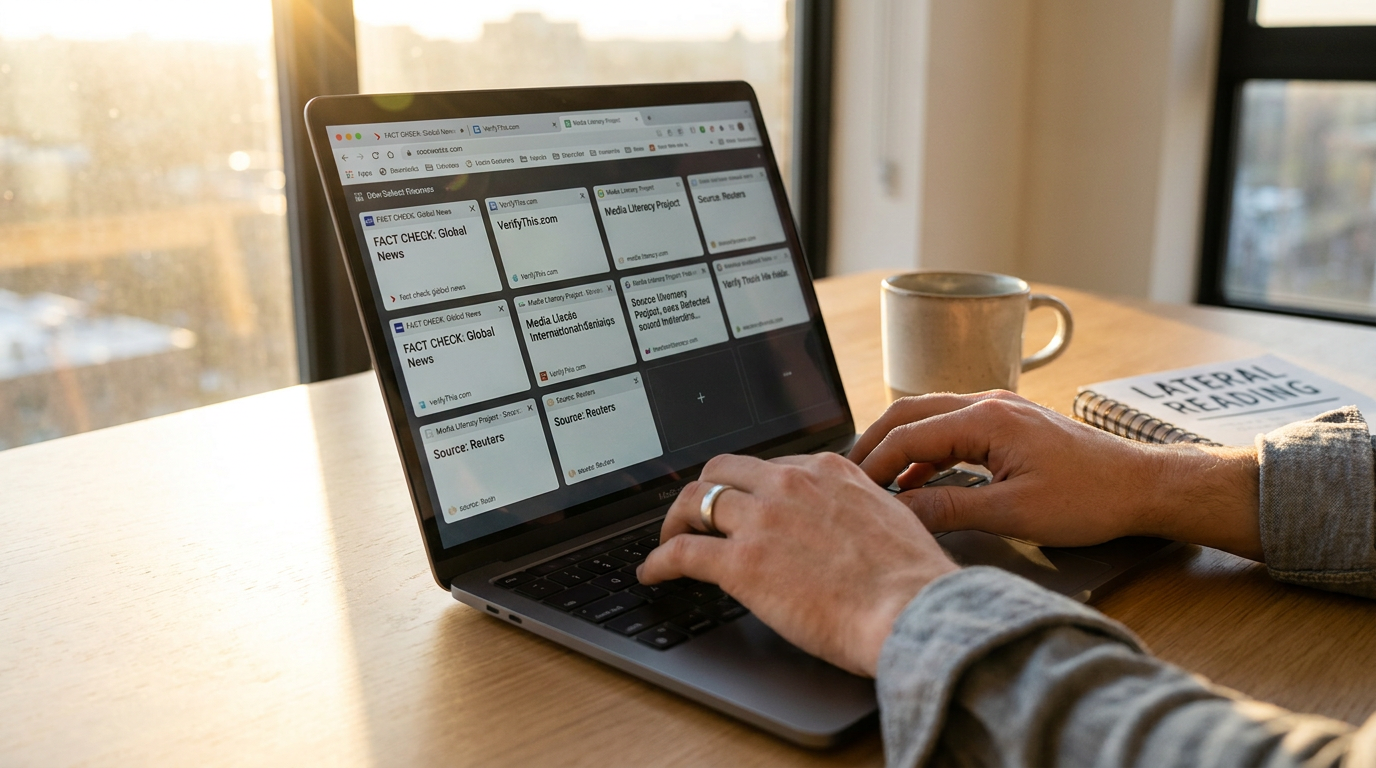
The professional fact-checkers, however, succeeded almost instantly. Their secret was a technique called "lateral reading." When a fact-checker landed on an unfamiliar website, they spent almost no time looking at the site itself. Instead, they immediately opened a new browser tab and searched for the name of the organization or the author. They looked at what the rest of the internet said about the source, rather than trusting what the source said about itself. By reading laterally across multiple tabs, the fact-checkers could identify a front group or a biased source in under sixty seconds. They bypassed the deceptive packaging entirely and went straight to the broader information landscape to establish credibility.[2][8]
To make this professional superpower accessible to the general public, digital literacy expert Mike Caulfield developed a streamlined framework known as the SIFT method. SIFT is an acronym that operationalizes lateral reading into four repeatable steps: Stop, Investigate the source, Find better coverage, and Trace claims, quotes, and media to their original context. Adopted by universities, libraries, and organizations like the News Literacy Project, the SIFT method is rapidly replacing outdated checklists like the CRAAP test. It acknowledges a fundamental truth of the modern internet: we do not have the time or expertise to become subject matter experts on every headline that crosses our feeds. Instead, we need quick, efficient heuristics to separate fact from fiction.[1][3]

To make this professional superpower accessible to the general public, digital literacy expert Mike Caulfield developed a streamlined framework known as the SIFT method.
The first step of the method is simply to "Stop." Before you read an article, share a post, or react to a provocative headline, you must pause. This step is largely about emotional regulation. Disinformation and engagement-bait are explicitly designed to trigger strong emotional responses—outrage, validation, fear, or intense curiosity. When you feel that surge of emotion, it is a signal that you are being targeted for engagement. By stopping, you interrupt the emotional loop and engage your critical thinking faculties. You remind yourself that you do not yet know if the information in front of you is true, and you commit to verifying it before allowing it to shape your worldview or your social media feed.[1][8]
The second step is to "Investigate the source." This is where lateral reading truly begins. Instead of reading the article, open a new tab and search for the publisher or the author. Your goal is to determine their expertise, their funding, and their reputation in the broader landscape. Surprisingly, one of the best tools for this step is Wikipedia. While traditional educators often banned Wikipedia, fact-checkers rely on it heavily. Because Wikipedia requires strict citations and is actively moderated, a quick glance at an organization's Wikipedia page will usually reveal if they are a respected news outlet, a partisan think tank, or a known purveyor of conspiracy theories. If the source is unreliable, you can stop reading immediately.[2][4]
The third step is to "Find better coverage." Often, you will encounter a claim that seems important, but it is hosted on a website you don't recognize or trust. You do not need to rely on that specific source to learn about the topic. If a major event has occurred or a significant scientific breakthrough has been made, reputable news organizations and academic institutions will be reporting on it. By opening a new tab and searching for the core claim, you can find coverage from a trusted source. This allows you to learn the facts of the story without subjecting yourself to the spin, bias, or potential falsehoods of the original, unverified website.[1][6]

The final step is to "Trace claims, quotes, and media to their original context." The internet is a massive game of telephone, where quotes are routinely stripped of their context and images are recycled to fit new narratives. A photo of a natural disaster from five years ago might be shared today as evidence of a current crisis. A politician's quote might be clipped to reverse its meaning. To combat this, fact-checkers trace the information back to its source. They use reverse image searches—like Google Lens—to see when and where a photo was first published. They find the original video or transcript to see what was actually said before the internet aggregated and distorted it.[1][4]
Organizations dedicated to civic education are now working urgently to integrate lateral reading into classrooms and public workshops. The News Literacy Project, for example, offers tools like RumorGuard to help citizens practice these verification skills on real-world viral claims. The goal is to build a society that is resilient against manipulation. When citizens know how to quickly verify information, the power of disinformation campaigns is drastically reduced. It shifts the balance of power away from those who create deceptive content and back to the readers who consume it.[3][6]
The necessity of lateral reading is only accelerating with the rise of generative artificial intelligence. As AI tools make it effortless to produce photorealistic fake images, clone voices, and generate thousands of convincing, typo-free articles in seconds, the internal markers of quality are completely obsolete. You can no longer trust a website just because the grammar is perfect or the author's headshot looks professional—both could be entirely synthetic. In an AI-saturated internet, the only reliable way to verify reality is to step outside the content itself. Lateral reading—checking the broader consensus, tracing the provenance of an image, and verifying the publisher's history—remains the most robust defense against the coming wave of synthetic media.[4][8]

Ultimately, the beauty of lateral reading and the SIFT method is that they are fundamentally empowering. They do not require you to become a cynical skeptic who trusts nothing, nor do they require you to spend hours researching every tweet. Instead, they offer a fast, practical toolkit for navigating the digital world with confidence. By adopting the habits of professional fact-checkers, anyone can learn to evaluate a source in under a minute. In an era defined by information overload, learning to read laterally is not just a useful skill; it is an essential civic superpower that protects our minds, our communities, and our shared reality.[7][8]
How we got here
1990s-2000s
Educators widely adopt 'vertical reading' checklists like the CRAAP test for evaluating early websites.
2017
Stanford researchers publish a landmark study showing fact-checkers drastically outperform historians using lateral reading.
2019
Digital literacy expert Mike Caulfield introduces the SIFT method to operationalize lateral reading for the public.
2024-2026
Organizations like the News Literacy Project push to integrate lateral reading into national civic education standards.
Viewpoints in depth
Media Literacy Educators
Advocates for replacing outdated checklists with lateral reading techniques in classrooms.
This camp argues that traditional media literacy education, which relies on checklists like the CRAAP test, is actively harmful in the modern digital environment. By teaching students to stay on a page and evaluate its internal characteristics, educators inadvertently train them to fall for sophisticated front groups. They advocate for a complete curriculum overhaul, prioritizing speed, external verification, and the SIFT method to build civic resilience against disinformation.
Academic Researchers
Scholars studying the cognitive psychology of information evaluation and digital reasoning.
Researchers in this camp focus on the cognitive vulnerabilities that make vertical reading so dangerous, such as confirmation bias and emotional manipulation. They conduct empirical studies—like the landmark Stanford experiments—to quantify the effectiveness of lateral reading. Their data demonstrates that human intelligence and deep subject-matter expertise are insufficient defenses against modern digital deception unless paired with specific, network-aware verification heuristics.
Professional Fact-Checkers
Practitioners who verify claims in real-time for news organizations and platforms.
For this group, lateral reading is not an academic theory; it is a daily operational necessity. Fact-checkers argue that the sheer volume of digital information requires ruthless efficiency. They prioritize leaving the source immediately, relying heavily on Wikipedia, reverse image searches, and specialized databases to establish a publisher's reputation and trace claims to their origin. Their methodology proves that establishing credibility is less about deep reading and more about understanding the broader information ecosystem.
What we don't know
- How effectively lateral reading skills can be scaled to older generations who did not grow up as digital natives.
- Whether the rapid advancement of AI-generated content will eventually require entirely new verification frameworks beyond the SIFT method.
Key terms
- Lateral Reading
- The practice of leaving an unfamiliar webpage and opening new tabs to see what other trusted sources say about it.
- Vertical Reading
- The traditional, often flawed method of evaluating a source by staying on the page and analyzing its internal content and design.
- SIFT Method
- A four-step framework (Stop, Investigate, Find, Trace) designed to quickly evaluate the credibility of online information.
- Front Group
- An organization that purports to be an independent entity but is actually funded by undisclosed special interests to push a specific agenda.
- Reverse Image Search
- A digital tool that allows users to upload a photo to find where and when it was originally published on the internet.
Frequently asked
Why is the CRAAP test no longer recommended?
Traditional checklists like the CRAAP test rely on vertical reading, which can be easily manipulated by modern websites that look professional but host false information.
Isn't Wikipedia unreliable for research?
While anyone can edit it, Wikipedia's strict citation rules and active moderation make it an excellent starting point for lateral reading to quickly identify a source's reputation and funding.
How long does lateral reading take?
Professional fact-checkers can often evaluate a source's credibility in under 60 seconds using lateral reading techniques, making it much faster than traditional deep reading.
Sources
Source coverage
8 outlets
3 viewpoints surfaced








[1]Open Washington PressbooksAcademic Researchers
Fact-Checking Online Health and Nutrition Information
Read on Open Washington Pressbooks →[2]Digital Inquiry GroupMedia Literacy Advocates
Teaching Lateral Reading
Read on Digital Inquiry Group →[3]News Literacy ProjectMedia Literacy Advocates
Combating Misinformation with News Literacy Project
Read on News Literacy Project →[4]ScienceUpFirstMedia Literacy Advocates
How to read laterally: SIFT
Read on ScienceUpFirst →[5]Community of Online Research AssignmentsMedia Literacy Advocates
SIFT & PICK Fact Checking & Source Evaluation
Read on Community of Online Research Assignments →[6]iCivicsMedia Literacy Advocates
Intro to Lateral Reading
Read on iCivics →[7]SSRNAcademic Researchers
Lateral Reading: Reading Less and Learning More When Evaluating Digital Information
Read on SSRN →[8]Factlen Editorial TeamFact-Checking Practitioners
Synthesis by Factlen editorial team
Read on Factlen Editorial Team →
Every angle. Every day.
Get meta stories with full source coverage and perspective breakdowns delivered to your inbox.