
The Rise of AI-Assisted Job Interviews: How They Work and How to Prepare
Asynchronous video interviews evaluated by artificial intelligence are becoming the new standard for first-round hiring. Understanding how these algorithms score candidates is the key to advancing to the human review stage.

In short
- Asynchronous video interviews evaluated by AI are now a standard first-round screening tool.
- Algorithms evaluate candidates on speech clarity, pacing, and the use of specific keywords from the job description.
- Candidates are increasingly using the STAR method to provide the structured data that AI systems favor.
The job market of 2026 has normalized a new kind of first-round interview: one where nobody is on the other end of the call.
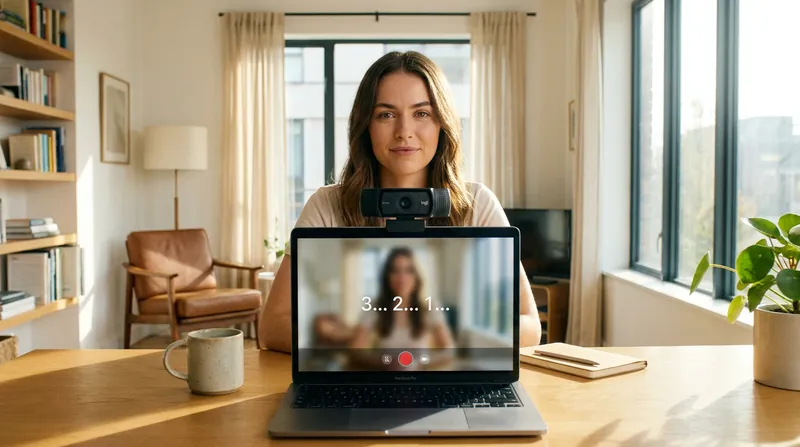
Candidates are increasingly receiving invitations to asynchronous video interviews. Instead of a handshake and small talk, they face a webcam, a countdown timer, and a series of text prompts.
Behind the screen, artificial intelligence is often doing the listening. According to recent industry data, 51% of companies now use AI in their recruitment processes, and up to 88% utilize some form of algorithmic screening.[2]
For hiring managers deluged by easy-apply job boards, the appeal is obvious. AI platforms can process thousands of applicants, standardize the questions, and rank candidates without scheduling conflicts.[1]
But for job seekers, the experience can feel like speaking into a void. The software records the response and uses machine learning to assess it, evaluating everything from speech articulation to keyword relevance.[3]
The algorithms are typically looking for structured data. They scan for action verbs that match the job description and measure the clarity and pace of the candidate's speech.[3]
Non-verbal cues are also part of the equation on some platforms. The system may track eye contact—specifically whether the candidate is looking at the camera lens rather than their own face on the screen—as well as posture and excessive movement.[3]
This algorithmic scrutiny has fundamentally changed how candidates must prepare. It is no longer enough to be charismatic; applicants must deliver highly structured, easily parsable answers.[3]
Career coaches now heavily emphasize the STAR method—Situation, Task, Action, Result. Because AI struggles with vague narratives, candidates must provide concrete metrics and clear chronological steps to score well.
The pressure of the ticking clock and the unblinking green light has spawned a new wave of candidate anxiety. In response, a cottage industry of AI-powered preparation tools has emerged.[3]
Startups are offering AI mock interviews that simulate the exact conditions of an asynchronous screening. These tools provide instant feedback on filler words, pacing, and whether the candidate successfully hit the required keywords.[3]
However, the technology has also sparked an arms race. Some candidates are deploying real-time AI copilots that transcribe the interview questions and feed suggested answers onto the screen while they speak.
Employers view these live-assistance tools as fraudulent, creating a new tension in the hiring landscape. The irony is not lost on candidates, who point out that companies are using AI to evaluate them while forbidding them from using AI to respond.
To combat the rise of AI-assisted applicants, companies are adjusting their downstream hiring pipelines. While AI handles the initial screening, employers are bringing back in-person interviews for later stages.
Industry data shows that in-person interview rounds rose from 24% in 2022 to 38% in 2025, as hiring leaders seek unstructured environments where real-time AI tools cannot be used.
For the modern job seeker, success requires mastering the hybrid reality. The goal of the AI interview is not to charm the machine, but to survive the algorithmic filter so a human can eventually watch the tape.[3]
Experts advise candidates to treat the digital setup with the utmost seriousness. A clean background, bright lighting, and a camera positioned at eye level remain critical, as human recruiters still review the top-ranked videos.
Ultimately, the AI screening is just a new type of gatekeeper. By understanding the metrics the software values—clarity, structure, and relevance—candidates can navigate the automated gauntlet and secure a seat at the human table.[3]
Terms to know
- Asynchronous Video Interview (AVI)
- A one-way interview where a candidate records video responses to automated questions for later review.
- Applicant Tracking System (ATS)
- Software used by employers to manage the recruiting process, increasingly powered by AI to filter resumes.
- STAR Method
- A structured framework for answering behavioral interview questions: Situation, Task, Action, Result.
- AI Copilot
- In a hiring context, software that listens to live interview questions and feeds the candidate suggested answers.
Questions readers ask
What is an asynchronous video interview?
It is a format where candidates record answers to pre-set questions on camera within a time limit, without a live human interviewer present.
How does AI evaluate my interview?
Algorithms analyze speech clarity, pacing, and how well your vocabulary matches the keywords and skills listed in the job description.
Is it cheating to use AI to prepare?
Using AI for mock interviews and feedback beforehand is widely accepted, but using real-time transcription and coaching tools during the actual interview is considered fraudulent by most employers.
Do humans ever watch the videos?
Yes. AI typically scores and ranks the videos, but human recruiters usually review the top candidates' recordings before making final hiring decisions.
Different angles
Hiring Teams' View
Employers see AI screening as a necessary tool to handle application volume and reduce initial bias.
For recruiters, the math is simple. The ease of 'one-click' applications on modern job boards has flooded open roles with thousands of resumes, many of them generated by AI. Hiring managers argue that AI-assisted asynchronous interviews are the only practical way to evaluate this volume. By asking every candidate the exact same questions and scoring them against a standardized rubric, proponents argue the technology actually reduces human bias in the initial screening phase, ensuring candidates are judged on their structured answers rather than a recruiter's gut feeling.
Candidates' View
Job seekers often find the automated process alienating and worry about algorithmic misinterpretation.
From the applicant's side of the screen, the AI interview can feel deeply dystopian. Candidates express frustration at having to perform for a machine, noting that the format strips away the natural back-and-forth of a human conversation. There is widespread anxiety that the software might penalize them for a stutter, a non-standard accent, or a lack of eye contact caused by looking at the screen rather than the camera lens. This alienation is driving the surge in candidates using their own AI tools to 'beat the system.'
AI Ethicists' View
Researchers warn that algorithmic hiring can amplify historical biases if not carefully audited.
Technology watchdogs and ethicists point out that AI models are only as objective as the data they are trained on. If an algorithm is trained on the speech patterns and vocabulary of historically successful candidates—who may skew toward specific demographics—it risks penalizing qualified applicants who communicate differently. While many platform vendors have disabled facial analysis to avoid discrimination, ethicists argue that vocal analysis and keyword scoring still require rigorous, ongoing human oversight to prevent automated redlining.
- Hiring Teams
- Value AI for its ability to screen massive candidate pools efficiently and standardize the first-round interview process.
- Job Seekers
- Often find asynchronous AI interviews alienating and stressful, prompting them to seek new preparation strategies.
- Candidate Copilot Startups
- Argue that candidates need their own AI tools to practice, level the playing field, and decode algorithmic scoring.
- Factlen Analysis
- Synthesizes the evolving arms race between employer screening algorithms and candidate preparation tools.
Perspectives this story doesn't cover
- Labor unions
- Disability advocates
Sources
Source coverage
3 outlets
4 viewpoints surfaced



- [1]Upwork ResearchHiring Teams
What Is an AI Interview and How to Prepare
Read on Upwork Research → - [2]Index.devHiring Teams
AI in Recruitment Statistics 2025-2026
Read on Index.dev → - [3]Factlen Editorial TeamFactlen Analysis
Synthesis by Factlen editorial team
Read on Factlen Editorial Team →

More in Careers & Work
See all →HR Tech
How to Navigate AI-Screened and Asynchronous Video Interviews in 2026
2 sources
AI Screening
Decoding the AI Interview: How Algorithmic Screening Works and How to Succeed
3 sources

Job Interviews
The Science of the Behavioral Interview: Why the STAR Method Still Rules Hiring
4 sources

Hiring Tech
The 2026 Interview Playbook: Navigating AI Screeners and the Skills-Based Hiring Shift
3 sources

Comments
Every angle. Every day.
Get Careers & Work stories with full source coverage and perspective breakdowns, free every day.