
AI is Unlocking the Lost Library of Herculaneum Without Unrolling a Single Scroll
Using particle accelerators and machine learning, researchers are reading carbonized scrolls buried by Mount Vesuvius in 79 AD, recovering lost classical texts and launching a new era of digital archaeology.
By Factlen Editorial Team
- Computer Scientists & AI Researchers
- View the project as a triumph of open-source collaboration and machine learning, proving AI can solve physical-world data problems.
- Classicists & Papyrologists
- Focus on the humanistic value of the 'invisible library,' hoping to recover lost philosophical texts and expand the classical canon.
- Archaeologists & Preservationists
- Champion the non-invasive nature of the technology, which allows the study of the past without destroying fragile physical artifacts.
What's not represented
- · Italian Cultural Heritage Ministry
Why this matters
This breakthrough unlocks an 'invisible library' of antiquity, potentially doubling the amount of surviving classical literature. By proving that AI can read texts previously thought destroyed, it opens the door to recovering lost histories, philosophies, and scientific knowledge that shaped human civilization.
Key points
- Mount Vesuvius carbonized roughly 1,800 papyrus scrolls in 79 AD, rendering them unreadable to the naked eye.
- The Vesuvius Challenge uses 3D X-ray scans from particle accelerators to digitally map the internal layers of the scrolls.
- Machine learning models are trained to detect the microscopic physical texture of the carbon-based ink on the charred papyrus.
- Recent breakthroughs have revealed lost philosophical texts, including the exact burial location of Plato.
- Researchers are now working to automate the digital unrolling process to read the remaining hundreds of scrolls at scale.
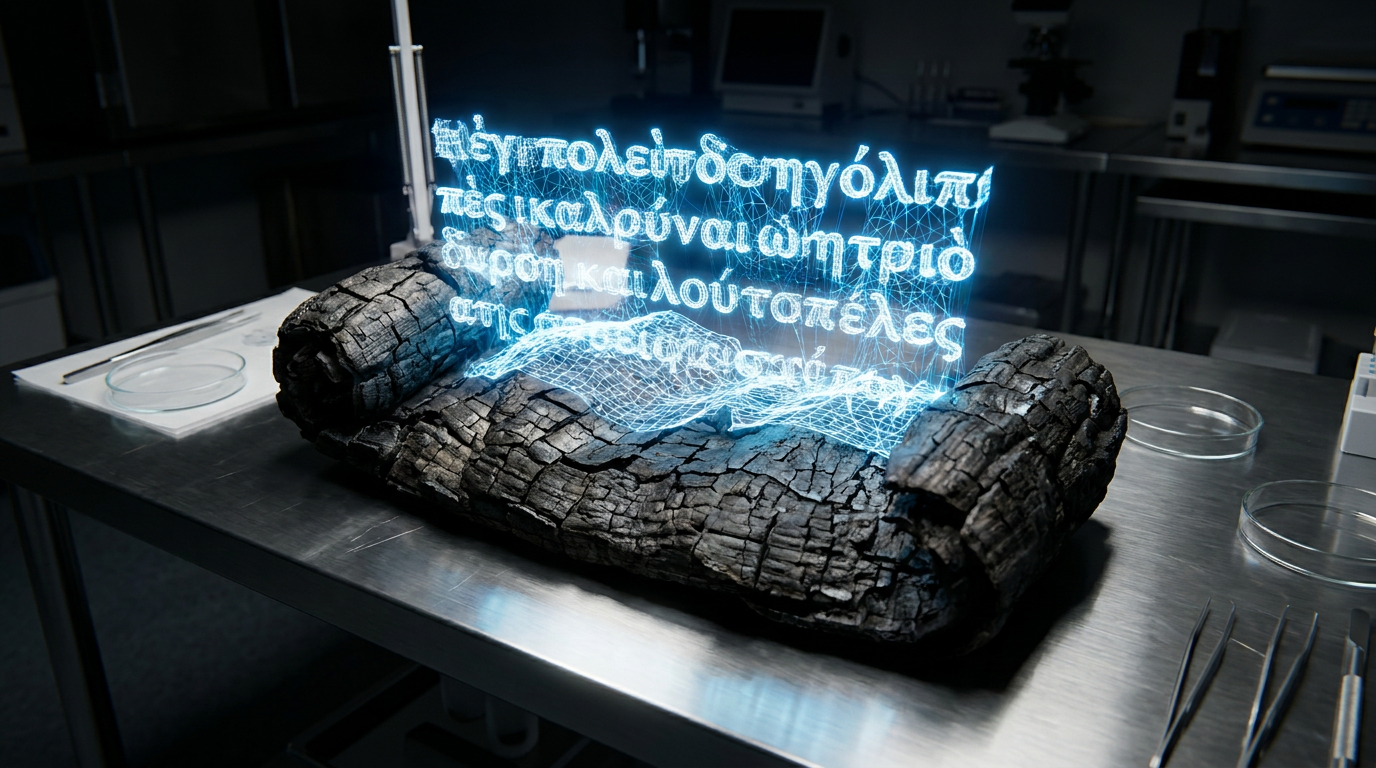
The eruption of Mount Vesuvius in 79 AD famously froze the city of Pompeii in time, but in the neighboring coastal town of Herculaneum, the volcano preserved something arguably more valuable: the only intact library surviving from the ancient world. Buried under twenty meters of scorching mud and ash, the library inside a luxury Roman mansion—believed to have belonged to Julius Caesar's father-in-law—was instantly carbonized.[2][5]
When excavators tunneled into the so-called Villa of the Papyri in the 1750s, they discovered roughly 1,800 papyrus scrolls. However, the intense heat of the eruption had baked the scrolls into brittle, blackened lumps that looked more like charcoal briquettes than books. For over two and a half centuries, the texts remained an agonizing mystery. Early attempts to physically unroll them resulted in the fragile papyrus crumbling to dust, destroying the very history researchers sought to save.[1][3][5][7]
Today, a coalition of computer scientists, classicists, and citizen researchers is finally reading the unreadable. Driven by the Vesuvius Challenge—a global machine-learning competition launched in 2023 by tech entrepreneurs Nat Friedman and Daniel Gross, alongside University of Kentucky computer scientist Brent Seales—teams are using artificial intelligence to virtually unwrap the scrolls. The project has transitioned from a theoretical proof-of-concept to an industrial-scale recovery operation, unlocking texts that have not been seen by human eyes for nearly two millennia.[1][3][4][5]
The technical hurdle facing the Vesuvius Challenge was immense. Because the ancient scribes used a carbon-based ink made of soot and water, the writing is chemically identical to the carbonized papyrus it sits on. To the naked eye, and even to standard X-ray machines, the ink is completely invisible against the blackened pages.[2][6][7]
To bypass this, researchers turned to particle accelerators. Scrolls are taken to facilities like the Diamond Light Source in Oxfordshire, the UK's national synchrotron, where electrons are accelerated to near light-speed to produce X-rays ten billion times brighter than the sun. These ultra-high-resolution 3D CT scans capture the internal structure of the rolled papyrus at a microscopic level, mapping the intricate, crushed layers of the scroll without ever opening it.[1][2][4]

Once the 3D X-ray volume is captured, the digital unwrapping begins. Software is used to trace the distinct layers of the rolled papyrus—a painstaking process known as segmentation. The segmented layers are then digitally flattened into a 2D surface. Yet, even on these flattened digital pages, the carbon ink remains invisible to human researchers.[5][6][7]
This is where machine learning bridges the gap. In 2023, an independent researcher named Casey Handmer noticed a faint, microscopic 'crackle pattern' on the papyrus surface in the X-ray data—a physical texture left behind by the dried ink. A college student and SpaceX intern named Luke Farritor trained an AI model to recognize this subtle texture, eventually revealing the first complete word: 'πορφύραc' (porphyras), the ancient Greek word for purple.[3][6][7]
That initial breakthrough triggered a cascade of discoveries. In 2024, a team comprising Farritor, Egyptian graduate student Youssef Nader, and Swiss robotics student Julian Schilliger claimed the $700,000 Grand Prize by decoding over 2,000 Greek letters from a single scroll. The text was identified as a lost philosophical treatise on pleasure and vice, likely authored by the Epicurean philosopher Philodemus, who served as the resident intellectual of the Villa of the Papyri.[1][3][5]
That initial breakthrough triggered a cascade of discoveries.
By 2025 and early 2026, the technology had advanced dramatically. The Vesuvius Challenge team deployed new scans at a staggering 2-micrometer resolution—roughly one-fiftieth the width of a human hair. More importantly, the AI models evolved from bespoke tools requiring constant retraining into generalist models capable of identifying Greek letters across multiple, distinct scrolls, even penetrating fused layers of papyrus that had melted together.[5][7]

These advancements yielded immediate historical dividends. In February 2025, the Bodleian Libraries at the University of Oxford announced the successful imaging of PHerc. 172, a scroll donated to the university in the 19th century. The digital unrolling revealed multiple columns of text penned in a surprisingly dense ink, with scholars quickly identifying the Greek word 'διατροπή' (diatrope), meaning disgust. Dr. Brent Seales noted that the Bodleian scroll contained more recoverable text than any previously scanned Herculaneum artifact.[1][4]
The historical revelations are already rewriting classical knowledge. Recently, researchers utilizing the AI pipeline decoded a scroll segment that pinpointed the exact burial spot of the philosopher Plato in Athens—a granular historical detail that had been lost for over two thousand years. Discoveries of this magnitude highlight the profound stakes of the Vesuvius Challenge: the scrolls are not just artifacts, but a vast, untapped reservoir of human thought.[5][6]
Scholars refer to this reservoir as the 'invisible library.' The surviving classical canon represents only a tiny fraction of the literature produced in antiquity; the vast majority of Greek and Roman texts decayed, were destroyed, or were lost to time. The Herculaneum library, precisely because it was carbonized and buried, survived the Middle Ages intact. Successfully reading the remaining 600 unopened scrolls could double the amount of classical literature available to modern historians.[5][6]
The potential contents of the unread scrolls are tantalizing. While the initial discoveries have heavily featured Epicurean philosophy, classicists hope the library contains lost works by Stoic philosophers, missing plays by Sophocles or Aeschylus, or early Roman histories that could reshape our understanding of the ancient Mediterranean world.[3][5]

Despite the breathtaking progress, significant hurdles remain. The primary bottleneck is no longer ink detection, but the labor-intensive process of segmentation—tracing the crumpled, fused layers of papyrus within the 3D scans. To solve this, the Vesuvius Challenge has issued new prize pools aimed at fully automating the segmentation pipeline, pushing toward a future where scrolls can be scanned and digitally unrolled with minimal human intervention.[5][7]
Furthermore, the 1,800 scrolls recovered in the 18th century may only be a fraction of the Villa of the Papyri's total collection. The villa has never been fully excavated, and archaeologists believe that lower levels of the mansion could house the main library, potentially containing thousands of additional Latin and Greek texts.[2]
As the technology matures, its applications extend far beyond Herculaneum. The virtual unwrapping pipeline developed for the Vesuvius Challenge is already being adapted to read other fragile artifacts, from Egyptian papyri used as mummy cartonnage to water-damaged medieval manuscripts. By fusing particle physics, computer vision, and classical philology, researchers have not only resurrected a lost library from the ashes of a volcano, but forged a new lens through which to view the entirety of human history.[1][4][5][6]
How we got here
79 AD
Mount Vesuvius erupts, burying Herculaneum and carbonizing the library at the Villa of the Papyri.
1752
Excavators discover roughly 1,800 blackened scrolls, though early attempts to open them destroy the fragile papyrus.
2015
Dr. Brent Seales pioneers 'virtual unwrapping' using X-ray tomography on the En-Gedi scroll in Israel.
2023
The Vesuvius Challenge is launched, releasing 3D scans and offering prize money to decode the Herculaneum scrolls.
2024
A team of three students wins the $700,000 Grand Prize by using AI to read over 2,000 Greek letters from a single scroll.
2025
Researchers successfully image the Bodleian scroll (PHerc. 172), revealing the clearest text recovered to date.
Viewpoints in depth
Computer Scientists & AI Researchers
A technical triumph achieved through open-source collaboration.
For the computer science community, the deciphering of the scrolls is a landmark victory for crowdsourced machine learning. By framing the problem as a global competition and releasing the raw 3D X-ray data to the public, the Vesuvius Challenge bypassed traditional academic silos. AI researchers emphasize that the transition from bespoke, heavily trained models to generalist models capable of reading multiple scrolls proves that AI can solve highly complex, physical-world data problems that have stumped human experts for centuries.
Classicists & Papyrologists
The potential to double the surviving literature of the ancient world.
Classicists view the Herculaneum library as an unparalleled time capsule. The classical canon that exists today is heavily filtered—surviving only because medieval monks chose to copy certain texts while letting others decay. The carbonized scrolls, however, offer an unfiltered, direct look at ancient Mediterranean thought. Papyrologists are particularly excited about the prospect of recovering lost works by major Stoic philosophers, missing theatrical plays, and early Roman histories that could fundamentally alter our understanding of antiquity.
Archaeologists & Preservationists
A new paradigm for non-invasive archaeological study.
Historically, archaeology has involved a degree of destruction; to study a sealed artifact often meant breaking it, and early attempts to unroll the Herculaneum scrolls destroyed them entirely. Preservationists champion the virtual unwrapping pipeline as a revolutionary shift toward non-invasive study. By using particle accelerators and AI, researchers can extract the intellectual value of an artifact while leaving its physical form perfectly intact for future generations, a technique that is already being applied to other fragile antiquities worldwide.
What we don't know
- Whether the unexcavated lower levels of the Villa of the Papyri contain a larger, primary library of Latin and Greek texts.
- Exactly which lost works of antiquity—such as missing plays or early Roman histories—are hidden within the currently unread scrolls.
- How quickly the AI segmentation pipeline can be fully automated to process the remaining 600 intact scrolls.
Key terms
- Carbonized
- Reduced to carbon or charcoal by intense heat, which preserved the scrolls but made them extremely brittle.
- Synchrotron
- A type of particle accelerator that produces incredibly bright X-rays, used to scan the internal structure of the scrolls.
- Segmentation
- The painstaking digital process of tracing and separating the individual, crumpled layers of papyrus within a 3D scan.
- Epicureanism
- An ancient Greek system of philosophy founded by Epicurus, which is the primary subject of the scrolls decoded so far.
Frequently asked
Why couldn't they just unroll the scrolls?
The heat from the volcano baked the papyrus into brittle lumps of carbon. Physical attempts to unroll them caused the scrolls to crumble into dust.
Why couldn't standard X-rays see the ink?
The ancient ink was made from carbon soot and water. Because both the ink and the burned papyrus are carbon-based, they look identical on standard X-rays.
How does the AI find the letters?
The AI is trained to detect a microscopic 'crackle pattern'—a physical texture left on the papyrus fibers by the dried ink—that is invisible to the human eye.
What kind of texts are in the library?
So far, researchers have found Greek philosophical texts, primarily focusing on Epicurean philosophy, though they hope to find lost histories and plays.
Sources
Source coverage
7 outlets
3 viewpoints surfaced







[1]The GuardianArchaeologists & Preservationists
Writing on PHerc. 172 papyrus, found at Roman mansion in Herculaneum, revealed after 3D X-rays
Read on The Guardian →[2]CBS NewsArchaeologists & Preservationists
AI helps solve ancient mystery of scrolls buried by Mount Vesuvius
Read on CBS News →[3]National GeographicArchaeologists & Preservationists
AI just deciphered part of an 'unreadable' ancient scroll. Here's what it says.
Read on National Geographic →[4]University of OxfordClassicists & Papyrologists
Historic breakthrough in deciphering Herculaneum scrolls
Read on University of Oxford →[5]Vesuvius ChallengeComputer Scientists & AI Researchers
Resurrect an ancient library from the ashes of a volcano
Read on Vesuvius Challenge →[6]National Endowment for the HumanitiesClassicists & Papyrologists
AI Decodes Ancient Herculaneum Scrolls
Read on National Endowment for the Humanities →[7]Understanding AIComputer Scientists & AI Researchers
A volcano scorched hundreds of Roman scrolls — can AI recover their text?
Read on Understanding AI →
Every angle. Every day.
Get culture stories with full source coverage and perspective breakdowns delivered to your inbox.