
At-Home Brain Implant Restores Independent Speech for Man with ALS
A high-bandwidth brain-computer interface has allowed a man with severe paralysis to communicate independently at home, marking a major milestone for neuroprosthetics.
By Factlen Editorial Team
- Neuroengineering Researchers
- Scientists focused on crossing the threshold from lab proof-of-concept to reliable at-home execution.
- Patient Advocates
- Individuals with severe motor impairments prioritizing autonomy, digital access, and personal connection.
- Industry Analysts
- Market observers tracking the commercialization, execution risk, and scaling of BCI technology.
What's not represented
- · Health Insurance Providers
- · Medical Ethicists
Why this matters
For millions of people living with severe paralysis, locked-in syndrome, or neurodegenerative diseases, the loss of communication is devastating. Proving that brain-computer interfaces can be used independently at home transforms this technology from a laboratory experiment into a practical, life-altering medical device.
Key points
- A 45-year-old man with ALS successfully used a high-bandwidth brain-computer interface independently at home.
- The system translates neural signals from the motor cortex into synthesized speech with 97% accuracy.
- Processing occurs in just 10 milliseconds, allowing for fluid, natural-feeling conversations.
- The AI routes the decoded text through a digital reconstruction of the patient's pre-illness voice.
- This milestone proves BCIs can function as reliable, consumer-ready medical devices outside of controlled labs.
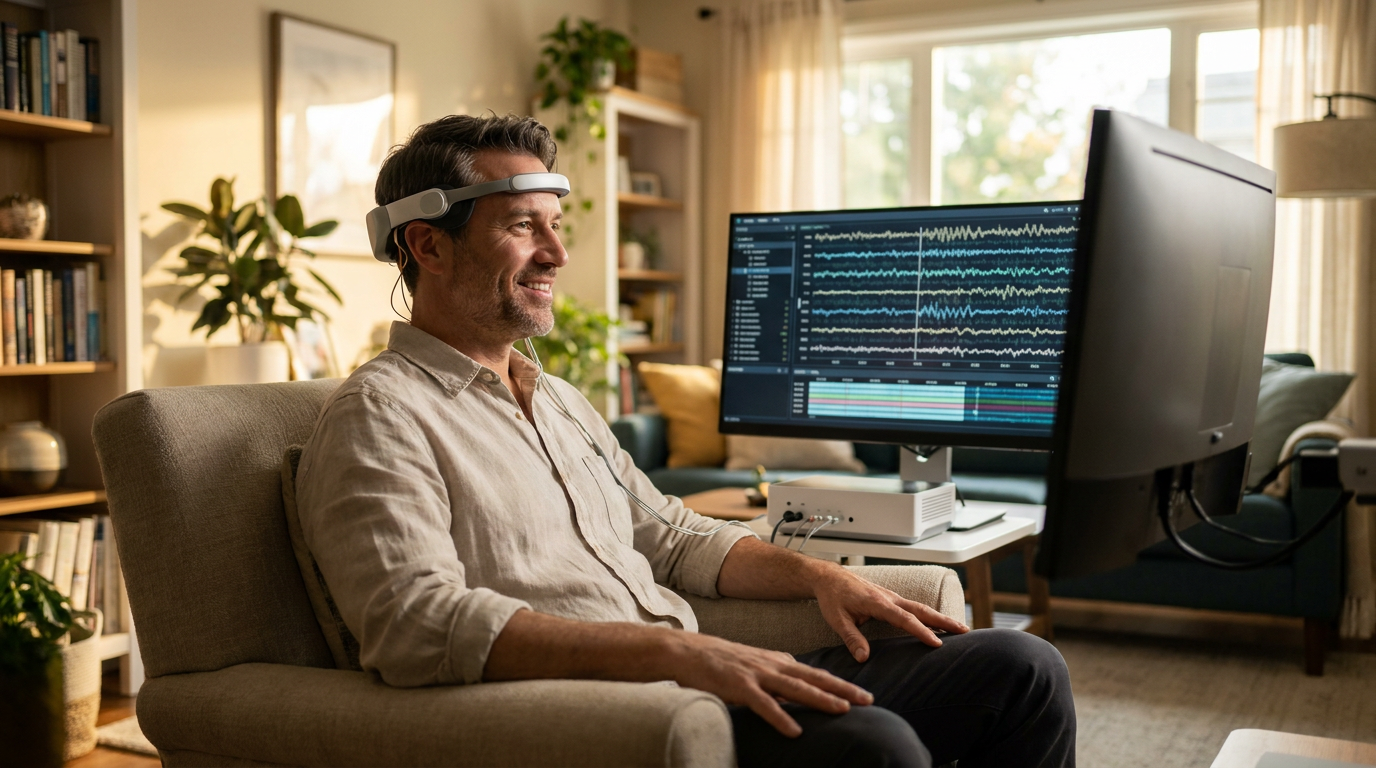
For decades, the remarkable potential of brain-computer interfaces (BCIs) has been confined to the highly controlled environments of research laboratories. While early iterations of the technology served as miraculous proof-of-concept demonstrations, they remained tethered to the clinic, requiring dedicated teams of neuroengineers to calibrate the hardware, monitor the data, and troubleshoot the complex algorithms. That operational barrier meant the technology was fundamentally out of reach for daily, practical life [2]. However, a landmark breakthrough published today in the journal Nature shatters that limitation. A 45-year-old man with severe paralysis caused by amyotrophic lateral sclerosis (ALS) has successfully used a high-bandwidth BCI independently in his own home. For the first time, a patient has been able to communicate, work, and control his digital environment without constant researcher supervision, marking a monumental leap from experimental science to functional, at-home medicine [1].[1][2]
The patient at the center of this milestone, Casey Harrell, received the implant as part of a collaborative clinical trial led by researchers at UC Davis, Brown University, and the Mass General Brigham Neuroscience Institute. By overcoming the twin hurdles of independent at-home use and reliable long-term performance, the study establishes a critical new threshold in the field of neuroengineering [3]. Harrell’s condition, ALS, is a progressive neurodegenerative disease that systematically destroys the nerve cells in the brain and spinal cord. This progression eventually severs the physical connection to the body's voluntary muscles, leaving the patient's cognitive faculties entirely intact but trapped within an unresponsive physical form [6]. The BCI system bypasses this damaged biological wiring entirely, tapping directly into the brain's electrical intent and translating it into actionable digital commands.[3][6]
The architecture of this specific BCI system relies on four microelectrode arrays—comprising 256 individual electrodes in total—that a neurosurgeon implanted directly into Harrell's ventral precentral gyrus [8]. This highly specific region of the motor cortex is responsible for coordinating the complex, rapid, and precise muscle movements of the lips, jaw, tongue, and larynx that are required to produce human speech. Even though Harrell's physical muscles can no longer execute these commands, his motor cortex continues to fire the exact same electrical patterns it always has whenever he attempts to speak [6]. The microelectrodes sit just beneath the surface of the brain, acting as highly sensitive listening devices that capture these microscopic voltage changes across populations of neurons, feeding the raw data outward to an external computer for processing.[6][8]

Capturing the neural data is only half the battle; the system must also translate that chaotic electrical noise into intelligible language instantaneously. The hardware extracts specific neural features within a single millisecond, feeding them into a sophisticated, multilayer Transformer-based artificial intelligence model [8]. This AI has been trained to decode the signals and predict the intended acoustic speech features every 10 milliseconds. The entire processing chain—from the biological firing of a neuron in the motor cortex to the synthesis of digital speech from a computer speaker—occurs so rapidly that it effectively mimics the natural biological delay between speaking and hearing one's own voice [3]. This near-zero latency is what allows the system to feel conversational and fluid, rather than mechanical and frustratingly slow.[3][8]
The clinical evidence detailed in the study demonstrates a staggering leap in both efficacy and usability. Historically, BCIs required months of grueling training to achieve basic proficiency, often limited to spelling out words letter-by-letter. In contrast, after less than two hours of initial training on a massive 125,000-word vocabulary, this new BCI achieved 90 percent decoding accuracy. Within just a few days of continued use, that accuracy climbed to an unprecedented 97 percent [8]. The system's ability to handle such a vast vocabulary with near-perfect precision means the user does not have to simplify their thoughts or rely on predictive text shortcuts. They can speak exactly what is on their mind, utilizing the full breadth of the English language with the speed of natural thought.[8]

The clinical evidence detailed in the study demonstrates a staggering leap in both efficacy and usability.
Beyond the raw technical metrics, the technology restores a profound degree of humanity and emotional resonance that is often lost with severe paralysis. Rather than outputting the decoded text to a generic, robotic text-to-speech generator, the system routes Harrell's neural commands through a digitally reconstructed version of his own pre-ALS voice [8]. The impact of this feature on his family has been deeply transformative. “It is very sweet to have the ability to look at my wife’s eyes when she hears my voice and conjures up a sweet memory,” Harrell shared in the study's release, noting that the technology allows him to remind his young daughter of what he used to sound like before the disease took his speech [3]. It is a restoration of identity, not just utility.[3][8]
This milestone represents a broader, highly anticipated pivot for the entire neurotechnology sector. According to industry analysts tracking the space, the BCI field has officially transitioned from "signal science to execution risk" [5]. The fundamental physics of reading the brain and decoding intent have been proven; the race is now entirely focused on building reliable, consumer-ready medical devices that can scale. A wave of well-funded companies is currently navigating this transition, each taking slightly different approaches to the brain. Neuralink, which implanted its first human patient earlier this year, utilizes 1,024 ultra-thin electrode threads inserted by a proprietary surgical robot to achieve massive bandwidth [4]. The UC Davis study provides crucial validation for this high-bandwidth, intracortical approach, proving that the complex signals required for fluid speech can indeed be stabilized for daily, unassisted use [3].[3][4][5]

While the intracortical arrays offer the highest resolution for speech decoding, other competitors are exploring minimally invasive routes to avoid the risks associated with open brain surgery. Synchron, for example, relies on a stent-like device called the Stentrode, which is delivered through the jugular vein and lodged in a blood vessel sitting adjacent to the motor cortex [4]. While this endovascular approach sacrifices some signal resolution—making fluid speech synthesis more difficult—it dramatically lowers the surgical barrier to entry and has already allowed patients to send text messages and browse the internet. The success of the UC Davis trial does not invalidate these other methods; rather, it proves that the upper ceiling of BCI capability is high enough to justify the surgical risks for patients with severe communication deficits [5].[4][5]
However, despite the triumph of independent at-home use, transparent uncertainty remains regarding the long-term biological durability of intracortical implants. The human brain's natural immune response is designed to protect it from foreign objects, which inevitably leads to the formation of glial scar tissue around the implanted microelectrodes [8]. Over a period of years, this scarring can slowly insulate the sensors, degrading the electrical signal quality and reducing the system's accuracy. Previous longitudinal studies of similar intracortical devices have documented this slow deterioration, raising critical questions about how often the hardware might need to be surgically replaced or algorithmically recalibrated to maintain its life-changing benefits [8].[8]

Furthermore, the current iteration of the technology remains highly experimental, expensive, and relatively bulky. While the patient can use it independently, the system still requires dedicated, high-powered computing hardware set up in the user's home to run the complex AI decoding models in real-time. Miniaturizing this processing power into a wearable or fully implanted device is the next major engineering hurdle [5]. Despite these ongoing challenges, the demonstration of independent, at-home use is an undeniable watershed moment for neuroprosthetics. For the millions of individuals living with severe paralysis, locked-in syndrome, or advanced neurodegenerative diseases, the implications are life-altering [7]. Brain-computer interfaces have finally crossed the chasm from experimental science fiction to functional medicine, actively restoring autonomy, agency, and the simple, profound joy of being heard [1].[1][5][7]
How we got here
2004
The first rudimentary intracortical BCI is implanted in a human, allowing a paralyzed man to move a computer cursor.
2022
Synchron begins human trials for its minimally invasive, stent-like BCI, allowing patients to send text messages.
Jan 2024
Neuralink implants its first human patient, demonstrating high-bandwidth cursor control and gaming.
Aug 2024
Early data shows Casey Harrell achieving 97% speech decoding accuracy using an intracortical BCI in a lab setting.
Jun 2026
Nature Medicine publishes results proving the BCI can be used independently at home without researcher support.
Viewpoints in depth
Neuroengineering Researchers
Scientists focused on crossing the threshold from lab proof-of-concept to reliable at-home execution.
For researchers, the primary victory of this trial is stability. Historically, intracortical implants required daily calibration by a team of engineers to account for microscopic shifts in the brain or changes in signal noise. By developing robust machine-learning algorithms that can auto-calibrate and adapt to these fluctuations, researchers have proven that high-bandwidth BCIs can function as independent medical devices rather than perpetual science experiments. Their next objective is miniaturizing the external computing hardware.
Patient Advocates
Individuals with severe motor impairments prioritizing autonomy, digital access, and personal connection.
From the patient perspective, the metrics of success are deeply personal. While engineers focus on latency and word-error rates, users emphasize the restoration of identity. The ability to synthesize speech using a patient's pre-illness voice rather than a generic robotic output is viewed as a massive leap in quality of life. Advocates stress that future development must prioritize affordability and ease of use, ensuring these devices do not become exclusive tools for the wealthy, but standard-of-care treatments for neurodegenerative diseases.
Industry Analysts
Market observers tracking the commercialization, execution risk, and scaling of BCI technology.
Analysts view this milestone as a massive de-risking event for the neurotechnology sector. With companies like Neuralink and Synchron raising hundreds of millions in venture capital, the pressure to demonstrate viable, at-home consumer products is immense. The UC Davis trial validates the intracortical approach's commercial viability, shifting the industry's focus from fundamental neuroscience to manufacturing, regulatory approval, and surgical scaling. However, analysts caution that the long-term biological durability of the implants remains the largest outstanding risk for investors.
What we don't know
- How long the microelectrodes can maintain high-quality signal detection before the brain's natural scarring process degrades performance.
- When this specific intracortical technology will receive full FDA approval for widespread commercial availability.
- How the high costs of the neurosurgery and the required external computing hardware will be covered by health insurance.
Key terms
- Brain-Computer Interface (BCI)
- A technology that establishes a direct communication pathway between the brain's electrical activity and an external device, such as a computer.
- Amyotrophic Lateral Sclerosis (ALS)
- A progressive neurodegenerative disease that destroys nerve cells in the brain and spinal cord, leading to a loss of muscle control and paralysis.
- Motor Cortex
- The region of the brain responsible for planning, controlling, and executing voluntary movements, including the complex muscle actions required for speech.
- Intracortical Array
- A small grid of microelectrodes implanted directly into the outer layer of the brain to record high-resolution neural signals.
- Glial Scarring
- The brain's natural immune response to a foreign object, which can form tissue around an implant and slowly degrade its ability to read electrical signals.
Frequently asked
What is a brain-computer interface (BCI)?
A BCI is a system that translates the brain's electrical activity into digital commands. In this case, it reads the motor cortex's signals for intended speech and converts them into synthesized audio.
How is this different from previous BCI trials?
Previous high-bandwidth BCIs required a team of researchers to be present for calibration and operation. This new system allows the patient to use the device independently in their own home.
Does the implant require open brain surgery?
Yes, the specific device used in this trial requires a neurosurgeon to implant electrodes directly into the brain's motor cortex. Other companies are developing less invasive alternatives.
Can the device read the patient's private thoughts?
No. The electrodes are placed specifically in the motor cortex, which controls voluntary muscle movement. It only decodes the signals generated when the patient actively attempts to move their mouth and speak.
Is this a cure for ALS?
No. The BCI does not slow or cure the progression of amyotrophic lateral sclerosis. It is an assistive neuroprosthetic designed to restore communication and digital autonomy.
Sources
Source coverage
8 outlets
3 viewpoints surfaced








[1]NatureNeuroengineering Researchers
At-home brain implant gives man with motor neuron disease his daily life back
Read on Nature →[2]Mirage NewsNeuroengineering Researchers
Brain-Computer Interface Empowers ALS Patient's Speech
Read on Mirage News →[3]UC Davis HealthNeuroengineering Researchers
Brain-computer interface enables independent, accurate communication for man living with ALS
Read on UC Davis Health →[4]Tech4ImpactIndustry Analysts
Medicine First: Where BCIs Are Already Saving Lives
Read on Tech4Impact →[5]NeuroTech AnalysisIndustry Analysts
From Signal Science to Execution Risk
Read on NeuroTech Analysis →[6]Signals BlogIndustry Analysts
Brain-computer interface could offer solution to people with motor neuron degeneration
Read on Signals Blog →[7]NewsNationPatient Advocates
Brain chip transforms daily life for ALS patient
Read on NewsNation →[8]The Straits TimesPatient Advocates
Brain-computer interface restores voice to man with ALS
Read on The Straits Times →


Every angle. Every day.
Get science stories with full source coverage and perspective breakdowns delivered to your inbox.