
The Science of Temperature: Cold Plunges vs. Saunas for Muscle Recovery
While both cold water immersion and heat therapy accelerate muscle recovery, new research reveals they trigger entirely different physiological mechanisms—and choosing the wrong one could sabotage your training goals.
By Factlen Editorial Team
- Clinical Researchers
- Focus on objective biomarkers like creatine kinase and the physiological mechanisms of vasoconstriction and vasodilation.
- Strength & Conditioning Coaches
- Prioritize functional outcomes like jump height, explosive power, and long-term muscle hypertrophy over mere pain reduction.
- Wellness & Longevity Advocates
- Emphasize the holistic benefits of temperature therapy, including parasympathetic nervous system regulation and heat shock protein activation.
What's not represented
- · Physical therapists treating acute soft-tissue injuries rather than exercise fatigue
- · Casual gym-goers who lack access to specialized thermal equipment
Why this matters
With the booming popularity of at-home cold plunges and infrared saunas, athletes and casual gym-goers are spending thousands on thermal recovery. Understanding the opposing physiological mechanisms of heat and cold ensures you don't accidentally sabotage your muscle growth or prolong your recovery time.
Key points
- Cold water immersion reduces inflammation and muscle soreness through profound vasoconstriction, making it ideal for immediate, short-term recovery.
- Using cold plunges immediately after resistance training can blunt the cellular signaling required for long-term muscle hypertrophy and strength gains.
- Heat therapy promotes vasodilation, increasing blood flow to flush out metabolic waste while triggering protective heat shock proteins.
- Infrared saunas penetrate up to three centimeters into muscle tissue, accelerating the recovery of neuromuscular performance without halting inflammation.
- Contrast water therapy alternates hot and cold to create a 'vascular pump,' effectively clearing edema, though it may not vastly outperform single modalities.
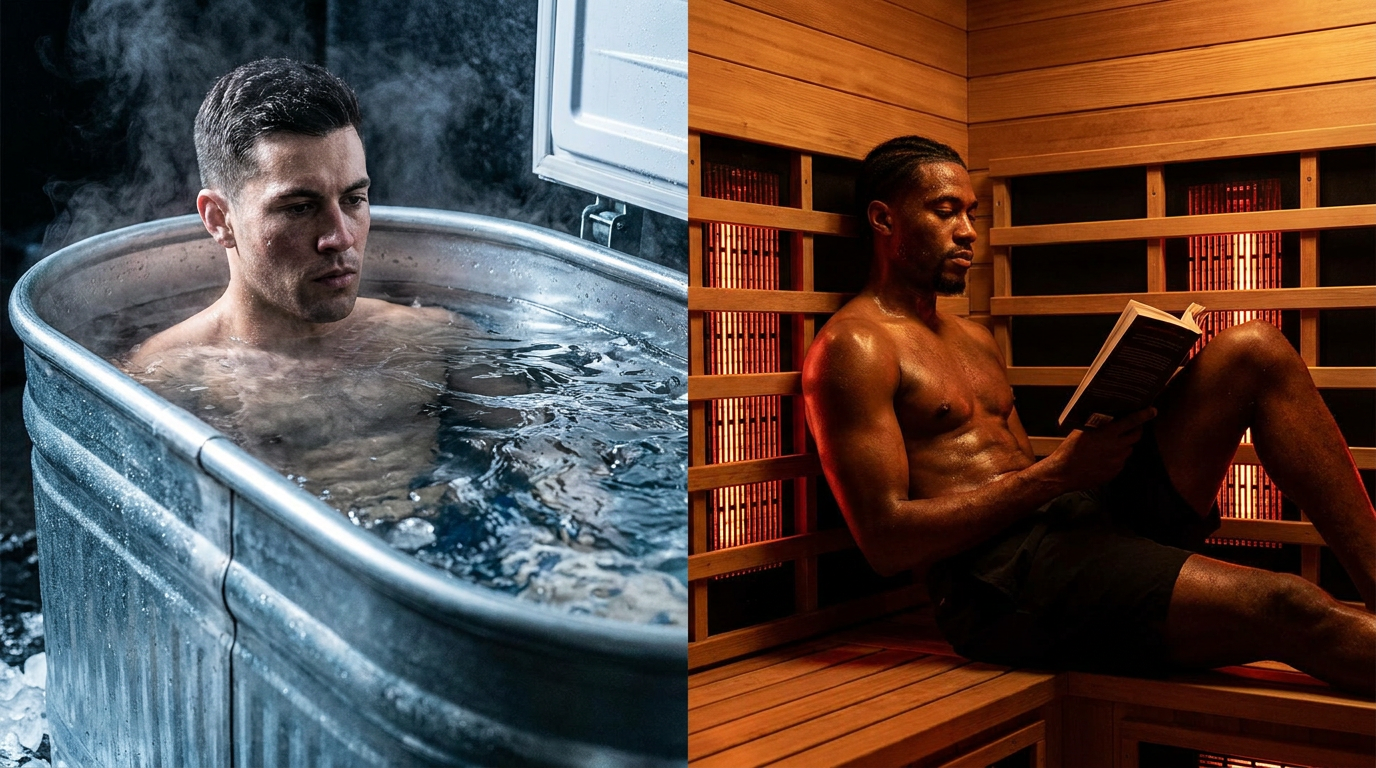
Walk into any high-performance training facility—or increasingly, a suburban garage—and you will likely find a juxtaposition of extremes: a chilling cold plunge tub sitting just feet away from a glowing infrared sauna. The wellness industry has fully embraced temperature manipulation, transforming what was once the exclusive domain of professional locker rooms into a mainstream fitness obsession. But as athletes and weekend warriors alike spend thousands of dollars on thermal recovery tools, a critical question emerges from the scientific community. While both extreme cold and intense heat are marketed as ultimate recovery hacks, they trigger entirely different, and sometimes opposing, physiological mechanisms. Understanding the cellular cascade initiated by each modality is no longer just for sports scientists; it is essential for anyone looking to optimize their training and avoid inadvertently sabotaging their own fitness goals.[1]
To understand how temperature heals, one must first understand how exercise harms. Intense physical activity, particularly movements involving eccentric muscle contractions like downhill running or heavy weightlifting, causes microscopic tears in muscle fibers. This phenomenon, known clinically as exercise-induced muscle damage (EIMD), sets off an inflammatory cascade. Over the following 24 to 48 hours, fluid and white blood cells rush to the damaged tissue, leading to swelling, stiffness, and the familiar, deep ache of delayed-onset muscle soreness (DOMS). Simultaneously, biomarkers of cellular damage, such as creatine kinase (CK), leak into the bloodstream. The goal of any recovery modality is to manage this inflammatory response, clear metabolic waste products, and restore the muscle's ability to generate force as quickly as possible.[2][3]
Cold water immersion (CWI) tackles this inflammatory cascade through aggressive restriction. When the body is submerged in water temperatures typically ranging from 5°C to 15°C, the immediate shock activates TRPM8 cold receptors in the skin. This triggers a rapid sympathetic nervous system response, leading to profound peripheral vasoconstriction. The blood vessels in the extremities and outer muscle layers clamp down, shunting blood toward the body's core to preserve heat. This mechanical constriction acts like a physiological tourniquet, physically limiting the amount of swelling and inflammatory fluid that can pool in the damaged muscle tissues. Furthermore, the cold temperature slows the firing frequency of nociceptive nerve endings, effectively numbing the area and providing immediate, localized pain relief.[4]

The clinical evidence supporting cold water immersion for pain management is robust. Comprehensive meta-analyses reviewing dozens of randomized controlled trials consistently demonstrate that CWI is highly effective at reducing the subjective sensation of DOMS. Furthermore, blood panels of athletes who utilize cold plunges post-exercise show significantly lower circulating levels of creatine kinase compared to those who rely on passive rest. By blunting the peak of the inflammatory response, cold therapy allows athletes to feel fresher and report lower levels of perceived fatigue in the days following a grueling workout. For a long time, this reduction in soreness was equated directly with optimal recovery, cementing the ice bath's status as a post-game staple.[2][3]
However, modern sports science has uncovered a significant caveat to the ice bath: reducing inflammation is not always desirable. Inflammation is the biological signal that tells the body to adapt, repair, and build stronger tissue. By artificially blunting this response with cold water immediately after resistance training, athletes may actually be short-circuiting their own gains. Studies have shown that while CWI reduces soreness, it can also inhibit the immediate recovery of explosive muscular power, often measured by countermovement jump height. More importantly, chronic use of cold water immersion immediately following strength training has been shown to attenuate muscle hypertrophy—meaning athletes who plunge after lifting weights may build less muscle mass over time than those who simply rest.[2][4]
However, modern sports science has uncovered a significant caveat to the ice bath: reducing inflammation is not always desirable.
If cold therapy is about restriction, heat therapy is about expansion. Stepping into a sauna, whether traditional or infrared, initiates a completely different cardiovascular response. As core body temperature rises, the body attempts to cool itself through profound vasodilation. Blood vessels widen, and cardiac output increases, mimicking the physiological effects of moderate-intensity aerobic exercise. This surge in peripheral blood flow delivers a massive influx of oxygen and nutrient-rich blood directly to the fatigued muscles. Instead of trapping metabolic waste products like lactic acid and cellular debris out of the muscle, the increased circulation actively flushes them away, accelerating the metabolic side of the recovery equation.[7]

Beyond simple blood flow, heat therapy triggers a profound cellular defense mechanism: the production of Heat Shock Proteins (HSPs). When cells are exposed to thermal stress, they rapidly synthesize these specialized molecules, which act as cellular first responders. HSPs patrol the intracellular environment, repairing misfolded proteins, protecting against oxidative stress, and preventing cellular death. In the context of muscle recovery, the activation of heat shock proteins is critical. They help prevent muscle atrophy during periods of rest and ensure that the new proteins being synthesized for muscle repair are functional and healthy. This cellular resilience is one reason regular sauna use is increasingly linked not just to acute recovery, but to long-term cardiovascular health and longevity.[1][7]
The delivery mechanism of the heat also plays a role in the recovery profile. While traditional Finnish saunas heat the ambient air to warm the body from the outside in, infrared saunas use specific light wavelengths to penetrate directly into the soft tissue. Research indicates that this radiant heat can penetrate up to three centimeters beneath the skin, warming the muscle tissue, blood vessels, and nerves more directly. Studies tracking athletes who utilized infrared saunas after heavy resistance training found that they not only reported significant reductions in DOMS, but also demonstrated a faster recovery of neuromuscular performance—meaning their central nervous system and muscle fibers re-coordinated more efficiently than those who used passive recovery.[7]
For athletes unwilling to choose between the benefits of expansion and restriction, contrast water therapy (CWT) offers a compelling middle ground. By deliberately alternating between hot and cold environments—typically spending three minutes in heat followed by one minute in cold, repeated for several cycles—practitioners attempt to harness both mechanisms. The rapid shift from vasodilation to vasoconstriction creates a 'vascular pumping' effect. The heat expands the vessels to bring in fresh blood, and the sudden cold contracts them, forcefully expelling stagnant fluid and edema from the muscle tissue. This mechanical pumping is theorized to clear metabolic waste far more efficiently than either modality used in isolation.[5]

The empirical data on contrast therapy is highly positive, though it introduces nuance into the recovery debate. Systematic reviews confirm that contrast water therapy significantly reduces both muscle soreness and the loss of muscular strength in the days following intense exercise when compared to simply sitting on the couch. However, when researchers pit contrast therapy directly against cold water immersion alone, the results are often a statistical tie. Both methods are vastly superior to passive rest, but the complex, time-consuming nature of shuttling between hot and cold tubs may not yield a mathematically significant advantage over a simple, well-timed cold plunge for the average athlete.[5][6]
Ultimately, the science suggests that the 'best' temperature for recovery depends entirely on the specific goals of the training session and the timeline of the athlete's next performance. Cold water immersion is the undisputed champion of acute symptom management. If an athlete is participating in a multi-day tournament, a CrossFit competition, or an endurance event where they need to perform again within 24 hours, the immediate pain relief and inflammation reduction of a cold plunge are invaluable. In these scenarios, the slight blunting of long-term adaptation is a worthwhile trade-off for the ability to step back onto the field feeling refreshed and capable.[1][6]

Conversely, heat therapy is emerging as the superior choice for athletes focused on long-term tissue adaptation, strength gains, and muscle hypertrophy. Because sauna use does not interrupt the necessary inflammatory signaling required for muscle growth, it safely accelerates the clearance of waste while actively promoting cellular repair through heat shock proteins. As the sports science community moves away from a one-size-fits-all approach to recovery, the new paradigm is clear: passive rest is no longer sufficient. By strategically deploying cold to survive the immediate demands of competition, and utilizing heat to build long-term resilience, athletes can finally align their recovery protocols with their physiological goals.[1][7]
How we got here
Early 1900s
Exercise-induced muscle damage (EIMD) and delayed-onset muscle soreness are first formally documented in medical literature.
2000s
Cold water immersion becomes a standard post-match protocol in elite professional sports to manage acute inflammation.
2013
Major meta-analyses confirm that contrast water therapy significantly reduces muscle strength loss compared to passive rest.
2022
Comprehensive reviews reveal that while cold plunges reduce soreness, they can actively blunt muscle hypertrophy if used after strength training.
2025
Infrared saunas gain widespread adoption as research highlights their ability to penetrate deep tissue and accelerate neuromuscular recovery.
Viewpoints in depth
The Acute Recovery Camp
Prioritizes immediate pain relief and inflammation reduction for athletes who need to compete multiple times in a short window.
For tournament athletes, CrossFit competitors, and endurance runners, the primary goal of recovery is surviving the next 24 hours. This camp heavily favors cold water immersion because of its unmatched ability to numb nociceptive nerve endings and physically restrict the pooling of inflammatory fluids. They acknowledge that cold might blunt long-term muscle growth, but argue that in the middle of a competitive season, immediate functional capacity and pain reduction are far more critical than fractional gains in muscle mass.
The Hypertrophy & Strength Camp
Focuses on long-term tissue adaptation and actively avoids modalities that interrupt the body's natural inflammatory signaling.
Strength and conditioning coaches focused on building muscle mass and explosive power view inflammation not as an enemy, but as a necessary biological signal. This camp warns against the chronic use of post-workout ice baths, citing studies that show cold therapy blunts the cellular pathways responsible for hypertrophy. Instead, they advocate for heat therapy, noting that saunas increase blood flow to clear waste without silencing the inflammatory signals required to build thicker, stronger muscle fibers.
The Cellular Longevity Camp
Looks beyond athletic performance to focus on the holistic, life-extending benefits of thermal stress.
Wellness advocates and longevity researchers focus on the systemic benefits of temperature manipulation, particularly heat therapy. They highlight the role of Heat Shock Proteins (HSPs), which are synthesized during sauna use to repair damaged cellular structures and protect against oxidative stress. For this camp, the 'passive cardio' effect of a sauna—where heart rate and cardiac output increase without mechanical wear and tear on the joints—makes heat therapy an essential tool for long-term cardiovascular health and disease prevention, independent of its effects on muscle soreness.
What we don't know
- The exact temperature threshold at which cold water immersion begins to negatively impact muscle hypertrophy.
- Whether the long-term cardiovascular benefits of sauna use can fully replace the need for active aerobic exercise in injured athletes.
- The precise physiological differences in cellular repair between traditional ambient heat saunas and targeted infrared saunas.
Key terms
- Delayed-Onset Muscle Soreness (DOMS)
- The deep, aching muscle pain and stiffness that typically peaks 24 to 48 hours after intense or unaccustomed exercise.
- Creatine Kinase (CK)
- An enzyme found in muscle tissue that leaks into the bloodstream when muscles are damaged, used by scientists as a biomarker for exercise-induced muscle damage.
- Vasoconstriction
- The narrowing of blood vessels, typically in response to cold, which restricts blood flow and reduces localized swelling.
- Vasodilation
- The widening of blood vessels, typically in response to heat, which increases blood flow and oxygen delivery to tissues.
- Heat Shock Proteins (HSPs)
- Specialized cellular proteins produced in response to thermal stress that repair misfolded proteins and protect cells from damage.
Frequently asked
How long should I stay in a cold plunge for recovery?
Research indicates that 10 to 15 minutes in water temperatures between 5°C and 15°C is the optimal dose for reducing muscle soreness and inflammation.
Will taking an ice bath kill my muscle gains?
It can. Using cold water immersion immediately after resistance training blunts the inflammatory signaling required for muscle hypertrophy and can inhibit the recovery of explosive power.
Is an infrared sauna better than a traditional sauna?
Both are effective, but infrared saunas use light wavelengths to penetrate up to three centimeters into the tissue, which may accelerate neuromuscular recovery more directly than the ambient heat of a traditional sauna.
What is contrast water therapy?
Contrast therapy involves rapidly alternating between hot and cold environments—typically three minutes of heat followed by one minute of cold—to create a 'vascular pump' that clears metabolic waste.
Sources
Source coverage
7 outlets
3 viewpoints surfaced







[1]Factlen Editorial TeamWellness & Longevity Advocates
Synthesis by Factlen editorial team
Read on Factlen Editorial Team →[2]Sports MedicineClinical Researchers
Effects of Cold-Water Immersion Compared with Other Recovery Modalities on Athletic Performance Following Acute Strenuous Exercise
Read on Sports Medicine →[3]Frontiers in PhysiologyClinical Researchers
Impact of different doses of cold water immersion on recovery from acute exercise-induced muscle damage: a network meta-analysis
Read on Frontiers in Physiology →[4]MDPI HealthcareStrength & Conditioning Coaches
Comparison of the Effects of Cold-Water Immersion Applied Alone and Combined Therapy on the Recovery of Muscle Fatigue
Read on MDPI Healthcare →[5]PLOS OneClinical Researchers
Contrast Water Therapy and Exercise Induced Muscle Damage: A Systematic Review and Meta-Analysis
Read on PLOS One →[6]Journal of Strength and Conditioning ResearchStrength & Conditioning Coaches
Effects of Cold Water Immersion and Contrast Water Therapy for Recovery From Team Sport: A Systematic Review
Read on Journal of Strength and Conditioning Research →[7]International Journal of Sports Physiology and PerformanceWellness & Longevity Advocates
A post-exercise infrared sauna session improves recovery of neuromuscular performance and muscle soreness
Read on International Journal of Sports Physiology and Performance →


Every angle. Every day.
Get fitness stories with full source coverage and perspective breakdowns delivered to your inbox.