
The Amazon Can Survive Global Warming, But Only If Deforestation Stops
New Earth system modeling reveals the Amazon rainforest possesses profound thermal resilience, capable of withstanding up to 4.0°C of warming if human-driven clearing is halted.
By Factlen Editorial Team
- Earth System Modellers
- Focuses on the mathematics of the tipping point, the interconnected variables of temperature and land-use, and the self-amplifying feedback loops of moisture loss.
- Conservation Advocates
- Argues that the science demands an immediate zero-deforestation policy and strict fire management to protect the intact canopy.
- Global Policy Analysts
- Emphasizes that the international community must eliminate market demand for deforestation-linked commodities to support local conservation efforts.
What's not represented
- · Indigenous communities living within the Amazon
- · Agricultural commodity exporters
Why this matters
The Amazon regulates weather patterns and agricultural rainfall across the Americas while storing billions of tonnes of carbon. Discovering that the forest can survive severe global warming if we simply stop cutting it down transforms a narrative of inevitable climate doom into a highly actionable, solvable policy challenge.
Key points
- A new Earth system model reveals the Amazon can withstand up to 4.0°C of global warming if deforestation is completely halted.
- If deforestation reaches 22–28% alongside 1.5°C of warming, up to 77% of the biome could collapse into degraded savanna.
- Currently, 17–18% of the Amazon has already been cleared, placing the forest perilously close to the critical threshold.
- The forest generates its own rainfall; removing trees breaks this moisture pump, causing self-amplifying droughts.
- The findings shift the focus toward immediate, localized conservation as a powerful buffer against global climate change.
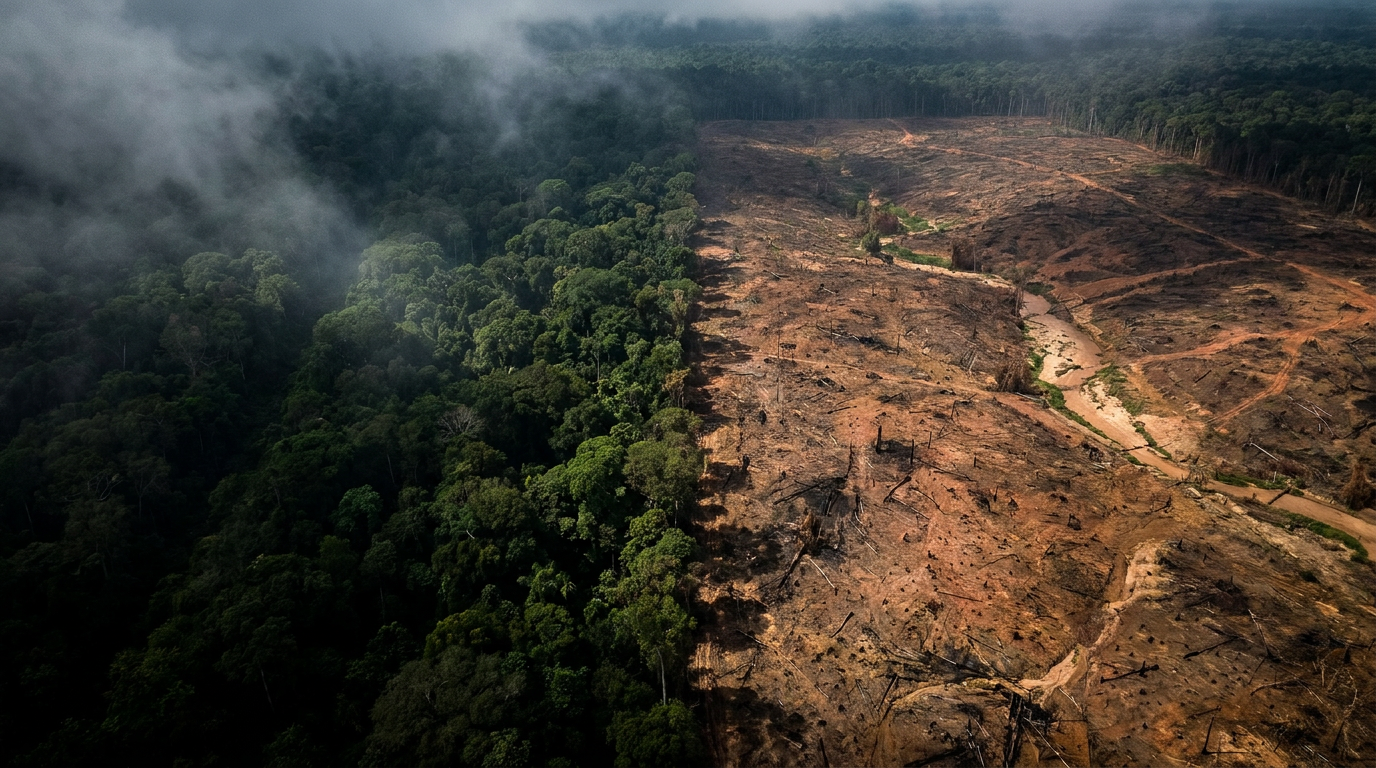
The Amazon rainforest is approaching a critical tipping point, but new evidence reveals a profound mechanism of resilience: the forest can withstand significant global warming if, and only if, human-driven deforestation is halted. This finding fundamentally reshapes how scientists and policymakers view the future of the world's largest tropical biome.[2][7]
The stakes for the global climate system are immense. The Amazon stores billions of tonnes of carbon and regulates rainfall across the entirety of South America. If the ecosystem collapses into a degraded, savanna-like state, it would release massive carbon stores into the atmosphere, accelerating global climate change and devastating regional agriculture that relies on the forest's moisture.[4][5]
A landmark paper published in the journal Nature by researchers at the Potsdam Institute for Climate Impact Research and the Stockholm Resilience Centre has modeled the combined stresses of warming and land-use change. The study provides the most precise mathematical boundaries yet for when the forest will lose its ability to sustain itself.[1][3]
The researchers identified a dangerous dual threshold. They found that if deforestation reaches between 22% and 28% of the original forest cover, while global temperatures simultaneously rise by 1.5°C to 1.9°C above pre-industrial levels, up to 77% of the Amazon could transition into a degraded state.[1][3]

The current reality places the biome perilously close to this danger zone. Roughly 17% to 18% of the Amazon has already been deforested, primarily for cattle ranching and industrial agriculture. Meanwhile, global average temperatures are already flirting with the 1.5°C threshold, meaning the dual conditions for collapse are nearly met.[4][5]
To understand why these two factors are so intimately linked, one must look at the forest's mechanism of survival. The Amazon generates its own rainfall through a process called transpiration. Trees act as massive water pumps, drawing moisture from deep within the soil and releasing it into the atmosphere as vapor, which then forms clouds and falls as rain further downwind.[7]
When deforestation occurs, it severs this moisture recycling pump. The resulting phenomenon, known as "deforestation-induced drying," means significantly less rain falls on the remaining intact forest. This artificial drought weakens the canopy's ability to survive natural heatwaves and dry seasons.[1][5]

When deforestation occurs, it severs this moisture recycling pump.
This drying triggers a self-amplifying feedback loop. As the forest dries out, it becomes highly susceptible to fire—a disturbance that is not naturally common in the humid Amazon. Fires kill more mature trees, which further reduces transpiration, causing even more drying and making the next fire season worse.[4][5]
However, the models revealed a striking and hopeful counter-factual. If deforestation is completely halted, the intact forest's internal moisture pump is remarkably robust. The deep roots and dense canopy create a microclimate that can buffer the ecosystem against extreme external heat.[1][3]
Without the compounding stress of deforestation, the Amazon's critical tipping point shifts drastically upward. The models indicate that an intact, undisturbed Amazon could survive global warming of between 3.7°C and 4.0°C before suffering a system-wide collapse.[1][4]

This finding shifts the climate narrative from one of inevitable doom to one of actionable policy. It proves that local and regional conservation efforts—stopping bulldozers and chainsaws—can effectively insulate the forest against the slower-moving threat of global-scale carbon emissions.[2][7]
A recent Nature editorial highlighted that a political window of opportunity currently exists. Brazil's administration under President Luiz Inácio Lula da Silva has successfully driven down deforestation rates in recent years, demonstrating that policy enforcement can yield immediate ecological dividends.[2][6]
Yet, Brazil cannot save the Amazon alone. Analysts stress that international markets must stop demanding commodities linked to deforestation, such as beef, soy, and timber. Furthermore, wealthy nations must provide the financial architecture required to make a standing forest more economically valuable than a cleared one.[2][6]
While the evidence for this resilience is strong, researchers acknowledge transparent uncertainties in the modeling. Earth system models still struggle to perfectly simulate the localized, compounding impacts of unprecedented extreme weather events, such as the severe droughts driven by recent El Niño cycles.[1][7]

Furthermore, even if the forest avoids a biome-wide collapse, field studies show that localized damage is already occurring. The edges of fragmented forests suffer severe biodiversity loss, transitioning away from specialized, fire-resistant old-growth trees toward fast-growing, generalist species.[4]
How we got here
2016
Early models suggest the Amazon tipping point sits at 20-25% deforestation combined with 2.0°C of warming.
2021
The Science Panel for the Amazon warns the biome is nearing a critical threshold, urging immediate conservation.
2023
Deforestation rates in the Brazilian Amazon begin to fall sharply under a new political administration.
2024
Global average temperatures temporarily surpass the 1.5°C threshold for the first time, heightening urgency.
May 2026
A landmark Nature study reveals that halting deforestation increases the forest's thermal resilience to nearly 4.0°C.
Viewpoints in depth
Earth System Modellers
Focuses on the mathematics of the tipping point and the self-amplifying feedback loops of moisture loss.
Researchers building Earth system models emphasize the interconnected nature of climate variables. They argue that looking at global warming in isolation ignores the localized physical mechanisms—like transpiration and canopy shading—that keep a biome stable. By quantifying the exact point where "deforestation-induced drying" overwhelms the forest's ability to recover, modellers provide a concrete mathematical boundary that shows how local land-use changes can trigger continental-scale ecological collapse.
Conservation Advocates
Argues that the science demands an immediate zero-deforestation policy and strict fire management.
For conservationists and ecologists working on the ground, the new modeling is a mandate for immediate action. They argue that while reducing global carbon emissions is a slow, multi-generational political battle, halting deforestation is a policy choice that can be enforced today. By prioritizing the protection of intact canopy and cracking down on illegal logging and deliberately set agricultural fires, advocates believe the worst outcomes of the tipping point can be entirely avoided.
Global Policy Analysts
Emphasizes that the international community must eliminate market demand for deforestation-linked commodities.
Policy analysts point out that the burden of saving the Amazon cannot rest solely on South American governments. They argue that the economic drivers of deforestation—specifically the global demand for cheap beef, soy, and timber—must be addressed by importing nations. Analysts advocate for strict supply-chain regulations and international financial mechanisms that compensate developing nations for keeping their forests standing, turning conservation into a viable economic alternative to industrial agriculture.
What we don't know
- How quickly the transition from lush rainforest to degraded savanna would occur once the tipping point is crossed.
- Whether localized reforestation efforts can effectively restart the moisture recycling pump in already degraded regions.
- Exactly how unprecedented extreme weather events, like severe El Niño droughts, might accelerate the timeline beyond current model predictions.
Key terms
- Tipping point
- A critical threshold where a system undergoes a rapid, often irreversible, change into a fundamentally new state.
- Transpiration
- The process by which moisture is carried through plants from roots to small pores on leaves, where it changes to vapor and is released to the atmosphere.
- Earth system model
- Complex mathematical simulations run on supercomputers to project how the atmosphere, oceans, land, and ice interact over time.
- Moisture recycling
- The process where a forest generates its own rainfall by evaporating water back into the atmosphere, which then falls as rain further downwind.
Frequently asked
Is the Amazon already turning into a savanna?
Not entirely, but parts of the southeastern Amazon are showing severe signs of degradation. Models suggest a large-scale transition could begin in the 2030s or 2040s if current trends continue.
Can planting new trees reverse the damage?
While reforestation helps, experts emphasize that halting the destruction of old-growth, intact forest is far more critical because mature trees pump significantly more moisture into the atmosphere.
Why does deforestation make the forest hotter?
Trees act as natural air conditioners by releasing water vapor through transpiration. When they are removed, the land absorbs more heat and the local climate becomes drier and hotter.
Sources
Source coverage
7 outlets
3 viewpoints surfaced






[1]NatureEarth System Modellers
Deforestation-induced drying lowers Amazon climate threshold
Read on Nature →The Amazon can be saved — with concerted action inside and outside Brazil
Read on Nature →[3]Stockholm Resilience CentreEarth System Modellers
Deforestation-induced drying lowers Amazon climate threshold
Read on Stockholm Resilience Centre →[4]MongabayConservation Advocates
Deforestation and warming could push Amazon to tipping point by 2040s: Study
Read on Mongabay →[5]Down To EarthConservation Advocates
As warming and deforestation intensify, the Amazon could begin driving its own collapse, study warns
Read on Down To Earth →[6]Carbon BriefGlobal Policy Analysts
The Amazon can be saved – with concerted action inside and outside Brazil
Read on Carbon Brief →[7]Factlen Editorial TeamGlobal Policy Analysts
Synthesis by Factlen editorial team
Read on Factlen Editorial Team →

More in science
See all 5 stories →

Every angle. Every day.
Get science stories with full source coverage and perspective breakdowns delivered to your inbox.