
What Is an NPU? How the 'AI PC' Revolution Is Changing Laptop Hardware
Neural Processing Units are moving artificial intelligence out of the cloud and directly onto your device. Here is how this specialized silicon improves battery life, protects privacy, and fundamentally changes computer architecture.
By Factlen Editorial Team
- Hardware Manufacturers
- Argue that NPUs are a mandatory evolution for computing, focusing on the massive gains in battery efficiency and the raw TOPS performance of their silicon.
- Privacy Advocates
- Champion the NPU as a critical security tool that allows sensitive data to be processed locally rather than being harvested by cloud servers.
- Tech Pragmatists
- Acknowledge the efficiency gains but warn consumers not to fall for marketing hype, noting that NPUs do not improve traditional gaming or heavy rendering.
What's not represented
- · Cloud Service Providers
- · Budget PC Builders
Why this matters
Understanding NPUs is essential for anyone buying a computer in 2026. This dedicated silicon dictates whether your next device can run local, privacy-preserving AI tools without draining its battery life.
Key points
- An NPU is a dedicated processor designed specifically for artificial intelligence tasks.
- By handling AI locally, NPUs drastically reduce power consumption compared to using a CPU or GPU.
- On-device processing protects user privacy by keeping sensitive data off cloud servers.
- Microsoft requires a minimum of 40 TOPS (Trillions of Operations Per Second) for its premium AI PC tier.
If you have shopped for a laptop in 2026, you have undoubtedly been bombarded by a two-letter marketing buzzword: AI. From Apple's M4 MacBooks to Windows "Copilot+" machines, manufacturers are aggressively pushing the concept of the "AI PC." But beneath the glossy marketing campaigns lies a genuine, fundamental shift in computer architecture.[1][2]
For decades, personal computers relied on a duopoly of processing power: the Central Processing Unit (CPU) and the Graphics Processing Unit (GPU). Today, a third pillar has quietly become standard silicon across the industry: the Neural Processing Unit, or NPU.[1][4]
To understand why the tech industry has spent billions integrating NPUs into everyday devices, it helps to look at how a computer delegates work. The CPU acts as the general manager. It is incredibly versatile, designed to handle a wide variety of sequential tasks—from running your operating system to opening a web browser and managing your files.[2]
The GPU, by contrast, is the heavy lifter. It excels at parallel processing, taking massive batches of similar mathematical equations and solving them simultaneously. This brute-force approach is essential for rendering 3D graphics in video games or exporting high-resolution video files.[4][7]

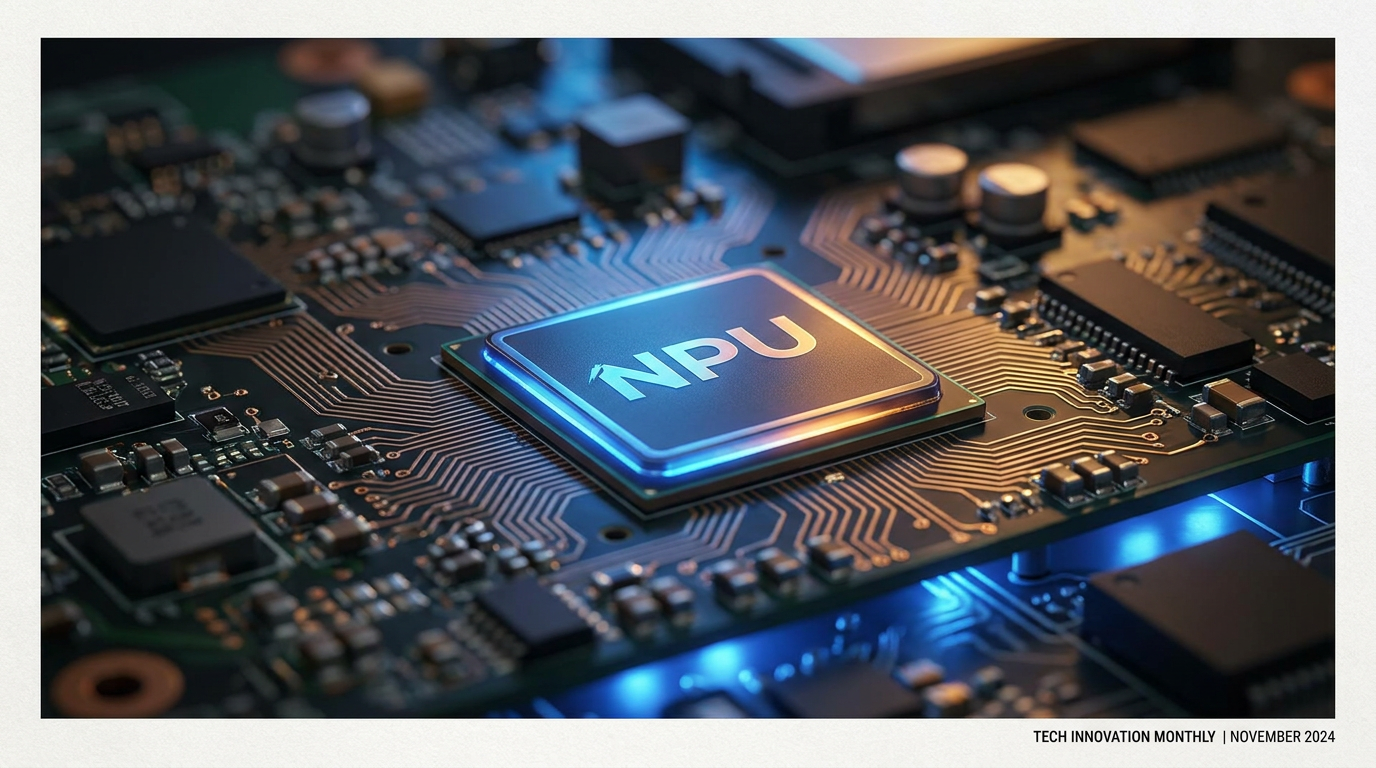
The NPU is the ultra-efficient specialist. It is a microprocessor engineered from the ground up to do one thing exceptionally well: accelerate machine learning inference and neural network operations. It does not care about rendering frame rates, and it does not care about managing your operating system.[3][6]
Artificial intelligence models—whether they are generating text, blurring your background on a video call, or isolating your voice from background noise—rely heavily on a specific type of math called matrix multiplication. While a CPU can perform these calculations, it does so slowly. A GPU can perform them rapidly, but it requires a massive amount of electricity to do so.[4][5]
The NPU achieves its speed and efficiency through a highly specialized architecture. It utilizes massively parallel Multiply-Accumulate (MAC) arrays and relies on low-precision arithmetic, such as INT8. This lower precision is perfectly suited for the probabilistic nature of artificial intelligence, where absolute mathematical perfection is less important than rapid pattern recognition.[4]
Furthermore, NPUs are designed to solve the primary bottleneck in modern computing: data movement. By keeping high-bandwidth memory (SRAM) physically close to the compute units, NPUs drastically reduce the time and energy wasted shuttling data back and forth across the motherboard.[4]

Furthermore, NPUs are designed to solve the primary bottleneck in modern computing: data movement.
The real-world result of this architecture is a dramatic reduction in power consumption. When running an AI workload, an NPU typically draws between 5 and 10 watts of power. Asking a GPU to perform the exact same task could draw 30 to 40 watts or more, generating significant heat in the process.[2][7]
For laptop users, this efficiency translates directly into battery life. Offloading routine AI tasks to the NPU can extend a device's battery life by 15 to 20 percent during intensive workloads, effectively adding hours of usable time to a single charge while keeping the cooling fans quiet.[2]

Beyond battery life, the rise of the NPU is fundamentally reshaping digital privacy. Before the widespread adoption of on-device AI accelerators, using advanced AI meant sending your data—your voice, your face, your private documents—to a remote cloud server for processing.[3]
Because NPUs provide enough local compute power to run these models directly on the hardware, sensitive data never has to leave the device. This local processing also eliminates the latency of waiting for a cloud server to respond, making features like real-time translation and live transcription feel instantaneous.[3][6]

To quantify this new era of processing power, the industry has adopted a new metric: TOPS, or Trillions of Operations Per Second. This number measures exactly how much AI math the chip can handle at any given moment.[2][5]
Microsoft has drawn a line in the sand, requiring a minimum of 40 TOPS from the NPU for a laptop to qualify for its premium "Copilot+" AI PC designation. This baseline ensures the computer can run advanced Windows AI features smoothly in the background without degrading overall system performance.[2][5]
This requirement has sparked a silicon arms race. In 2026, Qualcomm's Snapdragon X Elite, AMD's Ryzen AI, Intel's Core Ultra, and Apple's M4 Neural Engine are all fiercely competing to offer the highest TOPS with the lowest power draw, pushing the boundaries of mobile computing.[5]

However, it is crucial to understand what an NPU does not do. If you are a gamer hoping an NPU will boost your frame rates, you will be disappointed; traditional gaming still relies entirely on the GPU. The NPU is strictly for neural network tasks.[7]
How we got here
2017
Apple introduces the 'Neural Engine' in the A11 Bionic chip for iPhones, bringing early NPU tech to smartphones.
Late 2023
Intel launches its 'Meteor Lake' Core Ultra processors, integrating NPUs into mainstream Windows laptop chips.
May 2024
Microsoft announces the 'Copilot+ PC' standard, mandating a 40 TOPS NPU for next-generation AI features.
2026
NPUs become standard silicon across all major laptop manufacturers, solidifying the 'AI PC' era.
Viewpoints in depth
Hardware Manufacturers
Silicon designers view the NPU as the most important architectural leap in a decade.
Companies like Intel, AMD, Qualcomm, and Apple argue that the NPU is a mandatory evolution for computing. As operating systems integrate AI into everyday functions—from live transcription to predictive typing—relying on the CPU or GPU would destroy laptop battery life. By pushing the TOPS (Trillions of Operations Per Second) metric higher each generation, manufacturers aim to make local AI processing completely invisible and frictionless to the end user.
Privacy Advocates
Security experts champion the NPU as a critical tool for data sovereignty.
For years, utilizing advanced AI meant surrendering personal data to massive cloud servers operated by tech giants. Privacy advocates view the rise of the NPU as a vital course correction. Because the NPU provides enough compute power to run models directly on the hardware, sensitive inputs—such as biometric facial scans, private voice conversations, and confidential business documents—never have to leave the device, drastically reducing the risk of interception or unauthorized data harvesting.
Tech Pragmatists
Hardware reviewers acknowledge the efficiency gains but warn against overblown marketing.
While tech analysts agree that NPUs offer fantastic battery life improvements for specific tasks, they caution consumers against the "AI PC" hype train. Pragmatists point out that an NPU will not make a computer faster at traditional tasks like web browsing, spreadsheet calculation, or video gaming. They emphasize that for users who do not regularly utilize AI-assisted video calls or local generative tools, the immediate benefits of an NPU remain relatively subtle.
What we don't know
- How quickly software developers will update legacy applications to actually utilize the NPU instead of defaulting to the CPU.
- Whether the 40 TOPS standard will remain sufficient as local AI models grow increasingly complex.
- If the fragmented software ecosystem across Intel, AMD, and Qualcomm will slow down the adoption of universal NPU features.
Key terms
- NPU
- Neural Processing Unit; a specialized processor built to handle the specific mathematical operations required by artificial intelligence models.
- TOPS
- Trillions of Operations Per Second; a measurement of a processor's AI computing speed.
- Inference
- The process of running live data (like your voice or a photo) through an already-trained AI model to get a result or prediction.
- MAC Array
- Multiply-Accumulate array; a hardware structure inside an NPU optimized for the repetitive math used in neural networks.
- Copilot+ PC
- A certification standard created by Microsoft for Windows laptops that feature an NPU capable of at least 40 TOPS.
Frequently asked
What does NPU stand for?
NPU stands for Neural Processing Unit. It is a specialized microchip designed specifically to accelerate artificial intelligence and machine learning tasks.
Will an NPU make my video games run faster?
No. Traditional video games rely on the Graphics Processing Unit (GPU) to render 3D environments. An NPU is dedicated solely to neural network operations and will not increase your frame rates.
What does TOPS mean?
TOPS stands for Trillions of Operations Per Second. It is the standard metric used to measure how fast an NPU can process AI mathematical workloads.
Do I need an NPU to use ChatGPT?
No. Web-based AI tools like ChatGPT process their data on remote cloud servers. An NPU only accelerates AI tasks that run locally on your actual device.
Sources
Source coverage
7 outlets
3 viewpoints surfaced





[1]Factlen Editorial TeamTech Pragmatists
Synthesis by Factlen editorial team
Read on Factlen Editorial Team →[2]HPHardware Manufacturers
What is an AI PC? Everything You Need to Know in 2026
Read on HP →[3]Built InPrivacy Advocates
What Is a Neural Processing Unit (NPU)?
Read on Built In →[4]UplatzTech Pragmatists
Neural Processing Units (NPUs): A Comprehensive Architectural Analysis
Read on Uplatz →[5]Local AI MasterHardware Manufacturers
2026 NPU Showdown: Intel, AMD, Qualcomm, and Apple Compared
Read on Local AI Master →[6]Microchip USAPrivacy Advocates
What is a Neural Processing Unit (NPU)?
Read on Microchip USA →[7]PCMagTech Pragmatists
Testing the First AI PCs: Do NPUs Actually Matter?
Read on PCMag →
More in ai
See all 7 stories →Local AI
How to Run Powerful AI Locally: The 2026 Guide to Offline LLMs
0 sources
Edge AI
How Small Language Models Are Moving AI From the Cloud to Your Pocket
0 sources
Photonic Computing
How Photonic Chips Are Using Light to Solve AI's Massive Energy Crisis
0 sources
Neuro-Symbolic AI
New AI Architecture Slashes Energy Use by 100x While Tripling Accuracy
0 sources
Every angle. Every day.
Get ai stories with full source coverage and perspective breakdowns delivered to your inbox.