
The End of the Wireless Charging Wars: How Qi2 is Unifying Apple and Android
The new Qi2 standard brings MagSafe-style magnetic alignment and 25W fast charging to both iPhone and Android devices, ending years of fragmented tech ecosystems.
By Factlen Editorial Team
- Consumer Tech Advocates
- Focus on the democratization of magnetic charging and the end of ecosystem lock-in.
- Hardware Engineers
- Emphasize the thermal management challenges of pushing 25W through a wireless connection.
- Industry Standards Bodies
- Prioritize global interoperability, safety certifications, and market unification.
What's not represented
- · Budget Smartphone Manufacturers
Why this matters
For years, consumers had to buy different chargers for Apple and Android devices, often suffering through slow, inefficient power-ups. The Qi2 standard eliminates this divide, allowing households to share a single, high-speed magnetic charging ecosystem that saves money and reduces electronic waste.
Key points
- The Qi2 standard uses a Magnetic Power Profile to perfectly align chargers with devices, eliminating energy waste.
- The newly certified Qi2.2 upgrade pushes wireless charging speeds to 25W, rivaling traditional wired connections.
- Major Android manufacturers are adopting the standard, ending the proprietary divide between iOS and Android accessories.
- Smart thermal management in Qi2 devices prevents overheating, protecting the long-term health of smartphone batteries.
For years, wireless charging has been a story of minor conveniences overshadowed by major frustrations. Anyone who has ever placed a smartphone on a charging pad before bed, only to wake up to a nearly dead battery because the device was a millimeter off-center, knows the struggle. The promise of a cable-free future was compromised by the reality of "blind" induction, where finding the exact charging sweet spot felt like a nightly guessing game.[6]
Apple temporarily solved this problem for its own users in 2020 with the introduction of MagSafe, which used a ring of magnets to snap the iPhone into perfect alignment. However, this created a walled garden, leaving Android users with slower, unaligned charging pads and forcing multi-device households to maintain separate charging ecosystems. Now, that divide is officially closing.[5]
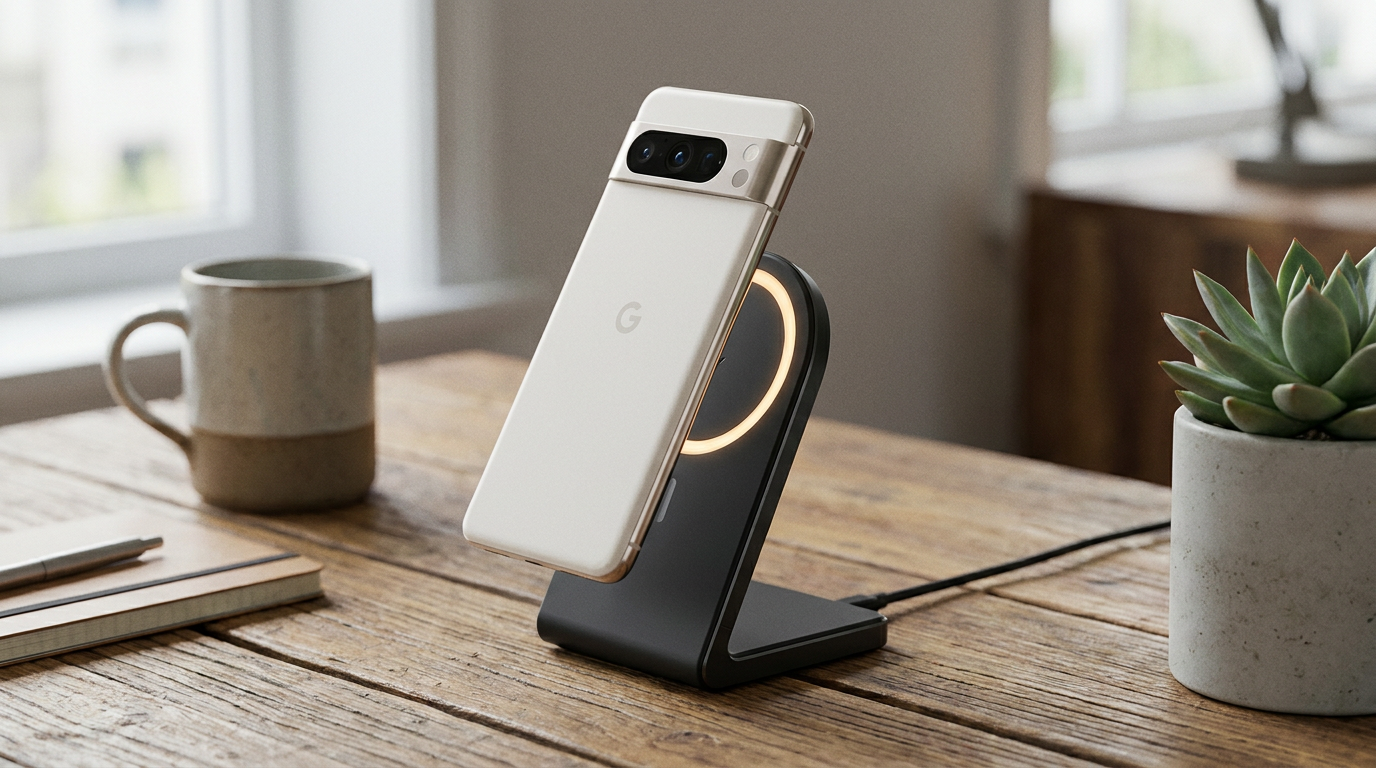
The Wireless Power Consortium (WPC)—the global body responsible for charging standards—has rolled out the Qi2 standard, effectively democratizing magnetic wireless charging for the entire mobile industry. Built directly on the foundation of Apple's MagSafe technology, Qi2 brings the satisfying "snap" of perfect alignment to both Apple and Android devices, eliminating the proprietary lock-in that has defined the accessory market for the past four years.[6]
The core innovation driving this universal standard is the Magnetic Power Profile, or MPP. By integrating a standardized ring of magnets around the central charging coil, MPP ensures that the transmitter and receiver lock together with millimeter precision. This is not merely a matter of ergonomic convenience; it is a fundamental requirement for efficient power transfer.[6]

When wireless charging coils are misaligned, energy escapes as excess heat rather than flowing into the battery. This wasted energy not only slows down the charging process but also degrades the long-term health of the smartphone's lithium-ion cells. By guaranteeing perfect alignment every single time, the Qi2 standard minimizes thermal loss, allowing manufacturers to safely push more power through the connection.[2]
That thermal efficiency has paved the way for the standard's most significant upgrade to date: Qi2.2, widely marketed as Qi2 25W. While the original Qi2 specification matched MagSafe's maximum output of 15 watts, the newly certified 25W standard represents a nearly 70 percent increase in power throughput.[5][6]
According to the WPC, this leap in wattage allows a fully depleted smartphone to reach a 50 percent charge in approximately 30 minutes. For the first time, wireless charging is stepping out of its role as a slow, overnight convenience and positioning itself as a genuine rival to traditional USB-C wired fast charging.[2][5]
According to the WPC, this leap in wattage allows a fully depleted smartphone to reach a 50 percent charge in approximately 30 minutes.
The hardware market is already rapidly adapting to this new reality. Tech accessory manufacturers are releasing a wave of Qi2-certified power banks and desk chargers that take advantage of the higher speeds without the expensive licensing fees associated with Apple's "Made for MagSafe" program.[1][2]

The Verge recently highlighted the Baseus AM52 as a standout example of this new generation of accessories, noting its unbeatable value and fast Qi2 wireless charging capabilities. Reviewers across the tech industry have praised the device for demonstrating how the 25W standard can be implemented properly, balancing rapid energy transfer with real-world usability.[1][2]
Delivering 25 watts wirelessly in a compact form factor presents significant engineering challenges, primarily regarding heat dissipation. Because slim magnetic power banks lack the physical space for active cooling fans, they must rely on passive thermal management, requiring careful design to avoid chunky, oversized batteries.[2][4][7]
To prevent overheating, modern Qi2 chargers utilize aluminum alloy enclosures that act as thermal pathways, drawing heat away from the battery cells. Furthermore, integrated temperature-monitoring chips constantly communicate with the attached smartphone, dynamically throttling the charging speed if the hardware begins to exceed safe thermal limits.[2][3][4]
This thermal discipline is what separates premium Qi2 hardware from older, less sophisticated chargers. Instead of delivering a short burst of fast charging that quickly tapers off due to heat buildup, well-designed Qi2 accessories maintain a cooler operating envelope, resulting in sustained high-speed power delivery over a longer period.[2]

Beyond speed and thermals, the most transformative aspect of Qi2 is its cross-platform harmony. The WPC has confirmed that major Android smartphone vendors are joining the Qi2 ecosystem, meaning that a single magnetic charger will soon be able to power a Samsung Galaxy, a Google Pixel, and an Apple iPhone with equal efficiency.[5][6]
The standard is also designed with backward compatibility in mind. Through its Extended Power Profile (EPP), a Qi2 charger can detect when an older, non-magnetic Qi device is placed upon it. It seamlessly drops the magnetic requirement and delivers standard inductive power, ensuring that legacy earbuds, older phones, and smartwatches are not rendered obsolete.[6]
For consumers, the widespread adoption of Qi2 signals the end of the "Apple Tax" on premium charging accessories. Because the standard is open to any manufacturer that passes the WPC's rigorous safety and efficiency testing, the market is seeing an influx of high-quality, affordable magnetic chargers that perform identically to proprietary first-party hardware.[2][3]

With over 1.5 billion certified Qi2 devices already in the global market, the transition away from fragmented charging ecosystems is well underway. As 25W speeds become the new baseline, the psychological and practical gap between wired and wireless charging is rapidly disappearing.[2][6]
Ultimately, the Qi2 standard represents a rare moment of industry-wide consensus in consumer technology. By prioritizing interoperability, safety, and speed, the tech world has transformed wireless charging from a finicky novelty into a robust, universal utility that simply works—no matter what logo is stamped on the back of the phone.[5][6]
How we got here
2010
The original Qi wireless charging standard is released, capped at 5W of power.
October 2020
Apple introduces MagSafe with the iPhone 12, popularizing magnetic alignment.
January 2023
The Wireless Power Consortium announces the Qi2 standard, built on Apple's magnetic technology.
November 2023
The first wave of Qi2 certified devices launches, supporting 15W charging.
July 2025
The WPC announces the Qi2.2 (25W) upgrade, bringing wired-level speeds to wireless charging.
Viewpoints in depth
Consumer Tech Advocates
Focus on the democratization of magnetic charging and the end of ecosystem lock-in.
For years, tech reviewers and consumer advocates have lamented the fragmentation of the wireless charging market. The arrival of Qi2 is celebrated as a major victory for consumer choice, effectively ending the "Apple Tax" required for premium magnetic accessories. By standardizing the technology, advocates argue that consumers can now invest in high-quality charging infrastructure that will seamlessly transition between iOS and Android devices, reducing electronic waste and household clutter.
Hardware Engineers
Emphasize the thermal management challenges of pushing 25W through a wireless connection.
While the convenience of Qi2 is widely praised, hardware engineers focus heavily on the physics of the new 25W standard. Pushing that much power wirelessly generates significant heat, which is the natural enemy of lithium-ion batteries. Engineers emphasize that the true innovation of premium Qi2 devices isn't just the magnets, but the sophisticated passive cooling materials—like aluminum alloy shells and graphene layers—combined with smart NTC chips that dynamically throttle power to protect the device's long-term battery health.
Industry Standards Bodies
Prioritize global interoperability, safety certifications, and market unification.
Organizations like the Wireless Power Consortium view Qi2 as a critical milestone in unifying a chaotic global market. Prior to Qi2, various smartphone manufacturers were developing proprietary fast-charging protocols that lacked interoperability and confused consumers. By establishing a rigorous, universal certification process, standards bodies aim to guarantee safety and efficiency across billions of devices, ensuring that a charger bought in one country will flawlessly power a device manufactured in another.
What we don't know
- Exactly which legacy Android devices might receive retroactive software optimizations to better handle Qi2 power profiles.
- How quickly budget-tier smartphone manufacturers will adopt the magnetic hardware required for full Qi2 compatibility.
Key terms
- Qi2
- The universal wireless charging standard developed by the Wireless Power Consortium, featuring magnetic alignment for faster, more efficient power transfer.
- Magnetic Power Profile (MPP)
- The core technology in Qi2 that uses a ring of magnets to perfectly align the charger's coils with the device's receiver.
- Wireless Power Consortium (WPC)
- The global standards organization that develops, maintains, and certifies the Qi wireless charging specifications.
- Made for MagSafe (MFM)
- Apple's proprietary certification program for magnetic accessories, which requires manufacturers to pay licensing fees.
- Extended Power Profile (EPP)
- The backward-compatible mode in Qi2 chargers that allows them to safely power older, non-magnetic wireless devices.
Frequently asked
Will a Qi2 charger work with my older iPhone?
Yes, but iPhones older than the iPhone 12 will charge at standard, slower Qi speeds and will not magnetically snap into place unless you use a specialized magnetic case.
Does 25W wireless charging damage the battery?
No. Qi2 certified chargers include smart thermal management chips that constantly monitor temperatures and automatically throttle the charging speed if the device gets too warm.
Do I still need to buy Apple MagSafe chargers?
No. Qi2 provides the exact same magnetic alignment and fast charging speeds as MagSafe, but is an open standard, meaning third-party chargers are often more affordable.
Will Qi2 charge my Android phone?
Yes. Major Android manufacturers are adopting the Qi2 standard for their new devices, and the chargers are backward compatible with older Androids that support basic wireless charging.
Sources
Source coverage
7 outlets
3 viewpoints surfaced







[1]The VergeConsumer Tech Advocates
My favorite Qi2 power bank is cheaper than ever for Verge readers
Read on The Verge →[2]PCWorldConsumer Tech Advocates
Baseus PicoGo AM52 review: Qi2.2 shows how wireless charging should be done
Read on PCWorld →[3]MacworldHardware Engineers
Baseus PicoGo AM52 Qi2.2 Magnetic Power Bank review
Read on Macworld →[4]NotebookcheckHardware Engineers
Baseus PicoGo AM52 magnetic power bank review
Read on Notebookcheck →[5]Hackster.ioIndustry Standards Bodies
Wireless Power Consortium Announces Qi2 25W, Offering a Big Boost to Wireless Charging Speeds
Read on Hackster.io →[6]Wireless Power ConsortiumIndustry Standards Bodies
WPC Ushers in Next Generation of Faster Wireless Charging
Read on Wireless Power Consortium →[7]AppleInsiderHardware Engineers
Baseus PicoGo AM52 review: 45W wired charging in your pocket
Read on AppleInsider →
Every angle. Every day.
Get technology stories with full source coverage and perspective breakdowns delivered to your inbox.