
The Science of Desirable Difficulties: Why Harder Learning Lasts Longer
Cognitive science reveals that study techniques feeling the most productive—like cramming and rereading—are actually the least effective. By introducing 'desirable difficulties' like spaced repetition and interleaving, learners can dramatically improve long-term retention.
By Factlen Editorial Team
- Cognitive Psychologists
- Focuses on the empirical evidence proving that spacing and interleaving dramatically improve long-term retention.
- Neuroscience Researchers
- Examines the cellular mechanisms, such as Long-Term Potentiation, that explain why effortful retrieval physically alters the brain.
- Classroom Educators
- Highlights the practical challenges of implementing these methods against student resistance and rigid curriculum constraints.
- Applied Learning Advocates
- Focuses on translating laboratory research into practical tools and algorithms for self-directed learners.
What's not represented
- · Students experiencing the frustration of interleaved practice
- · EdTech developers building spaced-repetition algorithms
- · Special education professionals adapting these methods for neurodivergent learners
Why this matters
Understanding how the brain actually encodes information allows students, professionals, and lifelong learners to stop wasting hours on ineffective study habits. By embracing productive struggle, anyone can build durable knowledge that lasts years rather than days.
Key points
- Study techniques that feel the most productive, like cramming and rereading, often result in the shallowest learning.
- Spaced repetition distributes study sessions over time, yielding a 10% to 30% boost in long-term retention.
- Interleaving mixes different problem types together, forcing the brain to practice selecting the correct strategy.
- Effortful retrieval triggers the cellular protein synthesis required to build durable, long-term memories.
- Learners must overcome the 'fluency illusion' and accept that making mistakes during practice is a sign of deep encoding.
The universal experience of studying is deeply misleading. Rereading notes, highlighting textbooks, and cramming the night before an exam all feel highly productive. The information flows easily into the mind, creating a comforting sense of mastery and fluency. But days later, the vast majority of that knowledge vanishes. This phenomenon is not a personal failing; it is a well-documented feature of human memory architecture.[1]
For decades, cognitive scientists have warned that the study techniques that feel the most effective in the moment are often the most shallow. In 1994, UCLA psychologist Robert A. Bjork gave a name to the solution: "desirable difficulties." He observed a pattern hiding in plain sight across a century of memory research—making learning harder actually makes it last longer.[7]
The desirable-difficulties framework proposes a counterintuitive rule for learning: interventions that slow down short-term performance actually strengthen long-term retention and transfer. If learning feels too easy, the brain is likely not encoding the information deeply. The friction is a necessary component of the process.[1]
The struggle is not a side effect of the learning process; the struggle is the mechanism. By deliberately making practice harder, learners force their brains to actively reconstruct information rather than passively recognize it. Two of the most robustly supported desirable difficulties in all of cognitive psychology are spaced repetition and interleaving.[7][8]

Spaced repetition is the ultimate antidote to cramming. Instead of massing study time into a single marathon session, spacing distributes the exact same amount of practice across days, weeks, or months. The concept dates back to German psychologist Hermann Ebbinghaus's discovery of the "forgetting curve" in 1885, but modern research has quantified its immense power.[7]
In 2006, a definitive meta-analysis published in Psychological Bulletin examined 184 studies involving over 14,000 participants. The researchers found that spaced practice consistently beat massed practice across the board, yielding a 10% to 30% improvement in long-term retention for the exact same time investment.[2]
The key to spacing is intentionally allowing a specific amount of forgetting to occur between sessions. When a learner attempts to retrieve a partially forgotten memory, the intense cognitive effort required to pull it back into working memory signals the brain that this information is vital for survival, triggering deeper encoding.[1][7]
This dynamic was dramatically illustrated in the famous Bahrick family study, where researchers tested foreign language vocabulary retention over several years. They discovered that study sessions spaced 56 days apart produced significantly better long-term retention than sessions spaced 14 or 28 days apart, even though the longer intervals resulted in fewer total study sessions overall.[5][7]

While spaced repetition dictates when to study, interleaving dictates what to study. In traditional classrooms, homework is usually assigned in blocks: a lesson on fractions is followed by twenty fraction problems. This "blocked practice" allows students to settle into a robotic rhythm, applying the same formula repeatedly without thinking.[8]
While spaced repetition dictates when to study, interleaving dictates what to study.
Interleaved practice, by contrast, mixes different types of problems together. A single worksheet might contain a fraction problem, followed by a geometry question, followed by an algebra equation. The learner never knows which strategy will be required next, forcing them to constantly evaluate the context.[3][8]
The results of interleaving are staggering, particularly in mathematics. In a landmark 2007 study, researchers found that while blocked practice produced higher scores during the practice session itself, interleaved practice resulted in 43% better scores on a delayed test.[3]
Later studies replicated this effect with even more dramatic margins, sometimes showing interleaved students outperforming blocked students by a full letter grade or doubling their test scores. The harder practice condition reliably produced vastly superior generalization and retention.[8]

Interleaving works because it trains a crucial, often-overlooked skill: discrimination. In the real world, problems do not arrive neatly labeled with the formula required to solve them. Interleaving forces the brain to first identify the nature of the problem before executing the solution, mirroring real-world application.[1][8]
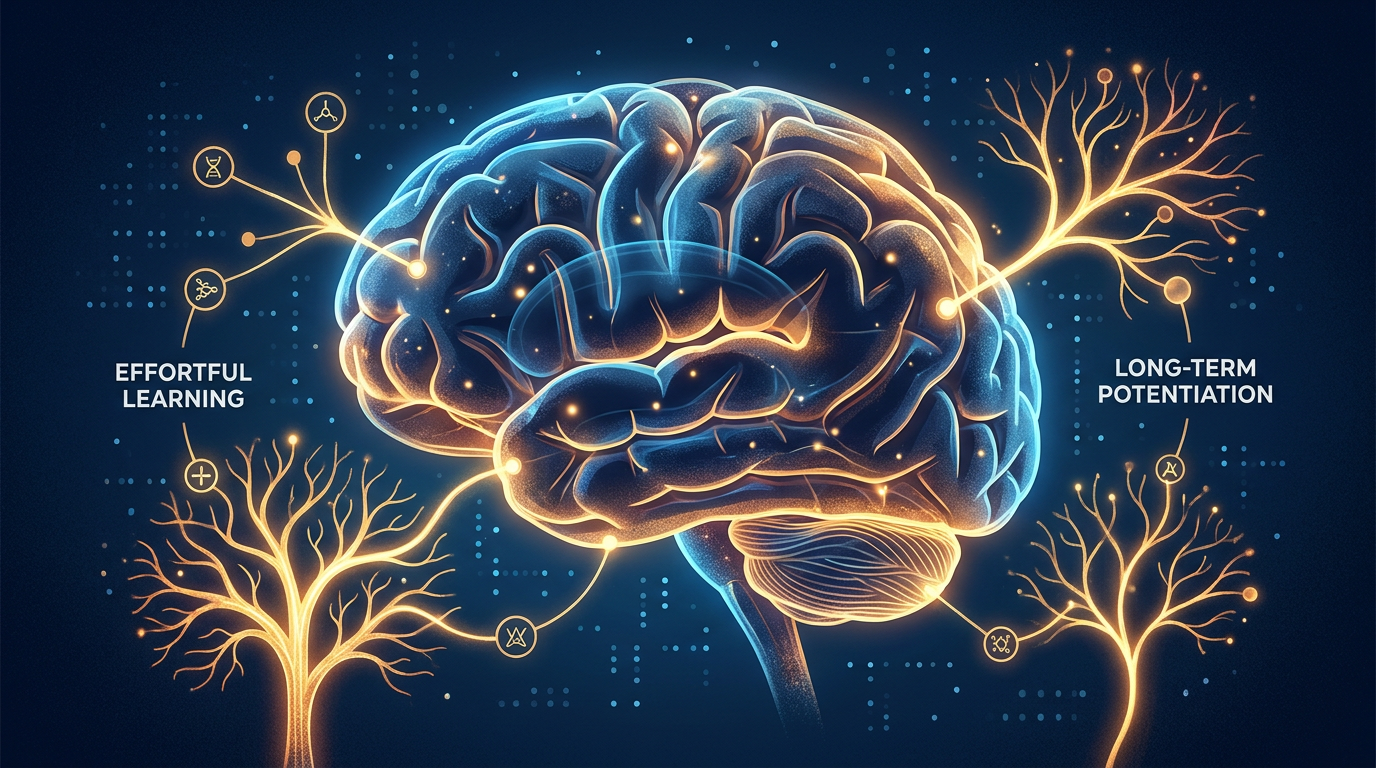
At the cellular level, the success of desirable difficulties is explained by the mechanics of neuroplasticity. The biological basis of long-term memory is Long-Term Potentiation (LTP), a persistent strengthening of synapses based on recent patterns of neural activity.[4]
Research published in Science demonstrated that behavioral learning induces the exact same molecular changes in the hippocampus as artificially induced LTP. Crucially, the late phase of LTP, which builds durable memories, requires protein synthesis and gene transcription that takes hours to consolidate.[4]
Casual, low-effort exposure—like rereading a textbook—does not reliably reach the activation threshold required to trigger this protein synthesis. Effortful retrieval, however, demands strong and sustained neural activation, kicking off the consolidation cascade that physically wires the memory into the brain's architecture.[1][4]

Despite overwhelming empirical evidence, desirable difficulties face steep resistance in both classrooms and corporate training programs. Because spacing and interleaving increase the error rate during practice, they violate the learner's expectations of what progress should feel like.[6][8]
Psychologists call this the "fluency illusion." When a student rereads a chapter, the text feels increasingly familiar, which the brain misinterprets as mastery. When that same student attempts an interleaved quiz and struggles, they mistakenly conclude the study method is failing them, even as deep learning occurs.[1][7]
Overcoming the fluency illusion requires a paradigm shift in how we view educational friction. Educators and self-directed learners must learn to separate performance during practice from actual, durable learning, recognizing that a perfect practice score is often a warning sign of shallow processing.[6]

By embracing the productive struggle of spaced repetition and interleaving, learners can stop fighting the natural decay of human memory and start working with the brain's biological imperatives. The path to never forgetting begins with allowing yourself to almost forget.[1]
How we got here
1885
Hermann Ebbinghaus publishes his research on the 'forgetting curve,' demonstrating how quickly memory decays without review.
1973
Sebastian Leitner develops the Leitner system, a practical method for applying spaced repetition using physical flashcards.
1994
UCLA psychologist Robert A. Bjork coins the term 'desirable difficulties' to describe learning methods that slow initial progress but boost retention.
2006
A massive meta-analysis by Cepeda et al. confirms that spaced practice universally outperforms massed practice across hundreds of studies.
2007
Rohrer and Taylor publish landmark research demonstrating that interleaved mathematics practice yields vastly superior delayed test scores.
Viewpoints in depth
Cognitive Psychologists' view
The empirical consensus that desirable difficulties outperform intuitive study methods.
For decades, cognitive psychologists have amassed a mountain of data showing that human intuition about learning is fundamentally flawed. Researchers in this camp emphasize that interventions like spacing and interleaving are not merely helpful tips, but necessary conditions for durable memory. They point to massive meta-analyses demonstrating that while cramming produces higher immediate scores, it guarantees catastrophic forgetting within weeks. Their primary goal is to convince learners to trust the data over their own subjective feelings of fluency.
Neuroscience Researchers' view
The biological imperative of effortful retrieval.
Neuroscientists approach the learning paradox from the cellular level, focusing on how synapses physically change. They argue that the brain is highly efficient and will not expend the metabolic energy required for protein synthesis—the building block of long-term memory—unless forced to do so. From this perspective, the 'struggle' of retrieving a partially forgotten fact is literally the biological trigger that initiates Long-Term Potentiation. Without that specific neural strain, the brain treats the information as transient and discards it.
Classroom Educators' view
The friction of applying cognitive science in real-world schools.
While educators largely agree with the science, they face the practical reality of student psychology and institutional pressure. Teachers note that interleaving and spaced repetition inherently lower short-term performance, which can demoralize students and alarm parents who expect high scores on daily assignments. Furthermore, traditional textbooks and standardized testing schedules are built around 'blocked' units. Educators advocate for a balanced approach, slowly introducing desirable difficulties while actively coaching students through the emotional discomfort of making more mistakes during practice.
What we don't know
- The exact optimal spacing intervals for highly complex, multi-layered conceptual frameworks outside of factual recall.
- How to perfectly calibrate the 'desirable' level of difficulty for individual students with varying baseline working memory capacities.
- The long-term impact of relying entirely on algorithmic spaced-repetition software versus self-managed review schedules.
Key terms
- Desirable Difficulty
- A learning task that slows down initial performance but significantly improves long-term retention and transfer of knowledge.
- Spaced Repetition
- The practice of reviewing information at gradually increasing intervals to interrupt the brain's natural forgetting process.
- Interleaving
- Mixing different topics or problem types within a single study session, rather than practicing one skill repeatedly.
- Blocked Practice
- Studying a single concept or practicing a single type of problem extensively before moving on to the next.
- Fluency Illusion
- The cognitive bias where a learner mistakes the ease of processing information for deep, durable learning.
- Long-Term Potentiation (LTP)
- The cellular mechanism of memory formation, involving the persistent strengthening of synapses based on recent patterns of neural activity.
Frequently asked
Why does rereading my notes feel so effective if it isn't?
Rereading creates the 'fluency illusion.' As the text becomes familiar, your brain mistakes the ease of reading for actual mastery of the concepts, even though the information hasn't been deeply encoded.
How long should I wait between study sessions?
The optimal interval depends on when you need to remember the information. For long-term retention spanning years, intervals of a month or more are highly effective, provided you can still successfully retrieve the memory.
Does interleaving work for subjects other than math?
Yes. While heavily studied in mathematics, interleaving improves learning in any domain that requires discrimination, such as identifying painting styles, medical diagnoses, or foreign language grammar rules.
What is the 85% accuracy rule in spaced repetition?
It is a benchmark for optimal difficulty. If you are getting 100% of your flashcards right, you are reviewing too soon. If you drop below 70%, you are waiting too long.
Sources
Source coverage
8 outlets
4 viewpoints surfaced







[1]Factlen Editorial TeamApplied Learning Advocates
Synthesis by Factlen editorial team
Read on Factlen Editorial Team →[2]Psychological BulletinCognitive Psychologists
Distributed practice in verbal recall tasks: A review and quantitative synthesis
Read on Psychological Bulletin →[3]Memory & CognitionCognitive Psychologists
The shuffling of mathematics problems improves learning
Read on Memory & Cognition →[4]ScienceNeuroscience Researchers
Learning Induces Long-Term Potentiation in the Hippocampus
Read on Science →Maintenance of foreign language vocabulary and the spacing effect
Read on Journal of Experimental Psychology →[6]Policy Insights from the Behavioral and Brain SciencesClassroom Educators
No Simple Solutions to Complex Problems: Cognitive Science Principles Can Guide but Not Prescribe Educational Decisions
Read on Policy Insights from the Behavioral and Brain Sciences →[7]The Learner LabApplied Learning Advocates
The Science Behind Spaced Repetition, Learning, and Retention
Read on The Learner Lab →[8]JustinMathClassroom Educators
Cognitive Science of Learning: Interleaving (Mixed Practice)
Read on JustinMath →


Every angle. Every day.
Get education stories with full source coverage and perspective breakdowns delivered to your inbox.