
The Right-to-Repair Revolution: How Modular Smartphones are Changing the Way We Buy Devices
Driven by new EU regulations and consumer demand, major smartphone brands are embracing repairability, making it easier than ever to fix your own device and extend its lifespan.
By Factlen Editorial Team
- Right-to-Repair Advocates
- Organizations and activists pushing for completely open repair ecosystems and an end to software locks.
- Mainstream Manufacturers
- Tech giants balancing consumer repair demands with security, brand reputation, and water-resistance standards.
- Mid-Range Innovators
- Brands using repairability as a competitive advantage to win over budget-conscious and eco-minded shoppers.
- Repair Analysts
- Independent evaluators who score devices based on teardown difficulty and parts availability.
What's not represented
- · Independent local repair shop owners
- · E-waste recycling facility operators
Why this matters
Buying a repairable phone can save you hundreds of dollars in service fees, extend the life of your device by years, and significantly reduce global electronic waste.
Key points
- New EU regulations require smartphones to display a repairability score, pushing the industry toward modular designs.
- Brands like Fairphone and HMD Global are leading the charge with phones that can be opened with a simple screwdriver.
- Apple has expanded its Self Service Repair program to 34 countries, allowing users to buy genuine parts and rent tools.
- While repairable phones save consumers money and reduce e-waste, they often feature slightly lower water-resistance ratings.
For the better part of a decade, buying a premium smartphone meant accepting a beautiful but fragile glass sandwich held together by industrial adhesive. If the battery degraded after a few years or the screen cracked from a minor drop, the device was often destined for a landfill or an expensive trip to an authorized service center. Consumers were locked out of their own hardware, forced to rely on proprietary tools and manufacturer goodwill just to keep their daily drivers functional.
But in 2026, the era of the "disposable" smartphone is rapidly coming to an end. Driven by a combination of stringent new regulations, shifting consumer demand, and the relentless advocacy of the right-to-repair movement, the industry has fundamentally altered how smartphones are designed, manufactured, and sold. Repairability is no longer a niche feature for tech enthusiasts; it has become a mainstream purchasing criterion that empowers users and saves them money.
The most significant catalyst for this shift arrived in the European Union. As of June 2025, smartphones sold in the EU are required to display a repairability score directly on their energy labels. This mandate has forced manufacturers to compete not just on camera megapixels or processor speeds, but on how easily a consumer can swap out a dying battery. The transparency has made long-term durability a highly visible metric on store shelves.[5]
At the forefront of this revolution is Fairphone, a company that has long treated repairability as its primary selling point. The brand's recent models have consistently earned perfect 10/10 scores from independent repair authority iFixit. By prioritizing ethical sourcing and modularity, Fairphone proved that a sustainable device could still deliver a modern Android experience without compromising on core functionality.[4]

Fairphone achieves its perfect scores by utilizing a strictly modular design where components like the USB-C port, camera modules, and battery can be swapped out with a standard Phillips-head screwdriver. Combined with a guarantee of up to eight years of software updates, the device is engineered to last the better part of a decade, drastically reducing the total cost of ownership for the consumer.[4]
While Fairphone established the gold standard, mainstream brands are now adopting similar philosophies to capture the mid-range market. HMD Global, the maker of Nokia-branded devices, recently launched the HMD Skyline, which earned the title of "Most Repairable Smartphone" from prominent teardown analysts. The device proves that repairability does not have to come at the expense of premium aesthetics.[3]
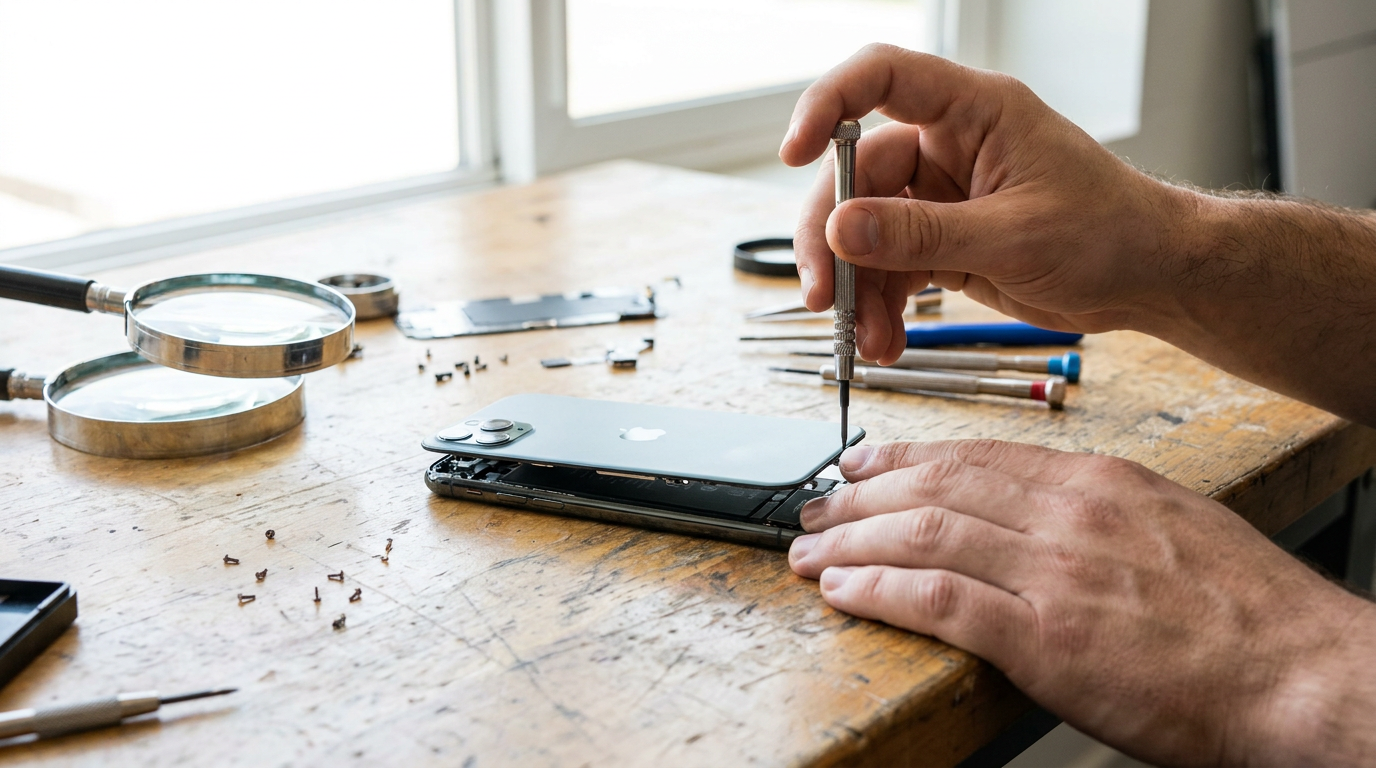
The Skyline introduces what HMD calls "Gen2 repairability." Instead of relying on heat guns to melt stubborn glue, the phone features a specialized Torx screw that releases the back cover. A simple prying tool or the edge of a plastic card is all that is needed to pop the casing off and access the internal components, making the process accessible even to novices.[2][7]
Inside the Skyline, the traditional adhesive used to secure the screen has been replaced by a foam gasket, and the battery utilizes a carefully calibrated adhesive that releases with a gentle pull. This thoughtful engineering earned the device a 9 out of 10 repairability score from iFixit, demonstrating that mass-market phones can be both sleek and highly modular.[2]

This thoughtful engineering earned the device a 9 out of 10 repairability score from iFixit, demonstrating that mass-market phones can be both sleek and highly modular.
Even the industry's biggest giants have been forced to pivot in response to regulatory pressure and consumer sentiment. Apple, which historically opposed right-to-repair legislation, has significantly expanded its Self Service Repair program. By 2025, the program had rolled out to 34 countries, including a recent expansion into Canada, covering dozens of Mac and iPhone models.[1]
Apple's program allows consumers who are comfortable with electronics to order genuine parts, rent professional-grade toolkits, and access official repair manuals. Following a successful repair, customers can return their used parts for recycling in exchange for a credit toward their initial purchase, creating a closed-loop system for e-waste.[8]
Apple has also made internal design changes to facilitate easier access for both DIYers and independent shops. Recent iPhone models feature a redesigned chassis that allows the back glass to be removed independently of the display. This architectural shift prompted iFixit to raise the device's repairability score to a 7 out of 10, a marked improvement from previous generations.[6]
The shift toward repairability relies heavily on independent ecosystems to keep manufacturers honest. Organizations like iFixit have become the de facto standard for evaluating these devices, meticulously documenting the number of steps, the type of fasteners, and the availability of spare parts required for common fixes. Their teardowns provide the data that fuels both consumer choice and regulatory frameworks.[6]

However, the transition to modular smartphones is not without its engineering trade-offs. Designing a phone to be easily opened often compromises its ability to keep out water and dust. While traditional glued flagships boast IP68 water resistance, highly repairable phones like the HMD Skyline often settle for an IP54 rating, meaning they can survive a splash but not a full submersion.[2]
Furthermore, the battle over "parts pairing"—where a manufacturer uses software to lock a specific component to a specific device motherboard—remains a point of contention. While Apple has improved its Repair Assistant software to better calibrate new parts, critics argue that software locks still create unnecessary hurdles for third-party repair shops trying to harvest parts from donor phones.[6]
Despite these ongoing challenges, the financial math for consumers has fundamentally changed. A DIY battery replacement using official parts and guides can cost a fraction of the price of an out-of-warranty service center visit. By extending the life of a phone from three years to five or more, users are saving hundreds of dollars while enjoying a fully functional device.
As shoppers navigate the smartphone market in 2026, the ability to fix a device at home is no longer an afterthought. It is a core feature that promises to empower users, break the cycle of forced upgrades, and put a significant dent in the millions of tons of electronic waste generated each year. The right to repair has finally become a reality.
How we got here
April 2022
Apple officially launches its Self Service Repair program in the United States.
August 2023
Fairphone 5 is released, setting a new industry standard with a 10/10 repairability score and an 8-year update guarantee.
July 2024
HMD Global launches the Skyline, introducing 'Gen2 repairability' to the mid-range smartphone market.
June 2025
The European Union mandates that all smartphones sold must display a repairability score on their energy labels.
Viewpoints in depth
Right-to-Repair Advocates
Organizations and activists pushing for completely open repair ecosystems and an end to software locks.
This camp, spearheaded by groups like iFixit and companies like Fairphone, argues that true ownership means the ability to fix what you buy. They celebrate the hardware modularity of new devices but remain highly critical of "parts pairing"—software locks that require manufacturer approval to calibrate a new screen or battery. They argue that until independent shops can freely harvest parts from broken donor phones without software errors, the repair ecosystem remains artificially constrained by corporate monopolies.
Mainstream Manufacturers
Tech giants balancing consumer repair demands with security, brand reputation, and water-resistance standards.
Companies like Apple and Samsung emphasize that while they are expanding self-service repair programs, modern smartphones are highly complex devices that require precision engineering. They argue that parts pairing is necessary to ensure biometric security (like Face ID or fingerprint sensors) isn't compromised by malicious third-party components. Furthermore, they point out that heavy industrial adhesives—the bane of DIY repair—are exactly what allow their flagship phones to survive being dropped in a swimming pool, a trade-off most consumers historically preferred.
Mid-Range Innovators
Brands using repairability as a competitive advantage to win over budget-conscious and eco-minded shoppers.
Manufacturers like HMD Global see repairability as a massive market opportunity. Unable to compete dollar-for-dollar with Apple's marketing budget, these brands are winning market share by offering "Gen2 repairability" that doesn't require heat guns or specialized training. They argue that the average consumer doesn't need a phone that can survive a scuba dive; they need a phone that won't cost $300 to fix when the screen inevitably cracks on the sidewalk.
What we don't know
- Whether the EU's repairability index will be adopted by other major markets like the US and Asia.
- How long manufacturers will continue to support software updates for mid-range modular phones as they age.
Key terms
- Right-to-Repair
- A consumer rights movement advocating for the ability of individuals and independent shops to repair their own electronic devices without manufacturer restrictions.
- iFixit
- An independent company and community that provides free repair manuals, tools, and replacement parts, known for scoring the repairability of new tech.
- Modular Design
- An engineering approach where a device is built using distinct, easily separable components that can be replaced individually when they fail.
- IP Rating
- Ingress Protection rating, a standard that defines how well a device is sealed against dust and water (e.g., IP68 means fully dust-tight and water-resistant).
- Parts Pairing
- The practice of using software to cryptographically link a hardware component to a specific device, restricting the use of aftermarket parts.
Frequently asked
Does repairing my own phone void the warranty?
In many regions, including the US and EU, using right-to-repair programs and genuine parts does not automatically void your warranty, provided you do not damage the device during the repair process.
What is parts pairing?
Parts pairing is a practice where manufacturers use software to link a specific component, like a screen or battery, to the phone's motherboard, making it difficult to use third-party or salvaged parts.
Do repairable phones have worse water resistance?
Often, yes. Phones designed to be easily opened usually rely on foam gaskets rather than heavy adhesives, which can lower their IP rating from a fully waterproof IP68 to a splash-resistant IP54.
Where can I buy parts to fix my phone?
Parts can be purchased directly from manufacturer self-service stores, like Apple's, or through partnered independent retailers like iFixit, which also provide the necessary tools and manuals.
Sources
Source coverage
8 outlets
4 viewpoints surfaced








[1]AppleInsiderMainstream Manufacturers
Apple's Self Service Repair program expands in Europe, Canada in 2025
Read on AppleInsider →[2]How-To GeekMid-Range Innovators
The HMD Skyline is a Highly-Repairable Android Phone
Read on How-To Geek →[3]NotebookcheckMid-Range Innovators
HMD Skyline lauded as Most Repairable Smartphone of 2024
Read on Notebookcheck →[4]Expert ReviewsRight-to-Repair Advocates
Fairphone 6 review: A sustainable smartphone built to last
Read on Expert Reviews →[5]MakeUseOfRight-to-Repair Advocates
Smartphone Repairability Matters More Now Than Ever Before
Read on MakeUseOf →[6]E-CatalogRepair Analysts
Smartphone Repairability: What It Means and Which Models Are Easier to Repair
Read on E-Catalog →[7]HMDMid-Range Innovators
HMD Skyline - Easily fixed
Read on HMD →[8]AppleMainstream Manufacturers
Apple announces Self Service Repair
Read on Apple →
Every angle. Every day.
Get shopping stories with full source coverage and perspective breakdowns delivered to your inbox.