
How 'Micro-Forests' Are Cooling Neighborhoods and Rewilding Cities
Communities worldwide are transforming vacant lots into dense, fast-growing pocket forests using the Miyawaki method to combat urban heat and boost biodiversity.
By Factlen Editorial Team
- Urban Greening Advocates
- Focus on the immediate, measurable benefits of rapid canopy growth and community engagement.
- Local Community Groups
- Value the localized social, mental, and environmental benefits of neighborhood stewardship.
- Forest Ecology Skeptics
- Demand rigorous empirical data and caution against overstating long-term ecological claims.
What's not represented
- · Municipal Budget Planners
- · Traditional Landscape Architects
Why this matters
As climate change drives deadlier summer heatwaves, traditional concrete-heavy city planning is failing. These community-planted micro-forests offer a proven, localized way to drastically cool neighborhood air temperatures while restoring lost urban wildlife.
Key points
- The Miyawaki method transforms small urban lots into dense, fast-growing micro-forests.
- Intense planting density forces saplings to compete for sunlight, driving rapid vertical growth.
- Micro-forests cool surrounding neighborhoods by providing shade and releasing water vapor.
- Survival rates often exceed 85%, significantly higher than traditional urban street trees.
- While initial growth is fast, some ecologists caution that claims of rapid old-growth maturity lack evidence.
The concrete and asphalt of modern cities have a dangerous side effect: they trap heat. As global temperatures rise, the "Urban Heat Island" (UHI) effect can make city neighborhoods up to 10 degrees Celsius hotter than surrounding rural areas. For decades, the standard municipal response has been to plant solitary street trees in concrete cutouts. But a growing grassroots movement is taking a radically different approach to urban greening, transforming neglected spaces into dense, self-sustaining ecosystems.[4][7]
Enter the "micro-forest." Often no larger than a tennis court—and sometimes as small as three square meters—these pocket woodlands are springing up in cities from London to Tokyo to Sydney. They are planted using the Miyawaki method, a technique developed in the 1970s by the late Japanese botanist Akira Miyawaki. Originally designed to restore degraded land around industrial sites, the method has been adapted by community groups and urban planners as a rapid-response tool for climate resilience.[2][8]
Proponents of the Miyawaki method claim it produces forests that grow up to ten times faster, become thirty times denser, and support significantly more biodiversity than conventional tree plantations. By packing dozens of native species into a small area, the technique aims to fast-track the ecological succession process, creating a mature forest canopy in decades rather than centuries.[7][8]
The success of a micro-forest relies on a highly structured, science-backed mechanism. It begins beneath the surface. Traditional urban tree planting often forces saplings into compacted, nutrient-poor dirt. The Miyawaki method requires extensive soil remediation. Volunteers and ecologists excavate the site, mixing the earth with organic biomass—such as compost, straw, and shredded mulch—to mimic the loose, nutrient-rich floor of an ancient woodland. This allows young roots to penetrate deeply and quickly.[2][8]

Next comes species selection, governed by the principle of Potential Natural Vegetation (PNV). Implementers do not plant ornamental or exotic trees; they exclusively select indigenous species that would have naturally thrived in that specific location before human intervention. A single micro-forest might contain 30 to 50 different native species, categorized into four layers: canopy trees, sub-canopy trees, understory shrubs, and ground-covering herbs.[2][8]
The most striking feature of the method is its extreme density. Saplings are planted at a rate of three to seven per square meter. In a standard municipal park, trees are spaced far apart to avoid competition. In a Miyawaki forest, competition is the entire point.[5][8]
This dense packing triggers a botanical race for survival. Because the saplings are crowded, sunlight cannot easily reach the lower leaves. Forced to compete for light, the young trees shoot rapidly upward rather than branching outward. This intense vertical growth is what gives Miyawaki forests their signature speed, with some projects recording growth rates of over one meter per year in temperate climates.[2][6]
Below ground, a different dynamic unfolds. Rather than competing, the root systems cooperate. The loose, inoculated soil encourages the rapid formation of mycorrhizal fungal networks. These underground webs connect the roots of different species, allowing them to share water and nutrients. A disease-resistant shrub might share resources with a struggling canopy tree, creating a resilient, interconnected super-organism.[5]
The loose, inoculated soil encourages the rapid formation of mycorrhizal fungal networks.
Within two to three years, the micro-forest reaches a critical milestone: canopy closure. The leaves of the tallest trees interlock, completely shading the forest floor. This shade prevents weeds from growing and drastically reduces water evaporation from the soil. At this point, the forest becomes entirely self-sustaining. The intensive weeding and watering required during the first two years can stop, and the ecosystem takes over.[5][8]
The empirical results of this dense, cooperative planting are striking. Traditional urban tree planting initiatives often suffer from high mortality rates due to poor soil, vandalism, and neglect. According to Earthwatch Europe, which runs the "Tiny Forest" program in the UK, Miyawaki forests consistently demonstrate survival rates between 85% and 95%. In one comparative study in Coventry, 95% of Tiny Forest trees survived their first six months, while a conventionally planted control group suffered total failure.[2]

Once established, these pocket forests act as powerful localized air conditioners. Trees cool the air not just by providing shade, but through a process called evapotranspiration. They act as biological water pumps, drawing moisture from the soil and releasing it as vapor through the stomata in their leaves. Research published in the journal MDPI analyzing heat waves in London found that urban forests significantly lower the Modified Temperature-Humidity Index, providing crucial relief during extreme 40°C weather events.[4][5][7]
Beyond temperature control, micro-forests serve as vital biodiversity hubs. The multi-layered canopy provides complex habitats that sterile lawns and solitary street trees cannot. Within months of planting, these sites often see a dramatic influx of pollinators, beetles, birds, and small mammals. Organizations like Carbon Positive Australia note that these native pocket forests can harbor biodiversity levels up to 18 times greater than traditional urban parks.[5][7]
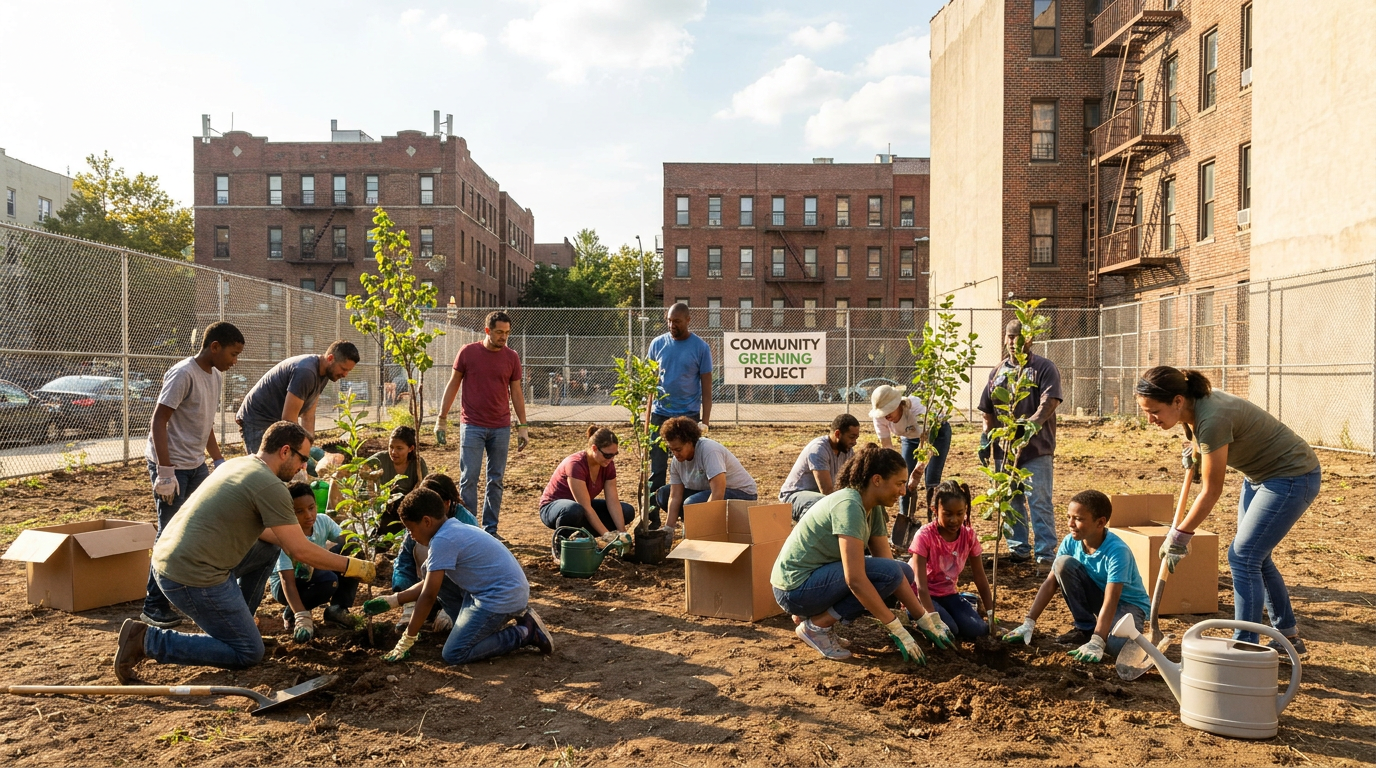
The human impact is equally profound. Because planting a Miyawaki forest requires significant manual labor—preparing soil, planting thousands of saplings, and mulching—it relies heavily on community volunteers. This shared effort fosters a sense of local ownership and environmental stewardship. Schools use them as living laboratories, and neighborhoods gain a wild, accessible green space that improves mental health and social cohesion.[5][6]

However, the method is not without its critics in the scientific community. A recent comprehensive review published in the Journal of Applied Ecology examined 51 scientific papers on the Miyawaki method. The researchers, including forest ecologists Narkis S. Morales and Ignacio C. Fernández, found that while the claim of rapid initial growth is partially supported by data, the assertion that these forests reach "maturity" in just 20 to 30 years lacks empirical evidence.[3]
The reviewers cautioned that true old-growth forests possess complex ecological successions and deadwood dynamics that cannot be artificially fast-tracked. They also noted that only a fraction of the existing literature on Miyawaki forests includes rigorous control groups or replication. Some ecologists worry that the method's intense popularity is driven more by the public's desire for "instant" greening than by long-term ecological data.[3]

Furthermore, the Miyawaki method is highly resource-intensive. Excavating urban soil, importing organic matter, and purchasing high volumes of native saplings makes these forests expensive to install per square meter compared to traditional planting. The heavy machinery sometimes required for soil preparation also carries an initial carbon footprint that the forest must eventually offset.[6]
Despite these scientific debates regarding long-term maturity, the immediate utility of micro-forests is difficult to ignore. They may not perfectly replicate a centuries-old woodland in a single generation, but they offer a drastic improvement over the concrete and degraded soil they replace.[1]
As cities brace for hotter summers and heavier rainfall, the micro-forest movement provides a tangible, localized solution. By combining botanical science with community action, neighborhoods are proving that even the smallest patches of land can be transformed into resilient, life-sustaining ecosystems.[1]
How we got here
1970s
Botanist Akira Miyawaki develops his dense planting method to restore degraded industrial land in Japan.
2000s
The method gains international traction, spreading to India, Europe, and South America for urban greening.
2020
Earthwatch Europe launches the 'Tiny Forest' program, pioneering the method as a community-science initiative in the UK.
July 2022
Record-breaking 40°C heatwaves in London highlight the critical cooling role of urban forests.
December 2025
A major review in the Journal of Applied Ecology calls for more rigorous empirical data to back long-term maturity claims.
Viewpoints in depth
Urban Greening Advocates
Focus on the immediate, measurable benefits of rapid canopy growth and community engagement.
Organizations implementing these forests emphasize their high survival rates and immediate impact on urban heat islands. They argue that even if a micro-forest doesn't perfectly replicate ancient woodlands, transforming a concrete lot into a dense, self-sustaining green space within three years is a massive ecological win for cities. The focus is on practical, rapid climate adaptation rather than perfect ecological purity.
Forest Ecology Skeptics
Demand rigorous empirical data and caution against overstating long-term ecological claims.
Academic ecologists warn that the enthusiasm for Miyawaki forests sometimes outpaces the science. They point out that true old-growth forests rely on complex, multi-generational successions and deadwood dynamics that cannot be artificially rushed. They advocate for more controlled, long-term studies before cities abandon traditional conservation for 'instant' greening, warning that high initial costs must be justified by proven long-term outcomes.
Local Community Groups
Value the localized social, mental, and environmental benefits of neighborhood stewardship.
For local residents and community organizers, the scientific debate over 20-year maturity is secondary to the immediate neighborhood impact. These groups value the micro-forests as living laboratories that bring neighbors together, provide accessible nature for children, and offer tangible relief from summer heatwaves. The act of planting the forest is seen as just as important as the forest itself.
What we don't know
- Whether Miyawaki forests genuinely achieve the complex ecological maturity of old-growth forests within a few decades.
- How these ultra-dense urban forests will respond to novel pests or diseases over a 50-year horizon.
- The exact carbon sequestration rate of these forests compared to the emissions generated by the heavy machinery used to prepare their soil.
Key terms
- Miyawaki method
- A reforestation technique that involves densely planting native species in enriched soil to rapidly create a self-sustaining forest.
- Potential Natural Vegetation (PNV)
- The specific plant species that would naturally exist in a given area without human intervention.
- Urban Heat Island (UHI) effect
- A phenomenon where urban areas experience significantly higher temperatures than surrounding rural areas due to heat-absorbing concrete and asphalt.
- Evapotranspiration
- The process by which water is transferred from the land to the atmosphere by evaporation from the soil and transpiration from plants, creating a cooling effect.
- Mycorrhizal network
- Underground fungal webs that connect the roots of different plants, allowing them to share water and nutrients.
Frequently asked
How much space is needed for a micro-forest?
Miyawaki forests can be planted in areas as small as three square meters, making them ideal for neglected urban lots and small community spaces.
Do these forests require a lot of maintenance?
They require intensive watering and weeding for the first two to three years. Once the canopy closes, they become entirely self-sustaining.
Are the claims of 10x faster growth scientifically proven?
While studies confirm they grow significantly faster initially due to dense competition, recent ecological reviews caution that claims of reaching full maturity in 20 years lack empirical backing.
Sources
Source coverage
8 outlets
3 viewpoints surfaced







[1]Factlen Editorial Team
Synthesis by Factlen editorial team
Read on Factlen Editorial Team →[2]Earthwatch EuropeUrban Greening Advocates
The Miyawaki forest planting method
Read on Earthwatch Europe →[3]MongabayForest Ecology Skeptics
Popular Miyawaki method of reforestation lacks empirical evidence, study finds
Read on Mongabay →[4]MDPI
Urban Forests and Heat Waves: Mitigating the Urban Heat Island Effect
Read on MDPI →[5]Carbon Positive AustraliaLocal Community Groups
The Magic of Miyawaki Pocket Forests
Read on Carbon Positive Australia →[6]Rewilding AcademyLocal Community Groups
Tiny Forests: A New Trend in Urban Afforestation
Read on Rewilding Academy →[7]SUGi ProjectUrban Greening Advocates
We need to plant more urban forests
Read on SUGi Project →[8]Urban ForestsUrban Greening Advocates
The Miyawaki Method: Principles and Benefits
Read on Urban Forests →

Every angle. Every day.
Get community stories with full source coverage and perspective breakdowns delivered to your inbox.